Asset Income / Trailer Rental · Claim Review
“I Built a 6-Figure Trailer Rental Business in Just 12 Months”
What we found: "6-Figure" Trailer Rental in 12 Months Is Only in the Title: The Per-Trailer Maths Checks Out, the Costs Are Left Out
Two trailers to about 25 in a year, $1,000 a month from a trailer booked 10 days, and no revenue total, profit figure or cost anywhere.
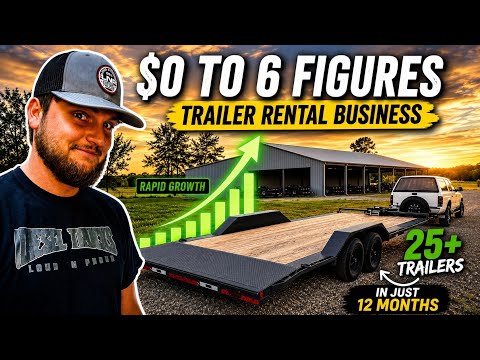
- Title only "6-figure"
- 2 → ~25 Fleet growth
- $1,000/mo One trailer, 10 days booked
- $7.5k–$8.5k Resale after 2 years
The claim
That he built a six-figure trailer rental business in twelve months, growing from two trailers to about 25, and that each added trailer can bring $800–$2,800 a month for about ten minutes of upkeep while barely losing value.
- Six-figure revenue or profit — Title only; no figure in the video
- Fleet — "Two trailers to fulfilling the demand for 25", May 2025 to June 2026
- Monthly income per added trailer — "$800, $1,500, $2,800"
- Example trailer — "Over 100 bucks a day", 10 days a month = $1,000
- Trailer price and resale — $8,000–$10,000; "$7,500 to $8,500" after two years
- Time per rental / per trailer — ~10 min per transaction; ~10 min a month upkeep
- Example parking lot — "Might be 500 bucks a month, let's say"
- Insurance, maintenance, damage, fees — Named, not priced
What is this income idea?
Buy trailers — enclosed, car, dump, utility, stock — rent them by the day to local customers, reinvest the income in more trailers, and repeat.
- He started in May 2025 and, by June 2026, says he has gone "from two trailers to fulfilling the demand for 25 trailers in just a year". He sold a paid-off truck, then a second one, to buy more equipment when bookings outran supply.
- He is critical of the advice he started with, from someone selling a course: "you cannot get $150 rent for a $4,000 trailer", except as a one-off. Near a city and on the edge of farm country, competition sets prices, and "every single area is different, you have to do your own market research."
- His case for the model is per-unit. An example trailer rents "for over 100 bucks a day"; booked only 10 days a month, that is $1,000 a month and "an extra $12,000 a year". Each trailer added costs "about 10 more minutes per month" in upkeep and about 10 minutes per rental, for "an extra $800, $1,500, $2,800 a month".
- And he argues the capital is safe: "I might pay 8 grand for this trailer, 10 grand for this trailer, but even after I rent it out for 2 years I can still get 7,500 to 8,500 out of the thing."
- He says he learned the hard way about "pricing structure, insurance, legal agreements", and closes by gauging interest in a paid coaching package — "it would be at a cost" — covering equipment, pricing and agreements for a viewer's area.
Rent out trailers by the day and reinvest; the per-trailer numbers add up, but the business total and its costs are not given.
- Start with 2 trailers — May 2025
- Price for your area — Not $150 on $4k
- Rent by the day — $100+ on one unit
- Reinvest everything — Sold two trucks
- ~25 trailers — June 2026
- Resell later — His estimate
- Offer coaching — Planned, paid
A credible unit model; the business-level numbers are missing.
Better unit economics than the genre, and the same missing ledger
The lesson underneath the number
- This video is more grounded than most trailer rental pitches. He opens by debunking one: the idea that a $4,000 car trailer rents for $150 a day is, in his experience, a one-off rather than a business. He says prices are set by local competition and that every area needs its own research. His own example is modest by comparison: just over $100 a day, booked ten days a month.
- That example holds up arithmetically, and it is the most useful part of the video. $1,000 a month and $12,000 a year from one trailer at a third utilisation is a sensible way to think about the asset. Against an $8,000–$10,000 trailer it implies a gross payback inside a year. That is why the model attracts people.
- The title's "6-figure" does not appear in the audio, and neither does any annual figure. On his own unit numbers, a 25-trailer fleet could plausibly gross six figures, but the fleet grew through the year from two units, and nothing is said about what was actually collected. Insurance, parking, repairs and damage — all of which he names as things he learned about — are left as lessons rather than costs.
- The resale argument deserves care. Trailers do hold value better than cars, and his $7,500–$8,500 after two years on an $8,000–$10,000 trailer is a projection rather than a sale. He adds the condition himself: "unless it's been abused". Rental trailers are, by definition, used by strangers.
You cannot get $150 rent for a $4,000 trailer, and if you do it's a very one-off situation.
His correction of the advice he started with
How he says he built it
Concrete principles, one worked unit example, no totals.
Rates and resale values are given for single trailers; no fleet revenue, cost or profit is given.
- Do not plan on $150-a-day rates — He rejects the advice he first followed: $150 a day on a $4,000 car trailer is "a very one-off situation" and "not sustainable to scale". A useful correction to a common pitch.
- Price to your local market — "Find the sweet spot for your area." He says that took him from unknown to the highest-rated trailer rental in his county; no rating or booking data is shown.
- Reinvest by selling idle assets — He sold a paid-off 2022 truck, then its replacement, and now drives an old truck so the capital stays in trailers.
- Rent parking if you lack land — A farmer's gravel lot or gated storage, at perhaps "500 bucks a month, let's say". An illustrative figure, not his own cost.
- Keep up maintenance — Greasing bearings and tyres, at about ten minutes per trailer a month by his estimate. Parts, tyres and repairs are not priced.
The business model
Daily rental of enclosed, car-hauler, dump, utility and stock trailers. One example is given at over $100 a day.
Local renters within about an hour, in an area between a larger city and farm country.
Available, well-priced and well-reviewed trailers, ranked first in his county by his account.
Local reputation and ratings; specific channels are not named.
- Trailers — $8,000–$10,000 each in his example
- Parking — ~$500 a month for a rented lot, as an example
- Insurance — Named as a lesson, not priced
- Agreements and legal — Named, not priced
- Maintenance and tyres — ~10 minutes a month per trailer; parts not priced
- Depreciation — $500–$1,500 over two years by his resale estimate
He lists the cost categories that caught him out — pricing, insurance, legal agreements — and then sells the detail as coaching rather than giving it.
What you would actually need
Money
The barrier to entry is "pretty affordable", because trailers hold their value.
At his own $8,000–$10,000 a unit, 25 trailers is $200,000–$250,000 of equipment by our arithmetic, funded partly by selling two trucks. Holding value is not the same as cheap to start, and resale prices are his expectation.
Costs named or implied, not priced
- Trailers at $8,000–$10,000 each by his example
- Parking, perhaps $500 a month for a lot
- Insurance — named as a lesson, not priced
- Rental agreements and legal set-up
- Tyres, bearings and repairs
- Booking or payment fees, not mentioned
- Damage and abuse, which he says reduce resale
Time
~10 minutes per rental and ~10 minutes a month per trailer; it "doesn't take that much more of your time".
Plausible for hand-offs, light for everything else. Messages, bookings, cleaning, inspections, damage disputes and parts runs are not counted.
His time model, extended
- ~10 minutes per hook-up and hand-off
- ~10 minutes a month per trailer for upkeep
- Returns and inspections, not counted
- Bookings, messages and reviews, not counted
- Repairs and parts runs, not counted
The part you must pay attention to
The per-trailer maths works. It is revenue, not profit.
His example: a trailer that "runs for over 100 bucks a day... even if it only makes me an extra thousand bucks a month, that's an extra $12,000 a year... if it's only booked 10 days out of the month."
- Day rate on the example trailer — $100+
- Days booked a month — 10
- Months — 12
$12,000+ a year
Gross rent from one trailer
The arithmetic is correct: $100 × 10 = $1,000 a month, × 12 = $12,000. But it is gross rent. Insurance, parking, tyres, bearings, repairs, payment fees, cleaning and damage come out of it, and he names insurance, maintenance and abuse himself without pricing any of them. The ten-days-a-month utilisation is also an example rather than a measured average across the fleet; the 5x8 he shows "hardly moves".
"6-figure" is not said in the video, and no annual total is given. If the full fleet averaged even a third of his example — about $333 a month per trailer — 25 trailers would gross roughly $100,000 a year, so six figures of revenue is plausible. It says nothing about profit, and the fleet was not 25 trailers for the whole year.
- HIS PER-TRAILER EXAMPLE (CHECKED)
- $100/day x 10 days $1,000/mo
- $1,000 x 12 $12,000/yr
- -> checks out, gross
- WHAT SIX FIGURES NEEDS (OUR ARITHMETIC)
- $100,000 / 12 $8,333/mo
- / 25 trailers $333 each
- At $100/day ~3.3 days/mo
- THE CAPITAL
- 25 x $8,000-$10,000 $200k-$250k
- HIS RESALE CLAIM
- Buy $8,000-$10,000
- Sell after 2 yrs $7,500-$8,500
- Loss $500-$1,500
- Per month ~$21-$63
- -> before tyres, repairs, damage
The economics
Unit revenue is given; the fleet ledger is not.
- Example day rate — $100+
- Example days booked — 10 a month
- Example monthly / annual gross — $1,000 / $12,000
- Stated range per added trailer — $800–$2,800 a month
- Trailer cost — $8,000–$10,000
- Resale after two years — $7,500–$8,500
- Fleet — ~25
- Fleet capital at his unit prices — $200,000–$250,000
- Annual revenue, costs, profit — Not stated
What "6-figure" would require
$100,000 ÷ 12 months ÷ 25 trailers ≈ $333 per trailer per month ≈ 3.3 days at $100
Six figures of gross revenue is plausible for a full 25-unit fleet; profit cannot be assessed
IncomeIdeaLab calculation from the unit figures stated in the video
The fleet grew from two units during the year, so a twelve-month total would be lower than a full-fleet run rate. The video gives no total of either kind.
- Annual or monthly revenue for the business
- Profit, or what he takes home
- Insurance premiums
- Parking or lot costs for his own yard
- Repairs, tyres and damage costs
- Average utilisation across the fleet
- The price of the planned coaching
- The units he walks through — enclosed, car, dump, utility, tilt and stock trailers — come to about 20–22 by our count, depending on whether the two Lamar trailers are among the four car trailers. His figure is "fulfilling the demand for 25".
- His $800–$2,800 range spans 3.5 times from bottom to top; the $1,000 example sits near the low end.
- On his resale estimate, a trailer loses $500–$1,500 over two years, about $21–$63 a month, before tyres, repairs or damage.
- He criticises a course seller's numbers, then gauges interest in his own paid package. The conflict is stated openly.
Evidence status
Every substantive claim in the video.
- 6-figure business in 12 months — Title — Not said in the video; no total given.
- Two trailers to ~25 in a year — Creator — Units shown fit roughly; ~20–22 named by our count.
- Trailer rents for $100+ a day; $1,000 a month at 10 days — Creator — Arithmetic checks out; gross.
- $800–$2,800 a month per added trailer — Creator — A wide range with no breakdown.
- $8k–$10k trailer resells for $7.5k–$8.5k after 2 years — Creator — Plausible; an expectation, conditional on no abuse.
- ~10 minutes per rental, ~10 minutes a month per trailer — Creator — Covers hand-offs and greasing; omits admin and repairs.
- $150 a day on a $4,000 trailer is not sustainable — Creator — A useful correction, from his own experience.
- Highest-rated trailer rental in his county — Creator — No ratings shown.
- Paid coaching package planned — Creator — Disclosed openly; price not given.
What is actually proven?
The fleet exists. The income total does not appear.
- A sizeable trailer fleet is shown, with several units out on rent.
- The $100-a-day, 10-day example gives $1,000 a month and $12,000 a year.
- Six figures of gross revenue would need ~$333 per trailer per month across 25 units.
- Trailers resell for $7,500–$8,500 after two years.
- Annual revenue, costs and profit.
- That the business is six-figure, in revenue or profit.
What the headline doesn’t tell you
The title has a number the video does not.
- "6-figure" is not said. — Only in the title.
- $12,000 a year is gross. — Per trailer, before costs.
- Ten days is an example. — One trailer "hardly moves".
- Resale is projected. — "Unless it's been abused."
- Insurance is unpriced. — He names it as a lesson.
- 25 trailers is $200k+. — At his own unit prices.
- Coaching is coming. — "It would be at a cost."
Should you try it?
A sound unit model that needs your own cost sheet
Start with one trailer and real local rates; price insurance and parking before buying.
- Realism of unit pricing — 7 — Debunks $150-a-day pitches; uses ~$100 at 10 days.
- Arithmetic accuracy — 8 — The per-trailer example checks out.
- Support for the title — 1 — "6-figure" is not said or shown.
- Cost disclosure — 2 — Categories named, none priced.
- Conflict disclosure — 7 — Paid coaching openly floated.
- Capital required — 3 — $8,000–$10,000 a unit; he sold two trucks.
- The model is real and his unit thinking is better than most: price to your local market, do not believe $150 a day on a cheap trailer, and judge each unit by realistic days booked. That is the right way to start.
- What you need before your first purchase is the cost side he leaves out. Get an insurance quote, find parking, budget for tyres and bearings, and decide how you will handle damage. Then run his $100-a-day, ten-day example with those costs subtracted.
- Remember the capital. His fleet, at his own unit prices, represents $200,000–$250,000 of trailers bought by reinvesting everything and selling two trucks. Starting with one or two is sensible; expecting 25 in a year assumes the same reinvestment.
Passive or automated?
Automation
Bookings can be online; hand-offs and upkeep are manual.
Passive potential
Assets earn while out; each rental still needs him.
Trailer rental is closer to passive than most local businesses because the asset does the earning. He estimates ten minutes per rental and ten minutes a month per trailer, and spends the rest of his time on the farm. That estimate excludes messages, bookings, inspections, cleaning, disputes and repairs, which grow with the fleet. It is a low-labour business, not a hands-off one.
- Hooking up and handing over each rental
- Inspecting returns and handling damage
- Greasing bearings and replacing tyres
- Answering booking enquiries
- Buying and placing new units
Recommended beginner experiment
Prove one trailer before buying the second.
- Survey local day rates. — His point: every area differs.
- Price one trailer, new and used. — His range: $8,000–$10,000.
- Get insurance and agreement costs. — His hardest lessons.
- Secure parking. — Perhaps $500 a month for a lot.
- Track bookings for three months. — Is ten days realistic?
- Compute net per trailer. — Then reinvest.
Our verdict: 4/10
Sound per-trailer maths under a title the video does not support "6-figure" is unsaid, and every cost is left as a lesson rather than a number
Credited for debunking the $150-a-day pitch he started with, for a modest per-trailer example ($100+ a day, ten days a month, $12,000 a year) that checks out, and for openly floating his paid coaching. Marked down because "6-figure" appears only in the title, no revenue, cost or profit total is given, insurance, parking, repairs and damage are named but not priced, the resale values are projections, and the ten-minute time model omits most of the admin.
This is a more grounded trailer rental video than most. He starts by rejecting the pitch that drew him in — $150 a day on a $4,000 trailer — as a one-off, and he insists that pricing has to fit each local market. His own example is modest and correct: a trailer at just over $100 a day, booked ten days a month, grosses $1,000 a month and $12,000 a year. He grew from two units to about 25 in a year by reinvesting and selling two trucks, and the fleet he shows is substantial. The title is the problem. "6-figure" is not said anywhere in the video, and no annual revenue or profit figure is given. On his unit numbers a full 25-trailer fleet could gross six figures, but the fleet was much smaller for most of the year, and every cost he says he learned about — insurance, legal agreements, maintenance, parking, abuse — is left unpriced. His resale figures are a reasonable expectation, not a record of sales. The details he leaves out are what he proposes to sell as coaching. A viewer can use the unit model; the cost sheet they will need to build themselves.
- "6-figure" — Title only
- Fleet — 2 → ~25 in a year
- Example trailer — $1,000/mo, $12,000/yr
- Fleet capital at his prices — $200k–$250k
- Resale after 2 years — $7.5k–$8.5k
- Costs and profit — Not stated
Sources
- I Built a 6-Figure Trailer Rental Business in Just 12 Months — YouTube video, 2026-06-26
- FTC — Guides Concerning the Use of Endorsements and Testimonials — Regulatory guidance on earnings claims