Agencies / Productized Services · Claim Review
“The Most Profitable Solo Business You've Never Heard Of”
What we found: Design Joy’s $80K a Month Is Profit Before Tax — and the “No Audience” Launch Reached No. 4 on Product Hunt
About $1 million a year, run solo since 2017, with a price that climbed from $449 to $8,000 a month. The figures hang together; the intro does not mention the tax, the swings or the launch-day traffic.
- ~$1M Annual revenue
- $70–80k/mo Average net profit
- $40k–$200k Monthly range
- $449 → $8,000 Price path
The claim
That a solo designer, with no audience, launched a subscription design service over a weekend, kept a day job for four years until it made $80,000 a month, and now nets about $80,000 a month on 30 hours a week.
- Annual revenue — "About a million dollars a year"
- Average monthly net profit — $70,000–$80,000
- Lowest and peak months — ~$40,000 and ~$200,000
- Taxes — Excluded — "pretty astronomical"
- Monthly expenses — Unclear in the video
- Implied expenses from revenue vs profit — ~$3,000–$13,000 a month
- First-day revenue — "I think it was about $10,000"
- Launch-day visitors / Product Hunt rank — ~36,000 / No. 4
- Price per client now — Up to $8,000, then "dialed it back"; intro says $6,000
- Hours a week — ~30
What is this income idea?
A "productized" design agency: unlimited design requests, one at a time, for a flat monthly subscription that clients can pause — sold off a website with no calls or proposals.
- Brett, who runs Design Joy, says he has done it alone since 2017 and does "about a million dollars a year via that just myself". He designs branding, websites, social media assets and pitch decks for software companies, keeping "a certain number of clients at a time on basically a retainer."
- The origin story is quick. Working for a transportation company he saw being disrupted, he had the idea on a Friday, built the site in Webflow on Saturday and launched on Product Hunt on Sunday. Friends and family upvoted it to "number four"; "the unique website visits were about 36,000"; and "I think it was about $10,000 the first day."
- He kept his full-time job — paid $75,000 a year — for four years, until Design Joy was making $80,000 a month. Two months after he quit, "revenue doubles from 80 to 160k." He then "worked myself literally into a hospital", and rebuilt around faster systems and fewer, more selective clients.
- His price history is the most specific part of the interview: "$449 a month day one", then $849, $1,299, $2,500, $3,200, $4,000, $5,000, $6,000 "all the way up to 8,000 then I kind of dialed it back a little bit." Each increase, he says, raised demand rather than curbing it.
- On profit: "on average it's about 70 to 80,000 a month", it "swings a lot" because of churn and paused subscriptions, has been "as low as… 40,000 per month" and peaked around $200,000. He excludes taxes, which he calls "pretty astronomical".
- The second half covers AI tools, prompting, and other productized services he thinks others could start — AI-first design and development, branding, short-form clipping and thumbnails — with his own estimate that an AI build retainer would sit "somewhere in the $10 to $20,000 a month range".
Sell a skilled service like a subscription instead of a project, raise the price whenever demand overwhelms you, and keep the operation small enough to run alone.
- Idea on Friday — While employed
- Webflow site Saturday — Off-the-shelf offer
- Product Hunt Sunday — No. 4, ~36,000 visits
- ~$10k on day one — At $449 a month
- Day job for 4 years — $75k salary
- Quit at $80k/month — Doubled in 2 months
- Raise prices repeatedly — $449 to $8,000
- ~$1M/yr, ~30 hrs/week — Profit before tax
A fast start, a long build, and a pricing story that does most of the work.
The price ladder is the real playbook
The lesson underneath the number
- The most useful thing in this interview is the pricing history. He launched at $449 a month for unlimited design, then moved to $849, $1,299, $2,500, $3,200, $4,000, $5,000, $6,000 and eventually $8,000 before easing back. His explanation is counter-intuitive and worth hearing: raising the price did not curb demand, it "put me into another category". For a solo operator whose capacity is fixed, price is the only lever that grows income without growing hours.
- The arithmetic supports him. At $449, the roughly $10,000 he recalls from launch day is about 22 subscriptions. He later had "as much as 50 clients at a time" — and ended up in hospital. At $6,000–$8,000, $1 million a year is roughly ten to fourteen active subscriptions, which is consistent with "a certain number of clients at a time" and with working about 30 hours a week. The business did not scale by adding clients; it scaled by needing fewer.
- The figures are more coherent than most in this format. Revenue of about $1 million a year and average profit of $70,000–$80,000 a month imply costs of a few thousand dollars, which is what a one-person design shop should look like. Where the presentation outruns the substance is in the intro: it rounds a range up to "80 grand a month in net profit", omits that tax is excluded, omits the $40,000 months, and turns "I think it was about $10,000 the first day… it's a little early on the first day to call it reoccurring" into "10 grand in recurring revenue by Monday".
- And the "no audience" story deserves a footnote rather than a correction. He really did launch anonymously. But a No. 4 finish on Product Hunt with 36,000 visitors is a distribution event most launches never get, and he had a professional design skill that made the offer credible at first sight. Both are honest parts of his story; neither is something a viewer can assume will repeat.
Every time I would double my price i thought this will finally like curb the the demand but it just exponentially increased it.
The founder, on the lever that built the business
The model, as he gives it
Specific about pricing and positioning; light on acquisition after launch day.
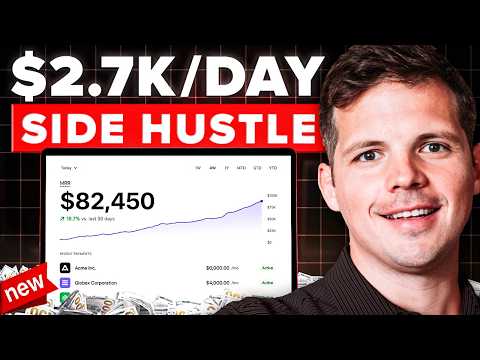
All figures are spoken; no dashboard is shown.
- Productize the service — "Selling it off the shelf" — no quote form, no calls, no proposals. A client buys on the website and starts submitting requests. He frames the goal as lowering "time to value".
- Charge a subscription, allow pauses — Clients "subscribe and pause anytime", which he presents as the selling point against hiring a contractor. It is also why his income "swings a lot".
- Launch where buyers already look — Product Hunt, upvoted by friends and family to No. 4, produced about 36,000 visitors and, he thinks, about $10,000 on the first day.
- Keep the day job until the numbers are undeniable — Four years, until $80,000 a month against a $75,000 salary. He says he did "most of my Design Joy work… during my meetings" at that job.
- Raise prices when demand overwhelms you — "Every time I would double my price i thought this will finally… curb the demand but it just exponentially increased it." From $449 to $8,000 over the life of the business.
- Cap the client count — He once had "as much as 50 clients at a time" and ended up in hospital. Now he is "more selective" and works about 30 hours a week.
The business model
Flat monthly subscriptions for unlimited design requests handled one at a time; clients can pause. About $1 million a year.
Software companies and startups needing branding, websites, product design and decks.
Agency-quality design faster and cheaper than a traditional agency, with no contracts, calls or proposals.
A Product Hunt launch in 2017, then reputation; he began posting on X four or five years later.
- Tools — Webflow, Figma, Midjourney, Krea, Claude, Photoshop, Loom — not priced
- Monthly expenses overall
- Tax — Excluded from every profit figure; "pretty astronomical"
- Founder's labour — ~30 hours a week; profit is his entire pay
- Churn and pauses — Cause swings of $50,000–$60,000 a month
A genuinely low-cost business. The large cost is tax, which he names and leaves out, and the founder's own skilled time.
What you would actually need
Money
"Very little cost involved" — a Webflow site and a Product Hunt launch, which is "totally free".
The start-up cost really was low, and his revenue and profit figures together imply monthly expenses of only a few thousand dollars. The real input is a professional design skill and portfolio good enough to command $449 on day one and $6,000–$8,000 later.
What it took
- A Webflow site
- A Product Hunt launch, upvoted by personal network
- Professional design skill (branding, web, product)
- Design and AI tools: Midjourney, Krea, Claude, Figma, Photoshop
- Tax: excluded from every profit figure
Time
Built in a weekend; run alongside a full-time job for four years; about 30 hours a week now.
A weekend to launch and four years of double duty to reach $80,000 a month. The scaling period included a hospital stay from overwork. Thirty hours a week now is the result of years of systems and client selection.
The timeline he gives
- 2017: idea, build and launch over one weekend
- ~1 year at roughly the first-day level
- 4 years alongside a $75,000 job
- Quit at $80,000 a month; $160,000 two months later
- Overwork to the point of hospitalisation
- Now ~30 hours a week
The part you must pay attention to
"Net profit" here means before tax and before paying the founder.
The intro says he is "making about 80 grand a month in net profit". In the interview he gives a range — 60 to 80, or 70 to 80 — excludes tax, and describes swings from $40,000 to $200,000.
- Annual revenue — ~$1,000,000
- Months — 12
- Average monthly revenue — ~$83,300
$70–80k profit ⇒ ~84–96% margin
Before tax and before any salary for the founder
The figures broadly reconcile: $1 million a year is about $83,300 a month, and $70,000–$80,000 of average profit implies only $3,000–$13,000 a month of costs, consistent with a one-person design business. But "net" here is not take-home. He explicitly leaves out taxes, which he calls "pretty astronomical", and as a sole operator the profit is also his entire pay for about 30 hours a week of skilled work. It is better compared with a senior designer's salary plus a business margin than with passive income.
The "no audience" framing also needs one addition. He did not have followers, and he says he did not tweet until four or five years in. But the launch reached No. 4 on Product Hunt and drew about 36,000 unique visitors — far more than the 500-person hometown the host mentions could supply. The upvotes came from his personal network; the traffic came from Product Hunt's front page. That route is open to others, but a top-five finish is an outcome, not a step anyone can schedule.
- REVENUE VS PROFIT
- Revenue ~$1,000,000/yr
- ~$83,300/mo
- Avg net profit $70,000-$80,000
- Implied costs ~$3,000-$13,000
- Margin ~84-96%
- (before tax, before his pay)
- CLIENTS IMPLIED BY PRICE
- $83,300 / $6,000 = ~14
- $83,300 / $8,000 = ~10
- Day one: $10,000 / $449 = ~22
- THE DAY JOB
- Salary $75,000/yr
- Design Joy at exit $80,000/mo
- THE SWINGS
- Low ~$40k Avg $70-80k Peak ~$200k
The economics
Revenue, profit and price broadly agree. Tax and expenses are the gaps.
- Annual revenue — ~$1,000,000
- Average monthly revenue — ~$83,300
- Average monthly net profit — $70,000–$80,000
- Implied monthly costs — ~$3,000–$13,000
- Profit range — ~$40,000 to ~$200,000 a month
- Current price per client — ~$6,000–$8,000 a month
- Implied active subscriptions — ~10–14
- Hours a week — ~30
- Tax — Excluded
- Stated monthly expenses — Unclear in the video
Profit margin from his own two figures
$70,000–$80,000 average profit ÷ ~$83,300 average monthly revenue
Roughly 84–96%, before tax and before any salary for the founder
IncomeIdeaLab calculation from figures stated by the founder
Revenue is given as "about a million dollars a year" and profit as a range, so the margin is approximate. Both are spoken figures; no dashboard is shown.
- Tax, which he excludes and calls "pretty astronomical"
- Current number of active subscriptions
- Churn and pause rates
- Revenue in the years between launch and the $80,000 month
- At exit, Design Joy made about $80,000 a month against a $75,000-a-year salary — more in a month than the job paid in a year, as the host says.
- "Revenue doubles from 80 to 160k" two months after he quit. Whether those are revenue or profit figures is not specified; the intro treats the $80,000 as profit.
- He says the first year stayed at roughly the launch-day level of about $10,000 a month, so the path to $80,000 took several years.
- His estimate that an AI design-and-development retainer could command "$10 to $20,000 a month" is a projection, not a result; he ties it to clients spending "thousands of dollars a month on tokens".
- The episode includes plugs for the host's paid community, his podcast feed, and a $100 referral offer for suggesting future guests; all are presented as the host's own.
Evidence status
Every substantive claim in the video.
- "About a million dollars a year… just myself" — Founder — Consistent with his profit and price figures.
- "About 80 grand a month in net profit" — Host intro — He gives 60–80 or 70–80, before tax, swinging $40k–$200k.
- "10 grand in recurring revenue by Monday" — Host intro — He said "I think… about $10,000 the first day" and that it was early to call it recurring.
- No. 4 on Product Hunt, ~36,000 unique visitors — Founder — The real launch engine behind "no audience".
- Kept a $75,000 job until $80,000 a month — Founder — Four years of double duty, stated plainly.
- Price path $449 → $8,000 a month — Founder — The most specific and useful figure set in the video.
- "Clients pay him six grand a month" — Host intro — Within his stated range after easing back from $8,000.
- ~30 hours a week now — Founder — After overwork put him in hospital.
- Expenses "about a[…] a month" — Founder
- AI agency retainer of $10,000–$20,000 a month — Founder — His estimate for a business he does not run.
What is actually proven?
Coherent spoken figures; nothing shown on screen.
- Revenue, average profit and price per client reconcile to within a reasonable range.
- Profit is stated before tax, by the founder himself.
- The full price history from $449 to $8,000.
- A Product Hunt No. 4 launch with ~36,000 visitors.
- After-tax income.
- Any document or dashboard confirming the figures.
What the headline doesn’t tell you
A solid business, rounded up in the intro.
- Profit is before tax. — He calls the tax "pretty astronomical".
- $40k to $200k swings. — Churn and paused subscriptions.
- "No audience" ≠ no traffic. — No. 4 on Product Hunt, 36,000 visits.
- Day one was "I think". — Not "recurring by Monday".
- Four years of two jobs. — Before he could quit.
- Overwork put him in hospital. — His own words.
- The skill came first. — Professional design, from day one.
- It is his salary too. — Profit pays for 30 hours a week.
Should you try it?
A sound model for people who already have a sellable skill
Productizing and repricing are transferable lessons. The launch luck and the professional design skill are not.
- Internal consistency — 8 — Revenue, profit and price broadly agree.
- Specificity of pricing — 9 — Every price step from $449 to $8,000.
- Honesty about the hard parts — 8 — Four years of two jobs; hospitalised from overwork.
- Tax and cost disclosure — 4
- Accuracy of the intro — 5 — Rounds up profit and firms up day-one revenue.
- Evidence shown — 3 — All figures spoken; nothing on screen.
- Beginner accessibility — 4 — Requires a professional skill clients will pay for immediately.
- Replicability of the model — 7 — Productized subscriptions work for many digital skills.
- The transferable lesson is the model, not the number. If you already have a digital skill people pay for — design, copywriting, editing, development — selling it as a subscription with a fixed scope ("one request at a time") removes the quoting and proposal work, and pause-anytime terms make it easy for a client to say yes. He is explicit that it can apply to "any sort of like mainly digital skill".
- The second lesson is pricing. His income did not grow by adding clients; it grew by charging more until he needed fewer. Fifty clients at lower prices put him in hospital. Ten to fourteen at $6,000–$8,000 is roughly $1 million a year on about 30 hours a week. If you try this, plan your price increases from the start.
- Read the profit carefully. "About 80 grand a month" is the top of his range, before tax, in a business that has had $40,000 months; and it is his entire pay for skilled, full-time-ish work. It is an excellent income, not a passive one.
- And be realistic about the launch. He had no followers, but he had a professional skill and a Product Hunt launch that reached No. 4 with 36,000 visitors. Most launches do not. Keep a job while you test, as he did for four years.
Passive or automated?
Automation
Sales and billing are self-serve; the design work is his, assisted by AI tools.
Passive potential
Income depends on his output; clients pause when work stops.
The front end is automated — clients buy on the site and pay by subscription with no calls — but every deliverable is produced by one person. AI tools speed him up: he uses Claude for requirements and prototyping and Midjourney and Krea for imagery. That reduces hours, not his role. The business ran him into hospital at around 50 clients, and today it takes about 30 hours a week of his time. Because clients can pause whenever they like, monthly income moves by tens of thousands of dollars. It is a very well-paid solo service business, not a passive one.
- All design and development work for every client
- Managing the request queue and client communication
- Deciding when to raise prices or cap clients
- Replacing clients who churn or pause
- Tax and bookkeeping on a ~$1M business
Recommended beginner experiment
His sequence, at your skill level.
- Pick a skill clients already pay for. — Design, copy, editing, development.
- Define the unit of work. — His was "one request at a time".
- Put a price on a page. — No calls, no proposals.
- Launch somewhere buyers browse. — He used Product Hunt.
- Keep your job while it grows. — He kept his for four years.
- Raise the price when you are full. — Not when you are tired.
- Cap clients before your health does. — He learned this in hospital.
- Set aside tax from day one. — He excludes it from every figure.
Our verdict: 7/10
A coherent solo-agency story, rounded up in the intro about $1M a year and $70–80K a month before tax, with a price ladder worth copying
Credited for figures that broadly reconcile — about $1 million a year in revenue, $70,000–$80,000 average monthly profit and a current price of $6,000–$8,000 per client imply ten to fourteen subscriptions and a few thousand dollars of costs; for an unusually detailed pricing history from $449 to $8,000; for stating that profit is before tax and that it swings from about $40,000 to $200,000; and for candour about four years of working a day job alongside the business and about overwork that put him in hospital. 4 on Product Hunt with about 36,000 visitors.
Strip away the intro and this is one of the more coherent solo-business interviews we have reviewed. Design Joy sells unlimited design, one request at a time, for a flat monthly subscription clients can pause; its founder says he has run it alone since 2017 for about $1 million a year. His average profit of $70,000–$80,000 a month implies costs of only a few thousand dollars, which is what a one-person design studio should look like, and his current price of $6,000–$8,000 implies roughly ten to fourteen active clients — consistent with his description of keeping "a certain number" at a time and working about 30 hours a week. The most valuable part is the pricing history: $449 at launch, then $849, $1,299, $2,500 and on up to $8,000, with each increase raising demand rather than cutting it. That, more than the launch, is what turned a busy freelancer with fifty clients — and a hospital stay — into a calmer business with a dozen. He is honest about the cost: four years of running it alongside a $75,000 job, and overwork that nearly broke him. What the packaging leaves out is real but modest. The profit is before tax, which he calls "pretty astronomical", and it is also his whole salary. It swings from about $40,000 to about $200,000 a month. "10 grand in recurring revenue by Monday" was, in his words, "I think it was about $10,000 the first day", too early to call recurring. And the anonymous launch still reached No. 4 on Product Hunt with about 36,000 visitors. None of this undermines the business; it just means the headline describes the best version of it.
- Annual revenue — ~$1,000,000
- Average monthly profit — $70,000–$80,000, before tax
- Profit range — ~$40,000 to ~$200,000
- Implied margin — ~84–96%
- Price per client — $449 at launch → $6,000–$8,000
- Implied subscriptions — ~10–14
- Launch — Product Hunt No. 4, ~36,000 visits
- Tax — Excluded
- Beginner suitability — With a professional skill
Sources
- The Most Profitable Solo Business You’ve Never Heard Of — The Koerner Office Podcast — YouTube video, 2026-04-21
- FTC — Guides Concerning the Use of Endorsements and Testimonials — Regulatory guidance on earnings claims