Remote Sales / Appointment Setting · Claim Review
“how i made USD 2.5k in 30 days living in madinah”
What we found: A $2.5k First Month as an Appointment Setter, With the Pay Structure Not Stated
The title figure is the creator's own first role, given as approximate and also as 2.6k to 2.7k. Base, commission and hours are not broken out, and the creator calls $1k to $3k a month the more realistic range.
- ~$2.5k First month, creator
- $1k–$3k/mo Realistic first role
- 10% Example commission
- 5+ a day Hours suggested
The claim
That the creator earned about $2,500 in 30 days in a first remote appointment-setting role while a full-time student, and that beginners can find similar roles by building a profile and networking.
- Creator's first 30 days — "I made 2.5k approximately in 30 days"
- Creator's first role, second mention — "Close to 3k I believe 2.6 2.7"
- Split between base pay and commission — Not stated
- Hours worked in that month — Not stated
- Example commission — 10% of a $2,000 sale = $200
- Our check of that example — $2,000 × 10% = $200, correct
- Realistic first-role range — $1k to $2.5k, "between one and three is more realistic"
- Setter median, in the creator's view — $2k–$3k or $3k–$4k a month
- Closer range — $8k–$15k a month, top end "really really good offers"
- Job board listings added in 7 days — 105
- Price of the creator's mentorship — Not stated
What is this income idea?
Work remotely as an appointment setter: message or call leads for a coach, agency or high-ticket business, qualify them, and book them onto calls with a closer, for a base, a commission or both.
- The creator says they landed a first remote sales role while a full-time student and earned about $2,500 in 30 days. The rest of the video is about where such roles are found, because, in their words, the common approach of spamming founders on Instagram, Indeed, Upwork and Telegram groups usually goes unanswered and can expose job seekers to people who ask them for money.
- The pay model is explained with one example. A lead is qualified and booked, a closer makes the sale, and the setter takes a percentage: "if they paid USD 2,000 you get 10% you would get USD 200." That arithmetic is correct.
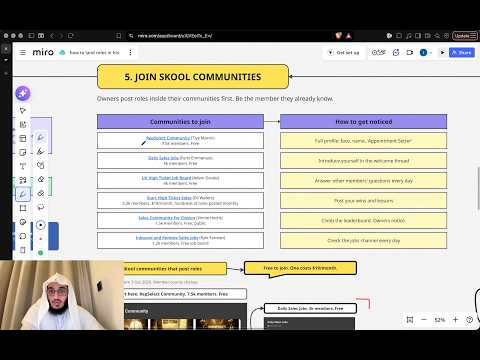
- The "right way" is six steps: build an Instagram profile that reads like a CV, set up LinkedIn with a 60-second Loom pitch, network genuinely with people who place setters, message businesses directly, join Skool communities with job channels, and then apply with a short video, a roleplay and a trial period.
- The creator is specific about what to avoid. Paying to be hired, unpaid trials with no end date, commission-only roles with no leads, roles that expect you to fund international calling yourself, and recruiters charging $2,000 to $3,000 placement fees are all named as warning signs.
- On income, the creator is more cautious than the title. Setters can make "1 to 10k a month", but the high end is "a very rare rare instance", most first roles pay $1k to $2.5k, and the creator says of their own result: "don't rely on it."
- The "easy way" is the creator's own paid mentorship, which includes a curated job board, coaching calls and accountability. Its price is not stated in the video.
Book sales calls for other people's businesses from home, for a cut of each sale; the creator says a first month of about $2,500 is possible but not typical.
- Profile as a CV — Instagram, LinkedIn
- 60-second Loom — Your pitch
- Network, not spam — Placers and closers
- Message businesses — The secret-shopper test
- Join job communities — Skool job channels
- Roleplay and trial — Often two weeks
- Base, commission or both — Get it in writing
A job search method, not a business: the income depends on the offer you are placed on.
The useful part is the list of offers to walk away from.
The lesson underneath the number
- Most of this video is about getting hired rather than about money, and the most practical section is the one on warning signs. The creator tells viewers not to pay to be hired, to be careful of trials with no end date and no pay, to avoid commission-only roles where the offer has no leads or no sales record, to ask whether trial work is paid, and to get the base and commission in writing. Those are the questions that decide whether a setter role pays at all, and they are stated plainly.
- The income figures are more modest than the title. The creator's own month was about $2,500, but they also say first roles usually pay $1k to $2.5k, that higher earnings tend to come after six months or a year, and that the top figures they mention belong to the largest offers in their niche. That candour is worth crediting. What the video does not give is the shape of the creator's own month: the base, the commission rate, the number of sets that closed and the hours worked. Without them a reader cannot turn $2,500 into an hourly rate or judge how repeatable it is.
- The two mentions of the same first role do not quite match. One says about 2.5k in 30 days, the other "close to 3k, 2.6, 2.7". The gap is small, and both are given as approximate, but it means the title is the lower of two recollections rather than a single figure read from a payslip or dashboard.
- Finally, the video has two parts with different purposes. The first five-sixths explains a free route that the creator says takes weeks or months. The last section presents the creator's paid mentorship and job board as the shortcut, with examples of a student hired within days. That is disclosed openly, with the link mentioned on camera. Its price and the share of members who land a role are not stated.
I myself first role got me close to 3k… but don't rely on it. I would say 1 to 2k between one and three is more realistic.
The creator, on their own result
The method, as the creator gives it
Six steps for the slow route, then the paid shortcut.
No figure is given for the hours, base or commission behind the creator's own first month.
- Treat your profile as your CV — A name and title such as "appointment setter", a one-line description, any proof or roleplay clips, and posts about your process. The creator says this works without showing your face.
- Use LinkedIn, with a short video pitch — A banner, a 60-second Loom and past experience reframed for sales, for example handling hundreds of customers a day as a cashier. Search posts, not just jobs, and reply with something specific.
- Network with the people who place setters — The creator calls this the best route: someone who can vouch for you to an offer owner. They name several accounts and communities that post roles; we make no claim about any of them.
- Message businesses that have not posted a role — Look for ads, "comment guide" posts and unanswered questions. Message as a lead, time the reply, then pitch the owner with that gap: "I messaged you Monday as a lead and I got a reply on Wednesday."
- Be active in job communities — Complete your profile, answer questions, post wins, check job channels daily and apply quickly, because "speed to applying" is noticed.
- Apply, roleplay, then trial — A 60-second Loom, a short roleplay, then usually a two-week trial. The creator advises asking in advance whether the trial is paid, prorated from the base, and getting the final terms in writing.
The business model
Pay from the business you set for: a base, a commission on closed sales (10% in the video's example), pay per call or set, or a mix.
The setter's employer: coaches, course sellers, agencies, real-estate firms, software and high-ticket local businesses.
Responding to and qualifying leads quickly so that more of them reach a closer.
Personal networking, Instagram and LinkedIn profiles, direct messages to businesses, and community job boards.
- Calling costs — Up to $50 a day if a role makes you fund international calls, per the video
- Unpaid search time — Weeks or months, per the creator
- Unpaid or prorated trials — The creator advises confirming pay in advance
- Mentorship and job board — Offered in the video. Price not stated
- Tax and currency conversion — Not mentioned
For an employee or contractor the costs are small. The financial risk sits in pay structure: commission-only roles depend on someone else's leads and closing rate.
What you would actually need
Money
The slow route is described as free. The creator warns against paying to be hired and against roles that expect you to fund calls, which can cost "up to USD 50 a day".
The search itself costs little apart from your time, which the creator says can run to weeks or months. The paid shortcut is the creator's mentorship, whose price is not stated. Once hired, tax, internet, a phone line and currency conversion are not mentioned.
Costs named or implied
- A computer, stable internet and a headset
- Calling costs if a role does not reimburse them, up to $50 a day per the video
- The creator's mentorship and job board, price not stated
- Placement fees, which the creator advises against above "the few hundreds"
- Income tax on contractor pay, not mentioned
- Weeks or months of unpaid search time
Time
"Five hours plus is the ideal time." Cold-calling roles may need six to nine hours a day. The slow route "can take a few weeks it can take a few months".
These are the creator's own figures and they are more candid than the title. What is missing is the hours behind the creator's own $2.5k month, which is what a reader would need to judge the hourly rate.
The time the video describes
- Weeks to months to land a first role the slow way
- Follow-up sequence over about 12 days per prospect
- Two-week trial before a hiring decision
- 5+ hours a day once working, more when cold calling
- Six months to a year before $3k–$4k is common, per the creator
- Hours behind the creator's own first month: not stated
The part you must pay attention to
The headline is one person's first month, and the creator says not to rely on it.
The video gives the first-role figure twice, as "2.5k approximately in 30 days" and as "close to 3k I believe 2.6 2.7". Neither mention says how much was base and how much was commission.
- Example sale paid by the customer — $2,000
- Example setter commission — 10%
$200 per closed sale
About 12–13 closed sales to reach $2,500 on commission alone (our arithmetic)
The load-bearing assumption is that a beginner lands a role on an offer with steady leads and a closer who converts. A setter's commission is paid only when someone else closes the sale, so the same effort can be worth very different amounts on different offers. The video states the creator's own role was "a bit of a different situation" and "a pretty good role" for their position, and does not say what the base, commission rate, ticket size or hours were.
The creator is frank about this. They say most first roles pay $1k to $2.5k, that between one and three thousand is "more realistic", that $3k to $4k usually comes after six months to a year, and that a $12k month they heard of was on one of the largest offers in their niche. Read against those statements, the title describes a good outcome rather than a typical one.
- THE TITLE FIGURE
- Stated first 30 days ~$2,500
- Same role, second mention 2.6k-2.7k
- Base vs commission not stated
- Hours not stated
- IF IT WERE ALL COMMISSION (ours)
- $2,000 sale x 10% = $200
- $2,500 / $200 = 12.5 sales
- COLD-CALLING EXAMPLE (ours)
- Stated pay $3,000-$4,000/mo
- 7 h x 22 days = 154 h
- $3,500 / 154 h = ~$23/h before tax
- TRIAL EXAMPLE
- $1,000 base, 2 weeks -> $500 stated
- Half a month of base = $500 checks
The economics
An earnings range from the creator, with the inputs behind their own month not given.
- Creator's first 30 days — ~$2,500 (also 2.6k–2.7k)
- Example commission — 10% of a $2,000 sale
- Commission per example sale — $200
- Realistic first-role pay — $1k–$3k a month
- Cold-calling setter pay — $3k–$4k a month
- Suggested hours — 5+ a day; 6–9 when cold calling
- Example trial — $500 for two weeks on a $1,000 base
- Cash collected before moving up — $100k–$300k, e.g. 10 sets at $10k
- Base, commission and hours behind the creator's month — Not stated
Hourly rate implied by the cold-calling example
$3,500 a month ÷ (7 hours × 22 working days = 154 hours)
About $23 an hour before tax and any unreimbursed calling costs
IncomeIdeaLab calculation from the creator's stated pay and hours; the mid-points are our assumption
The creator gives a range of six to nine hours a day and $3k to $4k a month, describes it as possible rather than certain ("you can still make… potentially"), and does not say how many days a month. At nine hours and $3,000 the rate falls to about $15 an hour.
- The base and commission behind the creator's $2.5k month
- Hours worked in that month
- The offer's ticket size and close rate
- The price of the creator's mentorship
- How many mentorship members land a role, and how fast
- Tax and currency costs for a contractor abroad
- The worked commission example is correct: 10% of $2,000 is $200.
- The prorated trial example is correct: two weeks of a $1,000 monthly base is $500.
- The $100,000 milestone is described as ten closed sets at $10,000 each, which is consistent. It refers to revenue collected by the employer, not the setter's pay.
- The sales-manager range is given as $8k–$15k and then "on the lower end as well like 4 to 8k 4 to 10k", so the bottom of the stated range moves within the same sentence.
- Job-board examples include roles with on-target earnings of $3k–$6k and companies said to be doing $25k and $400k a month; these are listing details read out by the creator and we could not check them from the video.
Evidence status
Every substantive figure in the video.
- "I made 2.5k approximately in 30 days" — Creator — Stated as approximate. Base, commission and hours are not given.
- First role "close to 3k… 2.6 2.7" — Creator — A second, slightly higher figure for the same role.
- 10% of a $2,000 sale is $200 — Creator — Correct.
- Setters make $1k–$10k a month — Creator — The creator calls the top end very rare and puts the median at $2k–$4k.
- A setter on a top offer made about $12k a month — Creator, second-hand — Heard of, not the creator's own result; described as rare.
- Cold-calling setters can make $3k–$4k a month — Creator — About $15–$26 an hour on the stated hours (our arithmetic).
- Closers make $8k–$15k a month — Creator — Top end described as "really really good offers".
- Two-week trial on a $1,000 base pays $500 — Creator — Correct as a prorated figure; the creator advises confirming it in advance.
- International calling can cost up to $50 a day — Creator — Given as a reason to avoid roles that do not reimburse it.
- 105 jobs added to the job board in seven days — Creator — We could not check this from the video.
- A student landed a $1k or $1.5k base within five days — Creator — Both amounts are given; the creator says it was "somewhere around that range".
- Mentorship price and placement rate — Nobody — Not stated in the video.
What is actually proven?
The method is explained clearly; the headline result rests on the creator's statement.
- The creator earned about $2,500 in a first 30-day role.
- The 10% commission and prorated trial examples both check out.
- The creator gives a lower realistic range and says the result is not typical.
- Specific warning signs for bad roles are listed.
- The paid mentorship and job board are promoted openly in the closing section.
- The base, commission and hours behind the creator's month.
- The mentorship price and how many members are placed.
What the headline doesn’t tell you
A first month, not a monthly average.
- One month, one person. — The creator's own first role.
- Two figures for it. — ~2.5k and 2.6k–2.7k.
- Pay split not given. — Base or commission is not stated.
- Hours not given. — So no hourly rate.
- $1k–$3k is "more realistic". — The creator's words.
- Commission depends on the closer. — Someone else makes the sale.
- Search takes weeks or months. — Unpaid, per the video.
- Closing section promotes a mentorship. — Price not stated.
Should you try it?
A real entry route into remote sales, at an ordinary wage
Low cost to start, and the warnings in the video are worth following. Expect the creator's lower range, not the title.
- Specificity of the job-search method — 8 — Profiles, messages, follow-up timings and application format are all given.
- Warnings about bad offers — 8 — Pay-to-be-hired, unpaid trials, no-lead commission roles, calling costs.
- Candour about typical earnings — 7 — Gives a lower realistic range and calls the high end rare.
- Evidence for the headline figure — 3 — Stated as approximate, with two versions and no breakdown.
- Pay-structure detail — 3 — Base, commission rate and hours behind the creator's month are not given.
- Disclosure of the paid offer — 6 — Promoted openly; price and placement rate not stated.
- Start-up cost — 8 — Little money needed if you avoid paid placements.
- Beginner accessibility — 6 — Good spoken English and long hours, by the creator's account.
- This is a job, not a business, and the video is clear about that. You are paid by the company whose leads you handle, and your income depends on their offer, their lead flow and their closer. That makes the warning section the most valuable part of the video: before accepting a role, find out whether there is a base, what the commission is, whether the trial is paid, who pays for calls, and get it in writing.
- Use the creator's own numbers rather than the title. They say most first roles pay $1k to $2.5k a month, that five or more hours a day is the norm, and that cold-calling roles can run to eight or nine hours. On the cold-calling example, that works out to roughly $15 to $26 an hour before tax by our arithmetic, which is a reasonable remote wage in many countries and an ordinary one in others.
- The slow route costs time rather than money, and the creator says it can take weeks or months. If you consider the paid shortcut, ask for the price, what share of members are placed, and how long placement takes, because the video does not state any of these.
Passive or automated?
Automation
The work is conversations with people, by message or phone.
Passive potential
Pay stops when you stop working.
Appointment setting is paid labour. Every set comes from a live conversation, the creator recommends five or more hours a day, and commission is earned only when a closer converts the call you booked. The creator also stresses that offers test whether you "sound human" rather than like an AI. Nothing in the role builds an asset that keeps paying once you stop.
- Replying to and qualifying every lead
- Following up over days and weeks
- Roleplays, interviews and trials to get hired
- Taking feedback and adjusting scripts
- A closer to turn your sets into commission
Recommended beginner experiment
Test whether you can get hired before paying for anything.
- Build one clean profile. — Name, "appointment setter", one line on what you do.
- Record a 60-second Loom. — Your experience, framed for conversations.
- Practise roleplays with peers. — Every hiring process in the video includes one.
- Apply daily for four weeks. — Track replies and interviews.
- Ask the pay questions up front. — Base, commission, trial pay, calling costs.
- Get the terms in writing. — The creator's own advice.
- Work out your hourly rate after month one. — Pay divided by hours actually worked.
- Only then consider paid help. — Ask its price and placement rate first.
Our verdict: 5/10
A careful job-search guide under a first-month headline the creator's own range for beginners is lower than the title
Credited for a specific, low-cost job-search method; for naming the warning signs of poor or unpaid roles; for advising viewers to confirm trial pay and get terms in writing; for worked examples that check out; and for stating that the creator's own result is not typical and that $1k to $3k is more realistic. Marked down because the headline $2.5k is given in two slightly different versions with no breakdown of base, commission or hours, because several ranges shift within the same sentence, and because the paid mentorship offered as the shortcut has no stated price or placement rate.
The title figure is real in the sense that the creator states it, but it is one person's first month, given as approximate and also as 2.6k to 2.7k, with no breakdown of base pay, commission or hours. The creator is more cautious than the headline: they say most first roles pay $1k to $2.5k, that higher earnings usually take six months to a year, and that their own role was an unusually good one. The method for finding roles is specific and cheap to try, and the list of warning signs (paying to be hired, unpaid open-ended trials, commission-only roles without leads, unreimbursed calling costs and large placement fees) is the most useful part of the video. On the creator's own cold-calling example, the pay works out to roughly $15 to $26 an hour before tax by our arithmetic. The closing section promotes the creator's paid mentorship and job board as a faster route; its price and placement rate are not stated in the video.
- Creator's first 30 days — ~$2,500 (also 2.6k–2.7k)
- Realistic first role, per creator — $1k–$3k a month
- Example commission — $200 on a $2,000 sale
- Cold-calling hourly rate — ~$15–$26 before tax
- Suggested hours — 5+ a day
- Pay split behind the headline — Not stated
- Mentorship price — Not stated
- Beginner suitability — Reasonable, at the lower range
Sources
- how i made USD 2.5k in 30 days living in madinah — Abdulrahman Kader — YouTube video, 2026-10-05
- FTC — Guides Concerning the Use of Endorsements and Testimonials — Regulatory guidance on endorsements and earnings claims