Asset Income / Car Wash · Claim Review
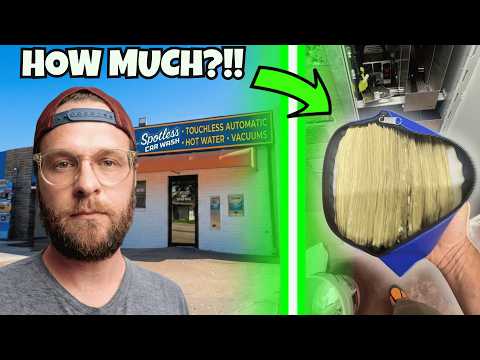
“I Spent $640,000 on a Self Serve Car Wash, This is How Much Money it Made in One Month..”
What we found: A $24,771 Car Wash Month That Ended About $3,144 Negative, and an Honest Ledger Behind It
The gross reconciles to the cent and every expense line is read out. The $640,000 in the title is never mentioned, and the $15,314 "normal month" he shows also has no chemical bill and no repairs in it.
- $24,771 September gross
- −$3,144 Cash flow after mortgage
- $18,458 Capital spending that month
- Not stated $640,000 in the title
The claim
That an eight-bay self-serve car wash with one automatic grossed $24,770.85 in September, ran a negative cash flow of $3,143.90 after its mortgage because of an $18,458.23 capital purchase, and would have produced $15,314.33 in a month without that purchase.
- Cash and coin for the month — $13,317.25
- Card revenue, self-serve bays — $7,415.60
- Card revenue, automatic — $4,038
- Total gross — $24,770.85
- Sum of the three parts — $24,770.85, exact match
- Total expenses incl. capital spending — $24,175
- Mortgage payment — $3,793.15
- Cash flow after mortgage — −$3,143.90
- Same, recomputed from his expense lines — −$3,197.90
- Purchase price, equity or total invested — Never stated
What is this income idea?
Own a coin-and-card self-serve car wash, upgrade its equipment, and run it yourself with a part-time handyman.
- The site is "an 8 bay self-serve car wash with one automatic". The video follows the last cash collection of September: emptying the bay coin boxes, two bill changers, the vending machines and the automatic, then counting it all back at the office.
- He gives the history up front. "When I bought this place it was only making 96,000." Last year it grossed $272,000. This year he has "completely redid these bays" and "installed an automatic", and in September installed air dryers and a new pump.
- The collection sets the scale. One three-day bay collection comes to 2,239 quarters, about $560. The cash for this collection is $1,750 after $10 of rejected bills. Added to the earlier collections, the month’s cash and coin is $13,317.25.
- Card revenue is added on top: $7,415.60 from the self-serve bays and $4,038 from the automatic, for a gross of $24,770.85. The same month last year was "USD 24,000 almost exactly", and the month before this one was $32,500.
- Then comes the part most videos in this genre leave out. He reads every expense line, adds the mortgage, and lands on a negative cash flow of $3,143.90 for the month. He then backs out the capital spending and shows $15,314.33 as "more in line with a normal month".
- Year to date he reports $230,000 gross and $79,592 of cash flow, and a target of $300,000 gross for the year.
A real car wash with a real ledger: about $25,000 in, a big equipment purchase out, and a month that lost money on paper because of it.
- Buy an underperforming wash — $96,000 a year at purchase
- Rebuild the bays — Plus a new automatic
- Collect coin and cash — Bays, changers, vending
- Add card revenue — Bays and automatic
- Pay running costs — Utilities, insurance, labour
- Pay the mortgage — $3,793.15 a month
- Fund upgrades from profit — Dryers, pump, a sign
A cash business with a disclosed cost base, and capital spending that swings the monthly result.
A losing month that tells you more than a winning one
The lesson underneath the number
- Most income videos show the best month. This one shows a month that lost money after the mortgage, then explains exactly why: $17,500 of air dryers and a pump landed in September. That is the right way to read a capital-heavy business. A single month’s result says little; the year-to-date figure, $79,592 of cash flow on $230,000 of gross, says much more, and he gives it.
- The ledger is also unusually complete. Utilities, insurance, property tax, a handyman, daily cleaning, trash and card fees are all read out, and he explains the lines that look odd: chemicals are zero because the bill has not been paid yet, repairs are zero because parts were expensed when bought. Very few creators volunteer the reasons a number is flattering.
- What is missing is the starting point. The title says $640,000, but that figure never comes up in the video. There is no purchase price, no down payment and no cost for the bay rebuild or the new automatic, which together nearly tripled the gross from $96,000 at purchase to $272,000 last year. Without those, a viewer can see that the business makes money but cannot work out the return on the money that went in.
- The forward-looking claims deserve the same care. The dryers "are supposed to increase your … gross revenue about 15%", which is a forecast, and September came in only about $770 above the same month last year despite the upgrades. He says so himself and calls the business "a little bit finicky". The upcoming $12,000 sign, he admits, will have almost no effect on revenue at all.
Regardless that’s just the gross revenue number. Now we need to add up all the expenses to see what my actual total is for this month.
The step most income videos skip
How the month was counted
The order he follows, and what each step adds.
The purchase price, down payment and total spent on upgrades are not given at any point.
- Empty every cash point — Self-serve bays, both bill changers, the vending machines and the automatic. He skips the vacuums this time, estimating about $50 inside, and says he will add it to next month.
- Separate tokens from quarters — 986 tokens were counted. He notes the quarters should at least match that, since tokens are bought with money, but some customers use tokens bought earlier.
- Count coin by machine — "2,239 quarters" from the bays, which he divides by four on camera. That is $559.75 for about three days. The vending quarters come to about $25.
- Count notes and add the rejects — $1,740 counted plus "USD 10 in reject bills", for $1,750 of cash in this collection.
- Add the month’s earlier collections and card revenue — Cash and coin for the month: $13,317.25. Card: $7,415.60 from the bays and $4,038 from the automatic. Total: $24,770.85.
- Subtract every expense, then the mortgage — Eleven expense lines read out, $24,175 in total including $18,458.23 of capital spending, then $3,793.15 of mortgage, for −$3,143.90.
- Back out the capital spending — Removing the $18,458.23 gives $15,314.33, which he presents as closer to a normal month.
The business model
Coin, token, cash and card payments at eight self-serve bays and one automatic, plus vending sales and vacuums.
Local drivers who wash their own cars, with demand that rises in warm, dry weather and after muddy days.
Cheap, self-service washing at any hour, with an automatic for customers who would rather not.
Location and a road sign; a new main sign is planned. No paid marketing is mentioned.
- Mortgage — $3,793.15 a month
- Utilities — $2,432.37 this month, rising with the previous month’s volume
- Chemicals — $0 this month, $2,281.46 the month before
- Labour and cleaning — $840 handyman plus $700 a month daily cleaning
- Insurance — $820 a month
- Property tax — $550 this month; about $6,000 to $7,000 a year
- Card processing — About $200 a month
- Trash — $175
- Capital spending — $18,458.23 this month; a $12,000 to $13,000 sign next
- Owner’s time — Self-managed and unpaid in the ledger
Income tax is not included; he says he will not know it until year end. Depreciation is mentioned for tax purposes only.
What you would actually need
Money
A mortgage of $3,793.15 a month is stated. The purchase price, down payment and the cost of the bay rebuild and automatic are not.
This is a capital-heavy business. A single month carried $18,458.23 of equipment, a $12,000 to $13,000 sign is next, and earlier upgrades were large enough that the gross nearly tripled. The $640,000 in the title may be the total, but the video does not say so.
Costs named in the video
- Mortgage: $3,793.15 a month
- Air dryers: $17,500
- Main sign: about $12,000 to $13,000, upcoming
- Chemicals: $2,281.46 in the prior month
- Utilities: $2,432.37 this month
- Insurance: $820 a month
- Property tax: about $6,000 to $7,000 a year
- Bay rebuild and new automatic: never priced
Time
"Pretty much daily as a car wash owner you got to come up spray down the walls", empty trash, and check for coin jams and failed bill acceptors.
He describes a daily presence and does the collections, counting, ordering and policing himself. "No management fees" means his own time is unpaid in the ledger, not that the work is absent.
What the owner does
- Daily wall spraying and trash collection
- Checking for jams: a bill acceptor jam cost revenue this month
- Cash collections and counting
- Restocking and reordering vending stock
- Asking loiterers to leave
- Managing upgrades and a handyman
The part you must pay attention to
The $15,314 "normal month" has no chemical bill in it.
He removes the capital purchase to show a typical month. That adjustment is fair. But two other lines in the same month are also unusually low, and he says why.
- His month without capex — $15,314
- Prior month’s chemical bill — $2,281
~$13,033
A month with a typical chemical bill
Chemical spend is $0 in September because "I haven't paid the bill yet. I just pay it whenever they send it", and the prior month it was $2,281.46. Repairs are also $0 because parts used this month were expensed when they were bought. Both are timing effects, so the adjusted month is better than a typical one. Utilities move the other way: he says September’s $2,432.37 is high because it pays for August’s busier month.
None of this changes the picture by much. A car wash grossing about $25,000 a month and clearing roughly $13,000 to $15,000 after its mortgage in an ordinary month is consistent with the $79,592 he reports for the first nine months, which already absorbs the dryers. The $640,000 is a different matter. The title puts it next to "one month", but the video never says what was paid, how much was borrowed or what the rebuild cost, so the return on the money invested cannot be worked out from what is said.
- SEPTEMBER, AS STATED
- Cash and coin $13,317.25
- Card, self-serve bays $7,415.60
- Card, automatic $4,038.00
- Gross $24,770.85 (matches)
- Expenses, read out $24,175.60
- of which capex $18,458.23
- Mortgage $3,793.15
- Our total -$3,197.90
- His total -$3,143.90
- -> $54 apart
- HIS "NORMAL MONTH"
- Add back capex $15,314.33
- Chemicals this month $0
- Chemicals last month $2,281.46
- With a chemical bill ~$13,033
- YEAR TO DATE (NINE MONTHS)
- Gross $230,000
- Cash flow $79,592
- Share of gross ~35%
The economics
A full month’s ledger, and no figure for what the business cost to buy.
- September gross — $24,770.85
- Same month last year — ~$24,000
- August gross — $32,500
- Total expenses incl. capex — $24,175
- Capital spending — $18,458.23
- Mortgage — $3,793.15
- Year-to-date gross / cash flow — $230,000 / $79,592
- Last year gross / cash flow — $272,000 / $120,000–$140,000
- Gross at purchase — $96,000 a year
- Purchase price and total invested — Never stated
Rebuilding the month from his own lines
$840 + $700 + $820 + $18,458.23 + $550 + $2,432.37 + $175 + $200 = $24,175.60; $24,770.85 − $24,175.60 − $3,793.15 = −$3,197.90
Expenses match his $24,175 total. The final cash flow comes out $54 below the −$3,143.90 he states, which is a minor gap, probably an expense read a little differently.
IncomeIdeaLab calculation from the figures read out in the video
His adjusted figure of $15,314.33 is exactly −$3,143.90 plus the capex, so his own arithmetic is consistent with itself. The $54 difference is between his total and the lines as spoken.
- Purchase price, down payment and loan size
- Cost of the bay rebuild and the new automatic
- Whether the title’s $640,000 is the price, the total invested or something else
- Income tax, which he says he will not know until year end
- A value for the owner’s own time
- The interest and principal split inside the mortgage payment
- Year to date, cash flow is about 35% of gross ($79,592 of $230,000), after the dryers. Adding the $18,458.23 back gives about $98,050, which matches his "almost USD 100,000".
- To reach $300,000 for the year from $230,000 needs $70,000 over three months, about $23,333 a month. He says $22,500, which would land near $297,500. The difference is small; the target is a stretch either way after August’s $32,500 and September’s $24,771.
- Cash flow is measured after the full mortgage payment. Part of that payment is principal, which reduces the loan rather than being a cost, so true profit is somewhat higher than cash flow. The split is not given.
- If the title’s $640,000 were the total cost, last year’s $120,000 to $140,000 of cash flow would be roughly 19% to 22% a year on it. That is our illustration on an assumed figure; the video does not state the investment.
Evidence status
Every substantive figure in the video.
- $24,770.85 gross for September — Owner, counted on camera — Built from three stated parts that add up exactly.
- $24,175 total expenses — Owner — Matches the sum of the lines read out.
- −$3,143.90 cash flow after mortgage — Owner — Our sum from his lines gives −$3,197.90. A $54 gap.
- $15,314.33 without capital spending — Owner — Consistent with his total, but includes $0 chemicals and $0 repairs.
- $17,500 air dryers will lift gross about 15% — Owner — A forecast. September beat last year by only about $770.
- $272,000 gross last year; $96,000 at purchase — Owner — Plausible given the stated rebuild, which is not priced.
- $79,592 cash flow year to date — Owner — About 35% of the $230,000 year-to-date gross.
- $12,000 sign will barely affect revenue — Owner — An unusually candid admission about his own spending.
- $640,000 spent — Video title only — Not mentioned anywhere in the video.
What is actually proven?
The month is well evidenced. The investment behind it is not stated.
- Cash and coin were collected and counted on camera.
- Cash, bay card and automatic card revenue add to the stated gross exactly.
- The expense lines add to the stated $24,175 total.
- A negative month after the mortgage is reported, with the reason.
- The adjusted month is flattered by a $0 chemical bill.
- The 15% revenue lift from the dryers.
- The purchase price, financing and cost of the upgrades.
What the headline doesn’t tell you
The ledger is honest. The title is doing different work.
- $640,000 is never said. — Only the title has it.
- The month lost money. — About $3,144 after the mortgage.
- Capex caused it. — $18,458, mostly air dryers.
- Chemicals were $0. — The bill had not arrived.
- Repairs were $0. — Expensed in earlier months.
- His time is unpaid. — Self-managed, daily.
- A jam cost revenue. — Nobody calls to tell you.
- A $12,000 sign is next. — He expects little return.
Should you try it?
A real business, with real capital and real hours
Worth studying for how to read a car wash ledger. Not a low-cost or hands-off start.
- Completeness of the monthly ledger — 9 — Revenue by source, eleven expense lines, mortgage and year to date.
- Arithmetic consistency — 9 — Gross and expenses reconcile; the final figure is $54 off.
- Honesty about a bad month — 9 — Shows a negative month and explains it.
- Explaining flattering lines — 8 — Says why chemicals and repairs are zero.
- Disclosure of the investment — 1 — No purchase price, loan or upgrade costs.
- Title accuracy — 3 — The $640,000 does not appear in the video.
- Beginner accessibility — 3 — Needs property, financing and daily attention.
- If you want to understand what owning a self-serve car wash looks like month to month, this is a useful video. The money comes from many small places: quarters, tokens, bill changers, card readers in the bays, a separate automatic and the vending machines. Things break, such as a jammed bill acceptor or a broken holder, and you only find out by checking.
- The ledger also shows where the money goes. Utilities were the largest running cost this month at $2,432.37, followed by the chemical bill when it arrives (about $2,281 the month before), insurance, labour and property tax. The mortgage is $3,793.15 a month on its own. In an ordinary month, after all of that, the business appears to clear somewhere around $13,000 to $15,000.
- What you cannot learn here is what it costs to get in. The title says $640,000, the video never does, and the bay rebuild and new automatic that nearly tripled the gross are never priced. Before treating a car wash as an investment, you need the purchase price, the loan terms and the full upgrade bill, then a return calculated on the cash you actually put in.
- Finally, take the description of the work at face value. Daily wall spraying, trash, collections, counting, restocking, dealing with loiterers and managing a handyman are all part of the job he describes. "Self-managed" saves a management fee by spending the owner’s own time.
Passive or automated?
Automation
Customers wash their own cars and card readers take payment; cash still has to be collected.
Passive potential
Daily visits, repairs and policing are described as part of the job.
A self-serve wash runs without staff in the bays, and card payments reduce the cash handling. But the owner here describes daily visits to spray walls before grime damages them, empty bins, clear jams and move on people loitering in the bays, plus regular cash collections and counting. A handyman comes daily for cleaning at $700 a month and helps with installs. Some of this could be hired out, but the ledger shows no management cost because the owner does it himself.
- Daily wall spraying and trash collection
- Cash and coin collection and counting
- Finding and fixing jams and broken parts
- Ordering chemicals and vending stock
- Managing contractors and upgrades
Recommended beginner experiment
How to check a car wash before you buy one.
- Ask for twelve months of revenue by source. — Coin, notes, card, automatic, vending.
- Get every expense line, not a total. — His ledger is a good template.
- Normalise timing items. — Chemicals and repairs come in lumps.
- Separate capex from running costs. — Then add a reserve for it.
- Price the loan before the business. — His mortgage is $3,793 a month.
- Value your own time. — "Self-managed" is still work.
- Check seasonality. — $32,500 one month, $24,771 the next.
- Calculate return on your cash. — The figure this video never gives.
Our verdict: 7/10
A complete, honest monthly ledger under a title it does not support and a "normal month" that is a little better than normal
Credited for counting the month’s takings on camera and building the gross from three stated parts that add up exactly; for reading out every expense line, the mortgage and the year-to-date figures; for showing a month that lost money after the mortgage and explaining it as a capital purchase; for explaining why chemicals and repairs are zero; and for admitting that a $12,000 sign will barely affect revenue. Marked down because the $640,000 in the title is never mentioned and no purchase price, loan or upgrade cost is given; because the $15,314.33 "normal month" includes a $0 chemical bill against $2,281.46 the month before; because the dryers’ 15% revenue lift is a forecast; and because his final cash flow is $54 better than the lines he reads out.
This is one of the more useful car wash videos we have reviewed because it shows the full month rather than the gross alone. The takings are counted on camera; cash, bay card and automatic card revenue add to $24,770.85 exactly; eleven expense lines are read out and match the $24,175 total; and the mortgage takes the month to a loss of about $3,144. He explains the loss as $17,500 of air dryers and a pump, removes it to show $15,314.33, and gives year-to-date figures of $230,000 gross and $79,592 cash flow, which already include the dryers. Two adjustments are worth making. The "normal month" has no chemical bill because the invoice had not arrived; with last month’s $2,281.46 it is nearer $13,000. And his final cash flow is $54 better than the lines he reads out, a small gap. The bigger gap is in the title. The $640,000 never appears in the video, and neither does a purchase price, a loan size or the cost of the rebuild that took the business from $96,000 to $272,000 a year. The business clearly makes money. How good a return that is on the money invested cannot be worked out from what is said.
- September gross — $24,770.85
- Cash flow after mortgage — −$3,143.90
- Capital spending — $18,458.23
- Month without capex — $15,314.33
- With a typical chemical bill — ~$13,033
- Year-to-date cash flow — $79,592
- Total invested — Never stated
- Beginner suitability — Capital and hours required
Sources
- I Spent USD 640,000 on a Self Serve Car Wash, This is How Much Money it Made in One Month.. — YouTube video, 2026-10-07