Dropshipping · Claim Review
“Dropshipping for Beginners (my full course)”
What we found: A Free Dropshipping Course Built on a Stated $10 Million: No Store Figures Are Given, and the One Student Result Is Stated Three Different Ways
The method is detailed and the cost rules are specific: a $25 to $30 margin, a $50 daily test budget, a $2.30 cost-per-click ceiling. The headline earnings are lifetime claims without a revenue or profit breakdown, and the course ends in a pitch for the creator's paid program.
- $10M+ Stated lifetime
- $70k–$80k Student result
- $50/day Test budget
- Not stated Own store P&L
The claim
That the creator has made over $10 million with dropshipping, and that a beginner can start for very little by following this free course: find a low-competition product, build a Shopify store, and test it with $50 a day of Facebook ads.
- Made with dropshipping — Over $10 million
- Best single product — Over $800k in a month
- Student Nicholas — $70k profit in 8 weeks / $70k in 7–8 weeks / $80k pure profit in 8 weeks
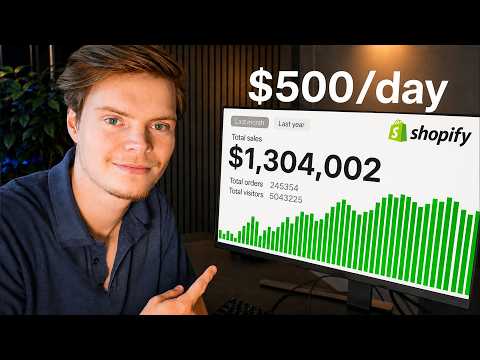
- Shopify dashboard shown at 12:50 — $57,988.52 total sales, 996 orders, 19 May–30 Jun (store owner not named; gross sales only)
- Target margin — $25 to $30+ after supplier cost
- Example product — Bought $27, sell $55 to $59
- Test campaign — $50 a day; first sale expected after $40 to $50
- Shopify — $1 a month for three months, then $30
- Own revenue, ad spend, profit — Not stated
What is this income idea?
Shopify dropshipping: list a product from a supplier such as AliExpress, advertise it on Facebook, and pay the supplier to ship it only after a customer has paid you.
- The creator says they have been dropshipping for over seven years, have made over $10 million, and that one product made over $800,000 in a month. None of these figures is broken down into revenue, ad spend, supplier cost or profit.
- The course has four parts. Product research: avoid big trends, skincare and heavy items, and look for products that solve a real problem with a $25 to $30-plus margin after the supplier cost. Two methods are shown: training an Instagram feed to show dropshipping products, and filtering Winning Hunter for TikTok Shop products under $300,000 in revenue that are still rising.
- Store: Shopify, with Shopify Payments or Stripe and PayPal, free shipping in five to seven days, and either the free Dawn theme or a paid page builder called Atlas. Creatives: download existing videos from TikTok or Winning Hunter, re-edit them in CapCut, and make photo ads with ChatGPT. Advertising: a Facebook sales campaign at $50 a day across the US, UK, Canada and Australia, with about ten creatives, cutting any ad above a $2.30 cost per click in the US.
- The example product is a foot massager found at $27 on AliExpress, to be sold at $55 to $59. A chest trainer is shown bought at about £29 and listed at £59, then £49.
- The last section introduces the creator's paid program, with student results, a 4.9-out-of-five rating, and a 24-hour refund policy.
A detailed free walkthrough of the dropshipping setup, with large lifetime figures that are stated but not broken down.
- Find a product — $25–$30 margin
- Build the store — Shopify, $1/mo to start
- Make creatives — Re-edited existing videos
- Test on Facebook — $50 a day
- Cut by CPC — Above $2.30 in the US
- Scale winners — Separate campaign
Every stage has a rule. None has a cost-and-return figure from a real store.
The best number in the video is the loss
The lesson underneath the number
- The creator tells a story from the start: going from broke to $7,000 a day in sales, believing the business was very profitable because a $14 product was selling for $39, and then discovering $40,000 later that the supplier was charging $50 to ship it. On those figures each order lost about $25 before advertising. It is a candid story and a useful one, because it shows exactly how a sales figure can sit on top of a loss.
- The same reasoning applies to the other figures in the video. Over $10 million "made", a product that "made me over 800K in a month", stores doing $20,000 a day and $200,000 to $300,000 a month, and a store that "crashed to zero" are all given without saying whether they are revenue or profit, and without ad spend. A student is described as going from $400 to $500 a month at a job to "two to 300K months", which reads as revenue. None of these can be checked from the video.
- The student result used as proof is stated three times. Early on, $70,000 in profit in eight weeks; later, 70K "in just 7 to 8 weeks in profit"; in the program pitch, $80,000 in eight weeks, "not talking revenue, it is pure profit". The two figures differ by $10,000. They may describe different points in time, but the video does not say so.
- The video opens by saying it has "no sponsors" and is not pushing "100 different affiliate links". It later says there is an affiliate link for Shopify, that the creator partners with Atlas and has a discount, that Winning Hunter and other tools are linked, and that the first link in the description is the paid program. Each of those is disclosed when it comes up, which is to the creator's credit; a viewer should still weigh the tool recommendations with those links in mind.
I thought I was making so much profit cuz I was buying the product for 14, selling it for 39, until I found out 40,000 later that the supplier was charging me 50.
The creator, on their first products
The method, as the creator gives it
Low-competition product, simple store, many cheap creative tests.
No ad spend, conversion rate or profit is given for any real store.
- Avoid big trends and heavy products — Skincare, makeup and deep problem-solving products are called unsuitable for beginners. The creator's heavy-product story is the warning: bought at $14, sold at $39, with the supplier charging $50 in shipping.
- Check three criteria — The product solves a problem or insecurity, leaves a $25 to $30-plus margin after supplier cost, and is new but has some content online.
- Research free or paid — Like dropshipping posts on a fresh Instagram account until the feed shows products, or filter Winning Hunter for TikTok Shop products under $300,000 in revenue.
- Set up Shopify — Payments, free shipping at five to seven days, "continue selling when out of stock", and a product page built around social proof.
- Build ten creatives — Download existing product videos, remove watermarks, re-cut them in CapCut, and generate photo ads with ChatGPT. Test three photos and seven videos.
- Run and prune a $50-a-day test — Cut ads with a cost per click above $2.30 in the US, or about $1.50 elsewhere, add five new videos a day, and move winners to a scaling campaign.
The business model
Retail sales of dropshipped products through Shopify stores; separately, a paid coaching program and affiliate or partner links promoted in the video.
Facebook and Instagram users in the US, UK, Canada and Australia shown problem-solving products.
A product that solves a problem, presented with heavy social proof and free shipping.
Paid Facebook ads, tested in batches of creatives.
- Facebook ads — $50 a day to test; scaling spend not stated
- Supplier cost and shipping — Per order
- Shopify plan — $1 a month for three months, then $30
- Apps and tools — Winning Hunter, Atlas; prices not stated
- Payment processing — Not stated
- Refunds — Not mentioned
Advertising is the largest variable cost in this model and is paid before any sale. No ad-spend total is given for any store.
What you would actually need
Money
Not much: Shopify at $1 a month for three months, and you only pay the supplier once a customer has paid you.
The supplier side is paid after the sale, but advertising is paid before it. At $50 a day, a test costs $350 a week, and the creator expects the first sale after $40 to $50 of spend, not the first profit. Shopify rises to a stated $30 a month after three months, and paid tools and themes are extra.
Costs named or implied
- Facebook ads at $50 a day while testing
- Shopify: $1 a month for three months, then $30
- Supplier cost per order, including shipping
- Payment processing on each order
- Winning Hunter and the Atlas page builder, prices not stated
- Refunds and chargebacks, not mentioned
Time
Your store can be up and running today.
A first store and campaign in a day is plausible. The daily work after that is not small: five new creatives a day, ad pruning, customer emails about five-to-seven-day shipping, and supplier management.
Where the time goes
- Product research
- Building the product page
- Making five new creatives a day
- Reading and pruning ads daily
- Answering customer emails
- Handling refunds and late deliveries
The part you must pay attention to
The proof is lifetime and student totals. None comes with the costs behind it.
The creator's own example of a margin going wrong is the most useful arithmetic in the video, and it shows why a sales figure without costs says little about profit.
- Stated sale price — $39
- Stated product cost — $14
- Stated supplier shipping — $50
−$25 an order
Before any advertising
The load-bearing assumption is that a beginner can find products with a $25 to $30 margin and buy traffic cheaply enough to sell them at a profit. The video gives the margin rule and the cost-per-click ceiling but no conversion rate, no cost per sale and no refund rate, so it is not possible to work out from the video whether a typical test campaign makes or loses money.
In the creator's own story, the business was "making $7,000 a day" in sales while each order was losing money, and they found out "$40,000 later". That is a fair warning, credited to the creator. It also means that the $10 million, the $800,000 month and the student figures cannot be read as profit unless the costs are given, and in this video they are not.
- THE HEAVY PRODUCT (OUR WORKING)
- Sale price $39
- Product cost -$14
- Supplier shipping -$50
- Per order -$25
- -> before ads and fees
- THE TARGET PRODUCT
- Sale price $55-$59
- Supplier cost $27
- Margin $28-$32
- Ad cost per sale not stated
The economics
Clear unit rules, and large totals with no costs attached.
- Stated lifetime — Over $10 million
- Best month for one product — Over $800,000
- Target margin — $25 to $30+ after supplier cost
- Example product — $27 cost, $55 to $59 price
- Test budget — $50 a day
- CPC ceiling — $2.30 in the US, about $1.50 elsewhere
- Spend before first sale — $40 to $50 expected
- Conversion rate, cost per sale, refunds — Not stated
What the stated rules imply per sale
$55 to $59 − $27 ; $40 to $50 of ads for one sale
A $28 to $32 margin, against $40 to $50 of ad spend for the first sale: a loss of roughly $8 to $22 on that first sale
IncomeIdeaLab calculation from the figures stated in the video
The $40 to $50 is the creator's estimate for when the first sale arrives, not a steady cost per sale; later sales may cost less. It shows that the margin rule only works if ad cost per sale falls well below the margin, which the video does not measure.
- Whether $10 million is revenue or profit, and over what period
- Ad spend for any store
- Cost per sale and conversion rate
- Refund and chargeback rates
- Payment processing fees
- Prices of Winning Hunter, Atlas and the paid program
- Share of students who reach a profitable store
- The creator says Australia-only targeting gives "five times cheaper" ad costs; no figures are given.
- A student is described as making a first $600 day and now doing $3,000 to $4,000 a day; these are sales figures with no costs.
- The 4.9-out-of-five program rating is stated as a platform rating; it is a satisfaction score, not an earnings measure.
- A 24-hour refund policy for the program is stated.
Evidence status
Every substantive figure in the video.
- Made over $10 million with dropshipping — Creator, opening — Revenue or profit not stated; we could not check it from the video.
- One product made over $800,000 in a month — Creator — No costs given.
- Student: $70,000 profit in 8 weeks — Creator, product section — Restated later as $80,000 pure profit in 8 weeks.
- Student: $80,000 pure profit in 8 weeks — Creator, program pitch — Does not match the earlier $70,000.
- $7,000 a day while each order lost money — Creator, own story — Our working: −$25 an order before ads.
- Target margin of $25 to $30+ — Creator — A rule, not a result.
- Foot massager at $27, sell at $55 to $59 — Creator — A $28 to $32 margin before ads and fees.
- First sale after $40 to $50 of ad spend — Creator — Would exceed the margin on that sale.
- Shopify $1 a month for three months, then $30 — Creator, affiliate link — Affiliate link disclosed.
- Program rated 4.9 out of five — Creator, pitch — A satisfaction rating, not earnings.
What is actually proven?
A method is laid out in detail. The money behind it is stated in totals only.
- A step-by-step setup from product research to a live ad campaign.
- Specific rules for margin, budget and cost per click.
- The creator's heavy-product story implies about −$25 an order before ads.
- Over $10 million made, with no revenue or profit split.
- A student profit figure that differs between mentions.
- Ad spend, cost per sale and profit for any store.
What the headline doesn’t tell you
A free course is useful. These are the parts it leaves open.
- $10 million is not split. — Revenue or profit not said.
- The student figure moves. — $70k, then $80k.
- Ads are paid up front. — $50 a day.
- The first sale may lose money. — On the stated figures.
- Shopify rises to $30. — After three months.
- There are links. — Affiliate, partner and program, each disclosed.
- Reused content carries risk. — See below.
Should you try it?
A thorough setup guide; budget for ad losses before profit
The rules are specific enough to follow. Set a fixed test budget you can afford to lose, and measure cost per sale before you scale.
- Specificity of method — 8 — Settings, budgets and cut-off rules given.
- Evidence for income — 2 — Lifetime and student totals only.
- Cost disclosure — 4 — Budget and margin rules; no store P&L.
- Disclosure of conflicts — 6 — Links disclosed as they come up; opening says no sponsors.
- Startup cost — 5 — Low platform cost; ads paid before sales.
- Beginner accessibility — 4 — Easy to launch, hard to make profitable.
- As a setup guide this is thorough. It covers which products to avoid and why, two research methods, the Shopify settings that matter, a simple product-page layout, how many creatives to test and when to cut an ad. A beginner could launch a store and a test campaign from it.
- What it cannot tell you is whether you will make money. Advertising is paid before any sale, at $50 a day in the example, and the creator expects a first sale after $40 to $50 of spend. With a $28 to $32 margin on the example product, that first sale would be at a loss. Profitability depends on cost per sale falling well below the margin, and the video gives no measured cost per sale.
- Two practices in the video deserve caution. Downloading other sellers' TikTok videos, removing watermarks and running them as your ads may conflict with the platforms' terms and with the original creator's rights, and the risk falls on you. Copying customer reviews from competitors' stores and posting them as your own is the kind of practice the FTC's endorsement guides address: reviews should reflect real customers of the product you sell.
- If you try it, fix a total test budget, record every order's full cost including shipping and payment fees, and work out cost per sale before adding budget.
Passive or automated?
Automation
Suppliers ship orders; everything else is daily work.
Passive potential
Ads need daily pruning and new creatives.
Dropshipping removes inventory and packing, and apps connect the supplier to the store. The rest of the work is active: the creator's own routine calls for five new creatives a day, daily review of every ad, and moving winners into scaling campaigns. Customer service is real work too, especially with five-to-seven-day shipping.
- Researching products
- Making new creatives daily
- Reading and pruning ads
- Answering customers about delivery
- Managing suppliers and refunds
Recommended beginner experiment
Test one product with a fixed budget and full costing.
- Set a hard test budget. — Money you can afford to lose.
- Price shipping in before listing. — The heavy-product lesson.
- Use your own creatives. — Or licensed ones.
- Show only real reviews. — From your own customers.
- Track cost per sale daily. — Not just cost per click.
- Include every fee. — Payments, apps, refunds.
- Scale only above break-even. — For a full week.
Our verdict: 4/10
A detailed free course with headline figures that are not broken down and a student result that differs between mentions
Credited for a specific, step-by-step method with clear rules on margin, budget and cost per click; for a candid story about a product that lost money on every order; for warning against heavy and highly competitive products; and for disclosing each affiliate link, partnership and the paid program when it comes up. Marked down because the $10 million and the $800,000 month are not described as revenue or profit and come with no costs; because the student profit figure is stated as both $70,000 and $80,000 for eight weeks; because no ad spend or cost per sale is given for any store; and because the opening "no sponsors" framing sits beside several commercial links.
As a free walkthrough, this covers the full dropshipping setup in usable detail: what not to sell, how to find candidates, how to set up Shopify, how to build a product page and creatives, and how to run and prune a $50-a-day Facebook test. The creator's own story of a $14 product selling for $39 while shipping cost $50 is the most instructive figure in it. The headline earnings, over $10 million and an $800,000 month, are stated without saying whether they are revenue or profit and without any costs, and the student result is given as $70,000 and as $80,000 of profit over eight weeks. The video ends in a pitch for the creator's paid program, and the tools recommended along the way include an affiliate link and a partner discount, each disclosed when it appears. Use it as a setup guide, and measure your own cost per sale before trusting any total.
- Stated lifetime — $10M+, split not stated
- Student result — $70k or $80k in 8 weeks
- Heavy product — −$25 an order before ads
- Example margin — $28–$32
- Test budget — $50 a day
- Own store P&L — Not stated
- Beginner suitability — Follow the setup; budget for losses
Sources
- Dropshipping for Beginners (my full course) — Henrik Wold — YouTube video, 2026-08-26
- FTC — Guides Concerning the Use of Endorsements and Testimonials — Regulatory guidance on endorsements, reviews and affiliate disclosure