Local Services / Home Improvement · Claim Review
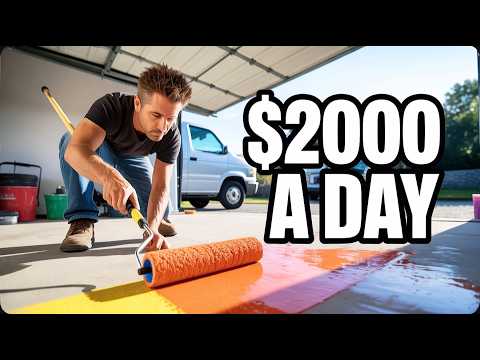
“How To Make USD 2k A Day With An Epoxy Garage Floor Business (Step By Step)”
What we found: Epoxy Garage Floors: $2,000 a Day Matches the Guest's $500,000 Year for an Established Two-Person Crew, Before Any Cost
A specific process, a $15,000 equipment estimate and about $4,200 per two-car garage. The guest's own first-year target for a new crew works out to $800 to $1,200 a day of revenue, and no material, labour or marketing cost is priced.
- ~$4,200 Typical two-car garage
- ~$15,000 Equipment to start
- $200k–$300k First-year target, one crew
- Not stated Materials, labour, profit
The claim
That a garage floor coating business can make $2,000 a day, with a step-by-step blueprint covering equipment, pricing, customers and the job itself.
- $2,000 a day — Said by the host in the intro; not given as a figure by the guest
- Years in business — About 25, since 2001, started with family
- Share of leads that are garage floors — 90%
- Price per square foot — Around $7, up to about $8
- Typical two-car garage — About 600 sq ft, about $4,200
- Crew time per two-car garage — Two half-days, about two hours on site each
- Equipment for a professional setup — About $15,000 "just guessing", plus transport
- Grinder rental instead — $300 to $600 a day
- Realistic first year, one crew — $200,000 to $300,000
- Established two-person crew — About $500,000 a year "attainable"
- Materials, wages, insurance, marketing, profit — No figure given
What is this income idea?
Grind bare concrete garage floors, lay a high-solids primer with decorative flakes, and seal it with a clear top coat, charged by the square foot.
- The guest runs a decorative concrete company in Virginia that he started with his brother and father in 2001. Over the last five years or so they have focused on garage floors, which he says are now 90% of their leads, alongside overlays, stained and metallic finishes, patios and basements.
- The video is an interview on a home-services channel. The host frames it in the intro as "you can make $2,000 a day painting garage floors" and the guest walks through licensing, equipment, materials, pricing, the two-day installation, upsells, marketing, his biggest mistake and the largest jobs he has had.
- Prep is the barrier to entry. Professionals grind the concrete rather than acid-washing it, and he says an efficient grinder costs $8,000 to $10,000; his own, which fits in a van, is "in the neighborhood of $10,000", plus a HEPA vacuum at $2,000 to $3,000 and hand tools, for about $15,000 "just guessing". Renting a grinder at $300 to $600 a day, or grinding by hand, is the cheaper start he suggests.
- Pricing is given as about $7 a square foot in Virginia, up to about $8, more in bigger cities and less per foot on large garages. A two-car garage is about 600 square feet, which the host multiplies out to $4,200. The guest adds that his company actually quotes on time, materials and profit, using a square footage and a photo sent by the customer.
- The job itself takes two half-days for his crew: grind, fill cracks with epoxy paste, vacuum, lay a 100% solids vapour-barrier primer at about 160 square feet per gallon, broadcast flakes until no epoxy shows, then return the next day to scrape, vacuum and lay a polyaspartic top coat at about 120 square feet per gallon.
- On scale he is measured. For someone brand new with one crew he would aim for $200,000 to $300,000 in a year, says "I don't think that you can start from scratch and do half a million with you and one guy in the first year", and puts $500,000 within reach for a two-person crew that has been doing it a while.
A real trade with clear steps and a per-foot price; the $2,000 a day is revenue that, on the guest's own numbers, an established two-person crew reaches, not a beginner's take-home.
- License and insure — Business and contractor
- Get a grinder — Rent at $300–$600/day or buy
- Quote by sq ft — ~$7 a foot
- Grind and fill cracks — Day one
- Prime and broadcast flakes — ~160 sq ft/gal
- Scrape and top coat — Day two, ~120 sq ft/gal
- Upsell patios, basements — Ask while on site
- Get the next lead — Ads, postcards, reviews
The job is well described; what it costs to deliver each one is not.
The guest's numbers are more careful than the title
The lesson underneath the number
- The figure in the title comes from the host's introduction. The guest, asked what a business can do in a year, gives a range for a beginner and a separate ceiling for an experienced crew, and volunteers the caveat himself: you will not start from scratch and do half a million with one helper in the first year. Spread over a working year, his beginner range is about $800 to $1,200 a day of revenue. The $2,000 a day lines up with his figure for a two-person crew that has been at it a while.
- The per-job arithmetic supports that reading. A 600 square foot garage at about $7 a foot is about $4,200 for two half-days of crew time. That is a strong number per visit, and it explains why the host is enthusiastic, but it only becomes a daily figure if the calendar stays full. The guest's calendar stays full because, after 25 years, "most of our leads are just coming organically", to the point where he quotes from a photo. A new operator, by his own advice, should be quoting in person because they will close more that way.
- What is missing is the cost side of each floor. He says professional primer is 100% solids, that pros use "hundreds of pounds of flakes", and that a two-car garage takes roughly three to four gallons of primer and five of top coat at the spread rates he gives. No price is attached to any of it, nor to the second person he says to hire quickly, the insurance the host asks about, or the Facebook ads he recommends. His own best advice to his younger self, to "charge a lot more" because the price must pay for the building, vans and equipment, is the clearest signal in the video that the gap between revenue and take-home is wide.
- Two things deserve credit. He describes the job in enough detail to follow, including the failure he says cost them most: mixing two part-A containers so the floor "just stayed like honey" and never set. And he is direct that DIY kits are a fair offer only if sold honestly as what they are. The video promotes the guest's paid course and coaching calls in its closing section, and includes several promotions for business software; whether those software placements are paid is not stated.
I don't think that you can start from scratch and do half a million with you and one guy in the first year though.
The guest, setting expectations for a new crew
The business, as the guest describes it
From licensing to the second-day top coat, with the figures he gives at each stage.
Equipment is priced; materials, wages, insurance and marketing are not.
- Get licensed — A business licence and a contractor's licence in Virginia; he notes that every state differs. Insurance is raised in the question but no figure or requirement is given in the answer.
- Solve the grinding problem — An efficient grinder is $8,000 to $10,000; lighter $3,000 to $4,000 machines are "not worth the money" in his view. Rental at $300 to $600 a day, ideally prepping two jobs on the same rental day, or hand grinding, are the cheaper routes.
- Buy professional materials early — Big-box kits are often 50 to 60% solids against 100% solids professional primers. He says that applied properly the per-foot cost is "not all that different", so he would not stay on DIY kits for long. No material price is given for either.
- Price the job — Around $7 a square foot for a typical 600 sq ft two-car garage in Virginia, less per foot on very large garages. In practice his company prices on time, materials and profit from a square footage and photo.
- Install over two half-days — Grind, crack-fill, vacuum, prime at about 160 sq ft per gallon and broadcast flakes on day one; scrape, vacuum and top-coat at about 120 sq ft per gallon on day two. About two hours each day on a two-car garage for his crew.
- Mention the other services — Porches, patios and unfinished basements come up once customers learn the company does them. He calls it "usually a pretty easy upsell". No upsell rate or value is given.
- Find customers — His leads are mostly organic after 25 years, from Instagram, YouTube and some Facebook ads. For someone new he recommends Facebook ads as the quickest route and postcards in chosen neighbourhoods. No ad budget or cost per lead is given.
The business model
Per-job pricing for garage floor coatings, roughly $7 a square foot, with patios, porches, basements and decorative concrete as add-on work.
Homeowners with two-car garages, plus occasional commercial and custom projects.
A ground, 100% solids, flake-broadcast floor that holds up better than a big-box DIY kit.
For the guest, mostly organic leads from reputation, Instagram and YouTube, with some Facebook ads; for a beginner, he suggests Facebook ads and neighbourhood postcards.
- Grinder — $8,000 to $10,000, or $300 to $600 a day to rent
- HEPA vacuum — $2,000 to $3,000
- Hand grinder and tools — Brings the setup to about $15,000 by his estimate
- Vehicle — A van in his setup. Not priced
- Materials per job — Primer, flakes, top coat. Not priced
- Second crew member — Recommended early. Wage not given
- Insurance and licences — Named. Not priced
- Marketing — Facebook ads called "not very expensive". No budget given
The equipment list is costed; the recurring per-job costs are not, so the margin on a $4,200 garage cannot be worked out from the video.
What you would actually need
Money
About $15,000 of equipment for a professional van setup, plus transport; or rent a grinder at $300 to $600 a day to start.
The equipment estimate is unusually concrete for this genre and the rental route is a sensible way in. Everything that recurs on every job is unpriced: primer, flakes by the hundred pounds, top coat, a second crew member, insurance, fuel and the ads that bring the next lead.
Named in the video, without a price
- Primer, flakes and top coat for each floor
- A second person, which he says you need "pretty quick"
- Insurance (asked about, not answered with a figure)
- A van or truck and trailer
- Facebook ads and neighbourhood postcards
- A building, vans and equipment that pricing must cover
- His paid course, if you take it
Time
Two half-days per two-car garage for an experienced crew; prep takes most of the time, and a solo operator can split a floor into sections.
The on-site time is short, but the revenue figures assume a steady flow of booked garages. His own lead flow comes from 25 years of reputation and social channels; a new business has to buy or knock for each job, and that time is not counted.
Where the hours go
- Quoting, in person where possible for a new business
- Grinding, the slowest step, faster with better machines
- Two site visits per garage
- Travel between jobs
- Marketing: ads, postcards, asking for reviews
- Learning to mix two-part materials without errors
The part you must pay attention to
The $2,000 a day is revenue, and on the guest's figures it belongs to an established two-person crew.
The guest never states a daily figure. His annual figures are $200,000 to $300,000 for a new one-crew business and about $500,000 for a two-person crew that has been doing it a while.
- Established two-person crew, per year — $500,000
- Working days a year (our assumption) — 250
~$2,000 a day
Revenue, before materials, wages and every other cost
Every daily or annual figure in the video rests on a continuous flow of booked garages. On his numbers one 600 sq ft garage is about $4,200 for two half-days of crew time, so $2,000 a day of revenue means roughly one garage every two working days, about 120 a year. His company gets that volume mostly organically after 25 years; for a new business, each of those jobs has to come from ads, postcards and in-person quotes whose cost is not given.
Applied to a new business, the guest's own first-year range of $200,000 to $300,000 works out to about $800 to $1,200 a day of revenue over 250 working days, which is our arithmetic. He is clear that half a million is not reachable from scratch in year one. None of these figures is profit: materials, a second person's wages, insurance, vehicle, fuel and marketing come out first, and no figure is given for any of them. His own advice that he "just didn't charge enough" at the start, because the price has to cover the building, vans and equipment, points in the same direction.
- ONE TWO-CAR GARAGE
- 600 sq ft x ~$7 = ~$4,200
- Crew time 2 half-days
- Primer 600 / 160 sq ft/gal = ~3.75 gal
- Top coat 600 / 120 sq ft/gal = 5 gal
- Material price not stated
- THE TITLE FIGURE
- $500,000 / 250 days = $2,000/day
- -> established 2-person crew
- $200,000 / 250 days = $800/day
- $300,000 / 250 days = $1,200/day
- -> new business, one crew
- GARAGES NEEDED A YEAR
- $200,000 / $4,200 = ~48
- $300,000 / $4,200 = ~71
- $500,000 / $4,200 = ~119
- All revenue. Costs: not stated
The economics
Equipment and price per foot are given; the cost of delivering a floor is not.
- Price per square foot — ~$7 (up to ~$8)
- Two-car garage size — ~600 sq ft
- Revenue per two-car garage — ~$4,200
- Equipment, professional setup — ~$15,000 plus transport
- Grinder rental — $300–$600 a day
- Primer spread rate — ~160 sq ft per gallon
- Top coat spread rate — ~120 sq ft per gallon
- First-year revenue, one crew — $200,000–$300,000
- Established two-person crew — ~$500,000 a year
- Materials, wages, insurance, ads, profit — Not stated
Turning the guest's annual figures into a daily rate
$200,000–$300,000 ÷ 250 working days = $800–$1,200 a day; $500,000 ÷ 250 = $2,000 a day
The title's $2,000 a day matches the guest's figure for an established two-person crew, as revenue
IncomeIdeaLab calculation from the guest's stated annual figures and our assumption of 250 working days
The working-day count is ours. Fewer days, for weather, slow seasons or gaps between jobs, raise the daily rate needed for the same year. None of these figures deducts materials, labour, insurance, vehicle or marketing, which are not given in the video.
- Material cost per square foot or per garage
- Wages for the second crew member
- Insurance and licence costs
- Vehicle, fuel and travel
- Advertising budget and cost per booked job
- Profit margin on a typical garage
- The guest company's own revenue or crew count
- The host multiplies 600 square feet by $7 to get $4,200 and rounds to "around $4,000"; the arithmetic checks out.
- At the stated spread rates a 600 sq ft garage needs about 3.75 gallons of primer and 5 gallons of top coat (our arithmetic). The guest says the per-foot cost of doing a DIY system properly is "not all that different" from professional material, but neither is priced.
- The equipment figures are internally consistent: about $10,000 for the grinder and $2,000 to $3,000 for the vacuum gives "around 12 or 13", and hand tools bring it to about $15,000. An earlier mention puts it at $15,000 to $20,000.
- The largest job is a tool factory that he expects to be "probably 500,000" when finished, a forward-looking figure; an aquarium attraction was "probably around 100,000". Both are commercial or custom work, not garage floors.
- At about $4,200 a garage, $500,000 a year is roughly 119 garages, or about one every two working days (our arithmetic).
Evidence status
Every substantive figure in the video.
- "You can make $2,000 a day painting garage floors" — Host, intro — Not stated by the guest as a daily figure. Matches his $500,000 a year for an established two-person crew, as revenue.
- About 25 years in business, since 2001 — Guest — His statement; we make no claim either way.
- 90% of leads are garage floors — Guest — Could not be checked from the video.
- Around $7 a square foot, up to about $8 — Guest — Given as a Virginia range; he says actual quotes use time, materials and profit.
- 600 sq ft two-car garage at about $4,200 — Host, from the guest's figures — The multiplication is correct. Revenue only.
- Equipment about $15,000 plus transport — Guest — Itemised and internally consistent. He calls the total a guess.
- Grinder rental $300 to $600 a day — Guest — A specific lower-cost entry route.
- Two half-days per two-car garage — Guest — For his experienced crew with efficient grinders.
- $200,000 to $300,000 in year one, one crew — Guest — About $800 to $1,200 a day of revenue on our 250-day assumption.
- $500,000 a year for an established two-person crew — Guest — About $2,000 a day of revenue, roughly 119 garages a year. No cost deducted.
- Factory job "probably 500,000" when finished — Guest — Commercial work in progress; not a garage floor.
- Aquarium project around $100,000 — Guest — He says he does not remember the exact figure.
- Materials, wages, insurance, ads, profit — Nobody — No figure is given in the video.
What is actually proven?
The method is clear; the earnings are revenue estimates with no cost side.
- The prep, priming, flake and top-coat process is described step by step with spread rates.
- An equipment budget of about $15,000, itemised, with a rental alternative.
- A price of around $7 a square foot for a typical two-car garage in Virginia.
- A 600 sq ft garage at that price is about $4,200 of revenue.
- The guest's first-year range is $800 to $1,200 a day of revenue; $2,000 a day matches his established-crew figure.
- Annual revenue of $200,000 to $300,000 for a new crew and $500,000 for an experienced one.
- Material, labour, insurance, vehicle and marketing costs.
- Profit per garage or per year.
What the headline doesn’t tell you
A price per job is not a daily income.
- $2,000 a day is the host's line. — The guest gives annual ranges.
- It is revenue. — Materials and wages come out first.
- It fits an established crew. — His own $500,000 figure.
- Year one is lower. — About $800 to $1,200 a day.
- You need a second person. — Their wage is not given.
- Materials are not priced. — On any floor in the video.
- His leads took 25 years. — A beginner buys or knocks for them.
- The course is his. — Promoted in the closing section.
Should you try it?
A learnable trade with real equipment cost and an unpriced margin
The process and entry routes are specific enough to plan from. Price your materials and labour before trusting any daily figure.
- Specificity of the process — 9 — Prep, crack fill, primer, flakes and top coat, with spread rates and timing.
- Equipment cost disclosure — 8 — Grinder, vacuum and tools priced, with a rental alternative.
- Realism of the guest's annual figures — 7 — He separates a beginner range from an experienced ceiling and says so plainly.
- Match between title and guest figures — 4 — $2,000 a day fits only his established-crew figure, as revenue.
- Per-job cost disclosure — 1 — No figure for materials, wages, insurance or ads.
- Profit clarity — 1 — Profit per garage cannot be worked out from the video.
- Beginner accessibility — 5 — Rental or hand grinding lowers the entry cost; licensing and skill still apply.
- Of the garage floor videos we have reviewed, this one has some of the most usable detail. You get the reason professionals grind rather than acid-wash, the machine weight that makes a grinder efficient, what 100% solids means for primer thickness, why two people work together on the coat, and the spread rates for primer and top coat. A beginner can turn that into a materials order and a job plan.
- Read the money the way the guest gives it rather than the way the title does. A typical two-car garage is about $4,200 of revenue for two half-days of work. A new one-crew business, on his estimate, might reach $200,000 to $300,000 in its first year, about $800 to $1,200 per working day before costs. The $2,000 a day in the title fits the $500,000 he gives for an established two-person crew.
- Then price what he does not. Ask a coatings supplier for the cost of primer, flakes and polyaspartic top coat for a 600 square foot floor, add a helper's day rate, insurance, fuel and an ad budget, and subtract that from $4,200. That number, not the price, is what each garage earns you. His own regret about undercharging early is worth taking literally.
- Finally, plan for the lead problem. His company quotes from photos because, after 25 years, enough work arrives organically. He tells new operators to use Facebook ads and neighbourhood postcards and to quote in person. Budget for that before counting on a full calendar. The course he sells in the closing section covers this material; the video itself gives enough to start pricing a first job.
Passive or automated?
Automation
Every floor is ground, coated and finished by hand on site.
Passive potential
Revenue stops when the crew stops working.
This is a hands-on trade and nobody in the video presents it otherwise. Each garage needs two site visits, a grinder and a two-person coating team working against the material's set time, and the mistakes he describes, such as mixing two part-A containers, happen on site. Scaling means hiring and running more crews; the guest's company has vans, a building and staff whose numbers are not given.
- Quoting and selling each job
- Grinding and crack filling
- Spreading and rolling primer as a pair
- Scraping and top-coating on day two
- Marketing, reviews and follow-up
Recommended beginner experiment
Prove the margin on one floor before buying a grinder.
- Check your state's licensing. — Business and contractor licence, plus insurance quotes.
- Price materials for 600 sq ft. — Primer, flakes and top coat at his spread rates.
- Rent, do not buy, the grinder. — $300 to $600 a day; book two preps together.
- Do a first floor with a helper. — Two people are needed for the coat.
- Work out profit per garage. — $4,200 less materials, labour, rental and fuel.
- Test a small ad budget. — Track cost per booked job.
- Ask for reviews in person. — Both host and guest say it works better.
- Buy equipment once jobs repeat. — About $15,000 for his setup.
Our verdict: 6/10
A clear trade walkthrough with honest annual ranges but the $2,000 a day is revenue that fits an established crew, and no per-job cost is given
Credited for a step-by-step installation process with spread rates and timing; for an itemised equipment budget of about $15,000 with a $300-to-$600-a-day rental route; for a specific per-square-foot price; and for the guest separating a $200,000-to-$300,000 first-year range from a $500,000 established-crew figure and saying plainly that half a million is not reachable from scratch in year one. Marked down because the title's $2,000 a day is the host's figure and matches only the established-crew revenue; because no cost is given for materials, a second person, insurance, vehicle or marketing, so profit per garage cannot be worked out; and because the closing section promotes the guest's paid course alongside several software promotions whose paid status is not stated.
This is a useful interview for anyone considering garage floor coatings. The guest has run a decorative concrete company for about 25 years and explains the work in practical detail: grind rather than acid-wash, use 100% solids primer, broadcast flakes until no epoxy shows, top-coat the next day, and work as a pair because the material sets fast. He prices the equipment at about $15,000, offers a rental route at $300 to $600 a day, and puts a typical two-car garage at about $7 a square foot, roughly $4,200. His annual figures are measured. A new one-crew business might reach $200,000 to $300,000 in its first year, which is about $800 to $1,200 per working day on our assumption of 250 days. An established two-person crew might reach $500,000, which is where the title's $2,000 a day fits. All of these are revenue. The video gives no figure for primer, flakes, top coat, a helper's wage, insurance, the vehicle or the Facebook ads he recommends, so what a garage earns after costs cannot be worked out. His own advice to charge more, because the price has to cover the building, vans and equipment, is a reminder that the gap matters. Treat the title as a ceiling for an experienced crew, take the process and pricing as a starting plan, and price your own materials and labour before counting on any daily figure.
- Two-car garage revenue — ~$4,200
- Equipment — ~$15,000 plus transport
- Year one, one crew — $200k–$300k revenue
- Per working day, year one — $800–$1,200 revenue
- Established crew — ~$500k, ~$2,000/day revenue
- Costs per job — Not stated
- Profit — Not stated
- Beginner suitability — Yes, with a rental grinder and a priced margin
Sources
- How To Make USD 2k A Day With An Epoxy Garage Floor Business (Step By Step) — YouTube video, 2025-10-08
- FTC — Guides Concerning the Use of Endorsements and Testimonials — Regulatory guidance on endorsements and earnings claims