SaaS / No-Code · Founder Case Study
“I shipped my app in 12 hours and now it makes $15K/month”
What we found: Shipped in 12 Hours — After the 15 Failures the Title Does Not Mention
The build really did take an afternoon. It was also their sixteenth-to-twenty-first attempt, they say so on camera, and the "$15K/month" comes from plans that do not renew automatically.
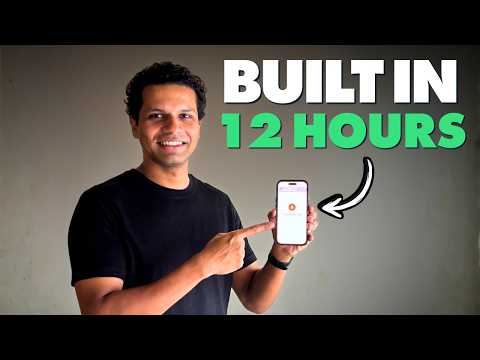
- 15–20 Products before this one
- ~$15,000 Monthly revenue
- $1,233/mo Disclosed tool costs
- 2.5% Free-to-paid conversion
The claim
That a part-time solo builder with no coding skills shipped an app in a 12-hour hackathon, took payment on day one, and grew it to over $15,000 a month.
- Build time to MVP — ~12 hours
- Prior products built — 15–20, mostly failed
- Total users — ~200,000
- Paying customers — 5,000+
- Pricing — $99/yr or $159/2yr
- Pricing page on screen at 2:36 — "Yearly Pass" $99 and "2 Year Pass" $159, both one-time, non-recurring payments
- Renewal — Manual, not automatic
- Tool prices on the channel’s tech-stack card (11:54) — Bubble $130, Xano $260, Draftbit $300, Loops $799, Plausible $19, OpenAI per usage
What is this income idea?
Build a very small software product with no-code tools, put a price on it immediately, and find out within a day whether anyone will pay.
- The product is a voice-to-text tool: you speak, it transcribes, and it rewrites what you said into a chosen style. It is deliberately narrow — one job, done well — and the founder says resisting the urge to expand into adjacent features is the main reason it survived while similar tools did not.
- The build genuinely did happen inside a 12-hour hackathon, and money genuinely did arrive before midnight. Beta testers they had only asked to try the product started paying without being asked to. That part of the story is unusual and, on their account, entirely real.
- What the title omits, and what they volunteer within two minutes, is that this was their sixteenth to twenty-first attempt. They had built "15 to 20 tools" since 2021, "most of which I failed", and they say outright that "there was a large portion of luck" and "I was bound to get lucky at some point".
- They then do something almost no founder does: they read out their entire monthly software bill, line by line, and the channel puts it on a tech-stack card: Bubble $130, Xano $260, Draftbit $300, Loops $799, Plausible $19 and OpenAI per usage. The card lists Draftbit as $300 without the "a year" they say aloud. That is what makes this worth analysing rather than merely admiring.
- The pricing page shown at 2:36 settles how the money comes in: a "Yearly Pass" at $99 and a "2 Year Pass" at $159, both described on the page as one-time, non-recurring payments.
They built a small voice-to-text app in 12 hours and it now makes about $15,000 a month. It was also their sixteenth-plus attempt, and the plans do not auto-renew.
- Build many small things — 15–20 before this one
- Design before building — Figma first, then code
- Build in public — Years of Twitter credibility
- Ship in 12 hours — The part in the title
- Price it immediately — Revenue before midnight
- Stay narrow — Resist adjacent markets
- Re-sell every year — Plans do not auto-renew
Steps one to three are the real story and take years. Step four is the one in the title and takes an afternoon.
The twelve hours is the only part of this that is fast.
The lesson underneath the number
- Everything that made the twelve hours work happened before them. Fifteen to twenty products built and mostly abandoned since 2021. Years of building in public until strangers on Twitter recognised their name. A hackathon community primed to cheer. Hype generated for a product that did not exist yet. They list all of it themselves, unprompted, and adds that a large portion of it was luck.
- That is the difference between this video and the genre it sits in. The founder describes a denominator; the title reports only the numerator. Someone who watches the thumbnail and skips the interview learns that apps can be built in twelve hours. Someone who watches the interview learns that this was the sixteenth attempt and that the builder had spent years earning an audience first.
- The cost disclosure is the other reason to take it seriously. Almost nobody reads their monthly software bill out loud. When they do, the structure of a freemium business becomes visible in a way it almost never is: the largest fixed line is email, priced per contact, and 97.5% of those contacts have never paid them a penny. That is not a flaw — a 2.5% free-to-paid conversion is a strong result — but it is what freemium actually costs, and it scales with the free users rather than the paying ones.
- Their strategic advice is also the correct kind: do one thing, refuse adjacent markets, design before building, and behave like a person rather than a company. None of it requires an audience to apply, which makes it the most transferable part of the video.
“I was bound to get lucky at some point.” They say it out loud. The title does not.
Louis Pereira, in the interview
What the founder teaches
The playbook as set out in the video.
Revenue and user figures are founder-stated; the cost stack was volunteered without being asked, is unusually specific, and is repeated on the channel’s tech-stack card at 11:54.
- Build a lot of things that can be shut down — Small tools with no users to disappoint if they fail. Their framing: the cost of experimentation is so low now that you should build many things and see what sticks.
- Design before you build — They are explicit that prompting an AI to build something is easy and deciding what it should look like is not. Design is where a product differentiates, and it takes longer than expected.
- Build in public, for years if necessary — They credit Twitter credibility built over months or years, an existing hackathon community cheering them on, and hype generated before the product existed. All of it preceded the 12 hours.
- Ship the simplest version that works — Launch something that does not look amazing but does its job well, then raise the price as it improves. The advice to launch early and reprice later is sound.
- Charge before you are ready — A waitlist opened ten hours into the build; Stripe notifications arrived before the twelve hours were up, from testers who had not been asked to pay.
- Do one thing and refuse the rest — They say they have been repeatedly tempted into adjacent markets and consciously did not go. They attribute the product’s survival to that restraint more than to any feature.
- Sound like a person, not a company — They report users citing their visible building journey as a reason they buy. For a solo product competing with funded ones, that is a genuine and unbuyable advantage.
The business model
Annual and biennial passes for a freemium voice-to-text tool, sold without auto-renewal.
People capturing thoughts, meeting notes and drafts by speaking rather than typing.
One narrow job — spoken mess to clean written text — done better than generalists.
Build-in-public on social, word of mouth, and a large free tier feeding conversions.
- Email platform (Loops) — $799/month on the stack card, priced per contact
- Backend (Xano) — $260/month
- App builder (Bubble) — $130/month
- Mobile builder (Draftbit) — ~$300/year aloud; $300 with no period on the card
- Analytics (Plausible) — $19/month
- AI APIs (OpenAI) — Usage-based on the card, and the largest line
A freemium product with 200,000 users and 5,000 payers carries the cost of the other 195,000. The email bill alone is roughly $800 a month, most of it spent reaching people who have never converted.
What you would actually need
Money
They read the whole stack out: about $130 a month for the app builder, $260 for the backend, $300 a year for the mobile builder, $800 a month for email, $19 for analytics — plus API costs, which they call the biggest line. The tech-stack card on screen gives the same prices, with email at $799.
That is roughly $1,233 a month in fixed tooling before a single API call (our sum, taking the mobile builder at $300 a year as said; the card shows $300 without a period, which read as monthly would make it $1,508), and the composition is the interesting part. The largest single bill is email, priced per contact — so most of it is spent on people who have never paid them anything.
The real cost structure
- Email platform (Loops) — $799/month, priced by contact count
- Backend (Xano) — $260/month
- No-code app builder (Bubble) — $130/month
- Mobile builder (Draftbit) — ~$300/year
- Analytics (Plausible) — $19/month
- AI API usage (OpenAI) — variable, and their largest cost
- Roughly $1,233/month fixed, before any of that
Time
Twelve hours to the MVP, built at nights and weekends around a full-time job in a family business.
The twelve hours are real and also the smallest number in the story. The years spent building fifteen to twenty failed tools and an audience on Twitter are what made twelve hours sufficient.
Where the ongoing work sits
- Building the products that fail — years of it
- Building in public, continuously
- Design decisions, which they say take longest
- Support for 200,000 users
- Re-earning the paying base annually
- Watching API costs as usage grows
The part you must pay attention to
The plans do not renew themselves.
They state it directly: "$99 a year or $159 for 2 years. Both are non-recurring subscriptions that users have full control over and can choose to renew at the end of their term."
- Described as monthly revenue — $15,000
- Every customer re-decides annually — No auto-renewal
Not MRR
A rolling average of one-off purchases
This changes what the headline figure means. Ordinary subscription revenue continues by default and churn is what removes it. Here nothing continues by default: the entire paying base has to actively choose to pay again every twelve or twenty-four months. A month at $15,000 is not $15,000 that will recur — it is $15,000 of annual passes bought that month, and the same customers must be persuaded again a year later.
It also explains the arithmetic. Five thousand paying customers at $99 is about $495,000 — which spread across roughly three years of trading averages close to the $15,000 a month they quote. The two figures reconcile if "5,000 paying customers" means everyone who has ever paid rather than everyone paying now, which is exactly what a non-renewing plan produces.
- PRICING (verified)
- One year $99
- Two years $159
- Auto-renewal No
- RECONCILING THE TWO HEADLINE FIGURES
- 5,000 customers × $99 = $495,000
- Spread over ~3 years of trading ≈ $13,750/mo
- Stated ≈ $15,000/mo ✓ consistent
- ...if "5,000 paying" is cumulative, not current
- THE COST STACK, READ OUT AND ON THE CARD
- Email, Loops (per contact) $799
- Backend, Xano $260
- App builder, Bubble $130
- Mobile builder, Draftbit ($300/yr) $25
- Analytics, Plausible $19
- ------
- Fixed $1,233/mo
- Plus API costs — “the biggest costs”
The economics
One of the few businesses on this site where the founder handed us the cost side.
- Monthly revenue — ~$15,000
- Annual price — $99
- Two-year price — $159
- Users — ~200,000
- Paying customers — 5,000+
- Fixed tooling (stack card, Draftbit at $300/yr) — ~$1,233/month
- Email platform pricing — Per contact, scales with list
Fixed costs against revenue
$799 + $260 + $130 + $25 + $19
$1,233/month — about 8% of revenue
IncomeIdeaLab, from the figures the founder reads out and the monthly prices shown on the video’s tech-stack card
Before API costs, which they describe as their biggest expense and does not quantify. If those run to a similar order, total costs would sit nearer 18–20% of revenue and the gross margin around 80% — a good software margin, and one that shrinks as usage grows.
- API spend, described as the largest cost but never quantified
- How many of the 5,000 customers are currently active
- Annual renewal rate on the non-recurring plans
- Any revenue figure we could check, such as a dashboard or statement
- What the 15–20 failed products cost in time or money
- Tax and their own compensation
- The pricing checks out exactly: $99 for a year and $159 for two years are the product’s published rates. That is a rare case of a founder’s stated numbers matching the live product precisely.
- A 2.5% free-to-paid conversion on 200,000 users is a genuinely strong B2C result and deserves crediting. The cost of that funnel is visible in the email bill, which is charged by contact count rather than by messages sent.
- The absence of auto-renewal is unusual and they present it as a customer-friendly choice, which it is; the pricing page on screen at 2:36 calls both passes one-time, non-recurring payments. It also means the business carries no compounding base: every year begins closer to zero than a conventional subscription would.
Evidence status
Every checkable statement in the video, and what supports it.
- Shipped in 12 hours — Founder — Credible and consistent with the hackathon format described. It was also their sixteenth-to-twenty-first product.
- 15–20 prior products, mostly failed — Founder — Volunteered within two minutes, alongside “a large portion of luck”. Absent from the title.
- $15,000 a month — Founder — Spoken; we could not check it from the video. Reconciles with 5,000 customers at $99 if that count is cumulative across roughly three years.
- Plans are $99/year and $159/two years — Founder — Confirmed against the product’s published pricing, and shown on the pricing page on screen at 2:36. Exact match.
- Subscriptions are non-recurring — Founder; pricing page on screen at 2:36 — Stated plainly. It means the headline is not recurring revenue — the base must be re-earned every year.
- 200,000 users, 5,000 paying — Founder — A 2.5% free-to-paid rate, which is strong. Whether the 5,000 are current or cumulative is not stated.
- Monthly tool costs of roughly $1,233 — Founder; channel’s tech-stack card at 11:54 — Read out line by line, unprompted, and shown in the channel’s on-screen graphic. The email platform at $799 is the largest, and is priced per contact. The card lists Draftbit at $300 without "a year".
- Email pricing scales with contacts — Loops — Confirmed. Contact-based pricing means the bill is driven by the 195,000 free users, not the 5,000 payers.
- Built with no coding skills — Founder — Consistent with the no-code stack they name. They do describe dabbling in no-code as far back as 2015.
- Anyone can build an app in a weekend — Framing by the publisher — The build can be. The audience, the design judgment and the fifteen prior failures cannot be compressed into one.
What is actually proven?
A real product at a verified price, with an unusually complete cost side.
- The product exists and is priced at $99/year and $159/two years.
- The email platform they name charges by contact count.
- They built 15–20 products before this one, most of which failed.
- They attribute a large part of the outcome to luck.
- The pricing page on screen shows both passes as one-time, non-recurring payments.
- Disclosed fixed tooling is about $1,233/month, roughly 8% of revenue.
- 5,000 payers at $99 reconciles with ~$15,000/month over ~3 years.
- $15,000/month, 200,000 users and 5,000 paying customers.
- API spend, renewal rate, and how many customers are currently active.
What the headline doesn’t tell you
The founder tells you most of them. The title does not.
- It was attempt sixteen to twenty-one. — 15–20 products built since 2021, most abandoned. They say so; the thumbnail does not.
- The audience came first. — Years of building in public, Twitter credibility, and a community primed before the twelve hours began.
- Nothing auto-renews. — The whole paying base has to choose to pay again every year. This is not recurring revenue.
- "5,000 paying customers" is probably cumulative. — It is what makes the two headline figures reconcile, and it is what non-renewing plans produce.
- The biggest cost is unquantified. — They name API spend as their largest expense and never puts a number on it.
- Email costs $799 a month. — Priced per contact, so most of it reaches the 195,000 people who have never paid.
- The revenue cannot be checked. — The pricing and the cost stack are on screen; the $15,000 a month is spoken.
- There is a bootcamp at the end. — Plus two lead-magnet downloads and a sponsor read in the middle.
Should you try it?
Build many, expect most to fail
The genuine lesson is the failure rate, not the twelve hours. Budget for fifteen attempts, not one weekend.
- Cost disclosure — 9 — Entire stack read out unprompted, and it checks out.
- Honesty about failure — 9 — 15–20 prior products and “a large portion of luck”, volunteered.
- Business-model validity — 8 — Real product, verified pricing, strong conversion.
- Quality of advice — 8 — Do one thing, design first, launch early, sound human.
- AI automation — 7 — No-code stack plus AI APIs. Genuinely buildable solo.
- Margin quality — 7 — ~8% fixed costs on the stack card, before an unquantified API line.
- Passive potential — 5 — Runs itself; the paying base must be re-earned annually.
- Beginner accessibility — 4 — The audience and the fifteen failures are the real prerequisites.
- Title accuracy — 3 — Reports the numerator and omits the denominator.
- Take the actual lesson, which the founder gives and the title does not mention: build many small things, expect most of them to fail, and double down the moment one stops failing. They built fifteen to twenty before this worked, and they say plainly that they were bound to get lucky eventually. That is a common shape for indie software, and it is more useful than any twelve-hour story.
- The tactical advice is good too. Design before you build, because deciding what a thing should look like is now the slow part rather than the coding. Launch something that works before it looks finished, then raise the price. And refuse adjacent markets — they credit the product’s survival to staying narrow while competitors sprawled.
- Read the cost disclosure carefully, because it is the clearest picture of freemium economics on this site. Roughly $1,233 a month in fixed tooling, the largest line being $799 for email priced by contact — meaning most of that bill serves the 195,000 users who have never paid. A 2.5% conversion is genuinely good; it is also what carrying the other 97.5% costs.
- And note what the headline figure is. The plans do not auto-renew, so every customer re-decides annually and nothing compounds by default. A month at $15,000 is a month of annual passes sold, not a base that will still be there next year without being persuaded again.
Passive or automated?
AI automation
No-code stack plus AI APIs. One person genuinely can build and run this.
Passive potential
The product runs itself; the revenue does not renew itself.
The software operates without intervention — users record, the API transcribes, the payment clears. What is not passive is the annual re-sell built into the pricing model, support for two hundred thousand users, and a cost base whose largest line grows with people who do not pay.
- Support across a very large free user base
- Re-earning the paying base each year
- Design and product decisions
- Watching API spend as usage grows
- Resisting the pull into adjacent features
Recommended beginner experiment
Their playbook, sized to the failure rate they actually describe.
- Plan for ten attempts, not one. — Their success came on roughly the sixteenth. Budget your patience accordingly.
- Build things you can shut down. — Small tools with no users to disappoint if you abandon them.
- Design it before you build it. — The slow, differentiating part. Prompting a build is now the easy half.
- Share the work before it exists. — The audience is what made twelve hours enough. It cannot be built in twelve hours.
- Put a price on it immediately. — Payment on day one is the only signal that means anything.
- Price the free tier before you offer one. — Email and API costs scale with free users, not paying ones.
- Decide about auto-renewal deliberately. — Manual renewal is customer-friendly and means nothing compounds.
- Do one thing and keep refusing the second. — They name this as the reason it survived. It is free to copy.
Our verdict: 6.5/10
A founder who discloses their failures behind a title that counts only the attempt that worked
Full cost disclosure, verified pricing, and the failure count volunteered unprompted. Marked down because the title omits the denominator and the revenue does not recur.
The twelve hours happened, and it is the least important number in the story. Within two minutes the founder volunteers that they had built fifteen to twenty products since 2021, that most of them failed, that this was the first to work, and that a large portion of it was luck — none of which appears in the title. They then read out their entire monthly software bill, which is close to unheard of and makes this one of the few businesses on this site with a checkable cost side: roughly $1,233 a month in fixed tooling, shown again on the channel’s tech-stack card, the largest line being $799 for email priced by contact, most of it spent reaching the 195,000 users who have never paid. Two things to hold onto. Their pricing checks out exactly at $99 a year and $159 for two, the pricing page on screen calls them one-time, non-recurring payments, and those plans do not auto-renew — so "$15K/month" is a rolling average of annual passes rather than recurring revenue, and the base has to be won again every twelve months. And the transferable advice is the failure rate, not the afternoon: build many small things, expect most to fail, and double down the moment one stops failing.
- Product and pricing — Verified
- Prior failures — 15–20
- Cost stack — Disclosed; ~$1,233/mo on the stack card
- Fixed costs — ~8% of revenue
- Revenue — Non-recurring (pricing page on screen)
- $15,000 a month — Spoken; not checkable
- Passive — Moderate
- Beginner suitability — Low
Sources
- I shipped my app in 12 hours and now it makes $15K/month — Source video — Starter Story, 2025-12-09
- AudioPen — Product and pricing — Vendor site
- Loops — Pricing — Vendor documentation
- Bubble — Pricing — Vendor documentation
- FTC — Disclosures 101 for social media influencers — Regulatory guidance