SaaS / E-commerce Tools · Claim Review
“How I Built a $4M Business (Simple Strategy)”
What we found: The $4M Figure Is a Run Rate, Stated Alongside a Twelve-Person Team
A clear lesson on positioning, attached to a figure that is ARR rather than income — and a "$0 in revenue" starting point that does not reconcile with twenty early customers.
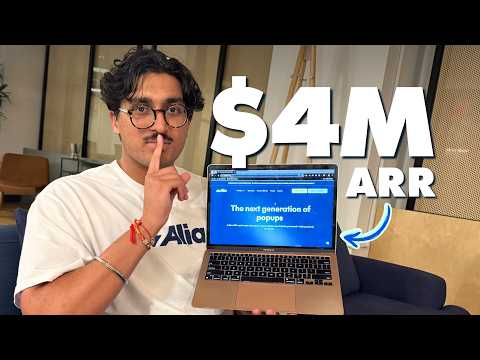
- $4M Stated ARR
- ~1,500 Brands using it
- 12 Team
- None Costs disclosed
The claim
That repositioning a struggling e-commerce SaaS as a single-purpose pop-up tool, after reading one book, took it from $0 in revenue to $4 million ARR in about a year.
- Annual recurring revenue — "Over 4 million ARR"
- Earlier ARR, from the founder's pinned X post shown on screen at 5:10 — "We're at $3.5M ARR with popups" (post date not visible)
- Time from repositioning to $4M ARR — "About a year"
- Early growth before repositioning — 2 to ~20 customers in ~6 months
- Brands using the product — ~1,500
- Implied average ARR per brand — ~$2,670 a year, ~$220 a month
- Team — 12 people, three of them co-founders
- Price, churn, costs, profit, close rate — Never stated
What is this income idea?
Stop describing your product the way you want to see it and start describing it the way your best customers already use it.
- The company, Alia, whose website is shown on screen, sells the email-capture pop-ups that appear on e-commerce sites — "enter your email to get 15% off". It started as something else. The founder built it in college for a campus club, and it was sold as a loyalty program and "an education tool".
- That early version had two customers, "one was my co-founder's cousin and the other was this girl from my class at university", and it took "about 6 months to get from two customers to about 20 customers". Prospects kept asking where it fit in their stack and what it replaced.
- A co-founder read the positioning book Obviously Awesome. The conclusion was uncomfortable: their best customers thought of them as a pop-up tool, not the education product the founder wanted them to be. So they became a pop-up tool and nothing else.
- The change was rolled out in four parts, and the founder is specific about each: website copy ("the next generation of pop-ups", product pages retitled "pop-up features"), content (a pinned X post, shown on screen at 5:10, reading "We're at $3.5M ARR with popups. That's all we do."), sales calls that open with "we do pop-ups", and internal language so support, sales and management describe the company the same way.
- They did not flip everything at once. They tried the new positioning on sales calls first, found calls "were shorter they were more succinct and they closed more often", then moved to content, then the website, then internal language.
- The result, as stated: about 1,500 brands using the product, including Nike Strength and a large footwear brand, a team of twelve, and "over 4 million ARR" roughly a year after the repositioning.
Find out what your best customers actually pay you for, rename yourself as exactly that, and test the new message on sales calls before rebuilding anything else.
- Two to ~20 customers — ~6 months, unclear pitch
- Read a positioning book — Co-founder's pick
- Ask how best customers see you — Answer: a pop-up tool
- Test on sales calls — Shorter, closed more
- Then content — Pinned post
- Then website and team — "Pop-up features"
- ~1,500 brands, $4M ARR — ~A year later
A clear positioning sequence — with no numbers on either side of the change except the end state.
Good positioning advice does not need a run rate dressed as a business
The lesson underneath the number
- The substance here is sound and unusually well explained. Most founders cannot say what their product is in a sentence, and this one admits they could not either — "the difficulty in me being able to describe to you what it was kind of shows the issue with positioning". The fix they describe is disciplined: ask what your best paying customers already use you for, accept the answer even when it is less ambitious than you hoped, and become that.
- The sequencing is the most transferable part. They did not rebrand overnight. They tried the new description on sales calls, where a bad message costs one conversation, and only moved it into content, the website and the team once calls improved. That is a cheap, reversible experiment most small SaaS founders could run this week. They also volunteer that the idea came from a book they have "no affiliation" with, and credit a co-founder with finding it.
- The figures do less work than the title asks of them. "$4M" is ARR, stated as such every time it is spoken, and the title turns it into "a $4M Business". ARR is a snapshot of monthly revenue times twelve; after a year of steep growth, the cash actually collected in that year is well below the run rate. Nothing is said about price, churn or the cost of the twelve people now on the team, so there is no way to tell from the video whether the business is profitable.
- And the causal story is told without a comparison. "Shorter", "more succinct" and "closed more often" are the only evidence that the repositioning, rather than product improvements, a maturing market, or the founders simply getting better at selling, drove the growth. It may well have — but a viewer is given the before as a feeling and the after as a number.
The difficulty in me being able to describe to you what it was kind of shows the issue with positioning.
The founder, on the product before the change
The repositioning, as they give it
Four changes, applied in order of risk.
The website and the pinned post are shown on screen. At 4:42 the Alia site has its Product menu open ("Popup Features: Smart Testing, Smart Triggering, Advanced Targeting") beside a Hostage Tape case-study card; at 5:10 an X post by Shaan Arora (@iamshaanarora) reads "We're at $3.5M ARR with popups. That's all we do." above a "Powering top brands on Shopify" logo grid. The post's date is not visible on screen.
- Ask what your best customers think you are — The core exercise from the book: not what you want to be, but what the customers who pay you use you for. "The hard truth is that they didn't think of us as that. They actually thought of us as a pop-up tool."
- Test the new position on sales calls first — The lowest-risk place to try a new message is a live call. They report calls got shorter and "closed more often". No close rate before or after is given.
- Rewrite content around the one thing — A pinned X post, shown on screen at 5:10: "We're at $3.5M ARR with popups. That's all we do." Anyone looking them up forms the same association. They link this to inbound demand.
- Rewrite the website — Tagline "the next generation of pop-ups", and the product menu relabelled "pop-up features" because that is "all that we do". Shown on screen.
- Align internal language — Support, sales and management use the same description, so that when people online ask "what's the best pop-up tool", the answer others give is the company's name.
- Iterate if the position does not land — Their framework: read the book, run its exercises with your co-founders, test on sales calls, and go back to step two if it does not improve.
The business model
Recurring subscriptions from e-commerce brands for an email- and offer-capture pop-up product.
Online stores — about 1,500 brands, from small shops to named large brands.
A single-purpose tool that does pop-ups better than broader marketing suites.
Founder-led sales calls, founder content, and word of mouth in online communities where people ask for tool recommendations.
- Team of twelve — Confirmed. Salaries never mentioned
- Engineering and infrastructure — Never mentioned
- Customer support and sales — Functions named. Never costed
- Content production — Central to the strategy. Never costed
- Churn — Never mentioned on a subscription product
No cost, price, margin or churn figure appears anywhere. The only financial number is ARR.
What you would actually need
Money
The strategy itself costs a book. The host describes the company as bootstrapped.
Repositioning is cheap. The business it repositioned is not: a working SaaS product with paying customers, and by the time of the interview a team of twelve. The founder never confirms or denies the host's "bootstrap" description, and no cost of any kind is given.
Present, never costed
- Salaries for a team of twelve
- Engineering and hosting for a product used by ~1,500 brands
- Customer support ("CS") and a sales function
- Content production for the inbound strategy
- Any platform or payment fees on subscriptions
- Churn — never mentioned
Time
"About a year" from repositioning to $4M ARR.
The year is after an existing product, built from a college project, had already been sold for a period long enough to reach two customers and then about twenty over six months. The full timeline from first build is never given.
Where the time actually went
- Built in college for a campus club
- Sold as a loyalty and education tool
- ~6 months from 2 to ~20 customers
- Repositioning tested call by call
- ~1 year to "over 4 million ARR"
- Twelve people working on it by the interview
The part you must pay attention to
"$4M" is annual recurring revenue — not revenue collected, not profit, not the value of the business.
The title says "How I Built a $4M Business". Every time a figure is spoken in the video, it is ARR.
- ARR, a forward run rate — $4M
- Brands using the product — ÷ ~1,500
- Never stated — − 12 salaries, churn, tooling
~$220/brand/month; profit unknown
Revenue per brand is plausible; margin is not addressed
ARR is the current monthly recurring revenue multiplied by twelve. A company that reaches a $4M run rate at the end of a steep year of growth has collected considerably less than $4M in that year, and will only collect $4M over the next one if no customers leave. The title converts that run rate into a "$4M Business", which reads as either annual income or a valuation, and neither is stated. The load-bearing assumption behind the lesson is different: that the repositioning caused the growth. The only evidence offered is qualitative — calls became "shorter", "more succinct" and "closed more often" — with no close rate, pipeline or revenue figure before the change to compare against.
The starting point is also inconsistent. The founder says twice that they went "from $0 in revenue" and that before the book they had "no revenue". The host's introduction, in the same video, says it took "about 6 months to get from two customers to about 20 customers", and asks what happened "when you kind of had those 20 customers before you made that change". Twenty customers of an e-commerce software product with no revenue between them is possible only if they were not paying, which is never said. The simplest reading is that "$0" is shorthand for "almost nothing", which is fair as a story and not accurate as a number.
- WHAT "$4M ARR" MEANS
- ARR = current MRR x 12
- $4,000,000 / 12 = ~$333k MRR
- -> a run rate at one moment,
- not a year's income
- PER BRAND (our arithmetic)
- $4,000,000 / 1,500 = ~$2,667/yr
- = ~$222/mo
- -> plausible for a pop-up tool,
- if all 1,500 pay
- THE STARTING POINT
- "$0 in revenue" x2
- "no revenue" x1
- customers before change ~20
- -> both cannot be literally true
- NOT GIVEN
- price, churn, close rate, 12 salaries
The economics
One revenue metric, stated clearly. Nothing on the other side.
- Current ARR — "Over 4 million"
- Earlier ARR, pinned X post on screen — $3.5M
- Implied current MRR — ~$333,000
- Brands using the product — ~1,500
- Implied ARR per brand — ~$2,667 (~$222/month)
- Customers before repositioning — ~20, after ~6 months
- Team — 12
- Price, churn, costs, profit, funding — Never stated
Revenue per brand
$4,000,000 ARR ÷ ~1,500 brands = ~$2,667 a year, or ~$222 a month
A plausible average for an e-commerce pop-up subscription, if all 1,500 brands are paying
IncomeIdeaLab calculation from the ARR and brand count stated by the founder
They say "brands using" the product, not paying customers. If some are on a free tier the paying average is higher. The ARR is also "over" $4M, so this is a floor.
- Pricing of any plan
- Monthly churn
- Salaries or total cost of the twelve-person team
- Profit or margin
- Close rate before and after repositioning
- Whether any outside funding was taken — the host says "bootstrap", the founder does not address it
- The pinned post at $3.5M ARR and the stated "over 4 million" are consistent with a business still growing at the time of recording. The post's date is not visible on screen, so the step from $3.5M to over $4M cannot be dated.
- The Alia website on screen at 4:42 carries a case-study card for Hostage Tape claiming +245% in welcome-flow revenue and a banner offering "Pay 20% less" to customers switching from other tools. These are the company's own marketing claims.
- "Zero to four million in just about a year" measures from the repositioning, not from founding. The product existed and had customers before that year began.
- The host twice promotes the channel's own paid programme, Starter Story Build, promising help going "from a simple idea to a real working app shipped to the real world in less than 2 weeks". It is clearly presented as their product. The founder's story is about repositioning an existing business, not about shipping in two weeks.
- Advice to "do one thing and do that one thing phenomenally" and to use speed against slower incumbents is general and reasonable; no figure is attached to either.
Evidence status
Every substantive claim in the video.
- "Over 4 million ARR" — Founder — Stated clearly as ARR. The title calls it a "$4M Business".
- $3.5M ARR at an earlier point — Founder's pinned X post, on screen at 5:10 — The founder's own post; undated on screen. Consistent with continued growth.
- "From $0 in revenue" — Founder — Conflicts with ~20 customers before the change, unless they were unpaid.
- 2 to ~20 customers in ~6 months — Host, confirmed in conversation — The slow pre-repositioning phase.
- ~1,500 brands using the product — Founder — Implies ~$222/month each if all pay. Plausible.
- Named large-brand customers — Founder; Alia website and post on screen — A "Powering top brands on Shopify" logo grid and a Hostage Tape case study (+245% welcome-flow revenue) are shown; both are the company's own marketing.
- Calls were shorter and closed more often — Founder — No close rate before or after.
- Repositioning caused the growth — Founder and host — Plausible; no comparison or counterfactual offered.
- Team of 12, three co-founders — Founder — The largest cost in the business, never quantified.
- Bootstrapped — Host — Asserted in a question; the founder does not respond to it.
- No affiliation with the book — Founder — Disclosed unprompted.
What is actually proven?
The method is clear. The money is one number.
- The repositioned website copy is shown on screen.
- The four repositioning steps and their order are described specifically.
- ARR of over $4M and about 1,500 brands.
- Average revenue per brand of roughly $222 a month.
- "$0 in revenue" cannot be literally true alongside ~20 earlier customers, unless none of them paid.
- Before-and-after close rates for the repositioning.
- Cost of the twelve-person team, churn and profit.
What the headline doesn’t tell you
A run rate, a team and a product that already existed.
- $4M is ARR. — Not revenue, profit or value.
- There is a team of 12. — Salaries never mentioned.
- "$0 in revenue". — Beside ~20 earlier customers.
- The year starts mid-story. — The product already existed.
- No close rates. — Only "closed more often".
- No price is given. — We derived ~$222/month.
- Churn is never raised. — On a subscription product.
- The ad is the host's own. — Starter Story Build, disclosed.
Should you try it?
Worth doing if you already have a product and a few customers
The positioning exercise is cheap and reversible. It is not a way to start a business, and $4M ARR is not what it will produce on its own.
- Clarity of the method — 8 — Four steps, applied in a sensible order.
- Cost to try — 9 — A book and some sales calls.
- Evidence the method caused the growth — 3 — No before-and-after figures.
- Accuracy of the title figure — 4 — ARR presented as "a $4M Business".
- Internal consistency — 5 — "$0 in revenue" versus ~20 earlier customers.
- Cost disclosure — 1 — Twelve people, no cost of any kind.
- Disclosure of interests — 7 — No book affiliation; host's product clearly labelled.
- Beginner accessibility — 5 — Requires an existing product with customers.
- If you already sell something and prospects keep asking what it is or what it replaces, this is one of the more useful fifteen minutes on the subject. The test is simple: look at the customers who pay you and stay, ask what they actually use you for, and try describing yourself as exactly that on your next few sales calls. If calls get shorter and close more often, move the new description into your content, then your website, then how your team talks.
- Measure it properly, which the video does not. Record your close rate and average call length for a few weeks before you change anything, then compare. The founder's evidence is that calls "closed more often"; yours should be a number, because that is how you will know whether to go back to step two.
- Do not take the headline as the outcome to expect. "$4M" is a run rate reached by a company that already had a product, had spent months finding its first twenty customers, and by the time of the interview employed twelve people. Nothing is said about what those twelve cost, what customers pay, how many leave, or whether any of the $4M is profit.
- And note what the channel is selling. The host's own programme promises a working app "in less than 2 weeks". The story you have just watched is the opposite lesson: the product existed, and the breakthrough was a year of disciplined re-description, not speed of building.
Passive or automated?
Automation
Software delivers the product; sales, support and content are people.
Passive potential
Recurring revenue, run by a team of twelve.
A subscription pop-up tool bills automatically and runs on thousands of sites without anyone touching each one, which is why SaaS scores higher here than service businesses. But the growth described came from people: the CEO opening every sales call with "we do pop-ups", founder-written content, a support team and a sales team all trained to use the same language. The company has twelve employees. Recurring revenue is durable only while churn is low, and churn is never mentioned.
- Founder-led sales calls
- Content that keeps the positioning visible
- Customer support for ~1,500 brands
- Product development against larger incumbents
- Hiring and managing a team of twelve
Recommended beginner experiment
Test the positioning, and keep score.
- List your best five customers. — The ones who pay and stay.
- Ask what they use you for. — Their words, not yours.
- Record current close rate. — The baseline the video skips.
- Open ten calls with the new line. — One sentence, one category.
- Compare close rate and call length. — Numbers, not impressions.
- Only then change content. — Their order of risk.
- Then the website and team language. — Last, once proven.
- Track MRR and churn, not ARR. — Cash, and who leaves.
Our verdict: 6/10
Sound positioning advice under a headline figure that is annual recurring revenue ARR sold as a "$4M Business", with no costs and no before-and-after numbers
Credited for a clear, specific account of how a repositioning was done — website copy, content, sales calls and internal language — and in what order; for testing on sales calls first, which is cheap and reversible; for stating the metric correctly as ARR every time it is spoken; for disclosing a team of twelve and three co-founders; and for volunteering no affiliation with the book recommended. Marked down because the title presents annual recurring revenue as "a $4M Business"; because "from $0 in revenue" conflicts with the roughly twenty customers the video says existed before the change; because the causal claim rests on calls that "closed more often" with no figures; because no price, churn, payroll or profit is given for a twelve-person company; and because the host's description of the business as bootstrapped is never confirmed.
As a lesson in positioning, this holds up. The founder is honest that the original product was hard to describe, that prospects kept asking where it fit, and that their best customers saw it as something less grand than they wanted — a pop-up tool. Becoming exactly that, and testing the new description on sales calls before touching the website, is disciplined and cheap, and anyone with an existing product and a handful of customers can try it. They credit a book they have no stake in and a co-founder who found it. The numbers are a different matter. The title's "$4M Business" is annual recurring revenue, a run rate reached at the end of a year of growth, not income collected, profit or a valuation — and the founder always says ARR. "From $0 in revenue" cannot sit literally beside the twenty customers the same video describes before the change. The growth is attributed to repositioning on the strength of calls that felt shorter and closed more often, without a single before-and-after figure. And the twelve people now running the company are never costed, nor is price, churn or margin. At roughly $222 a month per brand, the revenue is plausible. Whether it is a good business is not something this video tells you.
- Stated ARR — Over $4M
- Brands using it — ~1,500
- Implied per brand — ~$222/month
- Customers before the change — ~20
- Team — 12
- Costs and profit — Never stated
- Close-rate evidence — Qualitative only
- Beginner suitability — Existing products only
Sources
- How I Built a $4M Business (Simple Strategy) — Starter Story — Source video, 2025-08-27
- FTC — Guides Concerning the Use of Endorsements and Testimonials — Regulatory guidance on earnings claims