E-commerce / Dropshipping · Claim Review
“$1.7 million with a.i. dropshipping. f*ck it, just copy my store.”
What we found: AI Dropshipping Store at $1.7M: The Figure Is Gross Sales, With No Period, Ad Spend or Profit Stated
A clear, free walkthrough of a Shopify store builder offered through a stated Shopify partnership. The video says the creator's store has done "almost" $1.7 million in sales; what it cost to get there is not stated in the video.
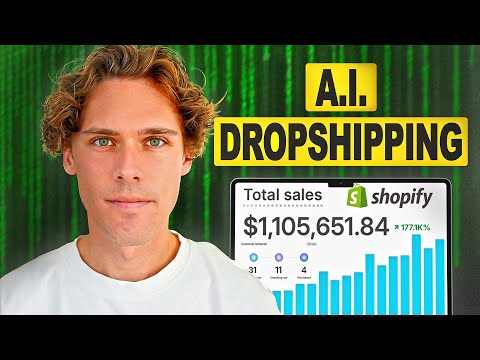
- ~$1.6–1.7M Store sales
- 3.04% Conversion rate
- ~$17 Average order
- Not stated Ad spend and profit
The claim
That a store built by a free AI store builder has done about $1.7 million in sales, and that a viewer can copy it and be ready to sell the same day.
- Sales on the creator's store — "1.6, almost 1.7 million in sales"
- Shopify analytics on screen at 0:05 — Total sales over time reads $1,602,354.84 in an animated count-up; a card above it reads $1,866,968.31 (label cut off); no date range is visible
- Time period for those sales — Not stated in the video
- Conversion rate — 3.04%, "constantly increasing"
- Orders — A Shopify plaque for 100,000 orders
- Average order, if both figures are the same store — ~$16.50–$17.00
- Revenue attributed to the email and SMS app — $67,000 in the last 30 days
- Experience — Full-time for over 7 years
- Ad spend, product cost, profit — Not stated in the video
What is this income idea?
Use a free AI store builder to set up a Shopify dropshipping store with products and a supplier already linked, copy the creator's product-page layout, and start selling.
- The video opens on the creator's own store: "this free AI built this store and it's already done 1.6 almost 1.7 million in sales." It is being turned "into an exitable company", and the creator says they have been doing this full-time for over seven years.
- The builder is described as "a free software within a partnership between me and Shopify", and the creator says Shopify "partnered with me to teach you guys." The link is in the description. That relationship is stated plainly at the start.
- The walkthrough is genuinely step by step: pick a niche, a colour and a banner; create a Shopify account on a 3-day free trial followed by 90 days at $1 a month; choose the Basic plan; link the store; install a supplier app that imports products already linked to fulfilment; remove the storefront password.
- The supplier app is free for up to ten products and costs up to $79 a month for 500 or more, and the creator says it now ships from a private warehouse in two to four days.
- The second half rebuilds the new store's product page to match the creator's best-converting one: title, price, urgency text, variant picker, buy buttons, a cross-sell block, collapsible rows for description, sizing and returns, a sticky cart, an Instagram feed and reviews. A short list of apps follows: an email and SMS pop-up app credited with $67,000 in the last 30 days, upsell and cart apps, a post-purchase offer, Okendo for reviews and Omnisend recommended for email.
- The video ends at the point a store is live. Ad strategy, creatives and scaling are left to "all the other videos on my channel", and a Discord with "live daily coaching calls every single day" is linked; whether it is paid is not stated in the video.
A free builder sets up the store and the products; the part that produced $1.7 million in sales, getting buyers to the store, is in other videos.
- Pick a niche — Changeable later
- Builder makes the store — Theme and products
- Shopify trial — 3 days, then $1/month
- Link supplier app — Free up to 10 products
- Copy the page layout — From the creator's store
- Add apps — Email, upsells, reviews
- Get traffic — Not covered here
Every step up to launch is specific. The step that drives sales is the one the video does not cover.
A good setup guide under a figure it does not explain
The lesson underneath the number
- As a setup guide this is useful and honest about its own mechanics. The creator states the Shopify partnership at the start, explains which plan to pick and why, says the supplier app's $79 figure is a ceiling rather than a charge, and walks through product-page blocks in enough detail to copy. The partner pricing checks out: $1 against a $39 Basic plan is the 97 per cent saving the video quotes.
- The headline number is a different kind of claim. "Almost 1.7 million in sales" is gross revenue with no time period attached. For a dropshipping store, gross sales are the least informative figure available, because the product cost, shipping and advertising behind every order come out of that number before anything is earned. None of those is given.
- The two figures the video does give point to small orders. If the 100,000-order plaque is the same store, the average order is about $17. A $17 order has to pay for the product, the shipping, card processing and the ad click that produced it. That can work at scale with tight buying and good creative, and the creator has been doing this full-time for seven years, but it is the part of the business the video leaves to other videos.
- So the title's "just copy my store" is accurate in a narrow sense. A viewer can copy the theme and the layout by the end of the video. What they cannot copy from this video is the traffic, the product selection and the seven years of practice that made the layout convert.
If you've got this completed and set up and you're ready to fully dive in with all the ad strategy, all of the ad creatives… make sure to check out all the other videos on my channel.
Austin Rabin, on where the traffic side is covered
The setup, as the video gives it
Clear enough to follow with the video open in another tab.
Setup costs are given for Shopify and the supplier app; no figure is given for advertising, product cost or apps beyond those.
- Choose a niche, colour and banner — The builder uses the niche to load starter products and homepage images. The creator stresses that all of it can be changed later, which is accurate for a Shopify theme.
- Open a Shopify account on the partner offer — A 3-day free trial, then "90 days for USD 1 per month", against a full Basic price of $39 a month. A new email is needed, because the offer is for accounts new to Shopify.
- Link the store and install the supplier app — The supplier app imports products already linked to fulfilment. It is free for 0 to 10 products, and the creator says "you're not going to get charged the USD 79" unless you list 500 or more.
- Remove the storefront password — A small step beginners do miss, and the video explains what the password does and does not protect.
- Rebuild the product page — Match the creator's converting layout block by block: title, price, urgency text, multi-buy offer, variant picker, buy buttons, cross-sells, collapsible rows, sticky cart, Instagram feed and reviews.
- Add conversion apps — An email and SMS pop-up app, an upsell app, a cart drawer, a post-purchase offer, Okendo for reviews and Omnisend for email. The creator says the first is optional at the start.
- Turn on daily automatic fulfilment — One checkbox in the supplier app fulfils orders and sends tracking to the customer. Payments must be set up in Shopify settings before any money arrives.
The business model
Retail margin on products sold through a Shopify store and fulfilled by a dropshipping supplier.
Online shoppers reached mainly through paid ads; the creator's own store sells clothing, including polos.
A professional-looking store with multi-buy offers, cross-sells, reviews and fast shipping from a private warehouse.
Not covered in this video. Ad strategy and creatives are referred to the creator's other videos.
- Shopify plan — $1 a month for 90 days on the partner offer, then $39 for Basic
- Supplier app — Free to 10 products, up to $79 a month at 500+
- Product and shipping cost — Paid per order. Not stated
- Advertising — Not stated in the video
- Apps — Email, upsells, cart drawer, post-purchase, reviews. Not priced
- Card processing — Mentioned only as a reason to stay on Basic
Setup costs are given precisely; the costs that decide profit on each order are not given at all.
What you would actually need
Money
Very little to start: about $4 for the first three months of Shopify on the partner offer, and a free supplier plan for up to ten products.
The launch costs are stated accurately and are genuinely low. The running costs of a store that sells are a different matter: advertising, the product and shipping cost of every order, card processing and the paid apps. None of those is priced in the video, and they are what decide whether $1.7 million in sales left anything over.
Costs the video names or implies but does not price
- Paid advertising, which the creator's other videos cover
- Product and shipping cost on every order, paid to the supplier
- Shopify at $39 a month after the offer, plus card processing
- Supplier app up to $79 a month at 500+ products
- Email, upsell, cart, post-purchase and review apps
- Refunds and returns
- Tax on any profit
Time
"It's not going to take very long at all", and by the end of the video "you're going to be ready to start selling today."
The build does look like an afternoon's work. Being able to sell is not the same as selling: the creator's own result rests on seven years of full-time work and a traffic operation the video does not describe.
Where the time goes
- Store build and page layout: hours
- Choosing and testing products
- Making ad creatives and running campaigns
- Customer service, returns and supplier issues
- The creator's own background: over 7 years full-time
The part you must pay attention to
$1.7 million in sales says nothing about what was kept.
The headline figure is stated as "sales", with no time period, and the video gives no figure for advertising, product cost or profit.
- Sales, period not stated — ~$1.7M
- Not stated — − ad spend
- Not stated — − product and shipping
- Not stated — − fees and apps
Unknown
Profit cannot be worked out from the video
The title invites the viewer to copy the store. What the video teaches a viewer to copy is the theme, the product-page layout and a list of apps. What produced the sales is buyers arriving at the store, and the video sends viewers elsewhere for "all the ad strategy, all of the ad creatives". The whole claim rests on the assumption that a layout which converts at 3.04% for the creator will convert similarly for a new store with new products and new traffic, and on the viewer then finding that traffic at a cost below their margin.
Two stated figures can be put together. A Shopify plaque for 100,000 orders appears beside the claim, described as "a live order account going for this exact store". If both refer to the same store, $1.65 to $1.7 million across 100,000 orders is an average of about $16.50 to $17.00 per order. At that order size, each sale has to cover the product, shipping, card fees and the advertising that brought the buyer, which is a narrow margin to work with. The video does not state an average order value, so this is our arithmetic on the two figures it gives.
- AVERAGE ORDER (OUR ARITHMETIC)
- Sales stated $1.6M-$1.7M
- Orders on plaque 100,000
- $1,650,000 / 100,000 = $16.50
- $1,700,000 / 100,000 = $17.00
- VISITORS BEHIND 100,000 ORDERS
- Conversion rate 3.04%
- 100,000 / 0.0304 = ~3.3M visits
- Cost of those visits not stated
- THE PARTNER OFFER
- $1 x 3 months = $3
- Video says "USD 4"
- $1 vs $39 Basic = 97.4% off
- -> "97% off" checks out
The economics
Precise on setup costs, silent on running costs.
- Store sales — 1.6, almost 1.7 million
- Period covered — Not stated in the video
- Orders (Shopify plaque) — 100,000
- Average order, if same store — ~$16.50–$17.00
- Conversion rate — 3.04%
- Revenue credited to email/SMS app — $67,000 in 30 days
- Shopify on partner offer — $1/month for 90 days, then $39
- Supplier app — Free to 10 products, up to $79/month
- Ad spend, product cost, profit — Not stated in the video
Average order value from the stated figures
$1,650,000 to $1,700,000 ÷ 100,000 orders
About $16.50 to $17.00 per order
IncomeIdeaLab calculation from the sales figure and the order plaque named in the video
This assumes the plaque counts the orders behind the same sales figure. The video links the plaque to "this exact store" but does not state an average order value or a time period, so the result is an estimate.
- The period over which the sales were made
- Total advertising spend
- Product and shipping cost per order
- Gross margin and net profit
- Refund and return rate
- Monthly revenue, which would show what share the $67,000 from the email app represents
- Any valuation for the "exitable company"
- The video says three months on the partner offer plus the trial costs "USD 4". At $1 a month for three months our arithmetic gives $3; the difference is small and may reflect billing timing, which the video does not explain.
- At a 3.04% conversion rate, 100,000 orders would need roughly 3.3 million store visits (our arithmetic). What those visits cost is the figure that decides profitability, and it is not stated.
- The $67,000 credited to the email and SMS app in 30 days is a meaningful number, but without the store's total monthly revenue it is not possible to say whether it is a large or small share.
- Card processing is mentioned only as the reason to upgrade plans later; no rate is given.
Evidence status
Every substantive claim in the video.
- The store has done almost $1.7 million in sales — Creator; Shopify analytics on screen at 0:05 — A Shopify Total sales over time figure of $1,602,354.84 is on screen in an animated count-up, with a card above it reading $1,866,968.31. The date range is not visible, and no cost or profit figure is attached. A screenshot can be edited, so the site has seen it, not confirmed it.
- A free AI built this store — Creator — Stated at the start. The second half of the video copies the creator's layout onto the new store by hand.
- 3.04% conversion rate, constantly increasing — Creator — A solid rate for e-commerce. Traffic source and period not stated.
- Shopify plaque for 100,000 orders for this store — Creator — Together with the sales figure, implies an average order near $17 (our arithmetic).
- Builder offered in partnership with Shopify — Creator — Stated plainly at the start, with the link in the description.
- 90 days of Shopify for $1 a month, "97% off" — Creator — $1 against $39 is 97.4% off. Checks out.
- $4 covers 3 months and 4 days — Creator — Three months at $1 is $3 by our arithmetic. Small difference, not explained.
- Supplier app free to 10 products, maximum $79 — Creator — Clearly explained as a ceiling tied to product count.
- Email and SMS app credited with $67,000 in 30 days — Creator — Total monthly revenue not stated, so its share is unknown.
- Ready to start selling today — Creator — The store can be live today. Traffic, which produces sales, is not covered.
- Ad spend, product cost, profit — Nobody — Not stated anywhere in the video.
What is actually proven?
The setup steps are concrete. The result they are attached to cannot be checked from the video.
- The store builder, Shopify offer and supplier-app pricing are described step by step.
- The Shopify partnership is stated at the start.
- The "97% off" figure for the partner offer checks out against $39 Basic.
- If the order plaque is the same store, the average order is about $17.
- The creator states almost $1.7 million in sales and a 3.04% conversion rate; we could not check either.
- The period, ad spend, product cost and profit behind the sales figure.
- How the store attracts its traffic, which is left to other videos.
What the headline doesn’t tell you
Sales are the top line of a dropshipping store. Everything that matters sits below it.
- $1.7M is sales. — Not profit.
- No time period. — Months or years is not stated.
- About $17 an order. — If the plaque is the same store.
- Traffic is elsewhere. — Ads are in other videos.
- Shopify partnership. — Stated at the start.
- Cheap to launch. — $1 a month for 90 days.
- Not cheap to run. — Ads and apps are not priced.
- Seven years full-time. — Behind the layout being copied.
Should you try it?
Build the store, but price the traffic first
The setup is cheap and well explained. Before spending on ads, work out what an order is worth to you after product, shipping and fees.
- Clarity of the setup steps — 9 — Every screen of the builder and Shopify signup is walked through.
- Disclosure of the partnership — 8 — The Shopify partnership is stated at the start.
- Accuracy of stated setup costs — 8 — Partner pricing and supplier tiers are given and check out.
- Evidence for the headline figure — 3 — Stated as sales with no period; we could not check it from the video.
- Cost disclosure for a running store — 1 — No figure is given for ads, product cost or apps.
- Coverage of how sales happen — 2 — Traffic and creatives are referred to other videos.
- Beginner accessibility — 7 — Anyone can build the store in an afternoon.
- If you want a Shopify store set up quickly and cheaply, this video does that job well. The partner offer keeps Shopify at $1 a month for 90 days, the supplier app is free for your first ten products, and the product-page layout is laid out block by block. You can follow it with no experience.
- What it does not give you is the business. A live store with products in it has no buyers until you send them, and the video says that part is covered elsewhere. The creator's own figures suggest small orders, around $17 each if the order plaque is the same store, so every sale has to pay for the product, shipping, card fees and the ad that found the customer.
- Before spending on advertising, take one product, write down its supplier cost and shipping, subtract card fees, and see what is left from a typical order. That number is the most you can pay to acquire a customer and still break even. The video does not give it for the creator's store, so you will need to work it out for your own.
- Treat the $1.7 million as the creator's statement about a store run full-time by someone with seven years' practice. It does not tell you what that store earned, and it does not tell you what a new store built from the same theme will do.
Passive or automated?
Automation
Fulfilment and tracking run automatically once the supplier app is set up.
Passive potential
Sales depend on continuous paid traffic and creative testing.
The automation in this model is real but narrow. Once the supplier app is linked and daily fulfilment is switched on, orders are sent to the supplier and tracking goes to the customer without the store owner touching them. Everything that causes an order to exist is still work: choosing products, making ad creatives, running and adjusting campaigns, answering customers and handling returns. The creator runs the store full-time and is preparing it for sale, and the video describes daily coaching calls for students. None of that describes a passive income.
- Choosing and testing products
- Making ad creatives and running campaigns
- Customer service and returns
- Monitoring supplier stock and shipping times
- Adjusting the store as conversion data comes in
Recommended beginner experiment
Use the cheap launch window to test the economics, not just the theme.
- Build the store on the 90-day offer. — $1 a month keeps the test cheap.
- Stay at ten products or fewer. — The supplier app is free at that level.
- Price one order end to end. — Product, shipping, card fees.
- Set a break-even cost per sale. — What is left from one order.
- Test a small, capped ad budget. — Stop when cost per sale passes break-even.
- Track refunds from day one. — Not discussed in the video.
- Add paid apps only when selling. — The creator says email can wait.
- Decide before day 90. — Shopify rises to $39 a month after.
Our verdict: 5/10
A clear store setup guide under a sales figure with no costs attached and the traffic that produced the sales is left to other videos
Credited for stating the Shopify partnership at the start; for a setup walkthrough clear enough for a complete beginner; for specific, accurate launch pricing, including a "97% off" figure that checks out and a supplier-app ceiling explained as a ceiling; and for naming the apps used. Marked down because the headline "almost 1.7 million" is gross sales with no time period, cost or profit; because the two stated figures together imply an average order near $17, a thin base for paid acquisition that the video does not discuss; because ad spend, product cost and card fees are not stated; and because the traffic strategy that produced the sales is referred to other videos, so "ready to start selling today" describes a live store rather than one with buyers.
This is a good guide to getting a Shopify dropshipping store live. The creator states the Shopify partnership up front, explains the 90-day $1 offer and why the Basic plan is enough, makes clear that the supplier app's $79 is a maximum tied to product count, and walks through a converting product page block by block. A beginner could follow it in an afternoon and spend only a few dollars doing so. The figure that sells the video is a different matter. "1.6, almost 1.7 million in sales" is gross revenue with no period attached, and the video gives no figure for advertising, product cost, shipping, card fees or profit. The two figures it does give, the sales total and a 100,000-order plaque linked to the same store, imply an average order of about $17, which leaves little room once the product, shipping and the ad click are paid for. That may well work for an operator with seven years' full-time experience, but the traffic and creative work that would show how is referred to other videos. A viewer can copy the theme by the end; the economics of the store remain the creator's statement.
- Store sales — ~$1.6–1.7M, period not stated
- Conversion rate — 3.04%
- Average order, if same store — ~$17
- Launch cost — ~$3–4 for 3 months of Shopify
- Supplier app — Free to 10 products
- Ad spend and profit — Not stated in the video
- Partnership disclosed — Yes, Shopify
- Beginner suitability — Setup yes, economics untested
Sources
- USD 1.7 million with a.i. dropshipping. f*ck it, just copy my store. — Austin Rabin — YouTube video, 2025-10-28
- FTC — Guides Concerning the Use of Endorsements and Testimonials — Regulatory guidance on endorsements and earnings claims