Print-on-Demand Books / AI Marketing · Claim Review
“I Tried to Market My AI Coloring Book. Here's What Happened.”
What we found: An AI Coloring Book Sold Zero Copies in Its First Month; the AI-Made Marketing Has No Sales Result Yet
The creator states the zero plainly and prices the book at $7.99. The video ends with one Pinterest pin posted and a Short planned, so whether the marketing sells a copy is not stated.
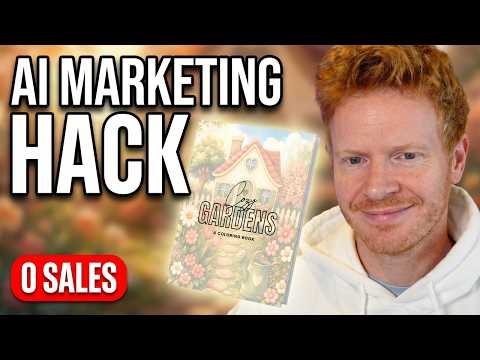
- 0 Copies sold
- $7.99 List price
- $0 Cost to publish
- Not stated Sales after the marketing
The claim
That a coloring book listed on Amazon with no marketing sells nothing, and that an AI design agent can produce the marketing for it from a cover and one sentence, in minutes rather than an afternoon.
- Time on sale — About a month
- Copies sold — Zero (KDP Orders Processed shows 0 units, Oct 6 to Nov 4, 2026, on screen at 0:24)
- Marketing done before this video — None
- List price — $7.99
- Upfront cost to publish — "A grand total of $0"
- Contents — 24 drawings on a cottage-garden theme
- Marketing produced — Two Pinterest pin designs, one short promo video, titles, descriptions and on-screen text
- Time to produce it with the agent — "The two minutes that it took me", against "an afternoon at least" by hand
- Royalty per copy, tool subscription cost — Not stated
- Sales after posting the pin and Short — Not stated
What is this income idea?
Make a coloring book with AI design tools, publish it as a print-on-demand paperback on Amazon, then use an AI agent to make the marketing that gets it seen.
- This is the second video in a series. In the first, the creator made a 24-page cottage-garden coloring book and its cover in a design tool, and had their AI coding agent, Claude Code, put the listing up on Amazon's Kindle Direct Publishing. It sells for $7.99.
- They open with the result so far: "it's been up for sale for about a month now, I have not done any marketing yet… so far it's sold zero." Their explanation is the point of the video: "that's what happens when you put a book on Amazon and don't tell anyone that it exists."
- They also name the competitive problem. Other coloring books with the same title already exist, one long-established title in the niche has a large number of reviews, and they could not find their own book in the results without searching their own name. They say they "probably should have picked a better niche" and "done some research beforehand".
- The plan is to put the book in front of buyers where they already look: Pinterest, which they describe as a search engine for pictures, and a short flip-through video, timed for Christmas and Black Friday gift shopping.
- They give an AI design agent the cover and one sentence asking for Pinterest and YouTube Shorts marketing. They post the pin to a new Pinterest board, marks it as AI-modified, and says the Short will follow.
- The video ends there: "book's been live for a month, no sales… we'll see if that brings anything in." Paid ads are offered as a possible next video.
A book nobody is told about does not sell. This video makes the marketing; whether it works is left for a later video.
- Book live on Amazon — $7.99, $0 upfront
- One month, no marketing — Zero sales
- Cover to AI agent — One sentence
- Agent asks questions — Then plans
- Pins, Short, copy — "Two minutes"
- Post the pin — Marked AI-modified
- Wait for sales — Result not stated
A clear account of the starting point, with the outcome still to come.
Zero is the most useful number in the video
The lesson underneath the number
- Most videos about AI coloring books open with a large monthly figure, often for someone else's book. This one opens with the creator's own book and its real result: a month on sale, no marketing, no copies sold. That is the typical outcome for a new title in a crowded category, and stating it on camera is more useful to a beginner than any estimate. They draw the right conclusion themselves: "if you build it they will come" is not how this works.
- They also volunteer the mistakes that made the zero more likely. The title duplicates existing books. A long-established competitor dominates the niche. They could not find their own listing without searching their name. And they say they should have researched the niche first. Each is a lesson a reader can apply before publishing, and each is offered without being asked for.
- The AI agent part of the video is a demonstration of speed. A cover and one sentence become two pins, a short video and their copy, and the agent asks sensible questions about audience and format before it starts. For a side project, that cuts real friction out of the step most people skip. The point they make about briefing it like an employee, rather than writing a long prompt, is practical.
- What the video cannot yet show is whether any of it works. The pin is posted at the end and the Short is still to come. A faster way to make marketing is valuable only if the marketing reaches buyers, and in a niche where the book is hard to find even by title, that is the open question. It is honest of them to leave it open rather than imply an answer.
It's been up for sale for about a month now, I have not done any marketing yet… so far it's sold zero.
The creator, on their own book
The process, as they give it
From an unsold book to posted marketing in one session.
No sales, royalty or tool-cost figure is given for any step after the book went live.
- Publish the book at no upfront cost — The book is a print-on-demand paperback: Amazon prints and ships each copy when it sells and keeps "a big chunk" of the price. They compare this with having to print a thousand copies in advance. The upfront cost is stated as $0.
- Accept that listing is not marketing — "Being live and being found are two totally different things." After a month with no marketing, the book has sold nothing and does not appear in a search for its own title.
- Pick channels where buyers already look — Pinterest, for people searching for coloring pages and gift ideas, and a short flip-through video, timed for the Christmas and Black Friday gift season.
- Brief the AI agent like an employee — Give it the cover and one plain sentence of context rather than a long prompt. They argue that over-specifying gives worse results, and lets the agent choose sizes, audience and creative direction.
- Review and edit the output — Two pins and one Short. They prefer the first pin, reconsiders showing the price on it, and has the agent add a line of text to an existing pin rather than regenerate it.
- Post and label it — The pin goes to a new Pinterest board, linked to the Amazon listing, tagged for coloring and gift searches, and marked as AI-modified. The Short is to follow on their channel.
The business model
Royalties on a $7.99 print-on-demand coloring book sold through Amazon.
Gift shoppers in the Christmas and Black Friday season, and people searching Pinterest for coloring pages.
A cosy, gentle 24-page cottage-garden coloring book at a low gift price.
Amazon listing, plus Pinterest pins and a YouTube Short linking to it; paid ads raised as a possible next step.
- Publishing — Stated as $0 upfront
- Amazon's share and printing — Described as "a big chunk"; not quantified
- AI design tool and agent — Used for the book and the marketing; cost not stated
- AI coding agent — Used to upload the listing; cost not stated
- Ads — Not yet run
The upfront print cost is genuinely zero. The running costs of the tools and the per-copy royalty are not given.
What you would actually need
Money
Publishing cost "a grand total of $0". No other cost is mentioned.
Publishing on print on demand does avoid an upfront print run, which is a real advantage. But the book was made in a paid-for category of tools: an AI design tool with a creative agent, and an AI coding agent to upload the listing. No subscription cost is given for either. Amazon also takes its share and the printing cost out of each $7.99 sale; the royalty per copy is not stated.
Costs the video does not price
- The design tool and its AI agent, used for the book and the marketing
- The AI coding agent used to publish the listing
- Amazon's share and printing cost on each copy
- Paid ads, raised as a possible next step
- The creator's time across both videos
Time
The marketing took "the two minutes that it took me", against "an afternoon at least" by hand.
Two minutes describes the generation time. The video also shows answering the agent's questions, reviewing two pin options, requesting an edit, downloading, writing tags, creating a Pinterest board and posting. That is still quick, but it is more than two minutes, and it has to be repeated for each new pin and video.
Where the time goes
- Making the book and cover (the earlier video)
- Briefing and answering the agent
- Reviewing and editing the output
- Posting to Pinterest and YouTube
- Repeating pins and Shorts over the season
- Hours in total: not stated
The part you must pay attention to
The video shows how to make the marketing, not whether it sells the book.
The title promises "here's what happened". What happened, in sales terms, is the starting point: zero copies in a month. The video ends as the first pin is posted.
- Copies sold in month one — 0
- Marketing produced — 1 pin + 1 Short
- Copies sold afterwards — ?
Not stated
Sales result of the AI-made marketing
The load-bearing assumption is that faster marketing production leads to sales. The agent saves time making assets, and the creator is clear about that. But a pin or a Short only sells a book if people see it, click it and buy, and the book is competing with established titles in the niche, including some with the same name. No view, click or sale figure for the posted pin is given.
This is a fair account of a work in progress, and the creator says so: "we'll see if that brings anything in." Readers should treat it as a demonstration of the tool, not as evidence that AI-made marketing moves books. The per-copy economics are also open. At $7.99, Amazon's share and the printing cost come out before any royalty, and the video does not give the figure that remains, so it is not possible to say how many copies would cover the tools used.
- WHAT IS STATED
- Months on sale ~1
- Marketing before video none
- Copies sold 0
- List price $7.99
- Upfront publishing cost $0
- WHAT THE VIDEO PRODUCES
- Pinterest pins (designs) 2
- Pins posted 1
- Short videos 1
- Stated time "2 min"
- WHAT IS NOT STATED
- Royalty per copy ???
- Tool subscriptions ???
- Views, clicks, sales
- after posting ???
The economics
A clear starting point, and no per-copy figures.
- List price — $7.99
- Upfront publishing cost — $0
- Copies sold in first month — 0
- Revenue so far — $0
- Amazon's share and printing — "A big chunk", not quantified
- Royalty per copy — Not stated
- Design tool and coding agent costs — Not stated
- Sales after the marketing — Not stated
Revenue to date
0 copies × $7.99
$0 in sales after about a month, before any tool costs
IncomeIdeaLab calculation from the figures stated in the video
The video is part of a series and the marketing was posted at its end, so later sales may differ. The royalty per copy is not given, so the number of sales needed to cover the tools used cannot be worked out from the video.
- Royalty per copy after Amazon's share and printing
- Subscription cost of the design tool and its agent
- Cost of the AI coding agent used to publish
- Views, clicks or sales from the posted pin
- Total hours spent across the series
- The zero is the creator's own statement about their own book, which is a stronger kind of figure than the tool estimates for other sellers' books common in this category.
- Print on demand does remove the inventory risk they describe, a thousand printed copies in a garage. The trade-off is that Amazon's share and the print cost come out of every sale, and at a $7.99 price that leaves a small royalty per copy. The figure is not given.
- "Two minutes" is the stated time to make the marketing with the agent. The video also includes briefing, review, an edit, downloading and posting, so the full task is longer, though still short.
- They mention a separate launch they are working on and says they will link it. No sponsorship of the design tool is mentioned in the video.
Evidence status
Every substantive claim in the video.
- On sale about a month, zero sold — Creator — The KDP Orders report on screen at 0:24 shows Units Processed 0 for 1 selected book, Oct 6 to Nov 4, 2026.
- No marketing done before this video — Creator — Consistent with the zero.
- Priced at $7.99 — Creator — Stated twice.
- Cost "a grand total of $0" to publish — Creator — True of upfront printing; tool costs are not mentioned.
- Amazon takes "a big chunk" of the profit — Creator — Acknowledged, not quantified.
- Hard to find in search, same-name competitors — Creator — Volunteered, with the lesson attached.
- Marketing made in "two minutes" — Creator — Generation time; posting and review take longer.
- By hand it would take "an afternoon at least" — Creator — Their estimate. Plausible for two pins, a video and copy.
- Pinterest pin posted and marked AI-modified — Creator — Done during the video.
- Sales from the marketing — Nobody — Not stated. The video ends at posting.
What is actually proven?
The starting point and the workflow. Not the outcome.
- A $7.99 coloring book sold zero copies in about a month without marketing.
- The AI agent produced pins, a short video and copy from a cover and one sentence.
- A pin was posted to Pinterest and linked to the listing.
- Revenue to date is $0.
- Royalty per copy and the cost of the tools used.
- Whether the marketing sells any copies.
What the headline doesn't tell you
The title promises an outcome the video leaves for later.
- Zero sales so far. — Stated by the creator.
- No result for the marketing. — The video ends at posting.
- $0 to publish. — Not $0 in tools.
- Royalty not stated. — Amazon's share is "a big chunk".
- Crowded niche. — Same-name books already exist.
- "Two minutes" is generation. — Posting and review add more.
- Part of a series. — Ads are a possible next video.
- No sponsor mentioned. — For the design tool.
Should you try it?
A realistic starting point, with the hard part still to come
Take the lesson about marketing and niche research. Do not take the AI agent as evidence that the marketing will sell the book.
- Honesty about the result — 9 — Zero sales stated on camera for their own book.
- Disclosure of mistakes — 8 — Same-name title, crowded niche, no prior research.
- Specificity of workflow — 7 — Brief, questions, output and posting all walked through.
- Evidence the marketing works — 0 — No view, click or sale figure after posting.
- Cost disclosure — 3 — $0 upfront stated; tools and royalty not priced.
- Title against content — 4 — "Here's what happened" covers the set-up, not the sales outcome.
- Beginner accessibility — 7 — Low upfront cost, though it relies on paid tools.
- If you are thinking about AI coloring books, this is a more useful video than most, because it starts from a real result for the creator's own book and that result is zero. A month on Amazon with no marketing sold nothing. That is what most new titles in a crowded category do, and it is the right expectation to start from.
- The mistakes they list are the ones to avoid before you publish. Check whether your title is already taken. Look at how many reviews the leading books in the niche have. Search for your own listing after it goes live. They say they should have researched the niche first, and that advice costs nothing to follow.
- The AI agent is a genuine time-saver for making pins and short videos, and their advice to brief it plainly and let it choose formats is sensible. But making marketing and selling books are different steps. The video does not get to the second one, so you would be testing that yourself.
- Before you start, work out the royalty you would actually receive on a book at your price after Amazon's share and the print cost, and add up what you pay for the tools. The video does not give either figure, and at a $7.99 price the number of copies needed to cover a monthly tool subscription matters.
Passive or automated?
Automation
Printing and shipping are automatic; AI speeds up making the marketing.
Passive potential
A listing alone sold nothing; sales here depend on ongoing promotion.
Print on demand is the automated part: Amazon prints and ships each copy, and there is no stock to hold. The creator also used an AI agent to upload the listing and another to make the marketing, which reduces the hands-on work further. But the video's own result shows the limit. With no promotion the book sold nothing in a month, so whatever income it earns will come from continued work: new pins, new videos, seasonal timing and possibly paid ads. The agent shortens each of those tasks; it does not remove them.
- Choosing a niche and title that are not already crowded
- Briefing and reviewing the AI-made marketing
- Posting pins and videos regularly through the season
- Tracking whether any of it produces sales
- Deciding whether to spend on ads
Recommended beginner experiment
Research first, publish second, market third, and measure each step.
- Search your title before you use it. — Their was already taken.
- Check the leaders' review counts. — A sign of how hard the niche is.
- Work out your royalty per copy. — After Amazon's share and printing.
- Add up your tool costs. — Not stated in the video.
- Plan marketing before launch. — A month without it sold zero.
- Post pins and Shorts with a link. — Their chosen channels.
- Track views, clicks and sales. — The figures the video leaves open.
- Decide on ads only after that. — With your own numbers in hand.
Our verdict: 6/10
Zero sales stated plainly; the marketing has no result yet a useful AI workflow demonstration that stops before the outcome its title promises
Credited for stating on camera that their own book sold zero copies in its first month, rather than quoting estimates for other sellers' books; for volunteering the mistakes behind it, including a duplicate title, a crowded niche and no prior research; for a clear walkthrough of briefing an AI design agent and posting the output; for acknowledging Amazon's share of each sale; and for leaving the outcome open rather than implying it. Marked down because the video ends at posting, so no view, click or sale figure is given for the marketing the title says it will report on; because the royalty per copy is not stated; and because the cost of the design tool and the AI coding agent used is not mentioned while publishing is described as costing $0.
The most valuable figure in this video is zero. The creator's own coloring book, priced at $7.99 and live on Amazon for about a month with no marketing, has sold no copies, and they say so in the first minute. That is a more honest starting point than most videos in this category, which tend to open with a monthly estimate for someone else's best-selling book. They also supplies the reasons: the title duplicates existing books, a long-established competitor dominates the niche, their own listing is hard to find, and they did no research first. The rest of the video demonstrates an AI design agent turning a cover and one sentence into two Pinterest pins, a short promo video and the copy for both, and the first pin is posted before the end. It is a quick, practical workflow and their advice to brief the agent plainly is sound. What the video does not reach is the result. "Here's what happened" covers the zero and the making of the marketing; whether the marketing sells a copy is left to a later video. The per-copy royalty after Amazon's share and printing is not given, and neither is the cost of the tools used, so the economics of the book cannot yet be judged. Watch it for the lesson that a listing is not marketing and for the research mistakes to avoid, and wait for the follow-up before drawing any conclusion about AI-made marketing and book sales.
- Copies sold, first month — 0
- List price — $7.99
- Upfront publishing cost — $0
- Revenue to date — $0
- Marketing time — "Two minutes"
- Royalty per copy — Not stated
- Tool costs — Not stated
- Sales after marketing — Not stated
- Beginner suitability — Good lesson, open outcome
Sources
- I Tried to Market My AI Coloring Book. Here's What Happened. — YouTube video, 2026-11-14