Dropshipping / AI Product Research · Claim Review
“ChatGPT vs Claude vs Gemini: What Should I Sell?”
What we found: AI Chatbots Put Dropshipping Supplier Costs 2.7 to 5 Times Below Real Quotes; the Chosen Product Leaves About $7 Gross
ChatGPT, Claude and Gemini were roughly right on selling prices and far off on supplier costs. The windshield cover the creator picks leaves $7.32 per sale by our arithmetic, before platform, payment and ad costs, none of which is stated.
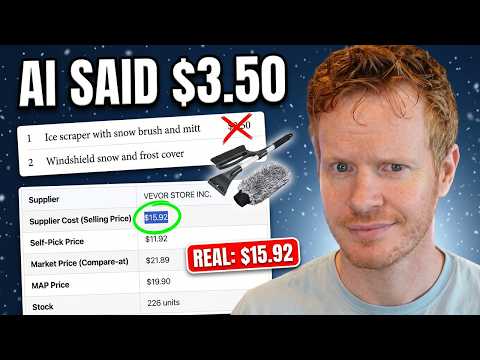
- $3.50 Ice scraper, AI supplier cost
- $15.92 Ice scraper, real supplier cost
- 2.7x to 5x low AI cost vs real quote
- $7.32 Chosen product, gross per sale
The claim
That general AI chatbots give usable selling prices for dropshipping products but supplier costs that are far too low, so a beginner who trusts their margins will pick the wrong products; and that checking against real supplier listings changes the decision.
- Prompt — Five products under $30, easy for a beginner, with supplier cost, sale price and margin; one prompt, no follow-up
- ChatGPT (free plan) — Microfiber towel four-pack at $2.70, sell at $13; based on two wholesale sites, volume pricing
- Claude (paid plan) — Ice scraper at $3.50, sell at $17; a foldable trunk item at $7, sell at $25; labelled as estimates
- Gemini (paid plan) — Default model gave no answer in three tries; Pro gave magnetic phone mounts at $6, sell at $20
- Ice scraper, real quote — $15.92 supplier cost, $19.90 minimum advertised price
- Microfiber towels, real quote — $13.58 supplier cost (no exact match), $19.40 market price, 4 to 13 days shipping
- Windshield cover, real quote — $13.48 supplier cost against an estimate of $5; $20.80 market price; 5 to 8 days
- Product chosen — Windshield snow and frost cover
- Gross per sale on the chosen product — $7.32
- Store fees, payment fees, ad cost, sales to date — Not stated
What is this income idea?
Use AI chatbots to pick products for a small dropshipping store, then check their numbers against real supplier listings before listing anything.
- The creator runs a small car-accessories dropshipping store, built on the channel. In dropshipping the store holds no stock: when a customer orders, the supplier ships directly to them, and the store keeps the difference between its price and the supplier's.
- For this video the same prompt went to ChatGPT, Claude and Gemini: five products to sell this month, under $30 each, easy for a beginner, with the supplier cost, the price to sell at and the margin. The rule was one prompt and no follow-up. ChatGPT was used on its free plan; Claude and Gemini on paid plans, which the creator discloses.
- ChatGPT searched two wholesale sites and quoted volume prices, such as a microfiber towel four-pack at $2.70 to sell for $13, with a note that these were gross margins before shipping, packaging and payment. Claude chose winter products for the season, such as an ice scraper at $3.50 to sell for $17, and said its supplier costs were estimates, not live quotes. Gemini's default model gave no answer in three attempts; its Pro model suggested magnetic phone mounts at $6 to sell for $20, without saying where its figures came from.
- The creator then checked the selling prices against Amazon and found most of them roughly in range, with the car wash mitt the clearest miss: closer to $6 to $8 than the $10 suggested.
- The supplier costs were the problem. Using a supplier search tool restricted to US warehouses, the ice scraper came back at $15.92 with a $19.90 minimum advertised price, the towels at $13.58, the windshield cover at $13.48 against an estimate of $5, and the car wash mitt at $30. The creator chooses the windshield snow and frost cover for the store.
- The supplier tool, Doba Pilot, is promoted in the video with a link in the description, 30 free credits and a 7-day trial. The creator also says they have made many videos for Doba. Whether this video is paid for is not stated.
The chatbots guessed sensible selling prices but much too-low buying prices, so their margins looked far better than the real ones.
- Same prompt to three AIs — One shot, no follow-up
- AI supplier costs — $2.70 to $7
- Check prices on Amazon — Mostly in range
- Check real suppliers — US warehouses only
- Real supplier costs — $13.48 to $30
- Pick a product — Windshield cover
- List and sell — Result not stated
A useful check on AI product research, ending before any sale is made.
A chatbot can guess a retail price; it cannot guess your supplier cost
The lesson underneath the number
- Retail prices are public. A chatbot that has read a lot of product listings can land near what an ice scraper or a phone mount sells for, and the Amazon checks in this video suggest the three of them mostly did. Supplier costs for dropshipping are different. They depend on the warehouse, the order size, shipping and the supplier's pricing rules, and none of that is in a general chatbot's answer unless it looks it up.
- The video shows the three ways this went. Claude said its supplier costs were estimates, which the creator credits. ChatGPT found real wholesale prices but for bulk buying, partly because the prompt did not mention dropshipping, a mistake the creator owns. Gemini gave numbers with no source. The result in each case was a margin that looked far better than the real one.
- The size of the gap is the useful part. An ice scraper that looked like $13.50 gross becomes $3.98 at the supplier's minimum price. Towels that looked like about $10 become $5.82. The windshield cover chosen in the end leaves $7.32. Each of those is before the store, the payment processor and the ads that bring the buyer in, and for a low-priced product those can take most of a margin that size.
- The real quotes come from a supplier tool the video promotes, and the creator says they have made many videos for that company. The specific figures are read out and the method is reasonable, but a reader should know the comparison is set up to end with that tool. The broader lesson stands on its own: check supplier cost, shipping time and minimum price in a real listing before trusting any margin, wherever it came from.
I think the three AIs did pretty good on the selling price but what they did not do a good job with was the supplier cost.
The creator, after the Amazon and supplier checks
The process, as the video gives it
From a chatbot prompt to a product decision.
No store fee, payment fee, ad cost or sales figure is given for any stage.
- Ask three AIs the same question once — Five products under $30, easy for a beginner, each with supplier cost, sale price and margin. No second prompt allowed. The creator later notes the prompt left out that the store is dropshipping, which is why ChatGPT quoted bulk prices.
- Look for agreement between models — ChatGPT and Gemini both suggested car seat gap fillers; Claude and Gemini both suggested magnetic phone mounts. The creator treats overlap between models as a sign an answer is more reliable.
- Check selling prices on Amazon — Towels at $13 look "not too far off"; the car wash mitt at $10 looks high against $6 to $9 listings; the ice scraper, windshield cover and phone mount look roughly in range. At a $3 cost and $6 price the mitt leaves $3 gross, a figure the creator works out on camera.
- Check supplier costs in US warehouses — Overseas shipping times lead to complaints and chargebacks, so only US-warehouse listings are used. Supplier costs come back between $13.48 and $30 for the products checked, against AI figures of $2.70 to $5.
- Weigh shipping time and pricing rules — The towels ship in 4 to 13 days, which the creator calls too long. The ice scraper has a $19.90 minimum advertised price. The windshield cover ships in 5 to 8 days, is in stock and has no minimum price.
- Choose the product — The windshield snow and frost cover, at $13.48 from the supplier against a $20.80 market price. The AIs, given the real figures, each named a product to drop and one to keep.
The business model
Retail margin on car accessories sold through a dropshipping store, with a US-warehouse supplier shipping each order.
Drivers buying low-priced car accessories, with winter products such as ice scrapers and windshield covers in season.
Useful car accessories under $30 with US shipping times of about a week.
The creator's own store; Amazon listings are used only to check market prices. How buyers are reached is not covered.
- Supplier cost — $13.48 for the chosen windshield cover
- Store platform — Not stated
- Payment processing — Not stated
- Ads — Not stated
- Supplier tool — 30 free credits and a 7-day trial; later price not stated
- Refunds and chargebacks — Raised as a risk of slow shipping; not quantified
The supplier cost is the only cost given for the chosen product. Everything between the $7.32 gross and a profit is not stated.
What you would actually need
Money
Dropshipping means no inventory and no money up front. The supplier tool offers 30 free credits and a 7-day trial.
No stock is a real advantage, and the creator says plainly that the trade-off is a thinner margin. But a store needs more than a supplier. Store subscription, payment processing, ads to reach buyers, refunds and chargebacks all come out of the $7.32 gross on the chosen product, and the video gives no figure for any of them. The supplier tool's price after the trial is also not stated.
Costs the video does not price
- Store platform subscription
- Payment processing on each sale
- Ads or other paid traffic
- Supplier tool after the free credits and trial
- Refunds, returns and chargebacks
- Whether the supplier cost includes shipping to the customer
Time
No time figure is given for the research.
The research in the video is quick: one prompt each, a handful of Amazon searches and four supplier lookups. The slow part comes after, and the video does not cover it: listing the product, running ads, handling customer messages and dealing with late deliveries, which the creator warns lead to "five messages" and chargebacks.
Where the time goes
- Prompting and comparing AI answers
- Checking selling prices on Amazon
- Looking up real supplier listings
- Listing the product in the store
- Marketing and ads, not covered
- Customer service and delivery issues
The part you must pay attention to
The AI margins were mostly supplier-cost guesses, and the real margin is a fraction of them.
Claude's ice scraper looked like $13.50 gross on a $17 sale. With the real US-warehouse cost and the supplier's minimum price, it is $3.98.
- Minimum advertised price — $19.90
- Real supplier cost — $15.92
$3.98
Gross per sale at the minimum price, before any fees (AI version: $13.50)
The load-bearing assumption in any AI product list is the supplier cost, and the chatbots did not have real figures for it. Claude said so; Gemini gave numbers without a source; ChatGPT used real wholesale prices, but for bulk orders, not dropshipping. Against US-warehouse quotes, the AI costs were 2.7 to 5 times too low on the three products with a matching listing, and ten times too low on the car wash mitt.
The creator's own conclusion is that these chatbots are not built for supplier research, and the figures in the video support it. The selling prices mostly held up; the costs did not. The product finally chosen, the windshield cover, leaves $7.32 between the $13.48 supplier cost and the $20.80 market price. That is our arithmetic, and it is before the store platform, payment processing and ads, none of which is priced in the video. Whether $7.32 covers the cost of finding each buyer is the question a reader would need to answer next.
- AI ESTIMATE vs REAL QUOTE
- Ice scraper $3.50 vs $15.92 4.5x
- Towels $2.70 vs $13.58 5.0x
- Windshield cover $5.00 vs $13.48 2.7x
- Car wash mitt $3.00 vs $30.00 10.0x
- GROSS PER SALE (OUR ARITHMETIC)
- Ice scraper $19.90 − $15.92 = $3.98
- Towels $19.40 − $13.58 = $5.82
- Windshield $20.80 − $13.48 = $7.32
- NOT STATED
- Store, payment, ad costs ???
- Sales of the chosen product ???
The economics
Real supplier quotes for four products, and no cost beyond them.
- Ice scraper: AI cost / real cost — $3.50 / $15.92
- Ice scraper: minimum advertised price — $19.90
- Towels: AI cost / real cost — $2.70 / $13.58
- Towels: market price — $19.40
- Windshield cover: estimate / real cost — $5 / $13.48
- Windshield cover: market price — $20.80
- Car wash mitt: AI cost / real cost — $3 / $30
- Store, payment and ad costs — Not stated
Gross per sale on the chosen product
$20.80 market price − $13.48 supplier cost
$7.32 per sale, about 35% of the price, before any store, payment or ad cost
IncomeIdeaLab calculation from the figures stated in the video
The $20.80 is the market price given by the supplier tool; the store's own price is not stated. Whether the supplier cost includes shipping to the customer is not stated. On the same basis the ice scraper leaves $3.98 (20%) at its $19.90 minimum price, against Claude's implied $13.50 (79%).
- The store's own selling price for the chosen product
- Store platform and payment processing fees
- Ad spend or cost to acquire a customer
- Price of the supplier tool after the trial
- Whether supplier costs include shipping
- Any sales of the chosen product
- The creator's rounded figures match ours: towels at "like $5" of potential profit against our $5.82, and "$10" for the AI version against our $10.30.
- The car wash mitt's real supplier cost of $30 against an AI figure of $3 is the widest gap. The creator checks that it is the same product and drops it.
- ChatGPT's answer itself warned that its margins were gross, before shipping, packaging and payment. The creator points this out as a useful caveat.
- The video promotes the supplier tool used for the real quotes, with a link, free credits and a trial; the creator says they have made many videos for that company. Whether this video is paid for is not stated.
Evidence status
Every substantive figure and claim in the video.
- Claude: ice scraper at $3.50, sell at $17 — Claude, read out by creator — Labelled by Claude as an estimate.
- Real ice scraper cost $15.92, minimum price $19.90 — Supplier tool, read out by creator — Leaves $3.98 gross at the minimum, by our arithmetic.
- ChatGPT: towels at $2.70, sell at $13 — ChatGPT, read out by creator — Real wholesale price, but for bulk orders.
- Real towel cost $13.58, market $19.40 — Supplier tool — Not an exact match; 4 to 13 days shipping.
- Gemini: phone mounts at $6, sell at $20 — Gemini, read out by creator — No source given; selling price looks in range on Amazon.
- Windshield cover real cost $13.48 against $5 estimate — Supplier tool — 2.7 times the estimate.
- Car wash mitt should sell nearer $6 than $10 — Creator, from Amazon — The clearest selling-price miss.
- AI supplier costs 2.7 to 5 times too low — IncomeIdeaLab — On the three products with a matching listing.
- Chosen product leaves $7.32 gross — IncomeIdeaLab — Before any store, payment or ad cost.
- Sales or profit from the chosen product — Nobody — Not stated.
What is actually proven?
The gap between AI and real supplier costs. Not a profitable product.
- Three chatbots gave supplier costs of $2.70 to $7 for car accessories.
- US-warehouse supplier quotes for matching products were $13.48 to $30.
- The AI costs were 2.7 to 5 times too low where a matching listing was found.
- The chosen windshield cover leaves $7.32 gross per sale at the market price.
- Store, payment and ad costs for the product.
- Whether the product sells, or makes a profit.
What the headline doesn't tell you
The comparison is clear; the business result is not part of it.
- Selling prices mostly held up. — Supplier costs did not.
- $13.50 became $3.98. — The ice scraper, at the minimum price.
- $7.32 is gross. — Before store, payment and ads.
- The prompt left out dropshipping. — The creator says so.
- Different plans. — ChatGPT free; Claude and Gemini paid.
- The checker is promoted. — Link, free credits and a trial.
- Paid or not is not stated. — Many earlier videos for the company.
- No sales yet. — The video ends at the choice.
Should you try it?
Useful as a warning about AI margins, not as a product pick
Take the method: check supplier cost, shipping time and minimum price in a real listing. Do not take $7.32 gross as a profit.
- Specificity of figures — 8 — AI and real costs read out for each product.
- Fairness of the test — 6 — Same prompt, but different plans and a prompt missing "dropshipping".
- Disclosure of own mistakes — 8 — Owns the missing word in the prompt.
- Cost disclosure beyond supplier — 2 — No store, payment or ad figures.
- Commercial disclosure — 5 — Tool link and offer stated; paid status not stated.
- Evidence of a profitable product — 1 — No sale of the chosen product is reported.
- Beginner accessibility — 6 — No stock needed; thin margins leave little room for ads.
- If you are thinking of using a chatbot to pick dropshipping products, this video is worth watching for one reason: it shows how far off the margins can be. The selling prices the AIs gave were mostly in range. The supplier costs were not, and in dropshipping the supplier cost is the number that decides whether there is any margin at all.
- The real figures leave little room. The product chosen leaves $7.32 between supplier cost and market price. Out of that would come the store subscription, payment fees and whatever it costs to get a buyer to the page, plus refunds when deliveries run late. The video gives no figure for any of those, so whether the product makes money is open.
- The method is sound and costs little to copy. Check selling prices against live listings, check supplier costs in a warehouse near your customers, and look at shipping times and minimum advertised prices before you list. The creator also shows that leaving one word out of a prompt, here "dropshipping", changes the answer.
- Bear in mind that the supplier tool used for the real figures is promoted in the video. The figures are specific and read out on camera, and a reader can repeat the lookups with any supplier.
Passive or automated?
Automation
The supplier ships each order; research and marketing are manual.
Passive potential
Thin margins and customer service leave little that runs unattended.
Dropshipping automates fulfilment: the supplier holds the stock and ships each order, and a connected store can pass orders through without handling. The chatbots in this video speed up brainstorming. Everything else is ongoing work. Products have to be checked against real suppliers, as the video shows, listed, marketed and supported, and the creator's own warning about late deliveries, repeated customer messages and chargebacks describes work that does not go away. At about $7 gross on the chosen product, there is also little margin to pay anyone else to do it.
- Checking AI suggestions against real supplier listings
- Choosing products with acceptable shipping times
- Pricing within minimum advertised price rules
- Running and judging ads
- Handling customer messages and chargebacks
Recommended beginner experiment
Treat every AI margin as a guess until a real listing confirms it.
- Say "dropshipping" in the prompt. — The creator's own correction.
- Ask where each cost comes from. — Claude said it was guessing.
- Check selling prices on live listings. — Price near the middle, not the bottom.
- Get a real supplier quote. — In a warehouse near your buyers.
- Note shipping time and minimum price. — They removed two of four products.
- Subtract store and payment fees. — Not stated in the video.
- Estimate the cost of one sale from ads. — The figure that decides profit.
- List only if something is left. — After all of the above.
Our verdict: 7/10
AI supplier costs ran 2.7 to 5 times below real quotes; the chosen product leaves $7.32 gross a clear, specific check on AI product research that stops before any sale
Credited for reading out every AI estimate and every real supplier quote; for checking selling prices against live listings; for owning the missing word in the prompt and disclosing which AI plans were paid; for noting that Claude labelled its costs as estimates; and for warning about shipping times and chargebacks. Marked down because no store, payment or ad cost is given, so the $7.32 gross on the chosen product cannot be taken further; because the real quotes come from a supplier tool the video promotes, with the commercial relationship described only as having made many videos for the company; and because no sale of the chosen product is reported.
This video sets three AI chatbots the same product-research task for a small car-accessories dropshipping store and then checks their answers, which is more than most AI-research videos do. The finding is specific. The selling prices the chatbots gave were mostly in range against Amazon, with the car wash mitt the clearest miss. The supplier costs were far too low: on the three products with a matching US-warehouse listing, the real cost was 2.7 to 5 times the AI figure, and the car wash mitt came back at ten times. Claude's ice scraper, which looked like $13.50 gross on a $17 sale, leaves $3.98 at the supplier's $19.90 minimum advertised price. The creator is open about the test's limits, including a prompt that did not say "dropshipping" and different AI plans. The product chosen in the end, a windshield snow and frost cover, leaves $7.32 between its $13.48 supplier cost and $20.80 market price by our arithmetic. That is before the store platform, payment processing and ads, none of which is priced, and no sale is reported. The real quotes come from a supplier tool the video promotes, and the creator says they have made many videos for that company; whether this one is paid is not stated. Watch it for the method and the size of the gap, and do your own full cost check before treating any of these products as profitable.
- Ice scraper, AI vs real cost — $3.50 vs $15.92
- Ice scraper gross at minimum price — $3.98
- Towels, AI vs real cost — $2.70 vs $13.58
- Windshield cover, estimate vs real — $5 vs $13.48
- AI cost shortfall — 2.7x to 5x
- Chosen product gross per sale — $7.32
- Store, payment, ad costs — Not stated
- Sales of the chosen product — Not stated
- Beginner suitability — Good method, thin margin
Sources
- ChatGPT vs Claude vs Gemini: What Should I Sell? — YouTube video, 2026-11-10
- FTC — Guides Concerning the Use of Endorsements and Testimonials — Regulatory guidance on endorsements and disclosure