Vending / Asset Income · Claim Review
“I Spent $1.7 Million on a Vending Machine Location…Will It Make Money?”
What we found: The $300 Vending Machine Is $793 All In, and Needs About 294 Drinks Sold to Pay Back — No Sales Are Counted Yet
A car wash owner adds a second-hand drinks machine, a new card reader and a first load of stock. The per-drink margins check out against the receipts; whether it makes money is left for a later video.
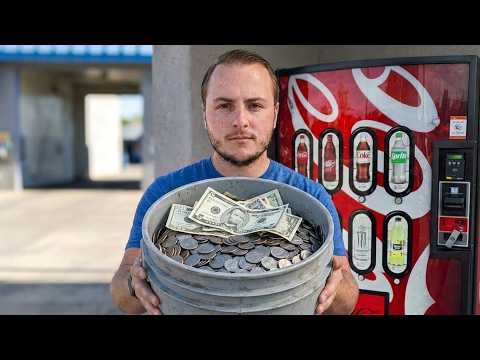
- $300 Machine price
- $792.88 All-in cost so far
- $2.17–$2.42 Margin per drink, as stated
- None counted Sales so far
The claim
That a $300 second-hand vending machine, fitted with a new card reader and stocked with drinks bought on sale, will earn about $2.17 to $2.42 per drink at a car wash.
- Machine (Royal 660) — $300
- Card reader — $350
- Equipment total — $650 — matches our sum
- First stock — $142.88
- Soda: $9.98 per 12 — ~$0.83 a bottle — checks out
- Root beer: $7 per 12 — ~$0.58 a bottle — checks out
- Energy drinks: $42.99 per 24 — ~$1.79 a can — checks out
- Prices set — $3 a bottle, $4 an energy drink
- Margins: $3 − $0.83, $4 − $1.79, $3 − $0.58 — $2.17, $2.21, $2.42 — all match
- Drinks sold, revenue, profit — Not stated — no sales counted yet
What is this income idea?
Buy a cheap used drinks vending machine, place it at an existing site with steady foot traffic, and sell bottles and cans bought on sale at a fixed markup.
- The owner of two car washes buys a Royal 660 drinks machine on Facebook Marketplace for $300 and installs it at site 2 beside the change machine and an existing detailing-product vendor. They say it took three people to lift the roughly 700 lb machine off the truck.
- The original card reader would not transfer to them, and a new account with the same provider would take three to four weeks, so they order a different reader for $350. They say they are not connected to that company. That brings equipment to $650.
- They stock it with 16.9 oz bottles of cola, diet cola, lemon-lime, lemonade, pepper soda and root beer bought on sale at a local grocery store, and two flavours of energy drink from a warehouse club. Bottles are priced at $3 and energy drinks at $4.
- At home they total the receipts: $142.88 of product, about $0.83 a soda bottle, $0.58 a root beer and $1.79 an energy drink, for margins they put at about $2.17, $2.42 and $2.21. They saw one regular customer use it on the first day, and say they will check the takings after the weekend.
A car wash owner spends about $793 to set up a drinks machine that should make a bit over $2 a drink — and has not sold enough yet to say whether it pays.
- Buy used machine — $300
- Add card reader — $350
- Stock drinks on sale — $142.88
- Price at $3 / $4 — ~$2.17–$2.42 margin
- Sell at the car wash — Construction workers, commuters
- Sales and payback — Not counted yet
The video covers set-up and margins. Sales come after the last step, in a later video.
Correct margins, open volume
The lesson underneath the number
- Every figure the owner reads out holds. $9.98 for 12 bottles is $0.83 each; $7 for 12 is $0.58; $42.99 for 24 is $1.79. At $3 and $4, that is $2.17, $2.42 and $2.21 a drink, exactly as they say. Even the receipt total reconstructs: two 24-packs of energy drinks at $42.99, five 12-packs of soda at $9.98 and one 12-pack of root beer at $7 come to $142.88 to the cent. That is our reconstruction from their prices, not a breakdown they give, but nothing else fits as neatly.
- The title is a question, and the video is honest that it does not know the answer yet. On the first load, if all 120 drinks sold, revenue would be $408 and margin $265.12 on our arithmetic. Paying back the $650 of equipment would take about 294 drinks at the average margin of the first load — roughly two and a half full machines’ worth of this stock.
- Two things will move that number. Stock bought at regular prices costs more than stock bought on sale, which the owner acknowledges. And card-reader fees come off every card sale, and this video gives no fee figure.
- What makes the experiment cheap is what the owner already has: a site they control, steady traffic and no commission to pay a host. A reader copying the idea without a location would face a different calculation.
It either works really well and we make our money back sell some drinks or we just lose 300 bucks.
Car Wash Rob, before buying the machine
How the set-up works, as described
One afternoon from Marketplace listing to a stocked machine.
No sales, takings or running costs are given for the machine yet.
- Buy a used machine — A Royal 660 from Facebook Marketplace for $300, which the owner thinks was left behind when a building was sold.
- Place it where traffic already is — Beside the changer and the existing vendor at site 2, which the owner says sees construction workers and people coming off shift.
- Replace the card reader — The existing reader could not be transferred, so a new one was ordered for $350.
- Stock with sale-priced drinks — Sodas at $9.98 per 12, root beer at $7 per 12, energy drinks at $42.99 per 24; $142.88 in all.
- Set prices — $3 a bottle and $4 an energy drink, with viewers asked whether that is too high.
- Check the takings — The owner plans to empty it after a busy weekend and report back.
The business model
Bottled soft drinks at $3 and energy drinks at $4, paid by coin, bill or card.
Car wash users at site 2, which the owner says includes many construction workers and people finishing shifts.
A cold drink at a site where customers are already standing around.
Placed inside an existing car wash the owner controls, so no placement fee or commission applies.
- Machine — $300, one-off
- Card reader — $350, one-off
- Stock — $142.88 first load; sale prices not guaranteed
- Card fees — Not mentioned
- Electricity — Called minimal; excluded by the owner
- Sales tax — Not mentioned
The owner leaves running costs out of the margins on purpose, calling the machine an add-on to the car wash. That is reasonable at this scale, but card fees are charged per transaction and are not covered by that reasoning.
What you would actually need
Money
$300 for the machine, $350 for a card reader and $142.88 of stock — “what am I going to lose”.
About $793 to start, which is low for a vending set-up. The owner already has the location, the foot traffic and a truck; someone without a site would also need a placement agreement, and possibly a commission to the site owner, which this video does not need to cover.
Costs to plan for
- Machine: $300 used, as here
- Card reader: $350, as here
- First stock: $142.88, as here
- Card-reader service and processing fees (not stated)
- Sales tax on drinks, where it applies (not mentioned)
- Electricity for refrigeration (called minimal; not priced)
- Restocking trips and time
Time
One day to collect, move, set up and stock the machine, then periodic checks.
Set-up is a day with three people to lift it. After that the work is buying stock, refilling and collecting cash, which the owner plans to fold into existing car wash visits and grocery runs.
Work mentioned in the video
- Collecting and moving a ~700 lb machine
- Fitting and setting up a card reader
- Buying stock when it is on sale
- Loading and mapping selections
- Testing the bill and coin acceptors
- Emptying cash and checking sales
The part you must pay attention to
The title asks “Will It Make Money?” and the video does not yet answer it.
Everything in the video is set-up and unit margin. The margins are correct; the number of drinks the machine will sell is the unknown that decides the outcome.
- Machine plus card reader — $650
- Average margin per drink on the first load (ours) — ~$2.21
~294 drinks
Sold to pay back the equipment, before card fees
The load-bearing assumption is volume. The video shows one customer on day one and no sales total. The stated margins also assume the sale prices the owner paid will repeat — they say themselves these “won’t always be on sale” — and leave out card-reader fees, which apply to every card sale, and any sales tax on drinks.
As a set-up video this is careful and candid: every cost is given, the margins are computed correctly, and the owner frames it as a $300 experiment. Whether the machine makes money depends on how many drinks it sells, which the video leaves for later.
- SET-UP COST (OUR SUMS)
- Machine $300.00
- Card reader + $350.00
- Equipment $650.00 ✓
- First stock + $142.88
- All in $792.88
- STOCK RECONSTRUCTED
- 2 × 24 energy @ $42.99 = $85.98
- 5 × 12 soda @ $9.98 = $49.90
- 1 × 12 root beer @ $7 = $7.00
- Total $142.88 ✓
- IF ALL 120 SELL
- 72 × $3 + 48 × $4 = $408
- Margin on first load $265.12
- PAYBACK ON $650
- $650 ÷ ~$2.21 ≈ 294 drinks
The economics
Set-up costs and unit margins are stated. Volume is not.
- Machine — $300
- Card reader — $350
- First stock — $142.88
- All in — $792.88
- Soda cost / price / margin — $0.83 / $3 / $2.17
- Root beer cost / price / margin — $0.58 / $3 / $2.42
- Energy drink cost / price / margin — $1.79 / $4 / $2.21
- Units in first load (reconstructed) — 72 bottles + 48 cans
- Drinks sold — Not stated
Payback on the equipment
First-load margin $408 − $142.88 = $265.12 over 120 drinks ≈ $2.21 each; $650 ÷ $2.21 ≈ 294 drinks
About 294 drinks sold to recover the machine and reader, before card fees, tax and any electricity
IncomeIdeaLab calculation from the stated prices, case costs and receipt total
The unit mix of 72 bottles and 48 cans is our reconstruction from the stated case prices and total. Payback assumes sale-price stock and no card fees; both would push the figure higher. No sales rate is given, so the time to pay back cannot be estimated.
- Number of drinks sold and takings
- Card-reader monthly or per-transaction fees
- Sales tax treatment of vended drinks
- Electricity cost of the machine
- Stock cost at regular, non-sale prices
- The owner says “now I’m into it for 600 including the card reader 650”, settling on $650 for equipment, which matches $300 + $350.
- They state they have no connection with the card-reader company they chose.
- They saw one regular customer use the machine on the first day.
- No course, coaching or sponsor is promoted; viewers are asked about cans versus bottles and about the prices.
Evidence status
Every figure in the video, checked against the others.
- Machine bought for $300 — Owner — Consistent throughout.
- Card reader $350; equipment $650 — Owner — $300 + $350 = $650. Checks out. The owner’s own spreadsheet “Soda - Initial Investment” on screen at 6:57 lists Machine $300.0…, Card Reader $350.0… and Total equipment $650.0…; the right-hand digits are cut off at the edge of the frame.
- Soda $9.98 per 12, about 83 cents a bottle — Owner — $0.832. Checks out.
- Root beer $7 per 12, about 58 cents — Owner — $0.583. Checks out.
- Energy drinks $42.99 per 24, about $1.79 — Owner — $1.791. Checks out.
- Margins $2.17, $2.21, $2.42 — Owner — Price minus unit cost in each case. All match.
- Stock total $142.88 — Owner — Reconstructs exactly from 2 × $42.99 + 5 × $9.98 + $7. The same spreadsheet at 8:52 shows a highlighted “total cogs” row with $142.8… (the last digit is cut off) under per-item costs of about $9.98 for the sodas and $7.0 for the root beer.
- Energy and upkeep costs “probably minimal” — Owner — Excluded by the owner; no figure is given.
- Will it make money? — Title — No sales are counted in this video.
What is actually proven?
The set-up costs and margins hold. The result does not exist yet.
- Equipment cost adds to $650 and all-in cost to $792.88.
- Each stated unit cost and margin matches the case prices.
- The $142.88 receipt total reconstructs exactly from the stated case prices.
- The machine is installed and working, and one customer used it on day one.
- Sales volume, takings, card fees and payback time.
What the headline doesn’t tell you
The $300 is the cheapest part, and the answer is still to come.
- It is $793, not $300. — Reader and stock included.
- No sales yet. — The title’s question is open.
- About 294 drinks to pay back. — Our arithmetic, before fees.
- Stock was on sale. — The owner says it won’t always be.
- Card fees are not counted. — They apply to every card sale.
- The location is free. — The owner runs the car wash.
Should you try it?
A cheap, well-documented experiment — if you already have the location
The costs are low and every one is stated. The missing piece is sales, so treat it as a test, as the owner does, and expect a different calculation if you would have to rent or share someone else’s site.
- Arithmetic consistency — 10 — Every stated cost and margin checks out.
- Cost disclosure — 8 — Machine, reader and stock itemised; fees and tax not mentioned.
- Result shown — 0 — No sales are counted yet.
- Honest framing — 9 — Framed as a $300 test with a stated downside.
- Capital required — 9 — Under $800 to start.
- Beginner accessibility — 6 — Cheap, but the free placement is not available to most.
- This is about as low-risk as a vending start gets: a $300 used machine, a $350 reader and $142.88 of stock, all itemised, with margins of a little over $2 a drink that our arithmetic confirms.
- The owner’s advantage is the site. They control the car wash, so there is no placement fee and no share of sales to a landlord, and the machine sits where customers already wait. Most beginners would have to negotiate that.
- The real test is volume, and this video does not reach it. On the first load’s average margin, about 294 drinks pay back the equipment before card fees. Whether that takes a month or a year is the number to watch for in the follow-up.
Passive or automated?
Automation
The machine sells and takes card payments unattended; buying and loading stock is manual.
Passive potential
Low effort once placed, especially folded into existing car wash visits; restocking still needs trips.
A single drinks machine at a site the owner already visits each week adds little work: restock, collect and occasionally fix. The owner plans to buy stock during ordinary grocery runs when it is on sale. That keeps the time cost low, but it is not zero, and it is not counted in the margins.
- Buying stock, ideally on sale
- Refilling and rotating selections
- Collecting cash
- Fixing acceptors and the card reader
Recommended beginner experiment
Copy the cost discipline, then measure what this video could not yet.
- Secure a location first. — Ask about commission before buying.
- Buy used, test everything. — Bill, coin and card acceptors.
- Price the card reader’s fees. — Monthly and per transaction.
- Cost stock at regular prices. — Not only sale prices.
- Count sales weekly. — Drinks sold, not just cash collected.
- Work out payback. — Equipment ÷ margin per drink.
Our verdict: 7/10
The $300 machine is $793 all in, with correct margins and no sales yet about 294 drinks to pay back the equipment, before card fees
Credited for itemising every cost, for unit margins that all check out against the receipts, for disclosing no tie to the card-reader company, and for framing the purchase as a test. Marked down only because the title’s question — will it make money — cannot be answered from this video, and card fees and tax are not mentioned.
The $300 in the title is the machine; with a $350 card reader and $142.88 of first stock, the owner is in for $792.88. Every unit cost and margin they read out checks against the case prices — $2.17 on soda, $2.42 on root beer, $2.21 on energy drinks — and the stock total reconstructs to the cent. The video is a careful set-up record and is open about being a $300 experiment. What it does not contain is any sales figure, so the title’s question is still open. On the first load’s average margin, the equipment pays back after about 294 drinks, before card fees and tax.
- Machine — $300
- Equipment total — $650
- All in — $792.88
- Margin per drink — $2.17–$2.42
- Payback on equipment (ours) — ~294 drinks
- Sales so far — Not counted
- Beginner suitability — Good, if you have a location
Sources
- I Spent USD 300 on a Vending Machine…Will It Make Money? — YouTube video, 2026-10-15