Agencies / AI Automation · Claim Review
“23 Ways to Get Clients for Your AI Agency”
What we found: 23 Client Channels, and the Creator’s Own Agency Used One of Them
The list is delivered in full. The evidence behind it is mostly unnamed members of the creator’s own programme, and the one dollar figure — a $10,000 client from a $3 webinar — arrives without an ad budget.
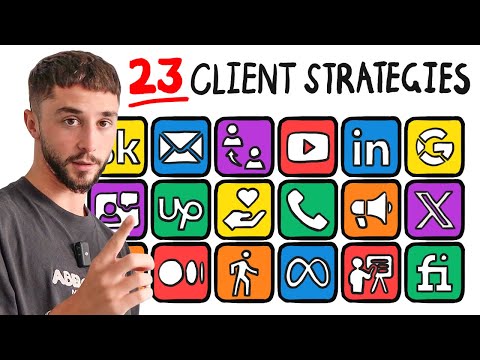
- 23 Methods listed
- 1 Used by own agency
- $10k Webinar client
- None Close or conversion rates
The claim
That any one of 23 lead-generation methods, done consistently for three to six months, will produce clients for a new AI agency.
- Methods covered — 23, of which 4 are separate ad platforms
- Methods the creator's own agency relied on — One — YouTube
- Paid ads run for the creator's own agency — None
- Webinar-funnel client — $10,000, from a $3 sign-up
- Upsells after a free chatbot — "Two three $4,000" products or services
- Warm-outreach results — "One two three clients within the first couple of weeks"
- LinkedIn blank-request uplift — 20–30% higher acceptance — Relayed second-hand from a friend
- Time to commit per channel — 3 to 6 months
- Ad spend, close rates, cost per lead — Never stated
What is this income idea?
Run an AI automation agency, and solve its lead-flow problem by choosing one acquisition channel from a list of 23 and sticking with it.
- The video is the second in a series. It frames starting an AI agency as three problems — technical expertise, lead flow, and "authority and credibility" — and addresses only the second: where clients come from.
- The 23 methods are all delivered: Fiverr, Upwork, referrals, warm outreach, LinkedIn content, LinkedIn automated connect-and-DM, Twitter content, Twitter cold DMs, YouTube, Medium, free work for charities and nonprofits, four paid ad platforms counted separately, online communities, Facebook groups, LinkedIn groups, cold calling, expos and events, walk-ins, cold email with a free audit or lead magnet, and a paid-webinar funnel.
- The coverage is deliberately shallow: "I'm not going to be giving you super in information just a high level overview." Resources for each method are promised on the creator's free online community rather than in the video.
- The central advice is sound and repeated throughout: "all you need to do is pick one of these and do it well," and "spend a solid 3 to 6 months" on it. The creator backs this with their own experience: "to grow Morningside AI my agency into what it is now we have only had to use one of them and that was YouTube."
- That candour cuts both ways. On paid ads, the creator says "we've never had to run ads for our agency so we haven't actually explored paid acquisition for AI agency clients." The evidence for most methods is therefore anecdote from members of the creator's free community and accelerator.
- The only full dollar result is the last method: a member ran ads to a webinar with a $3 sign-up fee as a "micro commitment" and "was able to convert that into a $10,000 sale." No ad spend, attendance or conversion figure is given.
A menu of 23 ways to find agency clients, with the good advice to choose one — from someone whose own agency grew through YouTube alone.
- Pick one channel — Of 23
- Commit 3–6 months — Per the creator
- Free work if needed — Charities, free chatbots
- Build credibility — Reviews, referrals
- Book discovery calls — Rates never given
- Upsell — "Two three $4,000"
A sensible sequence whose conversion rates, costs and timelines are left blank.
The best advice in the video is to ignore most of it.
The lesson underneath the number
- The strongest line in twenty-seven minutes comes before the list begins: "the worst thing you could do is to try to do too much at once." The creator repeats it after nearly every method, and it is correct. A new agency owner who tries LinkedIn content, cold email and Facebook groups in the same month will learn none of them well enough to see whether they work. A list of 23 is really an argument for choosing one.
- The creator also supplies the most useful piece of evidence against their own list. Their agency grew through exactly one channel — YouTube — and never ran ads for itself. That honesty is worth crediting; many list videos imply the presenter has done everything on it. But it means the case for the other 22 rests on members of the creator's free community and accelerator: a top-rated Fiverr seller, a member doubling a salary through Medium, an unnamed person running a cold-calling system for estate agents, another closing a webinar client. Almost none comes with a figure.
- Where figures do appear, the missing half matters most. "$10,000" from a $3 webinar is a genuinely clever structure, because a small paid commitment filters out people who will never buy. Without the ad spend, the attendee count or the number of webinars, it is one sale, not a method. "Two three $4,000" upsells after a free chatbot needs a rate: of how many free builds? Warm outreach producing "one two three clients within the first couple of weeks" needs a denominator: of how many members?
- The structure of the video is also worth noticing. Each method is covered at "a high level", with the depth moved to the creator's free community, which is also where the accelerator lives. That is a normal and legitimate funnel for an educator. It does mean a viewer should read this as a table of contents, and treat the success stories as coming from inside the programme that sells the training.
To grow Morningside AI my agency into what it is now we have only had to use one of them and that was YouTube.
The creator, before listing the other 22
The methods, grouped as the creator gives them
Twenty-three items, which collapse into about seven approaches.
Members of the creator's programmes are referred to by first name only in the video and are not identified further here.
- Marketplaces: Fiverr and Upwork — Methods one and two. They "work extremely well if you're willing to put in the effort on the platform." One member is described as top-rated on Fiverr for AI; no earnings figure is given, and platform fees are not mentioned.
- Your existing network: referrals and warm outreach — Build a list from phone contacts, email and followers and message them. Called "by far the easiest way to get clients initially", with accelerator members "signing one two three clients within the first couple of weeks." No count of members or success rate.
- Content platforms: LinkedIn, Twitter, YouTube, Medium — Post useful material, then message people who engage. YouTube is the creator's own route — "the gold standard of personal branding." A Medium example describes a member whose agency income matches a day job, with no figure.
- Automated outreach: LinkedIn connect-and-DM, Twitter cold DM, cold email — Automate connection requests and message sequences; offer a free AI audit, a lead magnet or a free build by cold email. One tip is specific: send connection requests without a note, relayed from a friend as a 20–30% higher acceptance rate.
- Free work to get a foot in the door — Offer charities and nonprofits a free build for testimonials, or offer small businesses a free chatbot, then upsell "two three $4,000 products or services." The upsell rate is not given.
- Paid ads: Google, YouTube, LinkedIn, Meta — Counted as four methods. Described as "extremely lucrative" and "wide open", while the creator states their agency never ran ads for itself. Suited to "people who are perhaps willing to invest a little bit more" — no budget suggested.
- In person and communities: groups, cold calls, expos, walk-ins, webinars — Join the online groups where buyers gather and build rapport before selling; call businesses; work an industry expo; walk into local businesses; run ads to a $3 webinar. Cold calling is framed as a near-guarantee: "there is no way that you would not get clients."
The business model
Project fees for AI automation builds — chatbots and similar — with upsells described as roughly $4,000 each.
Small and mid-sized business owners, with early adopters named as the easiest to sign.
Building AI solutions into a business, sold on outcomes and credibility rather than price.
One of 23 channels, chosen and worked for three to six months.
- Ad spend — For four ad-platform methods and the webinar. Never quantified
- Outreach software — LinkedIn automation and a cold-email platform are named. Never priced
- Marketplace fees — Fiverr and Upwork. Not mentioned
- Free work — Charity builds and free chatbots. Unpaid time
- The owner's time — 3 to 6 months per channel before judging it
- Expert help — The video suggests bringing in an ads consultant. Never priced
The video is about finding clients, and not one acquisition cost, conversion rate or close rate appears.
What you would actually need
Money
Mostly unstated. Paid ads are for those "willing to invest a little bit more to get results faster"; the other channels are presented as low-cost.
Several of the 23 cost money the video never prices: ad spend on four platforms, automation and cold-email software, webinar ads, and — for the free-work routes — unpaid build time. The one dollar result, the $10,000 webinar client, cannot be judged without the ad spend behind it.
Named or implied, never priced
- Ad spend on Google, YouTube, LinkedIn or Meta
- Ads driving traffic to the $3 webinar
- LinkedIn automation software
- A cold-email platform and sending infrastructure
- Marketplace service fees on Fiverr and Upwork
- Unpaid time building free chatbots and charity projects
- Possibly a consultant or agency for ads, as the video suggests
Time
"Pick one and spend a solid 3 to 6 months really working on just getting the results out of that platform."
A realistic commitment, and more honest than most. But the creator's own channel took about 18 months to "completely transform" their life, by their account, and the video gives no timeline data for any member result beyond "the first couple of weeks" for warm outreach.
Timelines mentioned
- 3 to 6 months per channel, before judging it
- "First couple of weeks" for warm-outreach clients
- 2 to 3 months of documented content to build authority
- About 18 months of YouTube for the creator
- Webinar, ads, cold email: no timeline given
The part you must pay attention to
The creator vouches for one channel from experience, and the other 22 from members.
"Personally for me to grow Morningside AI my agency into what it is now we have only had to use one of them and that was YouTube."
- Methods listed — 23
- Used by the creator’s agency — 1
22 second-hand
Backed by programme-member anecdotes, mostly without figures
The load-bearing assumption is that consistency on any single channel produces clients — "if you just pick one and spend a solid 3 to 6 months ... then you will see results." The video offers no rate for any channel: no reply rate for cold email, no booking rate for cold calls, no cost per lead for ads, no close rate on discovery calls. The one channel the creator can speak to first-hand is YouTube, and it arrived with a large existing following that the creator says has "built three different businesses." That is the channel least available to a beginner starting today. For paid ads — four of the 23 — the creator states plainly that their agency never used them.
The single dollar result deserves the same scrutiny. A member ran ads to a webinar with a $3 entry fee and closed "a $10,000 sale." It is a real and interesting structure — a small paid commitment filters out non-buyers — but without the ad spend, the number of sign-ups or the number of webinars run, a viewer cannot tell whether it was profitable or repeatable. The video also routes every method's detail to the creator's free community, where the creator's accelerator is also discussed; the accelerator is the source of most success stories and its price is never stated.
- WHO HAS TESTED WHAT
- Methods listed 23
- Creator's agency used 1
- (YouTube)
- Paid ads run for own agency none
- Rest: member anecdotes
- THE ONE DOLLAR RESULT
- Webinar entry fee $3
- Client signed $10,000
- Ad spend ?
- Sign-ups / attendees ?
- Webinars run ?
- -> cannot compute return
- RATES GIVEN FOR ANY CHANNEL
- Reply / booking / close none
- LinkedIn blank-request +20-30%
- (a friend's figure, "I believe")
The economics
A video about acquisition, with no acquisition costs.
- Webinar entry fee — $3
- Webinar-funnel client — $10,000
- Upsell size after free chatbot — ~$4,000 each, "two three" of them
- LinkedIn acceptance uplift — 20–30%
- Commitment per channel — 3–6 months
- Implied value of a free-chatbot client — ~$8,000–$12,000 if all upsells land
- Ad spend, cost per lead, close rate — Never stated
What a free chatbot could be worth, on the creator's figures
"Two three" upsells × ~$4,000 each
$8,000 to $12,000 per converted client — before knowing how many free builds it takes to get one
IncomeIdeaLab calculation from figures stated in the video
The upsell figure describes what members were "able to sell them" after a free build. How many free builds did not convert, and how long each took, is not stated, so the return on giving work away cannot be calculated.
- Ad spend behind the $10,000 webinar client
- Reply, booking and close rates for any channel
- How many members tried each method and how many succeeded
- Price of the creator's accelerator
- Cost of automation and cold-email software
- Revenue of the creator's own agency
- The 20–30% LinkedIn figure is introduced with "I believe you said", relayed from a friend described as a LinkedIn sales expert. It is a second-hand recollection rather than measured data.
- Four of the 23 methods are the same method — paid ads — on four platforms. Facebook groups and LinkedIn groups repeat the community method. Counted by approach, the list is closer to seven or eight ideas.
- The creator is explicit that they "don't usually recommend using this model as a side hustle", then cites a member doing exactly that through Medium. The tension is acknowledged in the moment.
- For warm outreach the creator points to an outside author's framework as "the gold standard" and links it as a free resource.
Evidence status
Every substantive claim in the video.
- 23 ways to get AI agency clients — Creator — All 23 are named. Several are the same approach on different platforms.
- The creator's agency grew through YouTube alone — Creator — Stated plainly. The most honest line in the video.
- Never run ads for their own agency — Creator — Yet four ad methods are called "extremely lucrative".
- $10,000 client from a $3 webinar funnel — Creator, about a member — One sale. No ad spend, sign-up or attendance figure.
- Upsells of "two three $4,000" after a free chatbot — Creator, about members — Conversion rate from free to paid never given.
- Warm outreach signs 1–3 clients in the first couple of weeks — Creator, about members — No count of members or failure rate.
- Blank LinkedIn requests accepted 20–30% more — A friend, relayed — Second-hand and hedged with "I believe".
- Cold calling daily means "no way that you would not get clients" — Creator — A guarantee with no rate attached.
- A member is the top-rated AI seller on Fiverr — Creator — Not checkable from the video. No earnings given.
- Commit 3–6 months to one channel — Creator — Sound advice, repeated consistently.
- Costs, rates, the accelerator's price — Nobody — Absent throughout.
What is actually proven?
The list exists. Its results are mostly asserted.
- All 23 methods are named with a short explanation each.
- The "pick one and do it well" advice is repeated consistently.
- The creator's agency grew through YouTube and never ran ads.
- One member closed a $10,000 client through a $3 webinar funnel.
- A free chatbot that leads to two or three $4,000 upsells is worth $8,000–$12,000 per converted client.
- Reply, booking, close and cost-per-lead figures for any method.
- How many programme members tried each method and failed.
- The price of the accelerator that supplies the success stories.
What the headline doesn’t tell you
The list is complete. The evidence is thin.
- The creator used one channel. — YouTube, with a large existing audience.
- Ads were never run for the agency. — Four of the 23 are ad platforms.
- $10,000 from a $3 webinar. — Ad spend never given.
- Success stories come from inside. — The creator’s community and accelerator.
- The accelerator’s price is never stated. — Nor is it pitched directly.
- Depth is deferred. — Each method’s detail lives in the community.
- Twenty-three is closer to eight. — Several are one method on several platforms.
- No conversion rate anywhere. — In a video about getting clients.
Should you try it?
Useful as a map, thin as evidence
Choose one channel and commit — the creator's best advice. Do not take the member stories as expected results.
- Completeness of the list — 9 — All 23 delivered, each explained briefly.
- Quality of the core advice — 8 — "Pick one and do it well", repeated and correct.
- First-hand evidence — 3 — One channel of 23 is backed by the creator's own agency.
- Quantified results — 2 — One dollar result, no rates, no costs.
- Cost disclosure — 1 — Ads, tools and free work are never priced.
- Conflict-of-interest clarity — 4 — Community and accelerator named; the accelerator's price is not.
- Honesty about the creator's limits — 7 — Volunteers that ads were never used.
- Beginner accessibility — 6 — Several channels are free; the best-evidenced one is not easy.
- Start with the one piece of advice the creator can back personally: pick a single channel and work it for months before judging it. That is the most common failure in early service businesses — hopping from method to method every fortnight — and the video names it directly.
- Then choose your channel on your own circumstances, not on the list order. The creator's own proof is YouTube, which took roughly eighteen months by their account and relies on being able to hold an audience on camera. Warm outreach to your existing network is the one the creator calls "by far the easiest", and it costs nothing but nerve. Cold email and cold calling are volume games whose rates you will have to measure yourself, because the video gives none.
- Be careful with the free-work routes. Building a chatbot free for a small business or a charity can open doors, and the video says it has led to $4,000 upsells. But it can also consume weeks with nothing to show, and the video does not say how often it converts. Set a limit — one or two free projects — and ask for a testimonial and a referral in writing.
- Treat the paid-ad methods as untested by the presenter. The creator says so directly, and the webinar example — a $10,000 client from a $3 sign-up — has no ad budget attached. If you try it, record spend, sign-ups, attendees and closes from the first day, so you know whether you have a method or a lucky sale.
Passive or automated?
Automation
Outreach sequences can be automated; selling and delivery cannot.
Passive potential
A service business whose leads stop when the owner stops.
An AI agency is a service business, and this video is about its most manual part. Several methods can be partly automated — LinkedIn connection sequences, cold-email platforms, ad campaigns — but each still ends in a discovery call, a proposal and a build carried out by a person. The creator's emphasis on rapport in communities, walk-ins, expos and cold calls makes the point: the recommended channels are about showing up, repeatedly, for months. Nothing described here produces income without the owner's continuous involvement.
- Choosing and working one channel for three to six months
- Discovery calls and closing
- Building the AI solutions that are sold
- Building rapport in communities before selling
- Running and measuring any ad spend
- Asking every finished client for referrals
Recommended beginner experiment
One channel, measured, for one quarter.
- Choose one channel only. — The creator’s core rule.
- Start with warm outreach. — Free, and called the easiest.
- Cap free work at two projects. — Get testimonials and referrals in writing.
- Measure reply, booking and close rates. — The video gives none.
- Price your offer before calls. — Upsells were ~$4,000 in the video.
- Commit for three months minimum. — The low end of the creator’s range.
- Only then test paid ads. — With a fixed budget and tracked spend.
- Treat member stories as possibilities. — Not as expected results.
Our verdict: 5/10
A complete list with one first-hand result and the right advice to pick one channel and ignore the rest
Credited for delivering every one of the 23 methods the title promises; for repeating throughout that a beginner should pick one channel and commit three to six months to it; for stating plainly that the creator's own agency grew through YouTube alone and never ran ads for itself; and for one genuinely interesting structure in the $3 webinar micro-commitment. Marked down because the evidence for 22 of the 23 methods comes from members of the creator's own community and accelerator, almost always without figures; because the one dollar result, a $10,000 client, comes with no ad spend or attendance data; because not one reply, booking, close or cost-per-lead rate appears in a video about acquiring clients; because ads, software and free work are never priced; and because the depth for every method is routed to the creator's community, whose accelerator supplies the success stories and whose price is never stated.
The title promises 23 ways to get clients and the video delivers 23, which is more than many list videos manage. It also contains a genuinely good rule, repeated after nearly every item: the worst thing a new agency owner can do is try several at once, so pick one and give it three to six months. The problem is what stands behind the list. The creator tells us, to their credit, that their own agency grew through exactly one of these methods — YouTube — and never ran ads for itself. Every other method is supported by members of the creator's free community and accelerator, and almost none of those stories carries a number. The one that does — a $10,000 client from ads to a webinar with a $3 entry fee — is a clever filter for serious buyers, but without the ad spend, the sign-ups or the number of webinars it is a single sale rather than evidence of a method. "Two three $4,000" upsells after a free chatbot and "one two three clients" from warm outreach have no denominators. No channel comes with a reply rate, booking rate, close rate or cost per lead. And each method's detail is moved to the creator's community, where the accelerator that produces the success stories is also found and never priced. Use this as a map. Choose one road on your own circumstances, measure it yourself, and treat the member anecdotes as proof that something happened once, not as a forecast.
- Methods delivered — 23 of 23
- Used by creator's agency — 1 (YouTube)
- Ads run for own agency — None
- Webinar client — $10,000
- Ad spend behind it — Never stated
- Conversion rates — None given
- Accelerator price — Never stated
- Beginner suitability — As a map, yes
Sources
- 23 Ways to Get Clients for Your AI Agency — Liam Ottley — YouTube video, 2024-07-23
- FTC — Guides Concerning the Use of Endorsements and Testimonials — Regulatory guidance on testimonials and earnings claims