Real Estate / Wholesaling · Claim Review
“The Ultimate Guide to Wholesale Real Estate from Scratch (2027)”
What we found: Wholesaling From Scratch: The $30,000 in 30 Days Is a Stated Goal, and Every Deal in the Video Is a Worked Illustration
A clear outline of how assignment wholesaling works, with a disclosed software partner. No closed deal, conversion rate or running cost is given, and two of the worked figures do not reconcile.
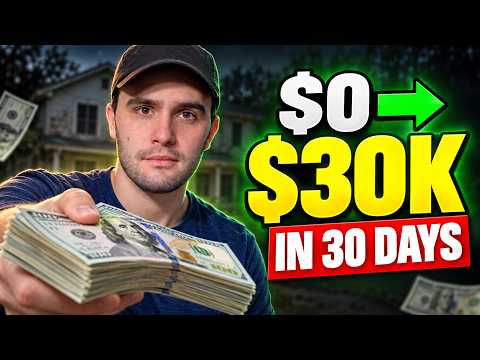
- $30,000 in 30 days Promised result
- $20k–$30k Example assignment fees
- None given Closed deals with figures
- Not stated Running costs
The claim
That a beginner who follows this step-by-step wholesaling method, using AI to pull lists, can get a first deal within 30 days and aim for $30,000 in the next 30 days.
- Stated aim — $30,000 in the next 30 days
- Defined goal — "Just a wholesale deal" in 30 days
- Cash-bills illustration — Buy $100k for $70k, sell for $90k = $20k
- Assignment illustration — Contract $100k, assigned at $130k = $30k fee
- Newport News example — ARV $370k, repairs $100k, opening offer $145k
- Cost per self-generated lead — $5 to $7
- Pre-foreclosures year over year — Up 20%
- Lead-to-deal rate, budget, software price — Not stated
What is this income idea?
Wholesaling: putting a house under contract with a motivated seller below market value, then selling (assigning) that contract to a cash buyer for a fee, without buying the house yourself.
- The presenter, who signs off as Zach, says he started wholesaling at 16 after seeing a $30,000 cheque on his father's desk, and that he has helped more people get their first wholesaling deal, first $100,000 and first million than anyone else. He also says he was the first to release a free wholesaling course. These are his statements and we make no claim either way.
- Step one is the market: a county of over 100,000 people with median home prices under half a million dollars. If your own market fails that test, he recommends wholesaling a different market remotely, naming Tulsa, Oklahoma City, Springfield and Kansas City as examples.
- Leads should be "ODN": off-market, direct to seller, needs to sell. He recommends four lists: driving for dollars (sticky notes on run-down houses), code violations, tax delinquencies and pre-foreclosures, all requested through public records. He says AI agents can now pull and refresh these lists for about an hour of setup, against 10 to 15 hours a week by hand, and can "stack" them to find owners who appear on several.
- Skip tracing (finding phone numbers) he says AI agents will not do. Free people-search sites take 40 to 50 hours; the alternative he recommends is XLeads, the software partner whose hat he wears. Calls follow a four-question script on motivation, condition, timeline and price.
- Offers are anchored low, using a "partner" who wants a lower price, after getting the seller to commit to a yes-or-no answer. The contract then goes to a title company and is assigned to a cash buyer found through XLeads, Facebook groups, realtors or landlords listing rentals, with the assignment fee paid at closing.
Find a motivated seller, agree a low price, and sell the right to buy the house to an investor for more; the video explains the steps but shows no completed deal.
- Pick a market — >100k people, <$500k homes
- Pull lists — Code, tax, pre-foreclosure
- Skip trace — Find phone numbers
- Call and qualify — Motivation, condition, time, price
- Offer low — Reverse price anchor
- Contract and title — Open title immediately
- Assign to buyer — Fee at closing
The method as described; each stage's conversion rate is not given.
The method is explained well. Its success rate is the missing number.
The lesson underneath the number
- As an explanation of how assignment wholesaling works, the video is clear. The stack-of-cash illustration, buying $100,000 of value for $70,000 and selling the right to it for $90,000, shows where the fee comes from and why both seller and buyer might accept it. The four-question seller script, the market tests and the advice to stack lists for owners with several problems are concrete and usable.
- What it does not give is any figure for how often the method works. There is no number of calls per conversation, conversations per offer, offers per contract or contracts that close. The drive-for-dollars example gives a count of sticky notes but no clear deal rate. Without those, the $30,000 is a fee size, not an expected result, and the 30 days is a target.
- The presenter is open about the commercial relationship: "That's why we partner up with X leads here." He also says you do not need XLeads to get a first deal, and that he did not use it for his. That is fair disclosure. The video also promotes his free course and community, and says a paid group with coaching calls is included with XLeads. The software's price is not stated.
- Several figures are stated without a source: the 20% year-over-year rise in pre-foreclosures, deals being five to ten times more likely under $500,000, and 99.9% of sellers agreeing to an upfront agreement. They may be accurate; we could not check them from the video.
Getting a wholesale deal is not that complicated. You just got to know exactly what you got to be doing.
The presenter, near the end of the video
The method, as presented
In the video's order.
No closed deal with its figures, and no cost for any stage, is given.
- Choose a market that passes two tests — County population over 100,000 and median home price under $500,000. He says a deal is "five six 10 times more likely" below that price, because sellers react to the size of a discount in dollars, not percentage.
- Build off-market lists — Driving for dollars, code violations, tax delinquencies of one to two years, and pre-foreclosures. He says code fines run $20 to $50 a day and that pre-foreclosures are up 20% year over year; no source is given for the 20%.
- Let AI pull the lists — About an hour of setup against 10 to 15 hours a week, or about 30 hours, by hand. Which AI tool, and its cost, is not stated.
- Skip trace and call — Free sites take 40 to 50 hours; XLeads includes 25,000 skip-trace records and a dialer. Google Voice is described as limited to about 10 calls an hour.
- Qualify, then condition the seller — Ask about motivation, condition, timeline and price; secure an "upfront agreement" to give a yes or no. He says 99.9% of sellers agree to it.
- Offer with a reverse price anchor — Quote a low "partner" figure first, then meet the seller part-way. In his example the partner says $145,000, the seller wants $210,000, and they settle at $160,000.
- Assign the contract at closing — Contract at $100,000, assigned to a buyer at $130,000: the buyer wires $130,000 to title, $100,000 goes to the seller and $30,000 to the wholesaler. The arithmetic checks out.
The business model
An assignment (finder) fee: the difference between the contract price agreed with the seller and the price a cash buyer pays for the contract, paid at closing.
Cash buyers: landlords and house flippers looking for discounted properties.
For sellers, a fast cash sale with no listing; for buyers, a below-market property found for them.
Off-market lists, skip tracing, daily calls and texts to sellers; buyer lists from software, Facebook groups, realtors and landlords.
- Lead lists — Free via public records; AI tool cost not stated
- Skip tracing — Free sites (40–50 hours) or XLeads (price not stated)
- Dialer and texting — Included in XLeads; price not stated
- Earnest money — Not mentioned
- Title company costs on failed deals — Not mentioned
- Driving for dollars — Fuel and sticky notes; not priced
- Tax on assignment fees — Not mentioned
Rules on assigning purchase contracts, and on marketing a property you do not own, vary by US state, and some states require a licence for repeated wholesaling. The video does not mention them; a reader should check their state's rules before making offers.
What you would actually need
Money
Lists can be pulled free with AI and public records; a self-generated lead costs about $5 to $7 on average, and "you could do it zero".
The video's low-cost route is real for list building, but the method as recommended involves costs that are not priced: the partner software, a dialer and texting, earnest money on each contract, and title costs if a deal falls through. Without a lead-to-deal rate, a reader cannot work out the cost of one deal.
Costs the method involves, not priced in the video
- XLeads subscription (price not stated)
- AI agent tools used to pull lists (not named or priced)
- Earnest money deposit on each contract
- Sticky notes, texting and dialer minutes
- Travel for driving for dollars and viewings
- Remote-market costs if your own market fails the tests
Time
One hour training an AI agent instead of 10 to 15 hours a week pulling lists; daily calling and texting.
The list-building time saving is stated, not measured in the video. The remaining work, calling and texting every day, qualifying sellers, negotiating and finding buyers, is ongoing and not timed. The 30-day window is a target.
Time figures given
- Pulling lists by hand: 10–15 hours a week, ~30 hours
- Training an AI agent: about 1 hour
- Skip tracing by hand: 40–50 hours
- Google Voice: about 10 calls an hour
- Calling and texting: every day
- Goal: a first deal in 30 days
The part you must pay attention to
The $30,000 in 30 days is a goal. Every deal in the video is a worked illustration.
"If you want USD 30,000 in the next 30 days I will help you." The video then defines its goal as getting one wholesale deal in 30 days, and illustrates it with round-number examples rather than a deal that closed.
- Buyer pays (illustration) — $130,000
- Contract price to seller (illustration) — $100,000
$30,000
Assignment fee, before marketing, software and deposit costs
The input that is not given is how many leads, calls and offers it takes to close one deal. The video says lists produce "plenty of leads", but gives no lead-to-contract or contract-to-closing rate, so whether a beginner gets one $30,000 assignment in 30 days, or in six months, cannot be worked out from it.
The mechanics are explained clearly and the assignment arithmetic is correct. But the closest the video comes to a real deal, the Newport News house, is a planned offer, not a closing. Two worked figures also do not reconcile. Meeting "in the middle" of $145,000 and $210,000 is $177,500, not $160,000; the $160,000 is about 23% of the way up from the low anchor. And the presenter says that for every $1 million he makes he has helped about $50 million in assignments, so $10 million would be about $500 million, where he gives "two or 300 million". These are stated in passing and do not change the method, but they are the figures a reader would rely on.
- ASSIGNMENT ILLUSTRATION (CHECKED)
- Buyer wires $130,000
- To seller - $100,000
- Assignment fee = $30,000
- THE "MIDDLE" (OURS)
- ($145k + $210k) / 2 = $177,500
- Stated settlement = $160,000
- HELPED-REVENUE RATIO (OURS)
- $10M x 50 = $500M
- Stated = $200–300M
The economics
Fee sizes from worked examples; no costs or rates.
- Cash-bills illustration fee — $20,000
- Assignment illustration fee — $30,000
- Newport News ARV — $370,000
- Newport News repairs — $100,000
- Newport News opening offer — $145,000
- Spread he expects at $145,000 — About $55,000
- Cost per self-generated lead — $5–$7
- Lead-to-deal rate, software price, deposits — Not stated
What the Newport News spread implies
$145,000 offer + about $55,000 expected spread = a buyer price of about $200,000
About $200,000 from a cash buyer, or about 54% of the $370,000 ARV, for a house needing $100,000 of repairs
IncomeIdeaLab calculation from figures stated in the video
The video does not state the maximum allowable offer clearly for this house or what a buyer would pay, so the $200,000 is our inference from the stated offer and spread. It is a planned offer, not a closed deal.
- Any closed deal with its contract price, assignment price and fee
- Lead-to-contract and contract-to-closing rates
- XLeads subscription price
- Earnest money and title costs on deals that fall through
- Which AI tools pull the lists, and their cost
- Tax on assignment income
- State rules on assignment and licensing
- The cash-bills illustration: $90,000 − $70,000 = $20,000. Checks out.
- The assignment illustration: $130,000 − $100,000 = $30,000. Checks out.
- The Ferrari and Corolla examples are both 70% of value ($210k of $300k; $21k of $30k). Checks out.
- The midpoint of $145,000 and $210,000 is $177,500; the settlement given is $160,000.
- At about $55,000 of spread on a $160,000 contract, the fee would be about $40,000, in line with his "like 30 grand 40".
- For every $1M made, $50M helped, gives $500M for $10M; he says $200–300M.
Evidence status
Every substantive claim in the video.
- $30,000 in the next 30 days — Presenter — A goal; no result shown.
- Most first deals / first $100k / first $1M helped — Presenter — His statement; we make no claim either way.
- Helped a person in prison get seven deals — Presenter — Anecdote; no detail given.
- $20,000 and $30,000 example fees — Presenter — Illustrations; arithmetic checks out.
- Deals 5–10× more likely under $500k — Presenter — No source given.
- Pre-foreclosures up 20% year over year — Presenter — No source given.
- Self-generated lead costs $5–$7 — Presenter — Plausible for mail or notes; not itemised.
- AI agent pulls lists after 1 hour of setup — Presenter — Tool and cost not named.
- 99.9% agree to an upfront agreement — Presenter — No data given.
- Meet "in the middle" at $160,000 — Presenter — Midpoint is $177,500.
- Running costs and conversion rates — Nobody — Not stated in the video.
What is actually proven?
A coherent method and correct example arithmetic; no completed deal.
- The assignment examples add up: $130k − $100k = $30k; $90k − $70k = $20k.
- The software partnership is disclosed in the video.
- The $30,000 in 30 days is a stated goal.
- The "middle" settlement and the helped-revenue ratio do not reconcile.
- Conversion rates, software price, deposits and tax.
What the headline doesn’t tell you
The steps are clear. The odds are not given.
- $30k in 30 days is a goal. — Not a reported result.
- Every deal is an illustration. — None closed on camera.
- No lead-to-deal rate. — For any list.
- The software is a partner. — Disclosed; price not stated.
- "The middle" is $177,500. — The example settles at $160,000.
- Deposits are not mentioned. — Nor failed-deal costs.
- State rules are not mentioned. — They vary.
Should you try it?
Learn the mechanics here, but budget for months, not 30 days
The process is explained well. Before you start, find out your state's rules on assignment, price your software and deposits, and expect many calls per deal.
- Clarity of the method — 8 — Lists, script, offer and assignment all explained.
- Evidence of results — 2 — No closed deal with figures.
- Internal consistency — 5 — Two worked figures do not reconcile.
- Cost disclosure — 2 — No software price, deposit or budget.
- Conflict-of-interest clarity — 7 — Partnership stated; price not given.
- Beginner accessibility — 5 — Low cash to start; heavy phone work.
- For someone curious about wholesaling, this is a usable outline of the job. The market tests are simple, the list types are concrete, the seller questions are easy to remember, and the assignment arithmetic shows exactly where the fee comes from.
- What a beginner should add is the success rate. Wholesaling depends on how many sellers you reach before one agrees to a price a buyer will pay. The video gives no figure for that, so set your own: track calls, conversations, offers and contracts, and decide in advance how many months and dollars you will spend before you expect a first fee.
- Two practical checks belong before the first offer: your state's rules on assigning contracts and on wholesaling without a licence, and how much earnest money and title cost you risk if a buyer does not take the contract.
Passive or automated?
Automation
List pulling and stacking can be automated, by the video's account.
Passive potential
Every deal needs calls, negotiation and a buyer.
The video's main automation claim is that AI agents can pull and refresh lead lists after about an hour of setup. Skip tracing it says AI agents will not do, and the rest of the business, calling and texting every day, qualifying sellers, negotiating offers, finding and vetting buyers and managing title, is described as hands-on work.
- Calling and texting sellers every day
- Qualifying motivation, condition, timeline and price
- Negotiating offers in person or by phone
- Finding and vetting cash buyers
- Managing contracts and title
Recommended beginner experiment
The video's method, with the missing numbers measured.
- Check your state's rules. — On assignment and licensing.
- Test your market. — >100k people, <$500k homes.
- Pull two free lists. — Code violations, tax delinquent.
- Set a 90-day budget. — Software, texting, deposits.
- Track every stage. — Calls, talks, offers, contracts.
- Line up buyers first. — Before signing a contract.
- Use a wholesale-friendly title firm. — Open title at contract.
- Review your rates at 90 days. — Then decide to scale.
Our verdict: 4/10
A clear explanation of wholesaling with a stated $30,000 goal, worked illustrations in place of closed deals, and no running costs
Credited for a clear, step-by-step explanation of assignment wholesaling; for concrete market tests, list types and a seller script; for correct assignment arithmetic; and for disclosing the software partnership and saying it is not needed for a first deal. Marked down because the $30,000 in 30 days is a goal with no result shown; because every deal is an illustration; because no lead-to-deal rate, software price, deposit or budget is given; because the negotiation "middle" and the helped-revenue ratio do not reconcile; because several statistics are stated without a source; and because state rules on assignment are not mentioned.
This video explains assignment wholesaling clearly: choose a market with enough people and cheap enough houses, build off-market lists from public records, find owners' numbers, qualify them with four questions, anchor a low offer, open title and assign the contract to a cash buyer. The fee arithmetic in its examples is correct. What it does not give is evidence of how often the method works or what it costs to run. The $30,000 in 30 days is a stated aim, every deal is a worked illustration, and there is no lead-to-deal rate, software price, deposit or marketing budget. Two worked figures do not reconcile: the negotiated "middle" of $145,000 and $210,000 is $177,500 rather than $160,000, and the presenter's helped-revenue ratio gives $500 million where he says $200–300 million. The recommended software is a disclosed partner. A beginner can learn the mechanics here, and should set their own budget, timeline and tracking, and check their state's rules, before making an offer.
- Promised result — $30,000 in 30 days
- Example fees — $20k–$30k
- Closed deals with figures — None given
- Conversion rate — Not stated
- Software — Disclosed partner; price not stated
- Running costs — Not stated
- Beginner suitability — Fair, with your own budget and tracking
Sources
- The Ultimate Guide to Wholesale Real Estate from Scratch (2027) — YouTube video, 2026-10-04
- FTC — Guides Concerning the Use of Endorsements and Testimonials — Regulatory guidance on endorsements and sponsored content