Freelance Marketplaces / Upwork · Claim Review
“Stop Applying to THESE Upwork Jobs (2026)”
What we found: 4,281 Jobs Analysed, and Not One Number From the Analysis
Ten sensible Upwork client warning signs, presented as data-driven findings that are never quantified — with the data itself sold separately in an ebook.
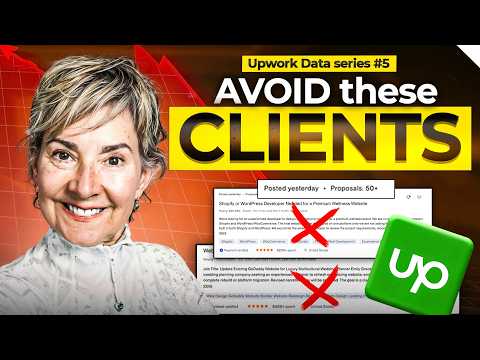
- 4,281 Jobs analysed
- $1M+ Lifetime Upwork earnings
- ~$67k Average per year
- ~$700 Average per job
The claim
That an analysis of 4,281 Upwork jobs shows freelancers save more time and money by avoiding ten client types than by improving their proposals.
- Jobs analysed — 4,281
- Any statistic produced by that analysis — None given
- Years on Upwork — More than 15
- Jobs completed — More than 1,434
- Lifetime earnings on Upwork — Over $1 million
- Average earnings per year — ~$66,700
- Average earnings per job — ~$697
- Business structure — Top Rated Plus agency — team size not stated
- Upwork fees and connects spent — Not stated
- Price of the "Upwork Stat 2026" ebook — Not stated
What is this income idea?
Win more profitable Upwork work by being stricter about which jobs you apply to, rather than by writing better proposals.
- The premise is that "the biggest problem is not always the proposal Sometimes the problem is the job you selected before you ever started writing". A strong proposal to a client who never hires is still a wasted connect.
- The credentials come early: more than 15 years on Upwork, more than 1,434 completed jobs, "over a million dollars", and a Top Rated Plus agency.
- Ten client types follow. Clients who post but rarely hire; budgets far below the scope; vague posts with no outcome; "free consultant" shoppers who want a full strategy before hiring; unpaid tests that are real work; scope that keeps changing before the contract; posts that lead with distrust; buyers who only ask for your lowest price; lots of meetings and no decision; and anyone who wants to work before the contract is funded or move payment off the platform.
- Each comes with a reasonable rationale and a suggested response: check hiring history, give a diagnosis and a next paid step rather than the whole solution, ask "What would you need to make a decision?", insist on a funded milestone.
- The close distils it to three questions — can this client hire, can I prove I solve this exact problem, and would winning it be good for my business — and points to a paid ebook, "Upwork Stat 2026", for "real Upwork data client pattern proposal strategies and the science".
Before spending a connect, check that the client actually hires, pays fairly and knows what they want — and walk away when they do not.
- Read the client history — Do they hire?
- Match budget to scope — Skip the impossible
- Find the outcome — Can you name it?
- Diagnose, do not deliver — No free strategy
- Refuse unpaid tests — If the work is usable
- Pin down scope — Before fixed price
- Ask for a decision — After reasonable talk
- Fund it on-platform — No work before
Practical screening rules — attributed to an analysis whose results are never shown.
A data claim without data is an anecdote with a big number in front
The lesson underneath the number
- Most of the advice in this video is sound, and some of it is genuinely useful. Read a client's hiring history before spending a connect. Treat an impossible budget as a statement about how the client values the work. When asked for a free strategy, give a diagnosis and a next paid step instead. Decline unpaid tests that produce usable work. Ask a client who keeps meeting without deciding what they would need to decide. Keep the contract funded and the payment on the platform. A newer freelancer who applied those rules would waste fewer proposals and avoid some bad contracts.
- The problem is the frame. "I analyzed 4,281 Upwork proposal jobs" is the first sentence and the last section heading, and it implies the ten categories were discovered by measurement. Nothing in the video shows that. There is no share of jobs from non-hiring clients, no award rate for low-budget posts, no comparison of win rates, no count of connects saved. The one numerical example is hypothetical. A list of red flags drawn from fifteen years of experience would be worth exactly as much — and would be described more accurately.
- The earnings figure works similarly. Over a million dollars and more than 1,434 jobs across fifteen-plus years is real evidence of a durable business: roughly $67,000 a year and $700 a job, on our arithmetic, earned through an agency rather than alone and before Upwork's fee. That is an honest, respectable result. It is quite different from the impression a seven-figure number gives on its own.
- Finally, the data the video does not show is what the closing pitch sells. The "Upwork Stat 2026" ebook promises real Upwork data and "the science". That may well be in it. But the video uses the existence of the analysis as authority while withholding everything it found, which is the structure FTC guidance on endorsements and earnings claims asks viewers to be alert to.
A job can be winnable and still be unprofitable stressful or poorly aligned with your goals.
The most useful sentence in the video — and it needs no data set
The screening rules, as she gives them
Useful, recognisable, and offered without a single supporting figure.
- Check whether the client actually hires — "A client may post 10 jobs and hire only once." Look for evidence they have spent money and completed projects. Sensible — and the one place a number from the 4,281 jobs would have been most useful.
- Treat the posted budget as information — A full website, e-commerce, SEO, branding and support on a tiny budget "reveals how the client currently values the project". Negotiating up "occasionally" works; usually you spend the contract defending your price.
- Give a diagnosis, not the solution — A strong reply includes "your diagnosis a relative example the process you would follow and the next paid step". The clearest single tactic in the video.
- Decline usable unpaid tests — "If the work provides direct business value it should generally be paid." Especially when the test seems split among applicants.
- Force a decision — For clients who meet repeatedly without committing: "What would you need to make a decision?" A good line, because activity "can feel like progress".
- Keep work and payment on the platform — Be cautious of anyone who wants you to start before the contract is active, refuses to fund a milestone, or wants to move payment outside Upwork.
- Ask the third question — "Would winning this job be good for my business" — because "a job can be winnable and still be unprofitable stressful or poorly aligned with your goals".
The business model
Client contracts won through Upwork proposals, delivered through a Top Rated Plus agency.
Upwork clients with a hiring history, realistic budgets and a defined problem.
Relevant proof of having solved the same problem, a clear diagnosis and a defined next paid step.
Upwork search and proposals, with connects spent selectively on high-intent posts.
- Connects — Named as the cost of every proposal; never priced
- Upwork service fee — Not mentioned
- Agency team — Implied by "agency"; size and cost not stated
- Unpaid interview and scoping time — The main waste the video targets
The video is about avoiding wasted cost, yet quantifies none — not connects spent, not hours lost, not fees paid.
What you would actually need
Money
Not discussed beyond the cost of each proposal: "It cost connects It costs time It costs attention and sometimes it costs confidence."
Connects are a real per-proposal cost on Upwork and the video is right that wasted ones add up, but it never says what they cost or how many she spent across 4,281 jobs. Upwork's own service fee on earnings goes unmentioned, which matters when reading a lifetime earnings figure.
Costs mentioned or implied, never priced
- Connects for every proposal submitted
- Upwork’s service fee on earnings
- Team costs inside a Top Rated Plus agency
- Unpaid time on interviews that go nowhere
- The "Upwork Stat 2026" ebook — price not stated
Time
Fifteen-plus years on the platform. No estimate of how long screening each job takes, or how long a newcomer needs before this matters.
The screening itself is quick — reading a client's history and a job post carefully. The bigger time saving is in the interviews and "high activity low decision" clients she tells you to drop, and that is plausible even without figures.
Where the time goes
- Reading client hiring and spend history
- Judging whether scope and budget match
- Interviews, follow-ups and scoping calls
- Writing targeted proposals with relevant proof
- Building the proof she says should win work
The part you must pay attention to
The analysis is the headline. Its results never appear.
The video opens "I analyzed 4,281 Upwork proposal jobs and I found something that can save freelancers more time more money than any other proposal template ever will", and returns to "the real lesson from 4,281 jobs" at the end.
- Jobs analysed — 4,281
- Client types to avoid — 10
0 figures
Hire rates, shares or comparisons reported
An analysis of four thousand jobs would naturally produce numbers: what share of posts came from clients who rarely hire, how often low-budget jobs were awarded, how win rates differed by client type, how much time or how many connects the bad categories consumed. None of those appears. The single quantity in the advice — "a client may post 10 jobs and hire only once" — is a hypothetical, not a finding. The conclusion offered from 4,281 jobs is that "freelancers need to become better at saying no", which is reasonable but is not something a data set was needed to say. The data is then offered in a paid ebook that promises "real Upwork data" and "the science". From the video alone, a viewer cannot tell whether the 4,281 jobs produced any measured result at all.
The earnings credential deserves the same arithmetic. Over $1 million across more than 15 years is about $66,700 a year, and across more than 1,434 jobs about $697 a job. That is a solid freelance business, and it is earned through "a top rated plus agency" — so some of it presumably paid other people, and none of it is shown net of Upwork's service fee. It is good evidence of longevity and reputation. It is not evidence that the ten rules, rather than fifteen years of reviews and a team, are what wins the work.
- THE ANALYSIS
- Jobs analysed 4,281
- Client types named 10
- Hire rates reported 0
- Win rates by type 0
- Connects wasted, measured 0
- The "data": in a paid ebook
- THE EARNINGS (ours)
- $1,000,000 / 15 years
- = ~$66,700 a year
- $1,000,000 / 1,434 jobs
- = ~$697 a job
- 1,434 / 15 = ~96 jobs a year
- Gross, via an agency,
- before Upwork fees and team
The economics
Real longevity, modest annual figures, and no measured savings.
- Lifetime Upwork earnings — Over $1,000,000
- Years on Upwork — More than 15
- Jobs completed — More than 1,434
- Average per year — ~$66,700
- Average per job — ~$697
- Jobs per year — ~96
- Jobs analysed for the video — 4,281
- Connects, fees, team costs — Not stated
Turning the lifetime total into annual figures
$1,000,000 ÷ 15 years ≈ $66,700 a year; $1,000,000 ÷ 1,434 jobs ≈ $697 a job; 1,434 ÷ 15 ≈ 96 jobs a year
A steady agency-scale freelance business averaging about $67,000 a year in gross platform earnings
IncomeIdeaLab calculation from the figures stated in the video
"More than" and "over" make these floors, and earnings were almost certainly uneven across the years. The figures are gross of Upwork's service fee and are earned through an agency, so they are not a personal income.
- Any result from the 4,281-job analysis
- How the 4,281 jobs were chosen, and over what period
- Connects spent and proposals won, overall or by client type
- Upwork fees paid on the $1 million
- Team size and costs within the agency
- The price of the "Upwork Stat 2026" ebook
- The analysis is described as of "proposal jobs" at the start and simply "jobs" at the end; what was counted is not explained.
- "A client may post 10 jobs and hire only once" is offered as an illustration, not a measured rate.
- Earnings and job counts are lifetime totals, which flatter growth: a business averaging ~96 jobs a year could have been much smaller early on and larger now.
- The video correctly treats each proposal as a cost — in connects, time and confidence — but does not estimate any of them.
Evidence status
Every substantive claim in the video.
- Analysed 4,281 Upwork jobs — Creator — Stated three times; no result from it is given.
- Job selection saves more than any proposal template — Creator — Plausible, but no comparison is shown.
- 15+ years and 1,434+ jobs on Upwork — Creator — Consistent with ~96 jobs a year.
- Earned over $1 million — Creator — About $67,000 a year, via an agency, before fees.
- Top Rated Plus agency — Creator — Team size and costs not given.
- Clients who post often but rarely hire are a warning sign — Creator — Sensible; illustrated hypothetically.
- Low budgets reveal how clients value the work — Creator — Reasonable judgment, not measured.
- Unpaid usable tests should generally be paid — Creator — Sound professional advice.
- Keep work and payment on the platform — Creator — Sound and protective.
- The ebook contains "real Upwork data" — Creator — Not shown in the video; price not stated.
What is actually proven?
Good judgment is shown. The analysis is asserted.
- Ten specific client warning signs with practical responses.
- A clear tactic for free-strategy requests: diagnosis plus next paid step.
- The ebook is disclosed as her own product.
- 15+ years, 1,434+ jobs and over $1 million on Upwork.
- About $67,000 a year and $697 a job on average, gross.
- Any measured finding from the 4,281 jobs.
- Fees, connects and team costs behind the earnings.
What the headline doesn’t tell you
The rules are good. The research behind them is invisible.
- 4,281 jobs, zero statistics. — Not one rate or share.
- The one number is hypothetical. — "Post 10 jobs and hire only once."
- $1M is over 15+ years. — About $67,000 a year.
- It is an agency. — Team size never given.
- Gross of Upwork’s fee. — Which is never mentioned.
- Connects are a cost. — Never priced or counted.
- The data is in an ebook. — Price not stated.
- The lesson needs no data. — "Get better at saying no."
Should you try it?
Use the checklist; ignore the research framing
The ten red flags are free, practical and low-risk to apply. Do not buy anything because of the 4,281-job claim until you see a number from it.
- Practical value of the red flags — 8 — Specific, recognisable and actionable.
- Evidence for the analysis — 1 — Cited three times, never quantified.
- Clarity of the earnings credential — 5 — Lifetime, via an agency, before fees.
- Cost disclosure — 2 — Connects and fees named or implied, never priced.
- Protective advice — 8 — Funded milestones, on-platform payment, no free strategy.
- Conflict-of-interest disclosure — 6 — Ebook is hers; price and contents unshown.
- Beginner accessibility — 7 — Anyone can apply these filters today.
- If you freelance on Upwork, the ten client types are a useful checklist and cost nothing to adopt. Check whether a client has actually hired before; treat an unrealistic budget as information rather than a negotiation; answer requests for a full strategy with a diagnosis and a next paid step; refuse unpaid tests that produce usable work; ask the endlessly meeting client what they need to decide; and keep payment on the platform with a funded milestone. Those are good habits regardless of where they came from.
- What you should not do is treat them as research findings. The video says they came from analysing 4,281 jobs, but reports nothing that analysis measured. If the data matters to you — say, how often low-budget posts actually hire, or what share of clients never hire — ask for it before paying for the ebook that claims to contain it.
- Read the credential in annual terms. About $67,000 a year across fifteen-plus years, through an agency and before Upwork's fee, is a real and durable result. It also tells you this is a long game built on reputation, reviews and a team, not something a set of screening rules produces quickly.
- One caution in the other direction: a newer freelancer with few reviews may not be able to be as selective as someone with fifteen years of history. The third question — would winning this be good for my business — still applies, but the answer may sometimes be yes to work a veteran would turn down.
Passive or automated?
Automation
Screening, proposals and delivery are all manual judgment.
Passive potential
Client services income; it stops when the work does.
Freelancing on Upwork is active work by definition, and the video does not suggest otherwise. Better job selection reduces wasted effort — fewer dead-end proposals, interviews and difficult contracts — but every won job still has to be scoped, delivered and supported, and an agency adds the work of managing a team. Nothing here generates income without someone doing the work.
- Reading every job post and client history
- Writing targeted proposals with relevant proof
- Scoping, interviewing and negotiating
- Delivering the work
- Managing the agency team behind the earnings
Recommended beginner experiment
Run your own small version of the analysis she does not show.
- Log every job you consider. — Client history, budget, scope clarity.
- Apply her ten filters before bidding. — Note which ones fire.
- Record connects spent per proposal. — And the outcome.
- Use diagnosis-plus-next-step replies. — For free-strategy requests.
- Refuse usable unpaid tests. — Offer a small paid test instead.
- Review after 50 proposals. — Which filters predicted wins?
- Keep every contract funded. — No work before the milestone.
- Buy data only when you see some. — One number from 4,281 would do.
Our verdict: 5/10
A good red-flag checklist sold as a study with 4,281 jobs analysed and nothing from the analysis reported
Credited for ten specific, practical client warning signs; for a clear response to free-strategy requests — a diagnosis, a relevant example, the process and the next paid step; for advice to refuse unpaid usable tests, force a decision from clients who only meet, and keep payment funded and on the platform; for the useful third question of whether a winnable job is good for the business; and for disclosing the ebook as her own. Marked down because the video's headline claim — that the advice comes from analysing 4,281 Upwork jobs — is supported by no reported figure of any kind; because its one numerical example is hypothetical; because the $1 million credential is a fifteen-year agency total, about $67,000 a year before Upwork's fee, presented without that context; because connects, fees and team costs go unpriced in a video about avoiding wasted cost; and because the data withheld in the video is what the paid ebook sells.
Taken as advice from someone with fifteen years on Upwork, this video is worth a freelancer's time. The ten client types are recognisable and the responses are practical: check hiring history before bidding, read a mismatched budget as a signal, offer a diagnosis and a next paid step instead of a free strategy, refuse unpaid tests that produce usable work, ask the client who keeps meeting what they need to decide, and never start before the milestone is funded. The closing question — would winning this job actually be good for my business — is the best line in it. The trouble is the authority it borrows. "I analyzed 4,281 Upwork proposal jobs" frames the whole video, yet no hire rate, award rate, share of bad clients or comparison of any kind is reported; the only number in the advice is a hypothetical client who posts ten jobs and hires once; and the "real Upwork data" is offered in a paid ebook at a price the video does not give. The earnings credential needs context too. Over a million dollars across more than fifteen years and 1,434 jobs is about $67,000 a year and $700 a job, earned through an agency and before Upwork's fee — a solid, durable business, and a long way from what a seven-figure headline suggests. Use the checklist; ask to see the data before paying for it.
- Jobs analysed — 4,281
- Findings quantified — None
- Lifetime earnings — Over $1M in 15+ years
- Average per year — ~$66,700
- Average per job — ~$697
- Upwork fees, connects, team — Not stated
- Ebook — Disclosed, unpriced
- Beginner suitability — Checklist yes, data claim no
Sources
- Stop Applying to THESE Upwork Jobs (2026) — Colette Barry l Freelancer Upwork Strategy — YouTube video, 2026-07-29
- FTC — Guides Concerning the Use of Endorsements and Testimonials — Regulatory guidance on earnings claims