E-commerce / Print on Demand · Claim Review
“I’ve Designed 10,000+ T-Shirts, Here’s What Actually Sells”
What we found: A Sound T-Shirt Ideas Method — Sold on a $73,000 Shirt With No Costs Attached and a “10,000+ Designs” the Video Does Not Mention
The find-decode-flip process is clear and anti-copycat. The headline result is one design’s first-year revenue, with no price, units, printing cost or ad spend behind it.
- $73k+ One design, year one
- ~$6,080 Per month on average
- 10,000+ Title’s design count
- None given Costs and ad spend
The claim
That a deliberately unglamorous history-niche shirt, built by decoding why an unrelated bestseller sold, “made over $73,000 in the first year alone”, and that the same three-step method is how bestsellers get made.
- First-year revenue from one design — Over $73,000
- Average per month over that year — ~$6,080
- Average per day — ~$200
- When the design was made — “Four years ago”
- Retail price, units sold — Not stated
- Sales table in the intro (0:07), arrowed row — 3,530 | $71,918.50 | … | $71,266.58 — headers not visible
- Printing, platform and ad costs — Never stated
- Bestseller the design was derived from — Not named
- “Designed 10,000+ t-shirts” (title) — Not in the audio
- Style vs concept share of a sale — ~20% / ~80%
What is this income idea?
Print-on-demand t-shirts, with the effort put into the idea rather than the artwork: find designs that are already selling, work out the reason they sell, and build new designs on that reason instead of copying them.
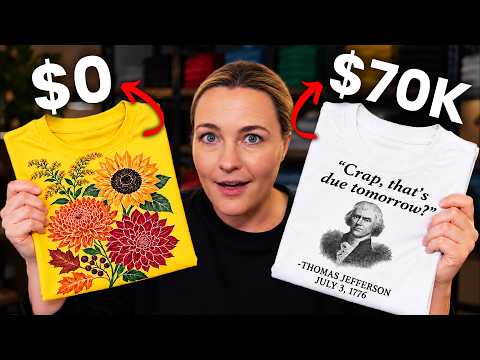
- The video opens with its result: “my bestselling designs are not my best looking designs”. One of them, a history-niche design featuring Thomas Jefferson, “made over $73,000 in the first year alone”, and they say they knew it would sell because the idea was derived from a bestseller in an unrelated niche.
- The core argument is against copying. They show a popular Etsy shirt — a penguin holding a knife with a line saying flight is off the table for it — then search the line and find page after page of near-identical versions. Every copier, they say, is now “splitting the same customer 40 different ways”, which makes the apparently safe move a gamble.
- Their alternative is a three-step method. Find: collect 5 to 20 designs that are demonstrably selling, using a shop’s review volume, a paid sales-estimate tool, Amazon review counts, or the “bestselling” sort on brands that advertise. Decode: separate style, image and words until you can state why it sells in one sentence. Flip: apply that reason somewhere new.
- The decode of the penguin is the strongest passage. The style helps, but every copier kept the style and none became a bestseller; the image alone is just odd; the joke lands only when “fight or flight” meets a bird that cannot fly. One level deeper, the pattern is “a two-sided saying and one creature that’s stuck on one side.”
- They then flip the pattern live into three new concepts — a rooster built on “put up or shut up”, a fishing cat built on “catch and release”, and a raccoon on a dumpster built on “feast or famine”, each stated with the same “… was not an option” construction (our paraphrase) — and recommend generating 20 to 50 concepts before opening a design tool.
- The video closes by promoting a free “brand blueprint” linked in the description, described as every resource they use from finding designs to launching a brand.
Don’t copy the shirt that sells; work out why it sells and use that reason for a shirt nobody has made yet.
- Find proven sellers — 5–20 designs
- Ignore whether you like them — Only whether they move
- Decode the style — ~20% of the sale
- Decode the concept — ~80% of the sale
- Name the pattern — One sentence
- Flip it elsewhere — New saying, new subject
- Batch 20–50 concepts — Before any design work
A clear ideation method. The selling, pricing and advertising that turn a concept into $73,000 are outside it.
Copy the reason, not the shirt — and read the $73,000 as revenue
The lesson underneath the number
- The demonstration at the centre of this video is persuasive because it is visible. They take one shirt that is selling, search its line, and show the page of near-identical versions it has spawned. Each copier did the apparently safe thing, and each is now competing for the same buyer with the same joke. Their point that this is “not safe, that’s a gamble” is well made and widely applicable beyond t-shirts.
- The decode is equally good. Separating style, image and words, and noticing that every copier kept the style without becoming a bestseller, isolates the concept as what actually sells. Taking it one level further — a two-sided saying and a creature stuck on one side — turns a single joke into a pattern, and the three flips they produce on camera show the pattern working as an idea generator. The 20/80 split between style and concept is their estimate, and they present it as one.
- The money figure deserves more care than the video gives it. “Over $73,000 in the first year” for one design is revenue, stated without a price or quantity, and print on demand spends a large share of every sale on producing and shipping the shirt. They mention an ad account in passing, so advertising was likely part of the picture; its cost is never given. We also do not know how many designs were produced before this one, which is the number that would tell a beginner what one hit costs.
- And the title claims something the audio does not. “I’ve designed 10,000+ t-shirts” is not said in the video. The video’s own evidence is one past design and one live exercise.
Every one of these people made the safe move and now they’re all splitting the same customer 40 different ways.
The clearest argument against copying in the video
The method, as they give it
Find, decode, flip — and then volume.
Taken from what is said and shown in the video. The sales table in the opening seconds is partly cropped and is described as shown.
- Start only from something that is selling — Signals they give: a shop with very large review counts where the design sits among its bestsellers, a paid tool estimating monthly sales for a listing, Amazon review volume, and the “sort by bestselling” menu on brands you have seen advertising.
- Collect without judging — “You’re not looking at whether they’re pretty, you’re looking at whether they are moving.” Screenshots of 5 to 20 designs, in or out of your niche.
- Decode style, image and words separately — Style catches the eye but is not what sells — every copier kept it. The concept lands “in the half second where the buyer gets the joke.” They estimate style at about 20% and concept at about 80%.
- Go one level deeper — Reduce the concept to a reusable pattern you could hand to someone else. For the penguin: a familiar two-option saying and a creature that cannot do one of the options.
- Flip the pattern, not the shirt — Explicitly not “penguin but a different bird”. Find other two-sided sayings and a subject stuck on one side. They produce three new concepts on camera.
- Front-load 20 to 50 concepts — The idea is the hard part; turning it into artwork is “almost mechanical”. Write the list first, then run one batch design session.
The business model
Retail t-shirt sales, presumably fulfilled by print on demand; prices are never given.
Niche buyers — history fans in the headline example; farming, fishing, cat or general funny-animal audiences in the flips.
A joke or concept that lands instantly with someone in the niche, rather than an attractive design.
Etsy and Amazon are used for research; an “ad account” is referenced. How the $73,000 design was sold is not described.
- Production and shipping — Per shirt. Never stated
- Platform or store fees — Never stated
- Advertising — Implied by the ad-account reference; never stated
- Research tool — Optional, paid, unpriced
- Design time — 20–50 concepts per batch
The video is about the idea stage. Every cost that sits between an idea and $73,000 of revenue is outside its scope.
What you would actually need
Money
Little for the method itself. A paid sales-estimate tool is “nice to have” but “not necessary”; an AI chatbot can help decode designs.
The ideation is cheap. Turning ideas into $73,000 of sales is not covered: printing and shipping per shirt, the selling platform’s fees, and advertising — which they refer to when they say a good concept will “get clicks in the ad account” — are never priced.
Named or implied, never priced
- An optional paid tool estimating listing sales
- A design tool (Canva is named)
- Print-on-demand production and shipping per shirt
- Marketplace or store fees
- Advertising — an “ad account” is referenced
- Refunds and misprints
Time
Coming up with 20 concepts “sounds like a lot” but is the efficient way to work; the design session afterwards “honestly flies”.
Plausible for someone who has practised, and they say themselves it takes practice. How many designs they produced to find one that made $73,000, and how long that took, are not stated.
Where the time actually goes
- Researching 5–20 proven sellers per round
- Decoding each until the pattern can be said in one sentence
- Generating 20–50 concepts before designing
- Batch design sessions
- Listing, advertising and testing — not covered
- Practice: “something that you have to practice”
The part you must pay attention to
$73,000 is one design’s revenue, not what it earned.
The figure is stated twice — “it made over $73,000 in the first year alone” and “that shirt went on to generate over $73,000 in the first year alone” — with no price, quantity or cost attached.
- First-year revenue, one design — $73,000
- Per shirt, never stated — − printing & shipping
- An ad account is mentioned — − fees & ads
Unknown
Profit cannot be derived from the video
In print on demand most of each sale goes to producing and shipping the shirt, and the rest is exposed to platform fees and advertising. They refer to an “ad account” when explaining what makes a concept good enough, which implies the business buys traffic, but no spend is given. Without a retail price there is not even a unit count: at an assumed $25 to $30 a shirt — our assumption, not theirs — $73,000 would be roughly 2,400 to 2,900 shirts. A sales table appears behind the Jefferson shirt in the opening seconds (0:07), with its column headers cropped off. The arrowed row reads 3,530, $71,918.50, two small deductions and $71,266.58; if those are units, gross and net sales, the average is about $20.37 a shirt (our arithmetic). No row reads $73,000 and no dates or product names are visible, so the table cannot be tied to the figure spoken. Like the spoken figure, it shows revenue only: no printing, platform or ad cost appears on it.
None of this makes the figure implausible; it makes it incomplete. The video presents the $73,000 as evidence that the method works, but the method is about choosing an idea, and the revenue also depends on pricing, advertising, timing and the shop’s existing traffic, none of which is described. The bestseller the Jefferson design was derived from is not named, and the shirt’s actual wording is not given, so the decode that produced it cannot be checked. The title adds a second figure — “10,000+ t-shirts” designed — that never appears in the audio.
- THE ONE FIGURE
- Year-one revenue $73,000+
- Per month ~$6,080
- Per day ~$200
- IF A SHIRT RETAILS AT (our assumption)
- $25 -> ~2,920 shirts
- $30 -> ~2,430 shirts
- SALES TABLE IN THE INTRO (0:07, headers cropped)
- Arrowed row 3,530 | $71,918.50 | $71,266.58
- 71,918.50 / 3,530 = ~$20.37 (ours)
- Costs on the table none
- WHAT IS MISSING
- Price per shirt ?
- Print + ship per shirt ?
- Platform fees ?
- Ad spend ("ad account") ?
- Designs tried to find it ?
- -> profit not derivable
The economics
One revenue figure, nothing to set against it.
- First-year revenue, one design — Over $73,000
- Monthly average — ~$6,080
- Daily average — ~$200
- Implied units at $25–$30 a shirt — ~2,400–2,900
- Retail price — Never stated
- Production, fees, ad spend — Never stated
- Designs made to find this one — Never stated
What $73,000 means per day and per shirt
$73,000 ÷ 12 ≈ $6,080 a month; ÷ 365 ≈ $200 a day. At an assumed $25–$30 retail, ≈ 2,400–2,900 shirts
A strong single design by any measure — with profit undeterminable from the video
IncomeIdeaLab calculation; the retail price range is our assumption, not the creator’s
Sales are unlikely to have been even across the year; history-themed shirts can be seasonal around particular dates. The video gives no monthly breakdown.
- Retail price and number of shirts sold
- Printing and shipping cost per shirt
- Marketplace or store fees
- Advertising spend, despite an “ad account” being referenced
- Where the design was sold
- How many designs were made before this one succeeded
- Evidence for “10,000+ t-shirts” designed
- The design is described as made “four years ago” and as earning $73,000 in its first year. Earnings since then are not given.
- The penguin shirt’s shop is described as having “hundreds of thousands of reviews”. That is offered as a signal of a proven seller, not as data, and was not checkable from the video.
- The sales table in the opening seconds lists seven rows with gross figures from $50,052.63 to $83,105.52; the arrowed row is $71,918.50 gross. Column headers, dates and product names are not visible.
- The Jefferson design’s concept is described as being about leaving something huge until the last minute. The source bestseller in the unrelated niche is not identified, so the decode that produced it cannot be followed.
- The call to action is a free “brand blueprint” linked in the description. Whether it leads to a paid course is not stated in the video.
Evidence status
Every substantive claim in the video.
- One design made over $73,000 in its first year — Creator — Revenue only; no price, units, costs or ad spend.
- Sales table: arrowed row 3,530 | $71,918.50 | $71,266.58 — On screen at 0:07, headers cropped — Shown on screen but not fully readable. Revenue columns only; not identifiable as the $73,000 shirt.
- “I’ve designed 10,000+ t-shirts” (title) — Video title — Never stated in the audio.
- Copying a bestseller splits the customer “40 different ways” — Creator, with an Etsy search — Shown on screen with a live search.
- Style is ~20% of a sale, concept ~80% — Creator — Their estimate, presented as such.
- Find–decode–flip produces new, proven concepts — Creator — Three new concepts produced on camera; their sales are untested.
- The Jefferson shirt was derived from an unrelated bestseller — Creator — The source bestseller is not named.
- Brands’ “bestselling” sort reveals their sales data — Creator — A sensible research shortcut; the sort order is set by each brand.
- “It is how best sellers get made” — Creator — One historical example and one untested exercise.
- Costs, ad spend, profit — Nobody — Absent throughout.
What is actually proven?
The method is shown. The result is asserted.
- Copycat listings of a selling design, shown through a live search.
- A step-by-step decode of why one design sells.
- Three new concepts flipped from the decoded pattern.
- One design earning over $73,000 in revenue in its first year.
- That averages about $6,080 a month, or $200 a day.
- The title’s 10,000+ designs.
- Price, units, production cost, fees, ad spend and profit.
What the headline doesn’t tell you
The method is the real content. The number is the hook.
- $73,000 is revenue. — For one design, in one year.
- No price, no units. — So no margin.
- An ad account exists. — Spend not given.
- It was four years ago. — Earnings since are unstated.
- 10,000+ is title-only. — Never said in the audio.
- The source bestseller is unnamed. — The decode can’t be checked.
- New concepts are untested. — Three ideas, no sales yet.
- A blueprint is the call to action. — Free, via the description.
Should you try it?
Yes for the ideation method; budget separately for selling
The decode-and-flip process is cheap to practise and avoids the copycat trap. It does not tell you how to price, advertise or profit.
- Usefulness of the method — 8 — Clear steps, live example, transferable pattern.
- Honesty about copying — 8 — Explains why the “safe” move is a gamble.
- Evidence for the income claim — 3 — One revenue figure, stated without supporting detail.
- Cost disclosure — 1 — No production, fee or ad cost given.
- Title accuracy — 3 — 10,000+ designs is not in the audio.
- Beginner accessibility — 7 — Needs research time, not money, to start.
- If you sell or plan to sell designs, the method is worth practising. Collect designs that are demonstrably selling, decode them until you can say in one sentence why they sell, and apply that reason somewhere new. It is cheaper than buying ideas and safer than copying, and their own live flips show how quickly it generates concepts.
- Treat the $73,000 as an illustration of what one strong concept can do, not as an expectation. It is a single design’s first-year revenue, made four years ago, with no price, unit count, printing cost, fees or advertising disclosed — and they refer to an ad account, so traffic was probably bought for at least some designs.
- Remember that a concept is the start. Print-on-demand margins depend on the price you can charge after production and shipping, and on whether your traffic is free or paid. None of that is in this video.
- And note the title. The video does not claim 10,000 designs anywhere in its audio; its evidence is one past success and one exercise.
Passive or automated?
Automation
Fulfilment can be outsourced; ideas, design and promotion cannot.
Passive potential
A design can keep selling, but new concepts are needed continuously.
A single successful design can sell for a long time once listed, and print on demand removes the need to hold stock. But the method in this video is explicitly a continuing creative process: research proven sellers, decode them, generate 20 to 50 concepts per round, then design in batches. The reference to an ad account suggests that paid promotion is part of selling, which is an active cost and an active job. Nothing about the $73,000 design is described as passive.
- Researching proven sellers each round
- Decoding and flipping concepts
- Producing designs in batch sessions
- Listing and pricing products
- Running and paying for ads
Recommended beginner experiment
Practise the method on paper before spending anything.
- Screenshot ten proven sellers. — In and out of your niche.
- Decode each in one sentence. — Style, image, words, pattern.
- Flip each into two concepts. — Never the same subject or line.
- Shortlist your best five. — The ones that make you smile.
- Price the shirt before designing. — Production, shipping, fees.
- List without ads first. — See if the concept moves on its own.
- Track units, not revenue. — And cost per sale if you advertise.
- Repeat in batches. — Their 20–50 concept habit.
Our verdict: 5/10
A genuinely useful ideation method, sold on an incomplete number and a title figure the video never says
Credited for a clear, three-step method demonstrated live on a real selling design; for showing, with an on-screen search, why copying a bestseller leaves sellers splitting the same buyers; for a decode that separates style from concept and reduces it to a reusable pattern; for generating three new concepts on camera; and for presenting the 20/80 style-to-concept split as an estimate. Marked down because the $73,000 is one design’s first-year revenue with no price, unit count, production cost, fees or advertising spend despite an ad account being referenced; because the bestseller behind it is not named; and because the title’s “10,000+ t-shirts” never appears in the audio.
As advice on coming up with t-shirt ideas, this is better than most. The creator shows a design that is selling, searches its line and finds dozens of near-copies, and makes a convincing case that copying is the risky choice because everyone ends up competing for the same buyer. Their alternative — find proven sellers, decode them until the reason they sell fits in one sentence, then flip that reason to a new subject — is demonstrated step by step, and the three concepts they produce on camera show it working as an idea engine. The 20/80 split between style and concept is offered as their estimate, which is the right way to present it. The income evidence is thinner. The $73,000 is one design’s revenue in its first year, four years ago, with no price, unit count, printing cost, platform fees or advertising spend, even though an ad account is mentioned. The bestseller that inspired it is not named, so the decode that produced it cannot be followed. And the title’s “10,000+ t-shirts” is not said anywhere in the audio. Use the method; cost out the selling side yourself.
- One design, year one — $73,000+
- Monthly average — ~$6,080
- Implied shirts — ~2,400–2,900 at $25–$30
- 10,000+ designs — Not in audio
- Production, fees, ads — Never stated
- Profit — Not derivable
- Beginner suitability — Method yes; model needs costing
Sources
- I’ve Designed 10,000+ T-Shirts, Here’s What Actually Sells — Meg Heckman — YouTube video, 2026-09-08
- FTC — Guides Concerning the Use of Endorsements and Testimonials — Regulatory guidance on earnings claims