E-commerce / 3D Printing · Strategy Review
“How to Design Best-Selling Products: The Triple Diamond Framework”
What we found: One 3D-Printed Product Brought In a Stated 375,000 in Revenue; the Per-Part Saving Adds Up, but Price, Units Sold and Profit Are Not Given
The design framework is explained step by step and the cost-per-part arithmetic checks out at the low end of the stated volume. The revenue is a gross figure, and the electronics, fees and margin behind it are not stated.
- 375,000 Revenue from one product
- 85% Share of total revenue
- $10 → ~$5 Cost per part
- Not stated Profit
The claim
That a structured three-stage design process — find the problem, find the solution, make it production ready for 3D printing — produced a best-selling product that brought in 375,000 in revenue in a year, and that the third stage alone halves the cost per part.
- Revenue from the slow feeder last year — 375,000
- Share of the business’s total revenue — 85%
- Implied total revenue — ~441,000
- Print time before and after redesign — 7 hours → 5 hours
- Filament before and after — 181 g → 140 g (41 g was support)
- Cost per part before and after — $10 → about $5
- Current production — 300–400 feeders a month
- Stated saving — 1,500 a month, 18,000 a year
- Selling price, units sold, profit — Not stated
What is this income idea?
Design a physical product around a researched problem, then redesign it so it can be printed without supports and produced automatically on a print farm.
- The creator, who says they studied mechanical engineering and have over 10 years in the industry, presents a framework built on the double diamond design model: research the problem broadly, narrow to one problem statement, explore several solutions, then converge on one. They add a third stage specific to 3D printing: redesigning the product so it prints without supports and can run on the farm without manual handling.
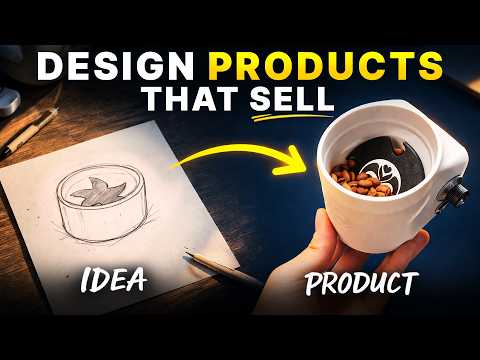
- The worked example is a slow feeder that feeds coffee beans into a grinder a few at a time. The creator says they started researching coffee extraction about two years ago, noticed home baristas slow-feeding beans by hand, tested three mechanisms with rough prototypes, chose an angled rotating disc, and validated demand by posting in a Facebook group for coffee enthusiasts. Version one launched without variable speed, with a self-assembly kit option at a lower price.
- They say the product brought in 375,000 in revenue last year, 85% of the business’s total. The third stage is credited with cutting print time from 7 to 5 hours, filament from 181 g to 140 g and cost per part from $10 to about $5, a saving of 1,500 a month at current production of 300 to 400 feeders.
- The video has a disclosed sponsor read for a domain registrar, and closes by offering a free framework document and a product design course inside the creator’s paid community, which they say has 400 active members.
Research a real problem, prototype quickly, then redesign the product so a print farm can make it cheaply without anyone touching it.
- Research the problem — Forums, reviews
- Define one problem — Converge
- Prototype options — Three mechanisms
- Validate demand — Facebook group
- Design for printing — No supports
- Automate production — 300–400 a month
The process is well explained; the commercial results behind it are partly stated.
The design lesson is real; the business result is half the picture
The lesson underneath the number
- This is a well-structured video. The double diamond is a recognised design method, and the creator applies it concretely: they name the problem, the three mechanisms tested, why the angled disc won, and how designing for support-free printing shaped the choice early. The point that a product needing supports and manual handling will not scale on a print farm is a useful one for anyone selling prints.
- The figures for the redesign hold together. The filament drops from 181 g to 140 g, which is the stated 41 g of support removed. A $5 saving per unit at 300 units a month is the stated $1,500 a month, and twelve months of that is the stated $18,000. At the 400-unit end of the stated range the saving would be $2,000 a month.
- The headline result is thinner than the framework. The 375,000 is revenue, stated once, with no selling price, no unit count for last year and no costs beyond the printed part. An automatic slow feeder carries a motor, batteries and a switch in every unit, and the video does not say what those cost. The stated cost per part also appears to refer to the printed housing, which the creator says has three printed parts; the saving is then applied per feeder.
- The creator credits themselves only with the design. Marketing, photography, listing and pricing are named as the next stage and left for another video, so the video does not explain how 375,000 of sales were reached. The sponsor read is announced as such, and the closing section promotes a free document and a paid community with a course.
The Triple Diamond gets you a great product but you still need to get in front of the right people.
The creator, near the end of the video
The process, as described
Three diamonds, each going wide and then narrowing.
Costs are given for the printed part only; no figure is given for electronics, fees or marketing.
- Discover and define — Research the problem broadly, then narrow to one statement. For the slow feeder: hand-feeding beans works but is tedious and inconsistent, so people need an automatic way to do it.
- Develop and deliver — Prototype several approaches quickly rather than perfecting each. The creator tested a flat disc, an angled disc and a spiral mechanism, and chose the angled disc partly because it could be printed without supports.
- Validate before scaling — A video of the prototype was posted in a coffee Facebook group and drew what the creator calls huge likes and comments. No count of responses, pre-orders or sign-ups is given.
- Launch a simpler version one — Variable speed was left for a second version so the product could launch before competitors. A kit option let customers assemble it themselves at a lower price; the price is not stated.
- Design for 3D printing — Internal geometry was reworked so the housing prints with zero supports, cutting print time from 7 to 5 hours and removing manual post-processing.
- Automate the farm — An automatic plate-swapping system removes the labour of detaching parts and reloading plates. Its cost is not stated.
The business model
Sales of a 3D-printed coffee grinder accessory with electronics, sold assembled or as a self-assembly kit.
Home baristas interested in slow-feeding beans into their grinder.
An automatic version of a technique enthusiasts were doing by hand, one bean at a time.
Not stated. The creator mentions moving from marketplaces to an own store only in the sponsor read.
- Printed housing — About $5 per unit after redesign, stated
- Electronics — Motor, batteries, switch, speed control. Not stated
- Print farm and automation — Not stated
- Shipping and packaging — Not mentioned
- Platform and payment fees — Not mentioned
- Marketing — Next topic, per the creator; not stated
One cost line is given a figure, for the printed part; the rest of the bill of materials and selling costs are not stated.
What you would actually need
Money
Not discussed, beyond the per-part cost.
The example product depends on a print farm, an automated plate system, sourced electronics and a sales channel. None of these is priced in the video, and a beginner would need several printers before the per-part saving matters.
Costs that apply, not priced in the video
- Printers and the automatic plate-swapping system
- Motor, batteries, switch and speed control for each unit
- Filament and electricity (part of the stated per-part cost)
- Packaging and shipping
- Marketplace, payment or storefront fees
- Marketing and product photography
- Returns and warranty replacements for an electronic product
Time
Research began about two years before the video.
The creator is clear that the research stage took time and that most failures come from skipping it. Design skill in CAD is assumed throughout.
Where the time goes
- Researching the problem and the market
- Learning CAD and iterating prototypes
- Sourcing and assembling electronics
- Redesigning for support-free printing
- Listing, photography and customer service
The part you must pay attention to
The 375,000 is revenue. The only cost given is for the printed part, so the profit on the product cannot be worked out from the video.
The creator says the slow feeder "generated 375,000 in revenue" last year. The selling price, the number sold last year and every cost except the printed part are not stated.
- Stated revenue, last year — 375,000
- Printed part, per unit, now — ~$5
- Electronics, shipping, fees, marketing — ?
Unknown
Profit from the product
Everything after the printed housing is missing: the motor, batteries and switch in each unit, packaging, shipping, platform fees and marketing. For an electronic product these are likely to cost more than the printed part, and the video gives no figure for any of them.
The saving arithmetic is consistent. Cutting $5 per unit at 300 units a month is $1,500 a month and $18,000 a year, as stated; at the 400-unit end it would be $2,000 a month (our calculation). If the current 300 to 400 units a month had held all year, the revenue would imply roughly 78 to 104 per unit (our calculation, assuming that volume, which the video does not state for last year).
- THE STATED SAVING
- $10 - $5 = $5 per unit
- x 300 a month = $1,500 (stated)
- x 400 a month = $2,000 (ours)
- $1,500 x 12 = $18,000 (stated)
- THE REVENUE
- 375,000 / 85% = ~441,000 total
- 375,000 / 3,600-4,800 units
- = ~78-104 per unit
- (if 300-400/month held all year)
- PROFIT ???
The economics
A revenue figure, a per-part cost and a volume range.
- Slow feeder revenue, last year — 375,000
- Share of total revenue — 85%
- Cost per part before redesign — $10
- Cost per part after — About $5
- Current monthly production — 300–400 feeders
- Selling price — Not stated
- Units sold last year — Not stated
Checking the stated saving
($10 − $5) × 300 = $1,500 a month; × 12 = $18,000. At 400: $2,000 a month, $24,000 a year
The stated saving matches the low end of the stated volume
IncomeIdeaLab calculation from the figures stated in the video
The video treats the per-part figure as a per-feeder saving. Whether it covers all three printed housing parts is not stated. The saving is in production cost and says nothing about the margin on each sale.
- Selling price of the assembled feeder and the kit
- Number of units sold last year
- Cost of the electronics in each unit
- Cost of the print farm and automatic plate system
- Shipping, packaging, platform and payment fees
- Marketing spend, if any
- Profit on the product or the business
- The currency of the 375,000 is not named in the video; the per-part costs are given in dollars.
- Demand validation is described as a well-received Facebook group post; no number of responses, orders or sign-ups is given.
- The creator says some prominent YouTubers had tested slow feeding and confirmed results; no names or details are given, and we make no claim about the coffee benefit either way.
Evidence status
Every figure and result stated in the video.
- Slow feeder brought in 375,000 last year — Creator — Gross revenue; no price, units or costs.
- That is 85% of total revenue — Creator — Implies about 441,000 in total (ours).
- Print time 7 → 5 hours — Creator — Plausible after removing supports.
- Filament 181 g → 140 g, 41 g support — Creator — Reconciles exactly.
- Cost per part $10 → about $5 — Creator, from their pricing tool — Printed part only.
- Saving 1,500 a month, 18,000 a year — Creator — Matches 300 units; 400 units would give 2,000.
- 300–400 feeders a month — Creator — Current rate; last year’s volume not stated.
- Strong demand from Facebook post — Creator — Not quantified.
- 400 active community members — Creator, in the closing promotion — We could not check this from the video.
- Profit on the product — Nobody — Not stated in the video.
What is actually proven?
The design steps are clear and the saving reconciles; the business result is gross only.
- The framework and its application to one product are explained step by step.
- The filament and monthly saving figures are internally consistent.
- The product is stated to have brought in 375,000 in revenue last year.
- The selling price, units sold and electronics cost.
- Profit on the product or the business.
What the headline doesn’t tell you
A design saving is not a margin.
- 375,000 is revenue. — Not profit.
- The price is not given. — Nor units sold.
- Electronics are in every unit. — Their cost is not stated.
- The $5 saving is per printed part. — Applied per feeder.
- The saving matches 300 units. — Not 400.
- Marketing is left out. — Saved for another video.
- A paid community is promoted. — Openly, at the end.
Should you try it?
A useful design method, not a sales forecast
Use the framework to design better products, then price the full bill of materials and selling costs before assuming a print farm product will pay.
- Clarity of the method — 8 — Each stage explained with one worked example.
- Evidence for the revenue — 3 — One stated gross figure.
- Cost disclosure — 4 — Printed part costed; everything else not.
- Arithmetic consistency — 8 — Filament and savings reconcile.
- Beginner accessibility — 4 — Assumes CAD skill and a print farm.
- The most transferable lesson is the third stage: a product that needs supports and manual handling costs more labour per unit than the print time suggests, and designing that out early matters once volumes grow. A beginner can apply this on one printer.
- What the video cannot tell you is whether a product like this is profitable. The example includes electronics in every unit, and no cost is given for them, for shipping, or for selling. Before building a product like this, cost every component and every fee and set a price that leaves a margin after all of them.
- The creator’s background is stated as mechanical engineering and over 10 years in industry. The prototyping and redesign steps assume a level of CAD skill that a beginner would need to build first.
Passive or automated?
Automation
Support-free printing and automatic plate swapping remove handling.
Passive potential
Assembly, shipping and customer service continue.
The creator’s point is that design choices decide how much of the printing can run unattended, and their farm system removes part detachment and plate reloading. The product still needs electronics fitted or kitted, units packed and shipped, and customers supported, and the video does not describe who does that or how long it takes.
- Fitting or kitting electronics
- Packing and shipping
- Maintaining the print farm
- Customer service and returns
- Designing the next version
Recommended beginner experiment
One product, fully costed, before scaling.
- Pick one problem. — From forums and reviews.
- Prototype two or three ideas. — Rough prints only.
- Cost the full unit. — Print, hardware, packaging, shipping, fees.
- Validate with real orders. — Not just likes.
- Redesign for no supports. — Measure time saved.
- Track margin per unit. — Before adding printers.
Our verdict: 5/10
A clear design method with a revenue figure and half a cost sheet the saving reconciles; the profit is not stated
Credited for a concrete, step-by-step design framework, a worked example with named trade-offs, per-part figures that reconcile, and an announced sponsor read. Marked down because the 375,000 is a gross revenue figure with no selling price or unit count, because electronics, shipping, fees and marketing are not costed, and because the stated monthly saving matches only the low end of the stated production range.
As a design lesson this video is useful. The creator shows how researching a problem, testing rough prototypes and then redesigning for support-free printing turned an idea into a product that, they say, brought in 375,000 in revenue last year and 85% of the business’s total. The redesign figures hold together: 41 g of support removed takes the filament from 181 g to 140 g, and a $5 saving at 300 units a month is the stated $1,500 a month and $18,000 a year; at 400 units it would be $2,000 a month. As evidence of a profitable product, it is incomplete. The revenue is gross, the price and number sold are not given, and the only cost stated is the printed part, while each unit also carries a motor, batteries and a switch that are not costed. Marketing, which the creator says is the next chapter, is not covered. The sponsor read is announced, and the free document and paid community at the end are promoted openly.
- Product revenue, last year — 375,000
- Cost per part — $10 → ~$5
- Monthly saving — 1,500–2,000
- Profit — Not stated
- Beginner suitability — Learn CAD first
Sources
- How to Design Best-Selling Products: The Triple Diamond Framework — 3D Farmers — YouTube video, 2026-04-20
- FTC — Guides Concerning the Use of Endorsements and Testimonials — Regulatory guidance on endorsements