Ecommerce / Dropshipping · Claim Review
“The ONLY Shopify Dropshipping Tutorial You Need 2026: Ultimate Step-by-Step for Beginners”
What we found: Shopify Dropshipping Tutorial: The $3.5 Million Is From Two Existing Stores, and No Sales or Costs Are Given for the Store Built in the Video
The stated revenue adds up, two Shopify Analytics screens on screen show total sales of US$2,402,536.77 and US$1,172,430.67 for the last 365 days, and margins are given, which is more than most. The margin is not defined, product and shipping costs are not stated, and the method is promoted alongside affiliate links and a mentorship.
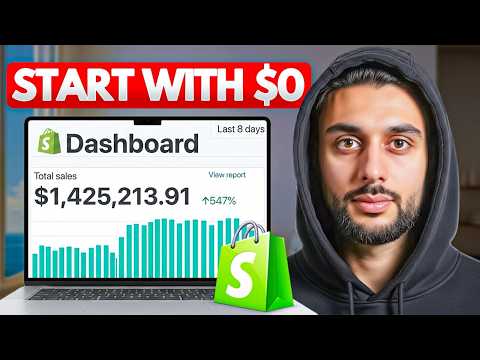
- $3.5M Two stores, last 365 days
- >25% Stated average margin
- ~$875k Implied profit, both stores
- None stated Demo store sales
The claim
That the step-by-step method in the video, from ad-spy product research to AI-built pages and Meta ads, is the same one the creator uses for stores that made $2.4 million and $1.1 million in the last year.
- Store one, last 365 days — $2.4 million said; Shopify Analytics on screen at 1:02 (9 Dec 2024 to 9 Dec 2025) shows total sales US$2,402,536.77, gross sales US$2,157,732.50 and net sales US$1,890,371.90, with 46,228 orders
- Store one profit margin — "Around about 24%"
- Store two, last 365 days — $1.1 million said; Shopify Analytics on screen at 1:37 (8 Dec 2024 to 8 Dec 2025) shows total sales US$1,172,430.67, gross sales US$1,138,554.05 and net sales US$1,028,148.62, with 14,412 orders
- Store two sales over the year — The chart at 1:37 shows most sales between about February and May 2025, peaking around April, and near zero after summer 2025
- Combined revenue — "Around about 3.5 million"; the two on-screen total-sales figures sum to US$3,574,967.44 (our arithmetic)
- Combined revenue, our check — $2.4M + $1.1M = $3.5M
- Average margin of the two stores — "Just above 25%"
- Store two margin implied by the average — ~27%
- Daily ad budget for a new product — $50 to $100
- Product cost and shipping cost — Not stated in the video
- Example store product page at 14:45 — Dhs 146.00 (was Dhs 371.00, "save 60%") for a window squeegee kit, in AED; not identified as the store built in the video; no cost shown
- Sales from the store built in the video — Not stated in the video
What is this income idea?
Find a product that others are already advertising profitably, sell it through a Shopify store supplied by a dropshipping agent, and buy customers with Facebook ads.
- The video opens with two of the creator's stores: $2.4 million in the last 365 days at a margin of "around about 24%", and $1.1 million in the same period. Combined, they say, that is about $3.5 million at an average margin "just above 25%". They also point to fulfilled orders against total orders to show that orders are being delivered. Shopify Analytics screens for the last 365 days are shown for both stores: total sales of US$2,402,536.77 (orders 46,228) at 1:02 and US$1,172,430.67 (orders 14,412) at 1:37, which include shipping and taxes. Gross sales are US$2,157,732.50 and US$1,138,554.05, and net sales US$1,890,371.90 and US$1,028,148.62. The second store's sales chart shows most of the year's sales between about February and May 2025, and near zero after summer 2025.
- Product research uses one method: an ad spy tool, Winning Hunter, filtered to English-language Shopify stores sorted by ad spend over the last 90 days. The example chosen is a silicone window-cleaning kit, which the creator then finds on AliExpress with 50,000 orders, as a sign of demand.
- The next step is a marketing angle. The creator copies an Amazon review page for the product into GenSpark with a prompt from their cheat sheet, and asks it for objections, desires and gaps. The angle chosen combines safety (cleaning high windows from the ground) and saving money against a professional window cleaner.
- The store is built on Shopify's free Dawn theme, with brand name, logo and page sections written by the creator's custom GPTs and Shopify's own AI section builder, images from Nano Banana Pro and video ads with AI avatars from Arcads. Products are supplied by Team Drop, which the creator recommends for its own warehouses and 5-to-8-day shipping.
- The ad setup is a Facebook campaign-budget campaign at $50 to $100 a day, three to five broad ad sets with a different angle in each, aimed at the US, UK, Australia, New Zealand and Canada or the EU, left to run for three days. Along the way the video promotes a one-to-one mentorship and links to most of the tools used.
Copy what is already selling on Facebook, find a sharper angle with AI, build the store with free AI tools, and test it with $50 to $100 a day in ads.
- Filter an ad spy tool — Winning Hunter, last 90 days
- Check AliExpress demand — 50,000 orders
- Mine Amazon reviews — GenSpark prompt
- Pick a combined angle — Safety plus savings
- Build on Dawn theme — Custom GPT sections
- Source from Team Drop — 5 to 8 day shipping
- Make AI ads — Arcads, Nano Banana Pro
- Test $50–$100 a day — 3 days, 3–5 ad sets
Every step is shown in practice; no step comes with a cost, a price or a sales result.
The research step is sound; the results belong to other stores
The lesson underneath the number
- The most useful part of the video is the angle research. Rather than copying the competitor's ad, the creator takes a product others are already advertising, mines several hundred Amazon reviews for complaints and wishes, and builds a message the competing ads do not use. Combining safety with a cost comparison against a professional cleaner is a specific, testable angle, and the instruction to check competitors' messaging before committing to one is good practice in any paid-ads business.
- The opening figures are also more complete than this genre usually offers. Two stores, two revenue figures that add up to the stated total, a margin for each, and a point made about fulfilled orders. What is missing is the definition of that margin. In a business where Facebook ads are the main variable cost, a 25% margin before ad spend and a 25% margin after it describe very different businesses, and the video does not say which this is.
- The method and the results are not connected in the video. The $3.5 million comes from two stores whose products, ad spend and history are not described. The store built on camera is the one a viewer would copy, and it ends part-built, with no sale price, product cost, shipping cost or ad result. The creator's demand signals, ads with high spend in a spy tool and 50,000 AliExpress orders, show that a product sells for someone; they do not show what it earns after costs, or that a new entrant will win the auction.
- Viewers should also weigh how the tools are presented. The Shopify link pays the creator an affiliate commission, which they say plainly. Links are given for Winning Hunter, Team Drop, GenSpark (which the creator says does not sponsor them), the image tool and the cheat sheet, and a one-to-one mentorship limited to 20 people is promoted in the middle of the video. The tools may well be good; the video does not compare any of them with alternatives on price.
If your video ads aren't to the same standard of the ones that are on the screen then they're not going to perform well.
The creator, on why beginners lose money on ads
The method, as the video gives it
From product research to a live ad campaign, in the order the creator follows.
No product cost, shipping cost, sale price or ad result is given for the example product.
- Filter ads by spend — In Winning Hunter: English, Shopify stores only, sorted by ad spend, created in the last 90 days. The creator uses its ad score, revenue against spend and ad history, plus an AI search for competitors selling the same product.
- Confirm demand on AliExpress — A keyword search finds the same window-cleaning kit with 50,000 orders, which the creator calls "clearly a proven product that's making money".
- Find an angle in Amazon reviews — An Amazon listing with 331 reviews is fed to GenSpark, which returns pain points, objections, desires and five marketing angles. The creator combines two: safety from the ground, and costing less than a professional cleaner.
- Check competitors' angles — A keyword search of other "winning" ads for the product shows angles the creator describes as basic, which they take as room for a different message.
- Build the store with AI — Shopify on the free Dawn theme; brand name, logo and section prompts from the creator's custom GPTs; sections generated by Shopify's own AI builder; product images from Nano Banana Pro. The creator stops part way: "it'll take me another 30 minutes".
- Source through Team Drop — Pushed into Shopify through Team Drop's app, with delivery stated at 5 to 8 days from its own warehouses. Free to sign up through the creator's link; product and shipping prices are not given.
- Run a three-day ad test — Three to five AI avatar video ads from Arcads, a campaign-budget Facebook campaign at $50 to $100 a day, three to five broad ad sets with one angle each, run for three days. The rest of the ad strategy is in the cheat sheet.
The business model
Retail sales of products sourced from a dropshipping agent, sold through a single-product Shopify store at a price the video does not set.
Homeowners in the US, UK, Australia, New Zealand, Canada or the EU, reached through broad Facebook ads.
For the example product: cleaning high windows safely from the ground, for less than one visit from a professional window cleaner.
Facebook ads with AI avatar videos, three to five angles per campaign, optimised by Meta's own targeting.
- Meta ad spend — $50 to $100 a day per test. The main variable cost
- Product and shipping — Through Team Drop. Not priced
- Shopify — $1 a month for three months on the affiliate link, then the standard plan
- Research and creative tools — Winning Hunter, Arcads, an image subscription. Not priced
- Payment fees, refunds, returns — Not mentioned
- Team and time — The creator refers to "my team". Not sized
The only costs the video quantifies are Shopify's introductory price and the daily ad budget. The cost of the product itself is not given for any store.
What you would actually need
Money
Shopify at $1 a month for three months through the creator's link, a free supplier sign-up, and AI tools described as "completely free". An ad budget of $50 to $100 a day.
The fixed costs are low at the start, but the ad budget is not. Three days at $50 to $100 is $150 to $300 for a single product test before any result, and most dropshipping operators test several products. Product and shipping costs are paid on every order and are not given, and the image tool is used through the creator's own paid subscription to another app.
Named or implied, not priced
- Meta ad spend: $150 to $300 per three-day test, our arithmetic
- Product and shipping cost per order through Team Drop
- Shopify after the $1 months: the standard plan the creator puts at $29
- Winning Hunter subscription, not priced
- Arcads for AI avatar video ads, not priced
- Payment processing, refunds and returns, not mentioned
Time
The whole method is presented in one video, with the store build cut short to save time and the ad test lasting three days.
The research and build steps are realistic for a day or two of work per product. The time that matters is repeated testing: the video gives no figure for how many products fail before one sells, or how long the two stores in the opening took to reach their revenue.
Where the time goes
- Product research in the ad spy tool
- Review mining and angle work with AI prompts
- Building and fixing each AI-generated section
- Making 3 to 5 video ads per product
- Running and reading the ad test
- Customer service and order problems after launch
The part you must pay attention to
A margin with no definition, and a demo store with no numbers.
The opening gives margins for the two stores: "around about 24%" for the first, and "just above 25%" as the average of the two.
- Stated combined revenue — $3.5M
- Stated average margin, at least — 25%
~$875,000
Implied profit across both stores, before anything the margin leaves out
The video does not say what the margin is after: product cost, shipping, ad spend, refunds, apps, the team the creator refers to as "my team", or tax. In a store that buys its customers through Facebook ads, whether ad spend is in the margin decides whether the figure is close to profit. On our arithmetic, a 24% margin on $2.4 million and an average just above 25% across $3.5 million means the second store ran at about 27%, a figure the video does not state.
The larger gap is between those results and the method. The $3.5 million comes from two stores whose products, ad spend and launch dates are not given. The store built in the video is left part-finished, with no sale price, product cost, shipping cost or ad result. A viewer can see the steps, but the video does not connect them to any revenue, and the one worked price example (a $50 product against a $300 to $500 a year cleaning service) is a selling angle, not a margin.
- THE TWO STORES
- Store one revenue $2,400,000
- Store two revenue $1,100,000
- Combined $3,500,000
- -> matches the stated total
- THE MARGINS
- 24% x $2.4M $576,000
- 25% x $3.5M $875,000
- Store two would need $299,000
- $299,000 / $1.1M ~27%
- -> not stated in the video
- THE AD TEST
- $50 x 3 days $150
- $100 x 3 days $300
- -> per product, before results
- DEMO STORE SALES not stated
The economics
Revenue and margin for two stores; no unit economics for the one built in the video.
- Store one total sales, last 365 days (Shopify Analytics, 1:02) — US$2,402,536.77 (gross US$2,157,732.50; net US$1,890,371.90)
- Store one margin — ~24%
- Store two total sales, last 365 days (Shopify Analytics, 1:37) — US$1,172,430.67 (gross US$1,138,554.05; net US$1,028,148.62)
- Average margin — Just above 25%
- Implied store two margin — ~27%
- Implied profit, both stores — ~$875,000
- Daily ad test budget — $50–$100
- Cost of one three-day test — $150–$300
- Product cost and shipping — Not stated in the video
What the stated margins imply
25% × $3.5M = $875,000; minus 24% × $2.4M = $576,000; leaves $299,000 on $1.1M
The second store would need a margin of about 27% for the stated average to hold
IncomeIdeaLab calculation from the figures stated in the video
The creator may mean a simple average of the two percentages rather than a revenue-weighted one, in which case the second store would be nearer 26 to 27%. Either way, the margin is not defined, and the video does not say whether ad spend is included. The headline figures are total sales, which include shipping and taxes; applied to the combined net sales on screen (US$2,918,520.52, our arithmetic) a 25% margin would be about $730,000 rather than $875,000.
- What the stated margins are net of, above all ad spend
- Product and shipping cost for the example product
- The price the example product would sell at
- Ad spend for the two stores in the opening
- Refund, return and chargeback rates
- How many products were tested before the two stores worked
- The combined revenue checks out: $2.4 million plus $1.1 million is $3.5 million, as stated, and the two Shopify Analytics screens on screen show total sales of US$2,402,536.77 and US$1,172,430.67 for the last 365 days.
- The Shopify Analytics screens are shown on screen, so the site has seen them; a screenshot can be edited, so this is not independent confirmation.
- A WinningHunter screen at 2:32 (not fully legible) shows the tool's estimated spend and revenue for other advertisers' ads; these are tool estimates, not the creator's results.
- The saving example also checks out on its own terms: a $50 product against a $400 a year cleaning service is a $350 saving in year one, as stated. It is an ad angle for the customer, not a margin for the seller.
- Shopify through the creator's link is stated at $1 a month for three months, $3 in total, against $29; the creator says plainly that they earn an affiliate commission on it.
- The creator says the store tools shown are free, while the image generator is used through their own subscription to another app.
- The cheat sheet with the prompts and the full ad strategy is offered once the video reaches a like goal.
Evidence status
Every substantive claim in the video.
- $2.4 million in the last 365 days, store one — Creator, backed by Shopify Analytics at 1:02 — Total sales US$2,402,536.77 on screen (9 Dec 2024 to 9 Dec 2025), including shipping and taxes; gross US$2,157,732.50, net US$1,890,371.90. Stated with a ~24% margin; product and ad spend not given.
- $1.1 million in the last 365 days, store two — Creator, backed by Shopify Analytics at 1:37 — Total sales US$1,172,430.67 on screen (8 Dec 2024 to 8 Dec 2025); gross US$1,138,554.05, net US$1,028,148.62. The chart shows most sales between about February and May 2025 and near zero after summer 2025. No margin stated for this store alone.
- About $3.5 million combined — Creator, backed by two Shopify Analytics screens — The two on-screen total-sales figures sum to US$3,574,967.44 (our arithmetic).
- Average margin just above 25% — Creator — Implies ~27% for store two. Not defined as before or after ad spend.
- All orders are fulfilled — Creator — Given as a sign the stores are real and delivering.
- The method is the one used for the creator's own stores — Creator — We could not check this from the video; the two stores' products are not named.
- The window kit has 50,000 AliExpress orders — Creator — A demand signal, not a profit signal.
- Team Drop delivers in 5 to 8 days from its own warehouses — Creator — Recommended through the creator's link. Prices not given.
- The store tools shown are free — Creator — The image tool is used through a paid subscription.
- $50 to $100 a day for three days to test a product — Creator — $150 to $300 per test on our arithmetic.
- Sales for the store built in the video — Nobody — Not stated. The build is left part-finished.
What is actually proven?
Revenue and margins for two existing stores are stated; the method shown is not tied to them.
- Two stores at $2.4 million and $1.1 million in the last year: Shopify Analytics screens at 1:02 and 1:37 show total sales of US$2,402,536.77 and US$1,172,430.67 (9 Dec 2024 to 9 Dec 2025 and 8 Dec 2024 to 8 Dec 2025).
- The second store's sales chart shows most sales between about February and May 2025 and near zero after summer 2025.
- Margins of about 24% and just above 25% on average.
- The revenue figures add up; the margins imply ~27% for store two.
- A full research-to-ads workflow, done on camera for one product.
- An affiliate commission on the Shopify link, stated by the creator.
- A single three-day ad test costs $150 to $300.
- What the margin is net of, and whether ad spend is included.
- Any cost, price or sale for the store built in the video.
What the headline doesn’t tell you
The figures come from stores the video does not describe.
- Margin is not defined. — Before or after ad spend?
- The demo store has no numbers. — No price, cost or sale.
- The two stores are not named. — Totals are on screen; products are not.
- Ads cost $150–$300 per test. — Per product, our arithmetic.
- Product cost is not given. — Nor shipping.
- "Winning" means revenue. — Spy tools show spend, not profit.
- The links earn the creator money. — Shopify disclosed; others linked.
- A mentorship is promoted. — Twenty places, price not given.
Should you try it?
A workable test plan, if you budget for it
Use the angle research and the three-day test structure. Do not read the $3.5 million as what the method returns, and price every cost before you spend on ads.
- Specificity of the workflow — 8 — Filters, prompts, theme, budget, ad set structure and test length all given.
- Evidence for the creator's revenue — 8 — Two Shopify Analytics screens back the totals; products not described.
- Link between method and results — 2 — The demo store has no price, cost or sales attached.
- Cost disclosure — 2 — Shopify's intro price and an ad budget; no product or shipping cost.
- Clarity of the margin figure — 3 — Stated, but not defined as before or after ad spend.
- Disclosure of commercial interests — 6 — Shopify affiliate stated; other links and a mentorship promoted.
- Quality of the angle research — 8 — Review mining and competitor checks are sound practice.
- Beginner accessibility — 4 — Cheap to set up; ad tests cost real money and many fail.
- The workflow is detailed enough to follow. You get exact ad spy filters, a demand check, a prompt-driven way to mine reviews for an angle, a check against competitors' messaging, a store build on a free theme and a defined ad test: $50 to $100 a day, three to five broad ad sets, one angle each, three days. For a beginner, that structure is more useful than most dropshipping tutorials provide.
- What the video does not give you is the economics of the product it builds. There is no sale price, no product cost, no shipping cost and no ad result for the window-cleaning kit. Before you run a single ad, work out your own figure: sale price minus product, shipping, payment fees and an allowance for refunds, and from that the cost per sale you can afford from ads. Without it, a three-day test tells you about clicks, not profit.
- Read the opening figures carefully. $2.4 million and $1.1 million are the creator's statements about two stores whose products are not named, and the margins given are not defined. If they are before ad spend, profit could be much lower. Ad spy tools and AliExpress order counts show that a product sells for someone, which is a demand signal; they do not show that a new store with the same product will make money.
- Finally, note who benefits from each recommendation. The creator says plainly that they earn a commission on the Shopify link. Several of the other tools are offered through their links, and a one-to-one mentorship is promoted mid-video. None of that makes the advice wrong, but the video does not compare any of the tools with alternatives on price.
Passive or automated?
Automation
AI writes the copy and the supplier fulfils orders automatically; ads and products need constant attention.
Passive potential
Sales stop when ad spend stops, and creatives need replacing.
The video automates the build, not the business. AI tools write the page copy and make the images and video ads, and the supplier's app pushes products into the store and fulfils orders. Everything that causes a sale is still manual: researching products, choosing angles, making replacement ads, running and reading campaigns, and dealing with customers when delivery or quality goes wrong. A store bought into existence through Facebook ads earns only while the ads run.
- Finding and testing products
- Writing prompts and fixing AI-built sections
- Making new ad creatives as old ones fade
- Managing the Facebook campaigns
- Customer service, refunds and supplier problems
Recommended beginner experiment
Run the test the video describes, with the numbers it leaves out.
- Price the product before the store. — Sale price, product, shipping, fees.
- Work out your break-even ad cost. — Per sale, from that margin.
- Use the review-mining step. — It is the strongest part.
- Check competitors' angles. — Then pick one they do not use.
- Budget $150 to $300 per test. — Three days at $50 to $100.
- Plan for several tests. — The video gives no hit rate.
- Track refunds from the first order. — Not mentioned in the video.
- Compare tool prices yourself. — Several links pay the creator.
Our verdict: 6/10
A detailed launch workflow, with the results coming from other stores and no price, cost or sales figure for the store it builds
Credited for stating revenue and a margin for two stores, with figures that add up and are backed by two Shopify Analytics screens (total sales US$2,402,536.77 and US$1,172,430.67 for the last 365 days); for saying plainly that the Shopify link pays an affiliate commission; for a specific, followable workflow with exact filters, prompts, theme choice, ad budget, ad set structure and test length; and for sound angle research based on customer reviews and competitors' messaging. Marked down because the margin is not defined and the video does not say whether it is after ad spend; because the second store's implied margin of about 27% is not stated; because the store built in the video has no sale price, product cost, shipping cost or ad result; because the two stores in the opening are not described, so the method is not tied to their revenue; and because most tools are offered through links and a mentorship is promoted without comparison or pricing.
As a tutorial, this video delivers what its title promises: a complete, ordered workflow for launching a dropshipping product in 2026. It gives exact filters for an ad spy tool, a demand check on AliExpress, a prompt-driven way to mine Amazon reviews for a marketing angle, a competitor check, a store build on a free theme with AI-written sections and images, AI avatar video ads and a defined three-day Facebook test at $50 to $100 a day. The angle research in particular is sound and transferable. The opening results are also more complete than most: two stores at $2.4 million and $1.1 million in the last year, figures that add up to the stated $3.5 million, with margins of about 24% and just above 25% on average. Two Shopify Analytics screens for the last 365 days are shown on screen, with total sales of US$2,402,536.77 and US$1,172,430.67 (these include shipping and taxes; gross and net are lower), and the second store's chart is concentrated in February to May 2025. What they do not do is connect to the method shown. The margin is not defined, so it is not clear whether ad spend, the main cost in this model, is in it. The two stores are not described. And the store built on camera ends part-finished, with no sale price, product cost, shipping cost or ad result. The creator says plainly that the Shopify link pays them a commission; several other tools are offered through their links, and a one-to-one mentorship is promoted mid-video. Use the workflow, but run your own numbers first: a single test costs $150 to $300 in ads, and the video gives no figure for how many tests it takes to find a product that makes money.
- Two stores, last 365 days — $2.4M + $1.1M = $3.5M; Shopify Analytics total sales US$2.40M and US$1.17M
- Stated margins — ~24% and >25% average
- Implied profit — ~$875,000
- Ad test per product — $150–$300
- Demo store sales — Not stated
- Product and shipping cost — Not stated
- Affiliate links — Shopify disclosed; others linked
- Beginner suitability — Workflow yes, budget first
Sources
- The ONLY Shopify Dropshipping Tutorial You Need 2026: Ultimate Step-by-Step for Beginners — YouTube video, 2025-12-11
- FTC — Guides Concerning the Use of Endorsements and Testimonials — Regulatory guidance on endorsements and affiliate disclosure