Local Services / Asphalt Maintenance · Claim Review
“Sealcoating Business Training ”
What we found: The $42,000 Sealcoat Job Kept $30,000 After Materials Only — and the Host Helped Build the Course
A real, specific commercial job. The “71% profit margin” does not include three weeks of crew labour and equipment, the “$26,000 of revenue” figure is a profit figure, and the interview promotes a course the host worked on.
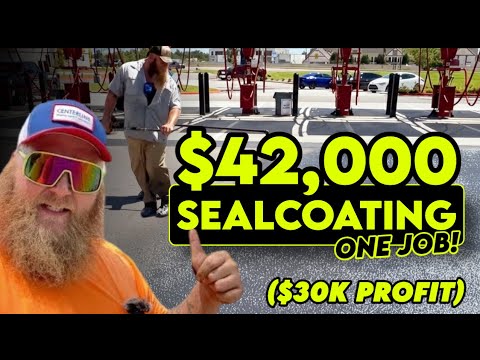
- $42,000 Biggest sealcoat job
- $12,000 Materials
- ~$30,000 “Walked away with”
- Helped build it Host’s stake in the course
The claim
That adding sealcoating to a line-striping business turned a $4,000 job into a $42,000 one, cleared about $30,000, and represents a 71 per cent profit margin.
- Line-striping ticket on the job — ~$4,000
- Sealcoating ticket — $42,000
- Area — 140,000 sq ft
- Price per sq ft — ~$0.30
- Materials — $12,000
- Revenue minus materials — $30,000
- “71% profit margin” — $30,000 ÷ $42,000 = 71.4%
- “Extra $26,000 of revenue” — Matches $30,000 − $4,000, not any revenue figure
- Duration — ~3 weeks against a planned ~1.5
- Crew labour, equipment, fuel on this job — Not given
- Course price — Not given; “50% off”
What is this income idea?
Add sealcoating — crack filling and sealing asphalt — to an existing parking-lot line-striping business, and sell it to the commercial customers you already have.
- The guest started parking-lot line striping about five years before the interview. It “really took off”, with recurring work, and about two years in customers began asking for sealcoating, which the guest turned down for lack of knowledge. The guest says that cost “thousands of dollars in work” and eventually bought a sealer tank and a direct-fire crack-fill kettle melter and added the service.
- The case study is specific. A university called for striping; the guest pitched sealcoating as well. The lot was 140,000 square feet, the sealcoating was $42,000, the striping “around $4,000”, materials were $12,000, and “we walked away with about 30 grand.” The host calls that “a 71% profit margin”.
- The job was meant to take about a week and a half in phases, and took about three weeks because of rain in Oklahoma; the crew moved to work in Texas during wet spells. The season runs from March to about November, with sealing only when it is dry and above 50°F.
- The business is now commercial and chain-focused: work in Texas and Oklahoma, “another 70 locations” sought in Missouri and Arkansas, and 127 on the list for next year on recurring contracts. A crew chief runs the sealcoating; the guest prefers line striping and closes by heading to a church job expected to take “an hour and a half” for “1,200 bucks”.
- Around all of this sits a course launch. There is a full ad read for the new sealcoating training, “just one parking lot job pays for the entire training program”, a 50 per cent discount, links to the guest’s existing striping course, and a statement from the host: “I was fortunate enough to to you know work with him on on putting this together kind of the backend tech side of it.”
Selling a second, higher-margin service to customers you already have can multiply a ticket — the one job shown proves that, but not the profit or the course.
- Run line striping — 5 years, recurring
- Get asked for sealcoating — Turned it down at first
- Buy tank and melter — Price not given
- Upsell on a striping call — $4k → $42k
- Spend $12k on materials — Only cost stated
- “Walk away with $30k” — Before labour
- Sell the course — 50% off
The upsell logic is real; the step from “walked away with” to “profit margin” skips the crew.
The upsell is the insight; the margin is the sales pitch
The lesson underneath the number
- The strongest idea in this interview is not sealcoating. It is that a contractor’s cheapest customer to win is one already on the phone. A university called for about $4,000 of striping and left with a $42,000 sealcoating job because the guest could offer both. That is a real, repeatable principle for any trade business, and the guest is candid that for two years they turned such requests away and lost the work.
- The numbers around that job are less careful than the idea. $42,000 minus $12,000 of materials is $30,000, and the guest’s phrase is “walked away with” — which, for a job that took a crew about three weeks, cannot mean profit. The host then converts it into “a 71% profit margin” and attributes it to overhead, which nothing in the guest’s answer covers. The opening hook, “an extra $26,000 of revenue”, turns out to be $30,000 minus the $4,000 striping ticket — a profit figure with a revenue label.
- Context matters too. This is described as the biggest sealcoating job the business has done, won through a five-year striping business with chain contracts in several states. It is a best case built on an existing pipeline, not a first-year expectation for someone buying a tank.
- And the interview is not neutral. It contains a full ad read for the sealcoating course, a 50 per cent discount, links to a second course, a claim that the training can turn someone with zero experience into someone “making multiple six figures”, and the host’s own statement that they worked on the course’s back end. That is disclosed in words, to the host’s credit, but it means the person asking the questions has a stake in the answers.
We went from a $4,000 ticket price to a $42,000 ticket price.
The real lesson — the upsell, not the margin
The add-on strategy, as the guest describes it
Upsell existing commercial clients rather than find new ones.
The last timestamp is consistent with the video length.
- Build a base with one service first — Five years of parking-lot striping with recurring commercial work came before sealcoating. Every sealcoating figure in the video rests on that existing customer list.
- Listen for what customers already ask for — Requests for sealcoating arrived about two years into striping. The guest calls turning them down a costly mistake — a fair, self-critical point.
- Stack the offer on every call — “Initially they called for the striping and I said hey you guys really need seal coating.” Pressure washing, crack sealing, sealcoating and repair are all named as upsells to raise the average ticket.
- Phase large commercial lots — Prep, seal cracks, apply sealer, let it dry, stripe — about a day and a half per phase. The university lot planned for about a week and a half.
- Plan around weather — Dry ground and above 50°F. Rain stretched the $42,000 job to three weeks, and the crew moved to Texas work in the gaps — which only works with a multi-state pipeline.
- Hand the field work to a crew — A trained crew chief now runs sealcoating. The crews worked a double shift the day before recording. None of this labour appears in the $30,000.
- Chase chains and recurring contracts — Work across Texas and Oklahoma, 70 more locations sought in Missouri and Arkansas, 127 listed for next year. Recurring commercial contracts are the business; the course is the pitch.
The business model
Per-job and recurring-contract fees for parking-lot striping, crack filling and sealcoating, plus paid training courses.
Commercial property owners — a university, a brewery, a church, and restaurant or retail chains with many locations.
One contractor for striping and asphalt maintenance, sold as a stacked offer on a single call.
Existing striping customers, chain relationships across several states, and the guest’s YouTube channel for the courses.
- Materials — $12,000 on the $42,000 job — stated
- Sealer tank and kettle melter — Named, not priced
- Crew labour — Crew chief and staff exist; wages not given
- Travel and fuel — Multi-state work; not priced
- Weather downtime — Doubled the big job’s timeline
- Insurance — Not mentioned
- Software — Endorsed; price not given
One real cost figure — materials — is given, which is more than many. Labour, the largest cost on a three-week commercial job, is not.
What you would actually need
Money
“I went out and I got a tank and I got a direct fire crack fill kettle melter.” No price is given for either, or for the course.
The equipment is the entry cost and it is unpriced, as is the course that “one parking lot job pays for”. Materials alone were $12,000 on one job, so working capital before the client pays is significant.
Named, not priced
- Sealer tank
- Direct-fire crack-fill kettle melter
- Materials — $12,000 on the one job given
- A truck and trailer to mobilise across states
- Crew wages, including double shifts
- The sealcoating course, “50% off”
- The striping course
- Quoting and invoicing software
Time
About a day and a half per phase; the big job should have taken a week and a half and took about three weeks.
The admission that rain doubled the timeline is useful. What the video does not show is the five years of striping and two years of turned-down requests that produced the customer who said yes.
Where the time actually went
- ~5 years building a line-striping business
- ~2 years before adding sealcoating
- ~3 weeks on the $42,000 job
- A March-to-November season
- Weather delays and cross-state travel
- Training a crew chief
The part you must pay attention to
Revenue minus materials is not profit, and $26,000 is not revenue.
“Spent $12,000 in material walked away with I think $30,000.” The host replies: “that’s a 71% profit margin uh based on the costs you know that your overhead.”
- Sealcoating ticket — $42,000
- Materials — $12,000
- Labour, fuel, equipment — not given — 3 weeks of crew
< $30,000
Actual profit on the job, by an unstated amount
The subtraction is right — $42,000 less $12,000 is $30,000, and $30,000 is 71.4 per cent of $42,000 — but the only cost removed is materials. The job ran about three weeks with a crew; the business has a crew chief and staff who worked a double shift the day before recording; it moved between Oklahoma and Texas during rain; and it needed a sealer tank and a kettle melter. None of those costs is subtracted, and the host’s framing of the 71 per cent as being “based on … your overhead” is not supported by anything the guest said. The later claim that sealcoating makes “60 to 70% margins” against “10% margins” from subcontracting is presented the same way, with no cost breakdown.
The opening hook has a different problem. “I would have missed out on an extra $26,000 of revenue” does not match any revenue figure in the story: the extra revenue from sealcoating was $42,000, or $38,000 if the $42,000 already includes the $4,000 striping. $26,000 is what you get by subtracting the $4,000 striping ticket from the $30,000 left after materials — a profit number minus a revenue number, labelled as revenue. It is most likely a slip in the moment, and the real point stands: upselling turned a small job into a large one. But it is the figure the video leads with.
- THE JOB (GUEST)
- Sealcoating ticket $42,000
- Materials -$12,000
- "Walked away with" $30,000
- Host: 71% margin 30/42 = 71.4%
- WHAT IS NOT SUBTRACTED
- ~3 weeks of crew labour ???
- Tank + kettle melter ???
- Fuel, travel to Texas ???
- THE $26,000 HOOK (OUR CHECK)
- Extra revenue: $42,000
- (or $38,000 if $4k inside)
- $30,000 - $4,000 = $26,000
- -> profit minus revenue
- PRICE PER SQUARE FOOT
- $42,000 / 140,000 = ~$0.30
- Materials $12,000 / 140,000
- = ~$0.09
The economics
One job, one cost, and a margin that leaves out the crew.
- Sealcoating ticket — $42,000
- Striping ticket — ~$4,000
- Area — 140,000 sq ft
- Materials — $12,000
- Revenue less materials — $30,000
- Materials-only margin — 71.4%
- Price per sq ft — ~$0.30
- Church striping job — $1,200 in ~1.5 hours
- Crew labour, equipment, travel — Not given
What the 71% actually measures
($42,000 − $12,000) ÷ $42,000
71.4% of revenue left after materials only — before three weeks of crew labour, equipment, fuel and insurance
IncomeIdeaLab calculation from the guest’s own figures
The guest says “I think $30,000”, so the figure is approximate. Whether $42,000 includes the $4,000 striping is ambiguous in the audio; either way, labour is not subtracted.
- Crew wages on the three-week job
- Price of the sealer tank and kettle melter
- Travel and fuel for multi-state work
- Annual revenue or number of sealcoating jobs
- Value of the recurring chain contracts
- Price of the sealcoating and striping courses
- Whether the software endorsement is paid
- $42,000 across 140,000 square feet is about $0.30 a square foot, and materials about $0.09 — useful benchmarks the video does not compute.
- The $1,200 church job is described before it happens (“probably take about an hour and a half”), so it is an estimate, not a result, and no materials or travel are deducted from it.
- The claim of “60 to 70% margins” in-house versus “10% margins” subcontracting is plausible in direction but comes with no breakdown.
- “Multiple six figures” for trainees with “zero experience” is a course-sales claim with no student results given.
Evidence status
Every substantive claim in the video.
- $42,000 sealcoating job, 140,000 sq ft — Guest — Specific and plausible at ~$0.30 per sq ft.
- $12,000 in materials — Guest — The only cost given.
- “Walked away with about 30 grand” — Guest — Revenue minus materials; labour not deducted.
- “71% profit margin … your overhead” — Host — Materials-only; overhead not covered.
- “Extra $26,000 of revenue” — Guest — Equals $30,000 − $4,000; not a revenue figure.
- Job took ~3 weeks instead of ~1.5 — Guest — Candid about weather.
- 70 more locations sought, 127 listed for next year — Guest — Pipeline, not signed revenue.
- $1,200 church job in ~1.5 hours — Guest — Described before it was done.
- 60–70% margins in-house vs 10% subcontracted — Guest — No breakdown.
- Training can take zero-experience people to “multiple six figures” — Guest — No student results given.
- Host helped build the course — Host — Stated on camera.
What is actually proven?
One job’s gross arithmetic. Nothing about net profit.
- $42,000 − $12,000 = $30,000, and 30 ÷ 42 = 71.4%.
- The 71% is a materials-only margin.
- The “$26,000 of revenue” hook is a profit figure mislabelled.
- The job took about three weeks with a crew because of rain.
- The host says they helped build the course being promoted.
- Labour, equipment and travel costs on the job.
- The course price and any student outcomes.
What the headline doesn’t tell you
A good upsell story inside a course launch.
- 71% is after materials only. — Three weeks of crew not deducted.
- $26,000 is not revenue. — It is $30,000 minus $4,000.
- This was the biggest job. — Not a typical one.
- Five years of striping came first. — The customer was already there.
- The host helped build the course. — Said in the interview.
- Equipment is unpriced. — Tank and kettle melter.
- The course is unpriced. — Only “50% off”.
- Rain doubled the timeline. — Admitted, to the guest’s credit.
Should you try it?
A sound add-on for existing contractors, not a starter business
If you already have commercial clients, ask what else they need. If you are starting from zero, the $42,000 job is years of pipeline away.
- Specificity of the case study — 8 — Area, ticket, materials and timeline all given.
- Arithmetic accuracy — 5 — Subtraction right; “margin” and “$26,000” mislabelled.
- Cost disclosure — 3 — Materials only.
- Honesty about delays — 7 — Rain doubling the job is volunteered.
- Conflict-of-interest disclosure — 5 — Host’s role stated; software status not.
- Typicality — 3 — Biggest job, built on five years of clients.
- Capital requirement — 4 — Equipment unpriced; $12,000 materials float on one job.
- Beginner accessibility — 3 — Commercial chains and crews, not a first step.
- For someone who already runs a striping, pressure-washing or paving business, the lesson is simple and good: ask every commercial caller what else the lot needs. The guest’s own mistake — turning down sealcoating requests for two years — is the most useful thing in the video, and the university job shows how much a stacked offer can change a ticket.
- For a beginner, the numbers need re-reading. $30,000 is what was left after materials on the business’s biggest sealcoating job, won from a customer that came in through five years of striping. Crew wages over three weeks, equipment, fuel for multi-state work and insurance all come out of it. The 71 per cent is not a profit margin, whatever the host calls it.
- Weather is a real constraint and the guest is honest about it: dry ground, above 50°F, March to November. The crew could move to Texas when Oklahoma was wet only because the business already had work in two states.
- Treat the course pitch separately from the case study. The host says they worked on the course, the price is not given, and the claim that training turns zero-experience people into multiple-six-figure earners comes with no student results. The upsell idea is free; you do not need to buy anything to apply it.
Passive or automated?
Automation
Quoting and invoicing software helps; every lot is prepped and sealed by a crew.
Passive potential
The guest delegates sealcoating to a crew chief, but crews still worked double shifts.
The guest has moved out of day-to-day sealcoating by training a crew chief, which is the only route to anything resembling leverage in a trade like this. But the business still runs on crews working in the field — including a double shift the day before recording — on weather-dependent schedules across several states, and the guest still goes out to do striping jobs. Recurring chain contracts smooth demand; they do not remove the work.
- Prepping, crack filling and sealing every lot
- Striping after the sealer dries
- Scheduling around rain and temperature
- Travelling between states for contracts
- Selling the upsell on every call
Recommended beginner experiment
Test the upsell before buying the tank.
- List what your current clients also need. — Striping, washing, crack sealing, sealing.
- Price one job with every cost. — Materials, crew hours, fuel, equipment.
- Subcontract the first one. — Learn the numbers before the kit.
- Compute price per square foot. — The guest’s job was ~$0.30.
- Plan for weather days. — Dry and above 50°F only.
- Buy equipment once demand repeats. — Tank and melter prices not given here.
- Ask for course outcomes before paying. — None are given in the video.
Our verdict: 5/10
A real upsell lesson with a materials-only “margin” inside a course launch the host helped build
Credited for a concrete case study — 140,000 square feet, a $42,000 ticket, $12,000 in materials, a planned and an actual timeline — for admitting two years of turned-down requests and a job that rain stretched from a week and a half to three weeks, and for the host stating on camera that they worked on the course. Marked down because the “71% profit margin” is revenue minus materials only on a three-week crew job; because the opening “$26,000 of revenue” is $30,000 minus the $4,000 striping ticket, a profit number labelled as revenue; because the equipment and the course are both unpriced; because the case is the business’s biggest job and rests on five years of existing clients; and because a software product is endorsed with no sponsorship status stated.
The idea at the centre of this interview is sound and cheap to apply: when a commercial customer calls for one service, sell them the others the lot needs. A university that called for about $4,000 of striping bought $42,000 of sealcoating, and the guest is honest that for two years before that they turned such work away. The case is specific — 140,000 square feet, $12,000 of materials, a week-and-a-half plan that rain turned into three weeks. What the video does with those numbers is less careful. “Walked away with $30,000” is revenue minus materials on a job that occupied a crew for three weeks, and the host’s “71% profit margin … based on your overhead” is not supported by anything said. The hook that opens the video, “an extra $26,000 of revenue”, is $30,000 less the $4,000 striping ticket — profit minus revenue. The job was the business’s biggest, won through five years of striping and chain contracts across states. And the whole conversation is framed around a course launch, at 50 per cent off with no price given, which the host says they helped build. Take the upsell; do the full cost sum yourself before believing any margin.
- Sealcoating ticket — $42,000
- Materials — $12,000
- Left after materials — $30,000
- Materials-only margin — 71.4%
- Price per sq ft — ~$0.30
- Labour and equipment — Not given
- Course price — Not given
- Beginner suitability — Add-on, not a start
Sources
- Sealcoating Business Training — Mike Vidan — YouTube video, 2025-10-05
- FTC — Guides Concerning the Use of Endorsements and Testimonials — Regulatory guidance on endorsement disclosure