Local Services / Screen Printing · Claim Review
“How I made screen printing my full time income. Part 1 Monday”
What we found: Screen Printing "Full-Time Income", Part 1: No Earnings Figure, and $81 of Rush Shipping on $72 of Paper
A candid Monday in a home decal and shirt business: one $30 job, a stock-out, and a rush order that cost more to ship than to buy.
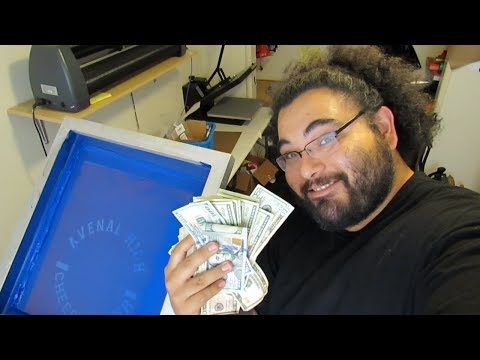
- Not stated Income shown
- $30 One walk-in job
- $153 Transfer paper paid
- $81 Rush shipping
The claim
That screen printing and decals from home became his full-time income, and that following his week will show "how much I make".
- Income for the day or week — Not given in Part 1
- Walk-in decal job for a local insurance office — $30
- Transfer paper, 100-pack — "$75", later "should only cost me like $72"
- Paid with guaranteed Wednesday delivery — $153
- Shipping on that order — "81 dollars", then "$85"
- Extra shipping for red vinyl after a stock-out — $6
- Orders due Wednesday — ~50 memorial shirts and 48 collared shirts
- Working day shown — 7:00 am to about 4:45 pm
What is this video about?
The first episode of a week-long vlog from a home decal and screen-printing business, filmed to show "how much I make, how my week goes and what's the worst thing about this."
- Monday starts at 7 am with confirmed orders, sketches to draw and messages to answer. By 10 am he has spent "three hours working on sketches and messages".
- The week's main jobs are about 50 memorial shirts and 48 collared shirts, both due Wednesday, alongside small decal orders that arrive unannounced. A local insurance office orders a decal for $30: "that's easy 30 bucks today."
- The first problem is a stock-out. He runs out of red vinyl, calls it "a rookie mistake", pays an extra $6 for faster shipping and offers the customer options: black now and red added later with free stickers, or a full refund with the decals free once the red arrives.
- The larger cost is transfer paper. Short of paper for the Wednesday shirts, he chose the shipping option guaranteed to arrive by Wednesday and paid $153 for paper that "should only cost me like $72". The customer then asked for a one-colour design that did not need it: "I just wasted 81 dollars on shipping when I didn't need to."
- He closes the shop around 4 pm, takes a late call from a customer at 4:45, and ends the episode on the point of the series: "running your business isn't all fun and games."
A real day in a small print shop, with its costs and headaches, but none of the income the title and intro promise.
- Sketches and messages — 7–10 am
- Decal orders — One at a time
- Stock-out on red — +$6 shipping
- Walk-in job — $30
- Rush paper order — $153 for ~$72
- Design changes — Rush not needed
- Income — Not shown
The day is all operations; the money side stops at costs.
An honest Monday that hasn’t reached the money yet
The lesson underneath the number
- The title says screen printing became his full-time income, and the opening promises viewers will "see how much money I make". Part 1 does not show it. The only income figure is a $30 decal for a local insurance office. The large Wednesday orders are mentioned without prices, and there is no daily or weekly total.
- What the episode does show is better than most income videos: the parts nobody films. Three hours of sketches and messages before production starts. A stock-out he calls his own rookie mistake. A customer offered a refund and free decals to make up for a one-day delay. A late call at 4:45. These are real costs of running a custom-order business, and he is open about each.
- The rush shipping is the clearest lesson. He paid $153 for transfer paper worth about $72 to guarantee Wednesday delivery, then the customer chose a design that did not need it. His own reflection — the design change was not the customer's fault, and a one-colour job is easier — is fair. The practical takeaway for a viewer is to confirm the design before paying for speed.
I just want to show you firsthand how running your business isn’t all fun and games.
His own summary of Monday
How the business runs, as shown
Practical habits from a working shop.
One sale and three costs are priced; no revenue total or profit is given.
- Batch messages between orders — "I focus on one order and when I do one order I'll go back to messages", because stopping for every message means never finishing. A sensible rule for a one-person shop.
- Take walk-in jobs when they fit — Unplanned decal orders, such as the $30 insurance office job, are fitted in around the big orders. Small jobs add up but are not totalled.
- Keep every colour in stock — The red vinyl stock-out cost $6 in shipping and a day's delay. His lesson: "I need to be stocked up in inventory in colors."
- Own mistakes with the customer — He tells the customer and offers black now with red added free, or a full refund plus the decals free later. Generous service with a cost that is not priced.
- Confirm the design before buying rush supplies — The $81 shipping bought paper for a full-picture design; the customer then chose a one-colour design. Fixing the design first would have avoided the rush.
The business model
Custom vinyl decals and printed shirts, including memorial shirts and collared work shirts. No prices other than a $30 decal job are given.
Local individuals and businesses, ordering by message and paying in person.
Custom designs, fast turnaround and personal service: "a fair price with great quality."
Word of mouth and direct messages, with in-person pick-up and payment.
- Transfer paper — ~$72–$75 per 100-pack, plus shipping
- Vinyl stock — A missing colour cost $6 extra shipping
- Rush shipping — $81 on one order
- Blank shirts — Not priced
- Refunds and free items — Offered to fix a mistake, not priced
- Equipment — Not discussed
Every figure in Part 1 is a cost or a single small job; the revenue that makes it a full-time income is not stated.
What you would actually need
Money
Not discussed in Part 1 beyond supplies and shipping.
A decal and shirt business needs vinyl in every colour, transfer paper, blank shirts and the cutting and pressing equipment, none of which is priced here. The day shows that running short of stock is expensive.
Costs named or implied
- Transfer paper, ~$72–$75 per 100-pack before shipping
- Vinyl in every colour customers ask for
- Rush or expedited shipping when stock runs out
- Blank shirts for the Wednesday orders
- Free stickers and refunds offered to fix mistakes
- Cutting and heat-press equipment, not priced
Time
A Monday from 7 am to about 4 pm, with calls continuing at 4:45 pm.
Close to ten hours, three of them on sketches and messages, plus collecting a payment in person. The time cost is clear; what it earned is not.
Where Monday went
- ~3 hours of sketches and messages
- Producing decal orders
- Driving to collect a payment
- Delivering the $30 decal
- Customer calls after closing
The part you must pay attention to
The shipping cost more than the paper.
He says the transfer paper "should only cost me like $72", and that he paid $153 to be sure it arrived by Wednesday.
- Paid for the 100-pack — $153
- Normal price of the paper — $72
$81
Rush shipping, 112% of the material
The figures reconcile with $72 as the base price: $153 − $72 = $81, matching "81 dollars on shipping". He also gives the pack price as $75, which would make the shipping $78, and later calls the loss "$85". The $81 version is the one that adds up.
Spread across the roughly 98 shirts due Wednesday, the rush shipping adds about $0.83 a shirt, which is small per item and large against a $30 job. The episode says nothing about what those 98 shirts sell for, so whether the rush order hurt the week's profit materially cannot be told from Part 1.
- THE PAPER ORDER (OUR ARITHMETIC)
- Paid $153
- Paper, his "should cost" $72
- -------------------------------
- Shipping $81
- Shipping / paper 112%
- If the pack is $75 instead $78
- His later figure $85
- PER SHIRT
- Shirts due Wednesday ~50 + 48
- $81 / 98 ~$0.83 each
- Paper per sheet $0.72 -> $1.53
- THE INCOME
- Promised "how much I make"
- Shown one $30 job
The economics
Costs are given; income is not.
- Walk-in decal job — $30
- Transfer paper, normal price — ~$72
- Paid with rush shipping — $153
- Rush shipping — $81
- Extra shipping on red vinyl — $6
- Shirts due Wednesday — ~98
- Revenue for the day or week — Not stated
Checking the transfer-paper order
$153 paid − $72 paper = $81 shipping; $81 ÷ $72 = 1.125
Shipping was about 112% of the material it carried, and about $0.83 per Wednesday shirt
IncomeIdeaLab calculation from the figures stated in the video
He also gives the paper as $75 and the loss as $85; the $72 and $81 pair is the one that sums to $153.
- Prices for the memorial and collared shirts
- Revenue for Monday or the week
- Blank shirt and vinyl costs
- Equipment costs
- Profit, or what "full-time income" amounts to
- The one sale priced in the episode, a $30 decal job, is smaller than the $81 rush shipping paid the same week.
- His refund offer — a full refund and the decals free later — would turn that order into a loss; whether the customer took it is not shown.
- The intro jokes about an ebook link and then says the knowledge is free; nothing is sold in this episode.
Evidence status
Every figure in Part 1.
- Screen printing is his full-time income — Title — No income figure is given in this part.
- "See how much money I make" — Intro — Not delivered in Part 1.
- $30 decal for an insurance office — Creator — Specific and plausible.
- $153 paid for transfer paper — Creator — Reconciles with $72 paper plus $81 shipping.
- Paper "$75" or "$72" — Creator — Two figures given; $72 fits the total.
- Shipping "81 dollars", then "$85" — Creator — $81 is the figure that reconciles.
- $6 extra shipping for red vinyl — Creator — Specific.
- ~50 memorial and 48 collared shirts due Wednesday — Creator — Volume given, prices not.
What is actually proven?
The work is shown. The income is not.
- A working home decal and shirt business with real orders.
- A $30 decal job and $153 spent on transfer paper.
- Rush shipping of $81 was about 112% of the paper's price.
- Daily or weekly revenue, and profit.
- That the business is a full-time income.
What the headline doesn’t tell you
The title is about income; the episode is about costs.
- No income figure. — Promised in the intro.
- One $30 job priced. — Big orders unpriced.
- $81 shipping on $72 paper. — Then it was not needed.
- Two prices for the paper. — $72 and $75.
- Stock-outs cost money. — $6 and a day's delay.
- Ten-hour day. — Three hours on messages.
Should you try it?
A useful look at the work, not at the earnings
Watch it for the operational lessons; look elsewhere for what this business makes.
- Honesty about problems — 8 — Owns the stock-out and the wasted shipping.
- Operational detail — 6 — Shows the order flow and customer handling.
- Income evidence — 1 — One $30 job; no totals.
- Cost detail — 5 — Paper and shipping priced; shirts and equipment not.
- Delivery on the title — 2 — "Full-time income" is not quantified.
- Beginner accessibility — 6 — A home-based, word-of-mouth model.
- The episode is a fair picture of what a custom-order print business feels like day to day: drawing sketches, answering a constant stream of messages, fitting in walk-in jobs and fixing mistakes with customers. That is useful to anyone imagining it as easy.
- Take two concrete lessons from it. Keep stock of every colour you sell, because running out costs shipping and goodwill. And confirm the design before paying for rush supplies; the $81 he spent on shipping was more than the paper itself and turned out to be unnecessary.
- Do not take an income figure from it, because there is none. Before starting, price your own shirts and decals against blank, vinyl, paper and shipping costs, and count your hours: this Monday ran close to ten.
Passive or automated?
Automation
Every order is sketched, cut and pressed by hand.
Passive potential
Income depends entirely on his hours.
Custom decals and shirts are made to order, one design at a time. Sketching, messaging, cutting, pressing, collecting payment and delivery are all done by him, and the episode shows customers calling after closing. Nothing here runs without him.
- Sketching each custom design
- Answering messages and calls
- Cutting vinyl and pressing shirts
- Collecting payments and delivering
- Managing stock and supplier orders
Recommended beginner experiment
Learn from Monday’s mistakes before the first order.
- Stock every vinyl colour you offer. — Avoid rush shipping.
- Confirm designs before buying supplies. — His $81 lesson.
- Price per item, including shipping. — Paper alone is $0.72 a sheet.
- Batch messages between jobs. — His rule for finishing work.
- Track every sale for a week. — The figure the episode lacks.
- Decide your refund policy in advance. — Not on the spot.
Our verdict: 4/10
An honest working day, without the income the title promises one $30 job, $81 of unnecessary rush shipping and no totals
Credited for showing the unglamorous side of a custom print business — hours of sketches and messages, a stock-out he owns as his mistake, a generous fix for the customer and a costly rush order — and for figures on the paper order that reconcile. Marked down because the intro promises to show how much he makes and Part 1 gives only one $30 job, because the paper and shipping are each given two different values, and because no shirt prices, revenue or profit appear.
This first episode is a candid day in a home decal and shirt business, and it is worth watching for what it shows about the work: three hours of sketches and messages before production starts, small walk-in jobs fitted around large orders, a red-vinyl stock-out he calls a rookie mistake, and a customer offered a refund and free decals to make up for a one-day delay. The money it shows is mostly going out. The paper for Wednesday's shirts cost $153 against a normal price of about $72, because he paid $81 to guarantee delivery, and the customer then chose a design that did not need it. The figures reconcile on $72 and $81, though he also gives $75 and $85. What the episode does not show is the thing its title and intro promise. Apart from a $30 decal job there are no prices, no daily takings and no weekly total, so "full-time income" is not quantified anywhere in Part 1.
- Income shown — Not stated
- Walk-in job — $30
- Paper order — $153
- Rush shipping — $81
- Working day — ~7 am–4:45 pm
Sources
- How I made screen printing my full time income. Part 1 Monday — YouTube video, 2018-06-01