AI Services / Vending / Side Hustles · Claim Review
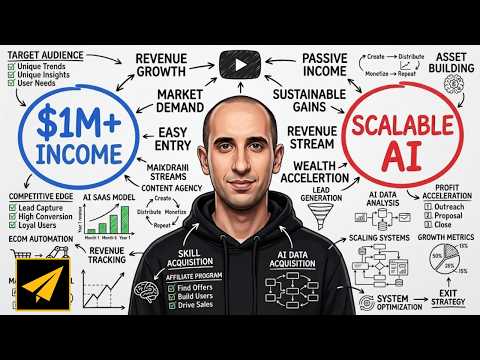
“One Person, One Laptop: The AI Model Making Millionaires in 2026”
What we found: The AI Millionaires Model Is Four Hypothetical $2,000 Clients
One solo software product is the only AI example. The $96,000 arithmetic is correct and hypothetical, and the video’s own Census figure works out to about $59,000 a year per one-person business.
- $2,000 × 4 Headline example
- 1 AI examples with revenue
- ~$59k Average one-person business
- ~1/3 Share of video on AI
The claim
That "one person with a laptop can outearn an entire company" by charging $2,000 a month for an AI-delivered service, and that this is "the AI business model that is making millionaires right now".
- Solo AI product revenue, as relayed (Tony Dinh, per the on-screen card) — Over $130,000 a month
- Suggested service price — $2,000 a month
- 4 clients × $2,000 × 12 — $96,000 a year
- 8 clients × $2,000 × 12 — $192,000 a year ("nearly $200,000")
- People shown running the service version — None
- One-person businesses (Census, as cited) — 30.4 million, $1.8 trillion (Census graphic at 13:47); 29M on the cold-open card at 0:12
- Average revenue per one-person business — ~$59,000 a year
- Cost of delivery, as stated — "A few dollars in AI and a couple hours"
- Part-time assistant recommended — 5–10 hours a week, cost unstated
What is this income idea?
Three pitches in one upload: an AI-delivered service business, nine machines you can buy and place, and ten businesses said to need no money.
- The AI section opens with a solo developer who left a big-tech job, built an AI chat interface product, and "pulls in over $130,000 a month" with no employees. The presenter says the developer publishes their numbers. The video's cold-open card at 0:12 names the developer as Tony Dinh, with "$130K" a month, "0 employees, 0 investors" and a source line referring to publicly posted revenue; the revenue itself is not shown.
- They then say the same model "works as a service" that needs no code: pick one expensive problem, charge "$2,000 a month to deliver an AI powered service", and "you only need four clients to hit $96,000 a year". Eight clients is "nearly at $200,000 a year".
- Delivery is described as AI drafts plus your editing — 30 social posts, a weekly newsletter and customer email for one client "in an afternoon", for "a few dollars in AI and a couple hours". Find clients through a "money 50 list" of connectors you interview on a podcast.
- The second section counts down nine machines: a mobile tyre-retreading unit from about $25,000, a sachet packaging machine at about $4,500, a nut-butter grinder, a bag-printing machine at $4,000–$6,000, a line-striping machine from $3,000, an NFC keychain printer, an ice kiosk at $15,000–$25,000, a phone-case vending machine at about $6,500, and a robotic cotton-candy kiosk at $5,000–$12,000.
- The third section lists ten "$0" businesses — AI consulting, chatbot building, commission sales, short-form video, email, lead generation, no-code automation, YouTube thumbnails, community management and a YouTube channel — each supported by a statistic attributed to a publication or company with no date or link.
Sell an AI-assisted service to a few businesses at a high monthly price; the video shows the sum, not anyone doing it.
- One expensive problem — One kind of client
- Charge $2,000 a month — Their suggested price
- AI drafts the work — "A few dollars in AI"
- You edit and deliver — "A couple hours"
- Find clients via connectors — "Money 50 list"
- 4 clients = $96,000 — If signed and kept a year
Every step is plausible. The step that makes the money — four clients at $2,000 for twelve months — is assumed.
The arithmetic is right. The inputs are wishes.
The lesson underneath the number
- The core advice in the AI section is sound. Choose one kind of client with one expensive, repetitive problem; charge a price that reflects the problem rather than your hours; use AI for first drafts and your own judgement for the finish; start with one conversation this week rather than a logo. Plenty of real freelancers work that way.
- What the video does not do is show anyone doing it. Its single revenue figure in the AI section belongs to a developer’s software product, and the presenter explicitly moves from that product to a no-code service version that nobody in the video is shown running. The money for the service version is then produced by multiplication: four clients at $2,000 a month for twelve months. The sum is correct. Every input is assumed, and the one that matters most — getting and keeping a $2,000-a-month client with no portfolio and no audience — is the one the video spends least time on.
- The title says the model is "making millionaires". The nearest thing to a millionaire in the AI section is the product developer, whose stated monthly revenue would come to about $1.56 million a year — revenue, not profit, and from a product. The machines section’s own Census figure puts the average one-person business at about $59,000 a year in revenue. Neither number is presented beside the other.
- The rest of the upload has the same pattern. Machines are described by materials cost against sale price — "about 31 cents in sugar" for a cotton candy that "sells for $5 to $10", "a profit margin of over 93%" — with no mention of the location, the rent or revenue share the site owner takes, repairs, permits or downtime. The "$0" businesses are each backed by a statistic credited to a company or publication with no date or link, and the section opens with a founder who started with $700 plus money from a marketer and their mother.
Imagine you charge $2,000 a month to deliver an AI powered service. You only need four clients to hit $96,000 a year.
The presenter — the sum the whole AI section rests on
The six steps, as they give them
The AI section, with our note on each.
From the video published 9 July 2026, checked against what is said and shown on screen. The video opens with an editor's stat-card graphic ("The AI Wealth Shift") at 0:12 whose cards carry short source lines. Two machine profit figures and one phone-case cost figure could not be established and are not used in our arithmetic.
- Pick one specific, expensive problem — Law-firm intake, estate-agent listings, restaurant social media. "If you can't say in one sentence you're still too broad." Sound and specific advice.
- Start high, not cheap — $2,000 a month, four clients, $96,000 a year. The multiplication is right. No client at that price is shown, and how long clients stay is never discussed.
- Let AI do the work a team used to do — Eliminate, automate, delegate. The delegate step includes "a part-time assistant for 5 to 10 hours a week", which is a cost the margin claim of "you keep almost everything" leaves out.
- Build relationships, not an audience — A list of 50 connectors, approached by inviting them onto a podcast. Supported by client stories — seven-figure businesses "off of a channel with fewer than 50 targeted subscribers" — with no names.
- Stay lean on purpose — "Keep your cost near zero." Reasonable as a principle; no cost figure for the model appears except "a few dollars in AI".
- Start before you are ready — One problem, one offer, one conversation this week. The most actionable instruction in the video, and it costs nothing to test.
The business model
For the viewer: monthly retainers for AI-delivered services, or machine sales, or commissions. For the presenter: a channel, a free worksheet, their "movement maker" coaching clients, and a split-testing software product they say they built.
Small businesses with one repetitive, expensive problem — law firms, estate agents, restaurants.
Agency-level output from one person, at a fraction of agency cost, because AI drafts the work.
A "money 50 list" of connectors, approached by inviting them onto a podcast or show you run.
- AI tools — "A few dollars", per the video
- Part-time assistant — 5–10 hours a week recommended. Never priced
- Client acquisition time — A podcast and a 50-person list. Never estimated
- Client churn — Never discussed
- Tax and payment fees — Never mentioned
"You're not paying a team, you keep almost everything" sits a minute before the advice to hire an assistant.
What you would actually need
Money
For the AI model: "a few dollars in AI". For the machines: "most… cost less than a used car". For the last section: $0.
The AI service genuinely needs little capital; its cost is the time to win clients. The machines need $3,000–$25,000 each before any location fee, permit, insurance or repair, none of which is mentioned. The "$0" section opens with a founder who started with $700 and a partner’s and their mother’s money.
Named or implied, never priced
- AI subscriptions for client delivery
- A part-time assistant, 5–10 hours a week
- Machine purchase: $3,000–$25,000 each
- Location rent or revenue share for every machine
- Restocking, repairs, permits and insurance
- The presenter’s coaching for "movement maker clients"
Time
One client’s monthly content drafted "in an afternoon". Machines that run "whether you show up or not".
Delivery time may well be short. The time not counted is selling: the video’s own client-finding method is to interview fifty connectors on a podcast before asking for anything. Machines need restocking, cleaning and cash or card collection.
Where the hours go
- Building and working a 50-person connector list
- Recording and editing a podcast to approach them
- Editing AI drafts for each client every month
- Managing an assistant
- Restocking and servicing each machine
- Commission sales: "terrible at your first 10 sales calls"
The part you must pay attention to
The $96,000 is a multiplication, not a result.
"Imagine you charge $2,000 a month to deliver an AI powered service. You only need four clients to hit $96,000 a year."
- Monthly fee per client — $2,000
- Clients signed — 4
- Months each one stays — 12
$96,000
Revenue a year, before any cost — correct arithmetic, imagined inputs
All three inputs are assumptions. Nobody in the video is shown charging $2,000 a month for an AI service, signing four such clients, or keeping them for a year. The one AI revenue figure given — over $130,000 a month — belongs to a developer who built and sells a software product, which the presenter themselves says is a different thing: "the model is not about coding… the exact same model works as a service". That is their extrapolation. The client stories offered for the service side — seven-figure businesses from fewer than 50 subscribers, a jump from two to 55 high-ticket sign-ups — are unnamed and come from their own coaching clients.
The video supplies its own reality check without using it. In the machines section it cites the US Census Bureau: 30.4 million one-person businesses with zero employees taking in "over $1.8 trillion a year". A Census-branded graphic at 13:47 shows the same 30.4 million, although the cold-open card at 0:12 gives 29M for one-person firms. Divided out, the spoken pair is about $59,000 a year in revenue per business, before costs — our arithmetic from their figures. That is a respectable average, and it is a long way from "outearn an entire company" or "making millionaires". The figure is used to show the opportunity is large, not to show what a typical one-person business takes in.
- THE HEADLINE SUM
- $2,000 x 4 clients x 12 $96,000
- $2,000 x 8 clients x 12 $192,000
- -> arithmetic: correct
- -> clients shown: 0
- THEIR OWN CENSUS FIGURE
- $1.8 trillion / 30.4 million
- = ~$59,000 a year each
- -> revenue, before costs
- THE ONE AI EXAMPLE
- >$130,000/month x 12
- = ~$1.56 million a year
- -> a software product,
- not the service taught
- COSTS LEFT OUT
- Assistant 5-10 hrs/wk ???
- Time to win each client ???
- Client churn ???
The economics
Revenue sums with no costs, and one figure that undercuts the title.
- Service price — $2,000/month
- Clients for $96,000 — 4
- Developer’s product, as relayed — >$130,000/month
- Census: one-person businesses / revenue — 30.4M / $1.8T
- Ice kiosk: cost / monthly profit — $15,000–$25,000 / $1,200–$2,400
- Ice kiosk payback — ~6 to ~21 months
- Bag printing: margin per bag — 15–45 cents
- Bags a month for $2,000–$4,000 profit — ~4,400 to ~26,700
- Commission sales: 10% of a $5,000 deal — $500
What the presenter’s own Census figure says about a typical one-person business
$1.8 trillion ÷ 30.4 million one-person businesses
About $59,000 a year in revenue per business, before any cost
IncomeIdeaLab calculation from the two figures the video attributes to the US Census Bureau
An average across every kind of one-person business, part-time and full-time; many take in far less and some far more. The video gives no year for the figures, and we have not checked them against the Census release.
- Any person shown running the $2,000-a-month AI service
- Client churn, and how long a retainer typically lasts
- The cost of the recommended part-time assistant
- Location rent or revenue share for every machine
- Repairs, permits, insurance and restocking for the machines
- A close rate for the commission-sales route
- The price of the presenter’s coaching
- Ice kiosk: the stated 84–90% margin is consistent with the stated 20–40 cents cost and $2–$3.50 price. At $15,000–$25,000 upfront and $1,200–$2,400 a month profit, payback runs from about 6 months to about 21 months — our arithmetic, assuming the profit figure already allows for location and upkeep, which the video does not say.
- Cotton candy: 31 cents against a $5 sale is a 93.8% materials margin, matching "over 93%". It is not a profit margin; the site, the machine’s cost and maintenance are not in it.
- Phone-case machine: "30 to 50 sales a day" at "$15 to $20" is $450 to $1,000 a day in revenue, or about $13,500 to $30,000 over thirty days — our arithmetic. The unit cost could not be established, and no location cost is mentioned, so no profit can be derived.
- Commission sales: "if you close one $5,000 deal a day you make $500 a day". One close every day is the assumption doing the work; the video also says "you'll be terrible at your first 10 sales calls" and gives no close rate.
- The cotton-candy operator is "on track to pull in over half a million dollars in revenue" from "around 10" machines — about $50,000 a year per machine, projected and before costs.
Evidence status
Every substantive claim in the video.
- One person can "outearn an entire company" — Presenter — No one-person service business is shown doing so.
- Solo AI product at over $130,000 a month — Presenter, about a third party; cold-open card at 0:12 — Tony Dinh's own publicly posted figure, relayed on an editor card; the revenue itself is not shown. A product, not the service pitched.
- 4 clients × $2,000 = $96,000 a year — Presenter — Arithmetic correct. Every input assumed.
- "Your actual cost is a few dollars in AI" — Presenter — Omits the assistant they recommend and the time to win clients.
- Clients with 7-figure businesses from <50 subscribers — Presenter, about their clients — Unnamed. Cannot be checked.
- Client went from 2 to 55 high-ticket sign-ups, past $1M — Presenter, about a client — Unnamed, no timeframe beyond "a few months".
- 30.4M one-person businesses, $1.8T — Attributed to US Census Bureau; graphic at 13:47 — Implies ~$59,000 average revenue each. No year given. The cold-open card gives 29M for the same count.
- Cotton candy: over 93% margin — Presenter — Correct as a materials margin. Not profit.
- Cotton-candy operator on track for $500,000+ — Presenter, about a third party — Revenue, projected, from ~10 machines.
- Ice kiosk: $1,200–$2,400 monthly profit — Presenter — No source. Payback ~6–21 months on their figures.
- Start a business with $0 — Presenter — Section opens with a founder who started with $700 plus others’ money.
- Ten statistics from McKinsey, HBR, HubSpot and others — Presenter — No dates or links given. Two cold-open cards carry source lines (McKinsey Global Institute; US Census Nonemployer Statistics).
What is actually proven?
The sums add up. Nothing shows anyone earning them from this model.
- The $96,000 and "nearly $200,000" figures are correct multiplications.
- The cotton-candy and ice-kiosk margins are consistent with the costs and prices stated.
- They disclose that they built the split-testing software they recommend.
- Their Census figure implies about $59,000 average revenue per one-person business.
- The $130,000-a-month product, the client success stories and every cited statistic.
- Whether anyone has earned $96,000 a year from the AI service model as described.
What the headline doesn’t tell you
The title promises AI millionaires; the video delivers a sum.
- $96,000 is a multiplication. — Four imagined clients.
- The AI example is a product. — Not the service they teach.
- Their Census figure averages ~$59k. — Revenue, before costs.
- AI is a third of the video. — Then machines, then $0 ideas.
- Margins are materials only. — No rent, repairs or locations.
- "$0" opens with $700. — Plus a marketer and a mother.
- Ten statistics, no links. — None dated.
- They recommend an assistant. — After "you keep almost everything".
Should you try it?
Try the one-conversation test, not the $96,000 plan
The service advice costs nothing to test. The income projection has no example behind it, and the machines need capital and locations the video does not price.
- Quality of the service advice — 6 — Narrow niche, value pricing, AI drafts, human finish.
- Evidence the service model earns — 1 — No one shown doing it.
- Arithmetic accuracy — 8 — Sums and margins check out on their inputs.
- Cost disclosure — 2 — Machine prices given; running costs and acquisition never.
- Source quality for statistics — 1 — Ten-plus claims, no dates or links.
- Beginner accessibility — 5 — The service route needs little money; winning a $2,000 client is hard.
- The assignment at the end of the AI section is the best thing in the video: this week, pick one problem, write one offer, and have one real conversation with someone who might pay. That costs nothing, and the answer you get will tell you more than any projection.
- Do not plan around $96,000. Four clients at $2,000 a month for a year is a goal, not a forecast, and the video never shows a person who has done it with an AI-delivered service. Ask what a first client in your niche would actually pay, how long similar retainers last, and how many conversations it takes to get one. Then count the assistant the video recommends and your own selling time.
- If the machines appeal, price the location first. Every figure in that section is machine cost against materials cost against sale price. The site owner, the repairs, the permits and the days the machine is broken are not in any of them, and the ice-kiosk payback of six to twenty-one months on their own figures assumes the stated profit already covers them.
- Treat every statistic in the video as unverified until you find the source yourself. None comes with a date or link — two cold-open cards name a source, McKinsey and the Census Bureau — and the one that can be checked against the video’s own numbers — the Census figure — points to a typical one-person business taking in about $59,000 a year.
Passive or automated?
Automation
AI drafts the deliverables; finding, keeping and serving clients stays manual.
Passive potential
The service is active work; the machines need restocking and locations.
The AI service model is explicitly a service: you choose clients, edit every draft for "a human touch, your taste", answer quickly and "overdeliver", and build relationships through a podcast. None of that is passive. The machines are pitched as assets that "keep working whether you show up or not", but each needs a location negotiated, stock replaced, and repairs when it breaks, and the video names none of those costs. The "$0" businesses are all services or sales jobs.
- Finding and selling to each $2,000 client
- Editing every AI draft before delivery
- Managing a part-time assistant
- Negotiating and keeping machine locations
- Restocking and repairing each machine
Recommended beginner experiment
Test whether one business will pay before multiplying anything.
- Write your one-sentence offer. — One client type, one problem.
- Have one sales conversation this week. — Their own assignment.
- Ask for a real price. — Record the answer, not $2,000.
- Deliver one month by hand plus AI. — Time every hour.
- Count the assistant before hiring. — 5–10 hours a week costs money.
- Track whether the client renews. — Churn is never discussed.
- Check any statistic before you quote it. — None here are sourced.
Our verdict: 3/10
Correct sums on imagined clients, inside a 38-minute compilation one product example, no service examples, and a Census figure that averages $59,000
Credited for practical service advice — narrow the niche to one sentence, price on the problem rather than the hours, use AI for drafts and your own judgement for the finish, and have one real sales conversation this week; for arithmetic that checks out on its own inputs, including the $96,000 and $192,000 sums and the cotton-candy and ice-kiosk margins; and for saying that they built the software they recommend. Marked down because the only AI revenue example is a developer’s software product, while the model taught is a no-code service that nobody in the video is shown running; because the $96,000 depends on four $2,000 clients kept for twelve months, none shown; because "you keep almost everything" sits beside advice to hire an assistant whose cost is never given; because the machine figures are materials margins with no location, repair or permit costs; because the "$0" section opens with a founder who started with $700 and others’ money; because more than ten statistics carry no date or link; and because the video’s own Census figure, about $59,000 a year per one-person business, is never set beside the promise of millionaires.
The AI section of this compilation gives sensible advice and then asks a sum to do the work of evidence. Picking one kind of client with one expensive, repetitive problem, pricing on that problem, letting AI draft and doing the finishing yourself are all reasonable, and the closing assignment — one problem, one offer, one real conversation this week — is the most useful instruction in the video. But no one is shown running the service it describes. The single revenue figure belongs to a developer’s software product, and the presenter moves from that product to a no-code service version by assertion. The money then comes from multiplication: four clients at $2,000 a month for twelve months is $96,000, eight is $192,000. Both sums are correct and every input is imagined, including the one that decides everything — whether a newcomer can win and keep a $2,000-a-month client. "You keep almost everything" appears a minute before advice to hire a part-time assistant. The machines that follow quote materials margins as if they were profit, without the location, repairs or permits; the "$0" businesses begin with a founder who started with $700 and others’ money; and none of the ten-plus statistics comes with a date or link. The most telling number is the presenter’s own: 30.4 million one-person businesses taking in $1.8 trillion, about $59,000 a year each before costs. That is a fair picture of working alone with a laptop. It is not the one in the title.
- Headline sum — $2,000 × 4 × 12 = $96,000
- Clients shown — None
- AI revenue example — >$130,000/month, a product
- Average one-person business — ~$59,000 a year
- Ice kiosk payback — ~6–21 months
- Running costs for machines — Never stated
- Sourced statistics — 0 of 10+
- Beginner suitability — Test the offer, ignore the projection
Sources
- One Person, One Laptop: The AI Model Making Millionaires in 2026 — Evan Carmichael — Source video, 2026-07-09
- FTC — Guides Concerning the Use of Endorsements and Testimonials — Regulatory guidance on testimonials and earnings claims