SaaS / Micro-SaaS · Claim Review
“Build a $1000+/Month Micro SaaS with Google AI Studio (Step-by-Step)”
What we found: Two Demo Apps, a Simulated Checkout, and No $1,000 Month
The title promises a $1,000+/month micro SaaS. The video builds two prototypes, says one is "fully simulated" in the browser, calls it "production ready", and never names a price or a customer.
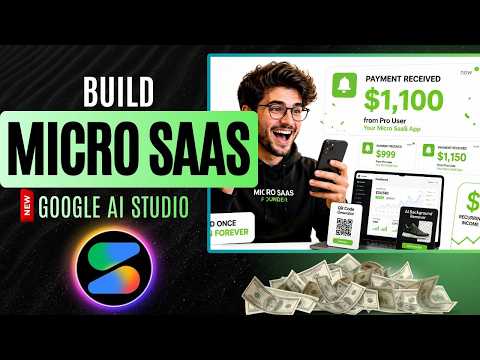
- $1,000+/mo Title promise
- $0 Revenue shown
- 2 Apps built
- Simulated Backend
The claim
That anyone can build a micro SaaS earning $1,000 or more a month using Google AI Studio, demonstrated by building a QR code generator and an AI background remover.
- Monthly revenue promised in the title — $1,000+
- Times "$1,000" is said in the audio — None
- Price set for either app — Never stated
- Paying users of either app — None shown
- Backend of the QR app — "Fully simulated clientside"
- Micro SaaS market size — ~$15–16B now, ~$60B by 2030
- Solo founders’ MRR from one product — $5,000 to $50,000
- Typical profit margins — 70% to 90%
- Subscribers needed for $1,000 at $9/month — ~112
What is this income idea?
Use an AI app builder to generate a small single-purpose web tool, put the useful features behind a subscription, and collect recurring revenue.
- The video opens with the case for micro SaaS: small tools that "do just one thing", with TinyPNG and bit.ly given as examples of simple products said to generate "millions of dollars every year". The pitch is that you no longer need a team or coding experience, because AI can build the product.
- It then gives market figures — a micro SaaS market "estimated at around 15 to $16 billion" and "projected to grow to nearly $60 billion by 2030", solo founders "earning anywhere from $5,000 to $50,000 in monthly recurring revenue from just one simple micro SASS product", and margins that "can often reach 70 to 90%". None of these is sourced.
- The bulk of the video is two builds. A prompt written in ChatGPT is pasted into Google AI Studio, which generates a QR code generator with a free tier, locked premium styling, a checkout, a user dashboard and an admin panel. The same is then done for an AI background remover, with the shared features skipped "since we've already explored these features".
- Partway through, the narrator explains how the first app actually works: "Google AI Studio has built this as a fully simulated clientside microsass application user accounts QR codes subscription plans and usage history are all managed locally in the browser." Real data storage would need "a real backend like Firebase or PostgreSQL".
- The video closes by saying "even a simple micro SAS with a few hundred paying users can generate consistent recurring monthly revenue". No price, launch, user count or revenue for either app is given at any point.
An AI tool builds a convincing prototype in minutes; everything that would make it earn money is left for later.
- Write a prompt — In ChatGPT
- Paste into AI Studio — Pick a theme
- Get a prototype — UI, dashboard, admin
- Test in the browser — Simulated accounts
- Add a real backend — "Whenever you're ready"
- Find paying users — Not covered
- $1,000 a month — Title only
The first three steps are on camera. The last four are not.
Building is the cheap part now — which is exactly why it is not the business
The lesson underneath the number
- The demonstration itself is genuinely useful to watch. In a few minutes Google AI Studio produces two applications with free and paid tiers, dashboards and an admin view, and the QR generator does what it should — a code generated on screen opens the right page on a phone. For someone yet to see a current AI app builder at work, that is informative, and the narrator is unusually candid about the limits: the first app is "fully simulated" in the browser, and a real backend is still needed.
- The problem is everything wrapped around it. The title promises a $1,000-a-month business; the audio never says $1,000, never sets a price, never mentions a user, and never shows a dollar of revenue for either app. The checkout that "succeeds" is part of the simulation. The analytics are described as "realistic", which is accurate in the sense that they are realistic-looking sample data. And the app is called "production ready" twice in the same breath as the explanation of why it is not.
- The market framing does not fill the gap. A micro SaaS market of $15–16 billion growing to $60 billion, solo founders on $5,000 to $50,000 a month, and margins of 70 to 90 per cent are all given without a source, and none is connected to either product. The examples chosen work against the pitch: the video itself says the QR and background-removal categories already have competitors with millions of monthly visitors. A newly generated clone enters that market with no distribution, and the video says nothing about how it would find its first paying user.
- The deeper point is one the video almost makes in its final minute — "the real opportunity isn't just building these tools it's solving real problems". If an app can be generated in minutes by anyone, then the app is not the scarce part. Distribution, a real problem that incumbents serve badly, and the unglamorous work of a reliable backend and payments are. Those are the parts that decide whether anything reaches $1,000 a month, and they are the parts left off camera.
Right now Google AI Studio has built this as a fully simulated clientside microsass application.
The narrator, one sentence before calling it production ready
What the video actually shows
Two prototype builds, and a set of claims around them.
The video ends mid-word in the closing call to action. The ChatGPT prompt used is described but its text is not read out.
- Generate the app from a prompt — A prompt drafted in ChatGPT is pasted into Google AI Studio, which offers several visual themes before building pages, navigation, pricing, sign-up, a dashboard and an admin panel "after waiting a few minutes".
- Test the free tier — A QR code for a URL is generated, downloaded as a PNG and scanned on a phone, which opens the site. Logo upload and custom shapes are locked behind the paid plan. This part works as described.
- "Purchase" a subscription — An account is created and the Pro plan is paid for with PayPal — "yes the payment is successful". Given the narrator's later description of the app as fully simulated in the browser, this is a simulated checkout, not a real transaction.
- Tour the dashboards — User and admin dashboards show scans, devices, subscribers and live logs. The narrator calls the analytics "realistic"; with no server and no users, they are generated sample data.
- Defer the backend — "Whenever you're ready for production you can simply connect a real backend like Firebase or PostgreSQL." No steps, cost or time for doing so are given.
- Repeat for a background remover — A second app removes image backgrounds "within a few seconds". Authentication, subscriptions and the admin panel are said to exist and not shown. The cost of running AI image processing per upload is not mentioned.
The business model
A monthly or yearly subscription unlocking premium features — logo upload, custom QR styles, SVG and PDF export, advanced editing tools.
Anyone who needs QR codes or background removal: e-commerce sellers, designers, content creators and marketers, per the video.
A single tool that does one job well, with a free tier to draw users in and a paid tier for branding and formats.
Not addressed. The video names QR Code Generator, QRFY and remove.bg as receiving "millions of visitors every month" and offers no plan for competing with them.
- Backend and hosting — Required for production, per the video. Never priced
- Payment processing — A share of every subscription. Never mentioned
- AI compute — Per image for the background remover. Never mentioned
- AI builder usage — Google AI Studio and ChatGPT. Never priced
- Marketing — The decisive cost in a crowded category. Never mentioned
"Very low operating costs" and "70 to 90%" margins are asserted for micro SaaS in general. Neither is tested against these two apps, and an AI image tool carries a per-use cost that a QR generator does not.
What you would actually need
Money
No figure. Micro SaaS is said to "require a smaller investment" and to run on "very low operating costs".
The prototype is cheap. A product people can pay for is not free: a real backend and hosting, a payment processor taking a cut of every subscription, a domain, and — for the background remover — compute for every image processed. Then marketing, which is the cost the video does not mention at all, in categories where it names competitors with "millions of visitors every month".
Costs the video leaves out
- Backend and database (Firebase, PostgreSQL or similar)
- Hosting and a domain
- Payment processing fees on every subscription
- Per-image AI compute for the background remover
- Google AI Studio and ChatGPT usage
- Marketing against established, high-traffic competitors
- Support, security and data-protection obligations
Time
"A few minutes" per app, built "with minimal effort".
Minutes is accurate for the prototype and nowhere near accurate for a business. Replacing a browser simulation with real accounts, real payments and real data storage is a development project in its own right, and acquiring a first hundred paying users in a crowded category is usually the longest part of all.
Where the time actually goes
- Prompting and choosing a theme — minutes
- Wiring a real backend and authentication
- Integrating and testing a live payment provider
- Deploying, monitoring and fixing bugs
- Finding users in a market with large incumbents
- Iterating on pricing and conversion
The part you must pay attention to
The app the video calls "production ready" is, in the narrator's own words, "fully simulated".
Halfway through the QR build, the narrator explains the architecture: user accounts, QR codes, subscription plans and usage history "are all managed locally in the browser". One sentence later the app is "a complete productionready micro SAS application".
- Monthly revenue in the title — $1,000
- An illustrative monthly price — the video gives none — $9
~112 subscribers
Needed every month, after churn, before any fees
A browser-only app cannot take real money or keep a customer's data. The accounts disappear when the browser's storage is cleared, the subscription status lives on the user's own machine, and the "successful" PayPal payment shown on camera did not move funds into a business account. The narrator is open about this — the word "simulated" is theirs — and the honest reading is that the video demonstrates prototyping, not a micro SaaS. Calling the result production ready twice, and closing on "this can easily become another profitable online business", turns that prototype into a claim about income the video does nothing to support.
The title number is not in the audio. The word "thousand" appears in the video only as part of "thousands of users" and "thousands of entrepreneurs". No price is set for either app, so even the simple question of how many subscribers $1,000 a month would need cannot be answered from the video; at an illustrative $9 a month it is about 112, sustained after churn and before payment fees. The video's own closing line — "a few hundred paying users" — is a reasonable target, and it is exactly the part it does not show how to reach.
- THE TITLE NUMBER
- "$1000+/Month" title only
- Said in the audio never
- Price for either app never
- WHAT $1,000 A MONTH NEEDS
- (illustrative prices, ours)
- at $5/mo 200 subs
- at $9/mo ~112 subs
- at $19/mo ~53 subs
- before payment fees & churn
- THEIR FOUNDER CLAIM vs
- "A FEW HUNDRED" USERS (300)
- $5,000 / 300 ~$17/user/mo
- $50,000 / 300 ~$167/user/mo
- -> top end needs far more
- users or a high price
- THE BACKEND
- "fully simulated clientside"
- -> "productionready"
The economics
A revenue target in the title, and nothing in the video to calculate it from.
- Title target — $1,000+/month
- Price for either app — Never stated
- Subscribers at an illustrative $9/month — ~112
- Solo founder MRR, per the video — $5,000–$50,000
- Implied revenue per user at 300 users — ~$17–$167/month
- Profit margin, per the video — 70–90%
- Market size, per the video — ~$15–16B, ~$60B by 2030
- Actual revenue, users, costs — None shown
What the title target requires
$1,000 ÷ $9 per month ≈ 112 paying subscribers, retained month after month
Roughly 112 subscribers at $9, about 53 at $19 — before payment processing fees and churn
IncomeIdeaLab calculation; the prices are illustrative because the video sets none
The video gives no price, no conversion rate, no churn and no cost figures, so no projection can be made from its own data. The subscriber counts show only the scale of the task the title implies.
- A price for either app
- Any real user, subscriber or revenue figure
- The cost of a production backend and hosting
- Payment processing fees
- Per-image compute cost for AI background removal
- Any marketing or distribution plan
- Sources for the market and founder-income figures
- The $5,000–$50,000 founder range spans a factor of ten and is attributed to no one. Against the video's own "few hundred paying users", the top end implies over $160 per user per month — implausible for a QR code or background tool.
- TinyPNG and bit.ly are said to generate "millions of dollars every year". The video gives no source, and both are long-established products whose success says little about a newly generated clone.
- The background remover is said to integrate "the AI background removal engine", without saying which one or what it costs per image. For an AI tool, that per-use cost determines whether a 70–90% margin is possible.
- No course, affiliate link or sponsor is mentioned in the video; the closing call to action is cut off mid-word, so whether one follows cannot be established.
Evidence status
Every substantive claim in the video.
- $1,000+ a month (title) — Video title — Not said in the audio. No revenue shown for either app.
- Two complete micro SaaS apps built with AI — Narrator, on screen — Two prototypes built and used. Not launched, priced or deployed.
- The QR app is "fully simulated clientside" — Narrator — Accurate and candid. Contradicts "production ready".
- The app is "production ready" — Narrator, twice — Not without a real backend, by the narrator's own account.
- A PayPal payment succeeded — Narrator, on screen — Inside a browser simulation. No real transaction shown.
- Micro SaaS market ~$15–16B, ~$60B by 2030 — Narrator, unsourced — No source given.
- Solo founders earn $5,000–$50,000 MRR from one product — Narrator, unsourced — No founder or source named.
- Margins of 70–90% — Narrator, unsourced — Not tested against an AI tool with per-use compute costs.
- TinyPNG and bit.ly generate millions a year — Narrator, unsourced — Unsourced, and not comparable to a new clone.
- Competitors get "millions of visitors every month" — Narrator — Offered as proof of demand; also evidence of heavy competition.
- "A few hundred paying users" can generate recurring revenue — Narrator — Reasonable, and the step the video does not cover.
What is actually proven?
That AI can build a prototype quickly. Nothing about income.
- Google AI Studio generated two working prototypes on camera.
- The QR generator produced a code that opened the right page on a phone.
- The narrator disclosed that the first app is simulated in the browser.
- The title's $1,000 a month does not appear anywhere in the audio.
- At an illustrative $9 a month, the title target needs about 112 retained subscribers.
- Any price, user, subscriber or dollar of revenue for either app.
- Backend, payment, compute and marketing costs.
What the headline doesn’t tell you
The build is real. The business is not shown.
- $1,000 is title-only. — Never said in the audio.
- "Fully simulated." — The narrator's own words.
- Then "production ready." — Twice.
- The payment was a simulation. — No money moved.
- No price is set. — For either app.
- No user is shown. — Analytics are sample data.
- Competitors have millions of visitors. — Per the video itself.
- AI images cost money to process. — Never mentioned.
Should you try it?
Try the tool, not the income claim
Use an AI builder to prototype and test whether anyone wants the thing. Budget real time and money for the backend, payments and distribution before expecting revenue.
- Usefulness as an AI-builder demo — 6 — Shows clearly what current tools generate in minutes.
- Candour about the architecture — 6 — "Fully simulated" is stated plainly.
- Consistency of the claims — 2 — Simulated and production ready, in consecutive sentences.
- Evidence for the title figure — 0 — Not stated, not shown, not calculable from the video.
- Cost disclosure — 1 — "Very low operating costs", unquantified.
- Distribution guidance — 0 — None, in crowded categories the video itself names.
- Beginner accessibility of the build — 8 — Prompting a prototype is genuinely easy.
- Watch this as a demonstration of what AI app builders can produce, because that part is accurate. A non-developer can now get a clean interface, a free and paid tier, and a dashboard in minutes, and test whether the core function works. That is a real change and a good way to explore an idea cheaply.
- Do not treat the result as a business. By the narrator's own description the QR app keeps its accounts and subscriptions in the browser; it cannot take money, and the payment shown is part of the simulation. Turning it into something customers can pay for means a real database, real authentication, a live payment provider, hosting and ongoing maintenance — none of which is shown, priced or timed.
- Then think hard about the ideas chosen. Both are categories the video itself says are dominated by sites with millions of monthly visitors. A generated copy has no advantage over them and no way of being found. If you use this approach, start from a narrower problem that existing tools serve badly, and work out how you will reach the first fifty users before you build anything.
- Do your own revenue arithmetic, because the video gives you none. Pick a price, divide your target by it, and ask how many people you would need to sign up — and keep paying — each month. At $9, the title's $1,000 a month is about 112 subscribers, before payment fees and churn. If the tool runs AI on every use, find out that cost per use before trusting the 70–90% margin claim.
Passive or automated?
Automation
Software runs itself once built properly; building it properly is the work the video skips.
Passive potential
Possible later for a stable product with users; nothing passive exists at the prototype stage.
A small subscription tool can become fairly low-maintenance once it has a reliable backend, working payments and a steady source of users — that is the genuine appeal of micro SaaS, and the video is right to point at it. None of those three things exists at the end of this video. The QR app is a browser simulation, the background remover's backend is asserted rather than shown, and no user has been acquired. Getting from here to a product that earns while you are not working involves development, payment integration, hosting, support, and above all marketing against incumbents the video itself says receive millions of visits a month. The build took minutes; the parts that make it pay are ongoing.
- Building a real backend and authentication
- Integrating and maintaining live payments
- Hosting, monitoring and fixing bugs
- Customer support and data protection
- Marketing against established competitors
Recommended beginner experiment
Use the speed of the builder to test demand, not to skip it.
- Pick a narrow problem. — Not a category with million-visitor incumbents.
- Prototype it in an AI builder. — Minutes, as shown.
- Show it to ten real prospects. — Before any backend work.
- Set a price and do the division. — Subscribers needed for your target.
- Cost the production stack. — Backend, hosting, payments, compute.
- Replace the simulation. — Real accounts and real payments.
- Plan distribution first. — Where the first 50 users come from.
- Track paying users, not demo data. — Sample analytics are not traction.
Our verdict: 3/10
A quick AI prototyping demo sold as a $1,000-a-month business with a simulated backend, a simulated checkout and no price, user or revenue anywhere
Credited for showing on camera what Google AI Studio generates and for a QR generator that works when tested on a phone; and for stating plainly that the first app is "fully simulated" in the browser and needs a real backend. Marked down because the title's $1,000+ a month is never said, shown or calculable from the audio; because the same app is called "production ready" twice immediately after being described as simulated; because the "successful" PayPal payment occurs inside that simulation; because market size, founder income and 70–90% margin figures are unsourced and unconnected to either app; because no hosting, payment, AI-compute or marketing cost is mentioned; and because both chosen categories are, by the video's own account, dominated by competitors with millions of monthly visitors, with no distribution plan offered.
This is a competent demonstration of an AI app builder wearing the title of an income claim. On camera, Google AI Studio turns a prompt into two polished-looking tools in minutes, and the QR generator produces a code that opens the right page on a phone. For anyone curious about what these builders can do in 2026, that is worth seeing. The narrator is also, to their credit, explicit about what was built: "a fully simulated clientside microsass application" in which accounts, subscriptions and usage live in the browser, with a real backend still to be added. Everything that would connect this to the title's $1,000 a month is missing. That figure is not said once in the audio. No price is set for either app, no user signs up, no revenue appears, and the PayPal payment that "is successful" happens inside the simulation. The app is nonetheless described as "production ready" twice, and the video ends by saying each could "easily become" a profitable business. The surrounding figures — a micro SaaS market heading to $60 billion, solo founders on $5,000 to $50,000 a month, margins of 70 to 90 per cent — carry no source and no connection to either product, and the categories chosen are ones the video itself says belong to competitors with millions of visitors a month. Use the tool to prototype and test an idea quickly. Then budget for the backend, the payments, the per-use costs and, above all, the distribution, because those are what determine whether anything earns — and none of them is in this video.
- Title promise — $1,000+/month
- Said in the audio — Never
- Revenue shown — None
- Price set — None
- Backend — "Fully simulated clientside"
- Subscribers for $1,000 at $9 — ~112
- Market figures — Unsourced
- Costs disclosed — None
- Beginner suitability — As a demo, yes
Sources
- Build a $1000+/Month Micro SaaS with Google AI Studio (Step-by-Step) — YouTube video, 2026-09-04
- Stripe — Pricing — Platform documentation on payment processing fees
- FTC — Guides Concerning the Use of Endorsements and Testimonials — Regulatory guidance on earnings claims