Micro SaaS / AI App Builders · Sponsored Build Review
“The Micro SaaS Business Almost Nobody Is Building (Until Now)”
What we found: A Micro SaaS Client Tracker Built in Under Eight Minutes: Every Revenue Figure Is a Projection, No Customers Are Stated, and the Video's Own Median Is $500 a Month
A sponsored, disclosed build of a client dashboard with an AI app builder. The $1,200 to $4,800 a month figures are illustrations at an assumed price; the opening data on 8,000 businesses is not sourced.
- $500/mo Median micro SaaS revenue
- 7 min 40 s Build time
- $1,200–$4,800/mo Example revenue
- Not stated Customers or sales
The claim
That a solo founder can build a sellable B2B micro SaaS product in under eight minutes with an AI app builder and turn it into $1,200 to $4,000 or more a month in recurring revenue.
- Micro SaaS businesses analysed — Over 8,000; source not stated
- Median revenue — $500 a month
- Top 5% solo founders — $10,000–$40,000 a month
- Build time — 7 minutes 40 seconds
- Developer cost to build from scratch — $20,000–$30,000
- Suggested price — $37–$197 a month
- 10 / 20 / 40 clients at $120 — $1,200 / $2,400 / "over $4,000" a month
- Customers, sales or revenue for this product — Not stated
- Builder subscription, acquisition, churn — Not stated
What is this income idea?
Find a task that small businesses stitch together by hand across several tools, build one product that does it with an AI app builder, and sell it as a monthly subscription.
- The creator opens with figures from what they say is an analysis of more than 8,000 micro SaaS businesses: a median of $500 a month, and a top 5% of solo founders making $10,000 to $40,000 a month. The source of the data set is not given.
- The creator, who says they run a marketing agency and have been building businesses for over 11 years, argues that the best micro SaaS products "sell time back", solve one problem for one group, and sell to businesses because businesses pay monthly and have a budget.
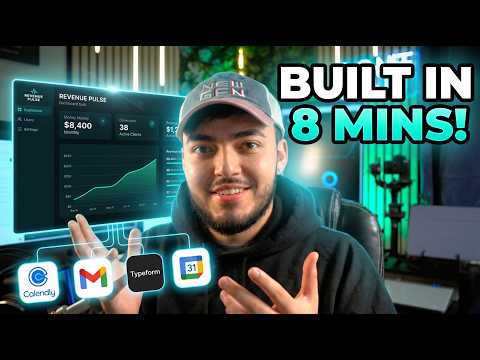
- The example comes from their own agency. Managing one client meant moving between a booking tool, email, a form tool, a calendar and a spreadsheet, so they built one dashboard to replace them.
- The build uses the video's sponsor, an AI app builder. One prompt produced a login, a dashboard with revenue, leads and conversion rate, a client database, a lead form and an analytics view, in 7 minutes 40 seconds by the creator's account. Five integrations followed: new bookings and form responses create leads, emails are logged against leads, and a client status change creates a follow-up calendar event.
- The business section is a pricing sketch: sell to freelancers, consultants and small agencies at $37 to $197 a month, with examples of 10, 20 and 40 clients at $120.
- The sponsorship is stated near the start and again at the end, with links to the builder and the prompt in the description.
Turn a workflow you already juggle across five tools into one subscription dashboard, then try to sell it to people with the same problem.
- Spot the manual stitching — Five tools, one client
- Write one prompt — AI app builder
- Build in ~8 minutes — 7 min 40 s stated
- Connect integrations — Bookings, forms, email
- Price per month — $37–$197
- Find paying clients — Not covered
- Recurring revenue — Projected only
The build is covered in detail; the step that produces revenue, finding customers, is not.
The build is the easy part, and the video says so in its own data
The lesson underneath the number
- The strongest idea in this video is how to choose what to build. The creator's agency moved client data between five tools by hand every week, and the product is the dashboard that removes that work. Starting from a problem you pay for in time yourself is a better basis for a product than a brainstorm, and the integration logic described, bookings and forms becoming leads and a status change creating a follow-up, is specific.
- The sponsorship is disclosed clearly, at the start and the end. That matters here because the central claim, that a sellable product can be built in under eight minutes, is a claim about the sponsor's tool, and a viewer should weigh the demonstration with that in mind.
- The revenue section is where care is needed. Ten, twenty and forty clients at $120 a month are correct multiplications, but no customers are stated for the tracker, and the video does not cover how any would be found. The most informative figure is one the creator gives in the first ten seconds: across the 8,000 businesses they say they analysed, the median makes $500 a month. That is about four customers at $120.
- There is also a tension the video does not address. If a client revenue tracker can be built from one prompt in under eight minutes, then so can a competitor's, and so can the prospective customer's own. The creator's line that what a developer would charge $20,000 to $30,000 for can now be built in minutes cuts both ways for anyone hoping to charge monthly for it.
The median revenue was USD 500 a month.
The creator, on the 8,000 micro SaaS businesses they say they analysed
The method, as they give it
Five steps from problem to price, with selling left out.
No customers, sales or costs are given for the product built in the video.
- Start from a workflow you already do by hand — The creator's own agency moved client data between five tools every week. Building for a problem you live with is a sound way to choose what to build.
- Sell to businesses, not consumers — Their reasoning: businesses "pay monthly they don't cancel easily and they actually have a budget". A common view; the video gives no churn figures to support it.
- Build with one prompt — Login, dashboard, client database, lead form and analytics from a single prompt, in 7 minutes 40 seconds by the creator's account.
- Wire up the integrations — Bookings and form responses become leads, emails are appended to lead notes, and a status change to client creates a one-week follow-up event. The builder asked multiple-choice questions and wrote the logic.
- Price between $37 and $197 a month — The creator's suggestion, "based on the demand you're able to generate". The examples use $120.
The business model
A monthly subscription to a client dashboard, suggested at $37 to $197 a month.
Freelancers, consultants, small agencies and solo operators who manage clients across several tools.
One dashboard for revenue, lead pipeline, conversion rate and client status, fed automatically from tools they already use.
Not described. The video does not say how customers would be found.
- AI app builder subscription — The sponsor; price not stated
- Payment processing — Not discussed
- Customer acquisition — Not discussed
- Support and changes — Edits described as quick; time not estimated
- Data security and privacy — Not discussed
No cost of any kind is stated for running the product as a business.
What you would actually need
Money
Not quantified. The creator says no developer, co-founder or investor money is needed.
Building may be cheap, but the costs of running a paid product are not stated: the builder's subscription, payment fees, hosting or usage limits, support and, above all, finding customers. A product handling clients' leads and revenue data also carries security and privacy responsibilities that the video does not cover.
Costs not stated
- The AI app builder's subscription
- Payment processing on every subscription
- Customer acquisition: ads, outreach or content
- Support and change requests from paying clients
- Data security and privacy for client records
- Tax on any revenue
Time
Under 8 minutes to build, and "less than 10 minutes" for what used to take months.
The build time covers the first version. Integrations, testing with real data, onboarding customers, handling their requests and selling are additional, and none of that time is estimated. The selling step in particular is where most micro SaaS products succeed or stop.
Where the hours go
- Writing and refining the prompt
- Connecting and testing each integration
- Finding and pitching freelancers and agencies
- Onboarding and supporting each customer
- Updating the product as clients ask for changes
The part you must pay attention to
The $1,200 to $4,800 is arithmetic on customers who do not yet exist.
The creator says: "If you have 10 clients at USD 120 a month that's USD 1,200 a month in recurring revenue."
- Clients, assumed — 10–40
- Monthly price, assumed — $120
$1,200–$4,800/mo
Revenue before any cost, churn or fee
Everything rests on the client count, and the video does not say how the creator would find a single paying client, nor whether the tracker already has paying users. The same video states that the median micro SaaS business makes $500 a month, which at $120 is about four customers. A product that anyone can rebuild with one prompt in under eight minutes also has little to stop a competitor, or a prospective customer, from building their own.
The multiplication is right: 10 × $120 = $1,200, 20 × $120 = $2,400 and 40 × $120 = $4,800, which is indeed "over $4,000". But these are illustrations at a chosen price, not results. Read them against the video's own data point: if the median of the 8,000 businesses is $500 a month, a typical outcome is closer to four $120 customers than to forty. No source is given for that data set, so even the median is the creator's statement.
- THE EXAMPLES
- 10 x $120 = $1,200/mo
- 20 x $120 = $2,400/mo
- 40 x $120 = $4,800/mo
- -> all before fees, churn, costs
- THE VIDEO'S OWN MEDIAN
- $500/mo / $120 ~4 customers
- $500 x 12 = $6,000/yr
- TOP 5% OF 8,000
- 8,000 x 5% = 400 businesses
- The other 7,600 not described
The economics
Correct arithmetic on assumed inputs, and no costs.
- Median micro SaaS revenue — $500/month
- Top 5% of solo founders — $10,000–$40,000/month
- Suggested price range — $37–$197/month
- Example price — $120/month
- Example client counts — 10, 20, 40
- Customers at the median — ~4 at $120
- Customers, churn, costs for this product — Not stated
The examples against the video's own median
40 × $120 = $4,800 a month; $500 median ÷ $120 ≈ 4 customers
The examples are ten times the customer count of the median business the creator describes
IncomeIdeaLab calculation from figures stated in the video
The source of the 8,000-business data set is not given, so the median and top-5% figures are the creator's statements. All revenue figures are before payment fees, churn, tooling and tax.
- Whether the tracker already has paying customers
- How customers would be found
- The app builder's subscription price
- Churn and support load
- The source of the 8,000-business data set
- Whether the creator is paid a flat fee or per sign-up by the sponsor
- 10 × $120 = $1,200 and 20 × $120 = $2,400 as stated; 40 × $120 = $4,800, which the creator rounds to "over $4,000".
- At the bottom of the suggested range, $37 a month, the median $500 is about 14 customers; at the top, $197, it is about three.
- The top 5% of 8,000 is about 400 businesses; the video describes what they do but not how the other 7,600 fare beyond the median.
- The developer estimate of $20,000 to $30,000 is the creator's statement of what a build like this would cost from scratch.
Evidence status
Every substantive claim in the video.
- Over 8,000 micro SaaS businesses analysed — Creator — Source of the data set not stated.
- Median revenue $500 a month — Creator — The most useful figure in the video for setting expectations.
- Top 5% make $10,000–$40,000 a month — Creator — About 400 of 8,000. No list or examples given.
- Built in 7 minutes 40 seconds — Creator — For the first version; integrations followed.
- A developer would charge $20,000–$30,000 — Creator — An estimate; no quotes given.
- Price at $37–$197 a month — Creator — A suggestion; no price tested with customers.
- 10 / 20 / 40 clients at $120 — Creator — Arithmetic correct; customers assumed.
- Businesses "don't cancel easily" — Creator — No churn figure given.
- Sponsorship — Creator — Disclosed at the start and the end.
- Customers, revenue or costs for this product — Not stated — No figure in the video.
What is actually proven?
A build is described. A business is not.
- The sponsorship is disclosed twice.
- A dashboard with five integrations was built, by the creator's account, in under eight minutes plus integration time.
- The client-count examples multiply correctly.
- $1,200 to $4,800 a month from 10 to 40 clients.
- A $500 median across 8,000 businesses, source not stated.
- Any paying customer for the product.
What the headline doesn’t tell you
The build is shown in detail; selling it is not covered.
- No customers stated. — For the tracker built.
- The revenue is illustrative. — 10–40 clients, assumed.
- The median is $500. — The creator's own figure.
- The data has no source. — For the 8,000 businesses.
- It is sponsored. — Disclosed, and the tool is the claim.
- Easy to build, easy to copy. — For competitors and customers.
Should you try it?
Worth a weekend build; plan for the selling
Build a tool for a problem you have, then try to pre-sell it to five people before counting on $120 a month from anyone.
- Idea-selection method — 7 — Build from a workflow you already do by hand.
- Detail on the build — 7 — Prompt, features and integration logic described.
- Sponsorship disclosure — 8 — Stated at the start and the end.
- Evidence of revenue — 0 — No customers or sales stated for the product.
- Coverage of selling — 1 — Target market named; no method given.
- Cost disclosure — 0 — No cost of any kind stated.
- Beginner accessibility — 6 — Building is easy; finding customers is the hard part.
- Building a small tool for a problem you live with is a good exercise and, with current AI app builders, cheap to try. The creator's example, one dashboard fed by a booking tool, forms, email and a calendar, is the kind of thing a freelancer or small agency might use, and starting from your own pain point is the right instinct.
- Set expectations from the creator's first statistic, not their last. They say the median micro SaaS makes $500 a month. At $120 that is four customers; at $37 it is about fourteen. Forty customers at $120 is a result the video illustrates but does not show anyone achieving.
- Treat selling as the real project. The video names who to sell to but not how to reach them, what conversion to expect or how many prospects it takes to win one customer. Before building further, describe the tool to the people you think need it and ask them to pay in advance.
- Think about defensibility early. If the product took one prompt to build, a customer may decide to build their own. What usually keeps subscribers is reliability, support and integrations kept working over time, which is ongoing work the video does not cover.
Passive or automated?
Automation
Integrations run on their own; selling and support do not.
Passive potential
Subscriptions recur once won, if integrations keep working.
Software subscriptions are among the more automatable incomes: once a customer is paying, billing recurs and the integrations described run without anyone touching them. Getting customers is not automated, and the video does not describe a method for it. Integrations with outside tools also need maintenance when those tools change, and paying clients will ask for changes, which the creator says can be made by describing them to the builder. The product can run unattended day to day; the business around it cannot.
- Finding and selling to each customer
- Onboarding customers and connecting their tools
- Handling support and change requests
- Fixing integrations when outside tools change
- Protecting client data
Recommended beginner experiment
Pre-sell before polishing.
- Write down your own manual workflow. — Tools, steps, time per week.
- Build a first version. — Cap it at one weekend.
- Show it to ten people with the problem. — Not friends; prospects.
- Ask for payment up front. — Even a small amount.
- Count paying users, not sign-ups. — Against the $500 median.
- Price all running costs. — Builder, fees, support time.
- Track cancellations monthly. — Test the "don't cancel" claim.
Our verdict: 4/10
A disclosed, sponsored build with projected revenue and no stated customers and an opening median of $500 a month that says more than the examples
Credited for disclosing the sponsorship at the start and the end, for choosing a product from a workflow the creator does by hand in their own agency, for describing the integration logic specifically, and for client-count arithmetic that is correct. Marked down because every revenue figure for the product is an illustration at an assumed price and client count, because no customers, sales, churn or costs are stated, because the opening data on 8,000 businesses has no stated source, and because the video does not cover how any customer would be found.
This is a sponsored build video, and it says so clearly. The creator takes a real problem from their own agency, client data spread across five tools, and builds a dashboard that pulls it together, with integration logic described in useful detail. As a demonstration of what an AI app builder can produce from one prompt, it is specific. As a business case, it stops before the hard part. The $1,200, $2,400 and over $4,000 a month figures are correct multiplications of 10, 20 and 40 clients at an assumed $120, but no customers are stated for the product and the video does not describe how any would be found. The creator's own opening statistic is the better guide: across the 8,000 micro SaaS businesses they say they analysed, the median makes $500 a month, about four customers at $120. A product that can be built in under eight minutes is also easy for others to rebuild. A beginner should build the tool if it solves their own problem, try to pre-sell it to a handful of prospects, and judge the opportunity by how many pay.
- Median micro SaaS revenue — $500/month
- Build time — 7 min 40 s
- Example revenue — $1,200–$4,800/month
- Customers at the median — ~4 at $120
- Customers for this product — Not stated
- Costs — Not stated
- Beginner suitability — Build yes; plan to sell
Sources
- The Micro SaaS Business Almost Nobody Is Building (Until Now) — YouTube video, 2026-06-30
- FTC — Guides Concerning the Use of Endorsements and Testimonials — Regulatory guidance on sponsored content and earnings claims