Founder Education / Masterminds · Claim Review
“The Business Advice You Won't Find on YouTube”
What we found: The $20K Mastermind Was “ROI Positive on Day One” Only on the Strength of an Idea Not Yet Built, With Travel Left Out
An unusually open account of what a coaching habit costs — $60,000 a year for this group, $100,000-plus a year in total — set against a return that is one unspecified idea, stated in the future tense.
- $100k+ Annual coaching spend
- $60k/yr This group
- >$20k Return claimed
- Excluded Travel, hotels, team
The claim
That a $20,000 entrepreneur event was worth it "by an absolute mile", and "ROI positive on day one", because of an idea that will add more than $20,000 of value to their business.
- Spend on coaches, mentors and events — Over $100,000 a year, for 5 years ("Invested $100K+/Year" on-screen graphic at 0:11)
- Implied five-year total — Over $500,000
- This group’s fee — $60,000 a year (on-screen graphic at 18:57)
- Per event (three a year) — $20,000 (on-screen graphic at 19:09)
- Value of the day-one idea — "Way more than $20,000"
- What the idea is — Not described
- Travel, accommodation, team member’s seat — Not counted
- Day-four "boardroom" threshold — A business doing at least $1M a year
- Guarantee of return — "Absolutely no guarantee"
What is this income idea?
Paying for business coaching, mentors and closed events, on the theory that tailored advice and a network of peers are worth more than free information online.
- The question is set up fairly: "why would you pay for business advice when it's all freely available on YouTube or on chat GBT", and how should you think about "an investment that has absolutely no guarantee of you actually being able to make your money back".
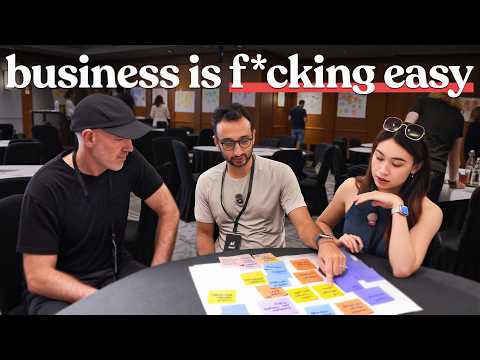
- The answer is shown across four days at an event in Thailand: goal-setting worksheets, a "moving mastermind" on boats in groups of six with ten minutes per person, a webinar workshop, a session on removing things from a business, a three-hour conversation about turning their curriculum into a visual model, and a final day for "boardroom" members with businesses doing "at least a million a year".
- Their argument for paying is that free advice is generic: a mentor "will actually be able to push back on your stuff", and the most useful knowledge is shared "in closed group circles" by people with no reason to post it online.
- A sponsored segment for a creator-storefront tool sits in the middle. They disclose it, and also disclose that the tool is one their own academy recommends to students.
- The money is given at the end: "$60,000 US per year to be part of the group", used mainly for "the three events that they do every year", so "each of the three events costs us $20,000". Their verdict: "hell yes … by an absolute mile", because a lunch conversation produced "an idea that will immediately add way more than $20,000 of value to the business so it was ROI positive on day one".
An honest account of what an expensive coaching habit costs, judged worthwhile on the basis of one idea that has not been carried out yet.
- $60k a year fee — Three events
- Fly to the event — Not costed
- Goals worksheet — Next four months
- Mastermind groups — 6 people, 10 min each
- Workshops — Webinars, "the reducer"
- One-to-one time — 3-hour model session
- An idea at lunch — "Will" add >$20k
- "ROI positive" — On day one
Costs counted in full on the fee side; the return is a forecast.
Honest about the cost, optimistic about the return
The lesson underneath the number
- Most videos about masterminds either sell one or never mention the price. This one names the fee, $60,000 a year, explains that they mainly use it for three events, and divides it into $20,000 per event. They add that they have spent over $100,000 a year on coaches, mentors and events for five years, and they open by saying there is "absolutely no guarantee" of earning it back. That is a level of disclosure that lets a viewer judge for themselves.
- They are also open about why they are filming it. Business advice online mostly comes from people "trying to sell you a business course", they say, and "this is one of the reasons why I'm doing this … it's aligned with the with the stuff that we sell". The sponsored segment is labelled as such, and they say their own academy recommends the sponsor's tool to students.
- The conclusion is weaker than the set-up. Having asked whether $20,000 was worth it, they answer "hell yes … by an absolute mile" because of one idea from a lunch that "will immediately add way more than $20,000 of value". The idea is not described, it has not been carried out, and the cost of carrying it out is not considered. The return is a forecast; the cost is a fact. And the $20,000 is only the fee — the flights to Thailand, the hotel, a team member's place and four or five working days are not counted.
- None of this means the event was not worth it to them; for an established business with a team, a single good idea can easily be worth that much. It means the video shows you the cost of the habit clearly and the return only as their belief. For a beginner, their own aside is the more useful line: "quite a lot of these business events are actually totally free".
How should someone think about an investment that has absolutely no guarantee of you actually being able to make your money back.
Ali Abdaal, opening the question the video sets out to answer
What happens at the event, as they show it
A clear look inside a paid mastermind. The structure is the useful part.
The event days are filmed as a vlog. The cost figures are spoken and also appear in the channel's on-screen graphics: "Invested $100K+/Year" at 0:11, "$60,000 / Year" at 18:57 and "$20,000 / Event" at 19:09.
- Set goals for the next four months — The first morning is worksheets: recent wins, goals until the next event in four months, and the core areas to focus on. A "focusing lens" for the rest of the week.
- Bring one problem to a small group — Groups of six, "about 10 minutes to bring their most pressing business challenge" and ten minutes of input. Their question was how to make members stay "for years rather than just months".
- Learn a specific skill from a specialist — A webinar workshop from someone they say has sold "$10 million worth of things" at a single workshop, against a couple of hundred thousand dollars for their own. Those figures are their statements about another person.
- Remove things, not just add them — A session on what to delete from a business, because "the danger with coming to an event like this is that you get all these different ideas and then you want to add them all". A good warning, and an honest one to include.
- Spend real time with one person — A three-hour conversation about turning their curriculum into a visual model. The outcome is "hopefully working with" that person — not a done result.
- Judge the return — Fee divided by events gives $20,000. The return is "an idea that will immediately add way more than $20,000 of value". The idea is not described.
The business model
Their own business sells an online business school — a six-month incubator aimed at a first $10,000 and a twelve-month accelerator — to people starting coaching, consulting or service businesses.
For the event: established coaches and online educators, with a top tier for businesses doing at least $1M a year. For their academy: "a normal person" starting out.
Personalised advice and a peer network that free online content cannot replace.
YouTube vlogs like this one, which they say are "aligned with the stuff that we sell".
- Mastermind fee — $60,000 a year
- Other coaching, mentors and events — Over $100,000 a year in total
- Travel and accommodation — Not stated
- Team attendance — A team member was at the event; cost not stated
- Coaches in their academy — Mentioned; number and cost not given
The video is unusually open about what they pay for advice. It gives no figure for what their own business earns, so the $100,000 a year cannot be set against revenue.
What you would actually need
Money
"$60,000 US per year" for this group; "over $100,000 every single year" on coaching overall. They also note "quite a lot of these business events are actually totally free".
The fee is disclosed more clearly than in almost any video of this kind. The true cost per event is higher than $20,000, because the trip, the hotel and a team member's attendance sit on top of it and are not mentioned.
On top of the $20,000
- International travel to Thailand, and next to Austin
- Accommodation for four to five days
- A team member also attending — seat cost not stated
- Four or five days of the founder's time
- Family travel, which they show but which is their choice
Time
Three events a year, each four to five days.
Roughly two to three weeks a year at events, plus travel days. The day-four "boardroom" is only for businesses doing at least $1M a year, which tells you who the group is built for.
What the group assumes
- Three multi-day events a year
- A business established enough to have "problems of scale"
- Coaches and a team to run things while away
- For day four: at least $1M a year in business revenue
The part you must pay attention to
“ROI positive on day one” is a forecast, not a result.
The cost is stated as a fact; the return is stated in the future tense. "We got an idea that will immediately add way more than $20,000 of value to the business so it was ROI positive on day one."
- Value the idea "will" add — >$20,000
- Fee share for this event — $20,000
- Costs not counted — travel + hotel + seat
Not yet known
The idea has not been carried out, and the cost is understated
Return on investment is money back divided by money spent. Here the money spent is real and partly counted, and the money back is an estimate of what an undescribed idea will be worth once it is done. Ideas are cheap to have and expensive to carry out; the value of this one depends on the work, time and cost of implementing it, none of which is mentioned. "ROI positive on day one" therefore means "I expect this to pay off", which is a reasonable thing for them to believe and a different thing from having been paid back.
The cost side is also narrower than it looks. Dividing $60,000 by three events correctly gives $20,000, but that is only the fee. The event is in Thailand, the next is in Austin, they stay four to five days, and a team member came too — the "idea" itself came from that team member's lunch. None of those costs is in the $20,000. Against that, they deserve real credit for stating the fee at all, for their wider $100,000-a-year figure, and for saying at the start that there is "absolutely no guarantee" of making the money back.
- THE COST, AS STATED
- Group fee $60,000 / yr
- Events per year 3
- Per event $20,000
- -> checks out
- NOT IN THE $20,000
- Flights to Thailand ???
- 4-5 nights accommodation ???
- Team member attending ???
- Founder time, 4-5 days ???
- THE RETURN, AS STATED
- One idea, not described
- "will immediately add
- way more than $20,000"
- -> projected, not realised
- THEIR COACHING HABIT
- $100,000+ x 5 years = $500,000+
- (our arithmetic)
The economics
The cost is clear. The return is an estimate.
- Coaching spend — $100,000+ a year for 5 years
- Five-year total — $500,000+
- This group — $60,000 a year
- Per event — $20,000
- Share of annual coaching spend — Up to 60%
- Travel, hotel, team seat — Not stated
- Value of the day-one idea — "Way more than $20,000"
- Their own revenue or profit — Not stated
What the coaching habit adds up to
$100,000 × 5 years = $500,000; $60,000 ÷ 3 events = $20,000
At least half a million dollars on advice over five years, with this group making up as much as 60% of a $100,000 year
IncomeIdeaLab calculation from the figures stated in the video
"Over $100,000" is a floor, so the true totals may be higher and the group's share lower. The video gives no revenue figure to set the spend against.
- What the day-one idea is, and what it will cost to carry out
- Travel and accommodation for this and other events
- Whether the team member's attendance carries a separate fee
- Their business's revenue or profit
- Any past event idea whose value was later measured
- The price-times-volume example — $100,000 as one sale of $100,000, ten of $10,000 or 10,000 of $10 — is arithmetically correct. They state their own view that selling fewer, more expensive things is easier, and say a guest's case for low-ticket products made them reconsider.
- Figures about other people — a guest said to make "about $10 million a year", a webinar specialist said to have sold "$10 million" in one workshop — are their statements about third parties and are not checked here.
- The sponsor read says students using the tool have made "hundreds and thousands and even tens of thousands of dollars". It gives no number of students or typical result. Its $47-to-$93 order example implies $46 of add-ons on one order.
- The sponsor read says the tool "doesn't take any cut of your sales". Card payments still pass through a payment processor, which normally charges its own fee; the segment does not mention this.
- The closing link points to a video on reaching "six figures a year in revenue … ideally within 12 to 18 months". That is a target, not a result shown here.
Evidence status
Every money claim in the video.
- Over $100,000 a year on coaches, mentors and events for 5 years — Creator; on-screen graphic at 0:11 — A clear cost disclosure, also shown in an on-screen graphic as "Invested $100K+/Year". At least $500,000 in total.
- $60,000 a year for this group — Creator; on-screen graphic at 18:57 — Stated plainly and shown in an on-screen graphic.
- $20,000 per event — Creator; on-screen graphic at 19:09 — Correct division of the fee, also shown as "$20,000 / Event" on screen. No travel, hotel or team-seat cost appears with it.
- An idea that "will immediately add way more than $20,000" — Creator — Future tense; idea not described or done.
- "ROI positive on day one" — Creator — Rests entirely on the projection above.
- "Absolutely no guarantee" of making the money back — Creator — An honest framing at the outset.
- Boardroom requires at least $1M a year — Creator — Describes the group's top tier.
- Students using the sponsor made up to "tens of thousands" — Sponsor read — No count or typical result given.
- Sponsor "doesn't take any cut of your sales" — Sponsor read — Payment processing fees not mentioned.
What is actually proven?
What they pay is clear. What they get back is their estimate.
- The event format — goal sheets, small-group masterminds, workshops — is shown.
- The sponsor and their own business interest in the topic are both disclosed.
- $60,000 a year for the group and over $100,000 a year on coaching overall, said aloud and repeated in the channel's on-screen graphics at 0:11 and 18:57.
- $20,000 per event, before travel, accommodation and a team member's attendance.
- At least $500,000 spent on coaching over five years.
- An idea that will add more than $20,000 of value.
- What that idea is, or what carrying it out will cost.
- Their business's revenue or profit.
What the headline doesn’t tell you
Most of the cost is disclosed. The return is not yet real.
- ROI on day one. — From an idea not yet done.
- The idea is not described. — Or costed.
- $20k is the fee only. — Thailand is extra.
- A team member came too. — Their cost is not given.
- $500k+ over five years. — By their own figures.
- Day four needs $1M a year. — Not a beginner's room.
- They sell business education. — And says so.
- Many events are free. — Their own aside.
Should you try it?
Not at this price, not at this stage
The group is built for established businesses. Start with the free events they mention and judge any paid one by results you can count afterwards.
- Cost disclosure — 8 — Fee, per-event cost and annual coaching spend all stated.
- Honesty about the risk — 8 — "Absolutely no guarantee" said up front.
- Disclosure of interests — 8 — Sponsor labelled; their own business stake acknowledged.
- Evidence for the return — 2 — One undescribed idea, in the future tense.
- Completeness of the cost — 5 — Fee counted; travel, hotel and team seat not.
- Usefulness of the event format — 7 — Goal-setting, small groups and "reducing" are transferable.
- Beginner relevance — 3 — A top tier requiring $1M a year in revenue.
- Specificity of what was learned — 5 — Topics named; outcomes mostly "hopefully".
- This is a useful video for seeing what a high-end mastermind actually involves: a goals worksheet, groups of six with ten minutes each, specialist workshops, a session on removing things from your business, and a lot of informal conversation. It also tells you plainly what it costs — $60,000 a year for this group and over $100,000 a year on coaching overall — which few videos of its kind do.
- Be careful with the conclusion. "ROI positive on day one" rests on an idea that "will" add more than $20,000 of value. You are not told what it is, how long it will take or what it will cost to do, and it has not happened yet. That is their reasonable expectation, not a return. When you judge any paid programme, count the money that actually came back, after the cost of acting on the advice.
- Count the full cost, too. The $20,000 is the fee only. This event was in Thailand and the next is in Austin; flights, four or five nights of accommodation, a team member's place and the days away from work all sit on top. For someone without their income, those extras could be a large share of the total.
- Most of all, notice who the room is for. The final day is reserved for businesses doing at least $1M a year, and their own challenges are "problems of scale". If you are starting out, their own suggestion fits you better: "quite a lot of these business events are actually totally free there are probably some in your local city".
Passive or automated?
Automation
Learning from people in a room cannot be automated.
Passive potential
A cost centre that pays off only if the advice is acted on.
Coaching and events are not an income stream; they are a cost that may lead to one. The value they describe — tailored advice, pushback, a network of peers, specialist skills — comes from showing up, asking questions and then doing the work of carrying out what was learned. They show the danger themselves: an event like this produces many ideas, and adding them all makes a business "even heavier". Whatever the event is worth depends on what happens after it, by people, at the business.
- Travelling to and attending three events a year
- Bringing a real problem and acting on the answers
- Carrying out the day-one idea
- A team to run the business while they are away
- Deciding what not to add
Recommended beginner experiment
Get the benefit they describe without the $20,000.
- Find one free local business event. — Their own suggestion.
- Bring one specific problem. — Ten minutes, like their mastermind.
- Ask someone a few years ahead. — For pushback, not praise.
- Write down one idea to act on. — Not twenty.
- Cost the idea before doing it. — Time, money, people.
- Measure what it returns. — Actual money, after the fact.
- Count travel in any event cost. — Not just the ticket.
- Pay only when the maths works. — On results, not expectations.
Our verdict: 6/10
An open account of what coaching costs, with a return that is still a forecast and a $20,000 per-event figure that leaves the trip out
Credited for stating the group fee ($60,000 a year), the per-event cost ($20,000) and their wider spend on coaching (over $100,000 a year for five years); for saying up front that there is "absolutely no guarantee" of earning it back; for labelling the sponsored segment and acknowledging that the video is "aligned with the stuff that we sell"; for a clear look inside the event format; and for pointing beginners to free local events. Marked down because "ROI positive on day one" rests entirely on an idea that "will immediately add way more than $20,000" which is not described, not costed and not yet carried out; because the $20,000 per event excludes travel to Thailand, accommodation and a team member's attendance; and because no revenue figure for their own business is given to set the spend against.
This video does something most coaching content avoids: it names the price. Sixty thousand dollars a year for this group, mostly used for three events, works out to twenty thousand per event, and they add that they have spent over a hundred thousand a year on coaches, mentors and events for five years — at least half a million dollars, by our arithmetic. They open by admitting there is "absolutely no guarantee" of getting it back, label the sponsor, and say outright that a vlog about a business conference serves the business education they sell. The event itself is shown clearly enough to learn from: small groups with one problem each, specialist workshops, and a session on taking things out of a business rather than adding more. The answer to their own question is where the evidence thins. The event was "ROI positive on day one" because of "an idea that will immediately add way more than $20,000 of value" — not described, not costed, not yet carried out. That is a forecast. And the $20,000 is only the fee; flights to Thailand, accommodation, four or five days away and a team member's place are not included. For an established business with a team and at least a million a year in revenue — the threshold for the group's final day — one good idea may well be worth it. For anyone earlier on, their own throwaway line is the best advice in the video: plenty of business events are free, and there are probably some in your city.
- Coaching spend — $100,000+ a year, 5 years
- Group fee — $60,000 a year
- Per event (fee only) — $20,000
- Five-year total — $500,000+
- Return — ">$20,000", one idea
- Travel and team costs — Not counted
- Their revenue — Not stated
- Beginner suitability — Free events first
Sources
- The Business Advice You Won't Find on YouTube — Source video, 2026-10-07
- FTC — Guides Concerning the Use of Endorsements and Testimonials — Regulatory guidance on sponsored content and earnings claims