Local Services / Laundromats · Claim Review
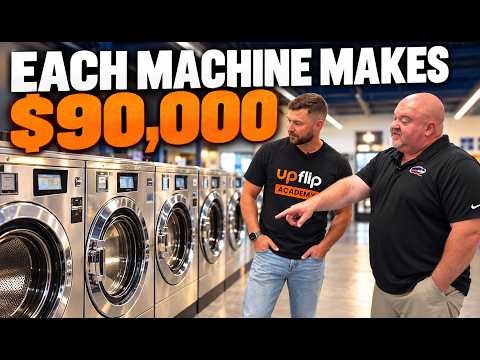
“Forget Self-Service Laundromats… THIS Is the Future!”
What we found: Four-Laundromat Business: The $1.8M Revenue Figure Adds Up From the Stores, but the Largest Store's Cost Figure Does Not Reconcile
The first purchase and its financing are fully itemised. Per-store revenue broadly matches the total. Total profit is not stated, and the $200,000 cost figure for the $1.2 million store would imply a margin twice the owner's own industry ceiling.
- ~$1.8M Revenue last year
- $85,000 First store price
- 90–100/week Hours in early years
- Not stated Total profit
The claim
That a laundromat bought for $85,000 in 2010 grew into a four-location business doing about $1.8 million a year, on track for $2.2 million, with pickup and delivery as the main growth engine.
- Year one revenue (partial year) — ~$100,000
- About five years later — ~$700,000 with two stores
- About five years after that — ~$1.2 million
- Last year — ~$1.8 million
- This year — "On path" to $2.2 million
- Three smaller stores — $250,000–$300,000 each, ~30% margin
- Largest store — ~$1.2 million revenue
- Sum of stated store revenues — $1.95–$2.1 million
- Largest store operating costs — "About 200,000", monthly or yearly unclear
- Profit for the whole business, owner pay, loan payments — Not stated
What is this income idea?
Buy an underperforming laundromat cheaply, make it profitable, expand to more stores, then add drop-off, dry cleaning and pickup and delivery to use machines while the store is closed.
- The owner has been in the business since 2010 and now runs four locations on the east side of Cincinnati with about 40 employees, about 250 machines and four delivery vans. A general manager and two assistant general managers run day-to-day operations.
- The first store was "a rundown hot mess" bought for $85,000. The owner says they had about $30,000 in savings: $15,000 went on the down payment, a small business loan covered $70,000, and the other $15,000 went on improvements. They bought a second, loss-making store about a year later, and quit their job about three years after that, shortly before buying a third.
- The revenue history given is about $100,000 in a partial first year, about $700,000 roughly five years later with two stores, about $1.2 million five years after that, about $1.8 million last year, and a path to $2.2 million this year.
- The growth thesis is utilisation. The owner says machines that are built to run 20 times a day were turning three to six times, so instead of opening more stores they added pickup and delivery and process about 90% of it overnight when the store is closed. Full-service work is now about 50% of revenue.
- Machine-level figures are given: a 60 lb washer costs about $12,000 and brings in about $150 a day self-serve; an 80 lb washer costs about $16,000 and brings in $200–$250 a day self-serve, or about $400 a day once pickup and delivery loads are included.
- The owner is open about the cost in time: "I worked 90 to 100 hours a week for 4 years", with a story about nearly leaving for work on Christmas morning. The episode includes a promotion for the channel's paid academy, which the host says was built in partnership with the guest.
Buy a struggling laundromat, fix it, add more, then fill idle machines overnight with delivery orders. The revenue adds up; the profit for the whole business is not given.
- Save $30,000 — Over 3–4 years
- Buy a failing store — $85,000, loan-funded
- Fix and stabilise — $15,000 improvements
- Buy more stores — Four by now
- Add full service — Drop-off, dry cleaning
- Pickup and delivery — 90% run overnight
- ~$1.8M revenue — Last year, stated
A step-by-step expansion story with real figures at the purchase stage and revenue-only figures at scale.
Utilisation, not more stores, is the strategy
The lesson underneath the number
- The most interesting idea in the episode is the owner's explanation for adding pickup and delivery. They had spent heavily on machines that were "turning three four five six times a day" when they are "built to run 20 times a day". Rather than open more stores, they filled the idle capacity overnight: about 90% of delivery laundry is washed when the store is closed. That is why one 80 lb washer is said to bring in about $400 a day with delivery against $200–$250 self-serve.
- The starting figures are better than most in this genre. The price, the savings, the down payment, the loan and the improvement budget are all given, and they add up. The owner also gives industry margin tiers, high teens to low 20s for average operators and 30–40% for the best, and says the three smaller stores run at about 30%. That is useful context a viewer can use to sanity-check any store they look at.
- Where the picture thins out is at the top. Last year's $1.8 million is revenue, and no profit figure is given for the whole business. The one cost figure for the largest store does not reconcile with the margins the owner describes in either reading, so its profitability cannot be calculated. Staff, vans and loan repayments on the later stores are not priced.
- The personal cost is stated plainly, which deserves credit. Four years of 90–100-hour weeks alongside a full-time job is part of how the first stores were turned around, and the owner says they would not recommend it. The episode also carries a promotion for the channel's paid academy, described as made in partnership with the guest, and the guest mentions their own book.
I had spent millions of dollars of equipment and it was turning three four five six times a day and it's built to run 20 times a day.
The owner, on why they added pickup and delivery
How the business was built, as the owner tells it
The first purchase is itemised in detail; later stages are given as revenue totals.
Purchase prices are given for the first store only; later acquisitions are not priced.
- Save and buy a distressed store — About $30,000 saved over three or four years. The first store cost $85,000 and was unprofitable when bought. $15,000 down plus a $70,000 loan is $85,000, and $15,000 down plus $15,000 in improvements is the $30,000 saved, so the figures reconcile.
- Make it profitable, then repeat — A second, loss-making store was bought about a year later and turned around. The prices of the second, third and fourth stores are not given.
- Keep the job until the risk is covered — The owner kept a full-time job for roughly the first three to four years and left about three weeks before closing on the third location.
- Choose the right location, equipment and price — The owner's three fundamentals: location first ("the best operator can't overcome it"), buying good equipment through a good distributor, and not overpaying for the store.
- Add full service and pickup and delivery — Launched at the fourth location, a 5,400 sq ft site with a laundromat floor of about 3,000 sq ft and "a couple thousand square foot of storage". About 10% of delivery laundry is processed during opening hours and 90% overnight.
- Ask for reviews on purpose — QR-code signs in store link to the business's Google profile, and customers get text and email follow-ups asking for a review. The owner says the majority of more than 100 five-star reviews were requested.
The business model
Self-service washing and drying, drop-off wash-and-fold, dry cleaning at some locations, and pickup and delivery. Full service is about 50% of revenue.
Local self-service customers plus households and businesses using drop-off and delivery.
Clean, modern stores with a strong review profile, and delivery that saves customers the trip.
Four physical locations, four delivery vans, and Google reviews driven by in-store QR codes and follow-up messages.
- Store purchases — $85,000 for the first; others not priced
- Equipment — $12,000–$16,000 per large washer; ~$5 million bought over the years
- Staff — About 40 employees plus a management team. Payroll not stated
- Vans and drivers — Four vans. Not priced
- Operating costs, smaller stores — About 70% of revenue, stated
- Operating costs, largest store — "About 200,000"; period unclear
- Loan repayments — Not stated
Margins are given by store type and by industry tier; a profit figure for the whole business is not.
What you would actually need
Money
The owner started with about $30,000 in savings and a $70,000 small business loan, and suggests partners or seller financing for people with less.
The starting figures are unusually complete and they add up. Scaling is a different scale of money: the owner says they have bought about $5 million of equipment from one distributor over the years, and the purchase prices of stores two to four are not given.
Stated or implied
- $15,000 down payment on the first store
- $70,000 small business loan
- $15,000 in early improvements
- $12,000–$16,000 per large washer
- ~$5 million of equipment bought over the years
- Four delivery vans, not priced
- About 40 staff, payroll not stated
Time
"I worked 90 to 100 hours a week for 4 years." The owner says they pushed too far and does not recommend it.
This is the most useful disclosure in the episode. The revenue history covers about 15 years, and the early years combined a full-time job with running the stores. Today a management team runs operations, which took years to build.
The timeline given
- 2010: first store bought
- About a year later: second store
- About three years later: job left before third store
- ~5 years in: ~$700,000 with two stores
- ~10 years in: ~$1.2 million
- Last year: ~$1.8 million; this year forecast $2.2 million
The part you must pay attention to
The revenue reconciles. The profit is not given, and one cost figure does not fit.
Asked for operating costs at the $1.2 million store, the owner answers "about 200,000"; the host then says "a year". Neither monthly nor annual readings sit with the margins the owner gives for the industry.
- Largest store revenue — $1.2M
- Stated operating costs, read as yearly — $200k
~83% margin
Against an industry ceiling the owner puts at about 40%
The owner says "the highest profit margins in the business are around 40%", that they do not know anyone who has reached 50%, and that the three smaller stores run at about 30%. A $1.2 million store with $200,000 a year in operating costs would be running at about 83%, more than double that ceiling. Read as $200,000 a month, costs would be $2.4 million a year against $1.2 million in revenue, which is a loss. The video leaves the figure there, so the largest store's margin cannot be worked out from it.
The rest of the revenue picture holds together well. Three stores at $250,000–$300,000 plus a $1.2 million store is $1.95–$2.1 million, which sits between last year's $1.8 million and this year's forecast $2.2 million. What the video does not give is profit for the business as a whole, the owner's pay, loan repayments on the later stores, or the cost of 40 staff and four vans. At the margins the owner describes, $1.8 million in revenue would be roughly $340,000–$720,000 in operating profit before debt and tax (our arithmetic, at 19–40%).
- FIRST PURCHASE
- Savings $30,000
- Down payment -$15,000
- Improvements -$15,000
- Loan $70,000
- $15,000 + $70,000 = $85,000 OK
- STORES VS TOTAL
- 3 stores x $250-300k = $750-900k
- Largest store + $1.2M
- Sum $1.95-2.1M
- Last year (stated) $1.8M
- This year (forecast) $2.2M
- LARGEST STORE COSTS
- $200k a year -> ~83% margin
- $200k a month -> a loss
- Owner's ceiling ~40%
The economics
Clear on the purchase, clear on revenue, incomplete on profit.
- First store price — $85,000
- Down payment / loan / improvements — $15,000 / $70,000 / $15,000
- Revenue last year — ~$1.8 million
- Revenue this year — ~$2.2 million
- Three smaller stores — $250,000–$300,000 each at ~30% margin
- Largest store — ~$1.2 million revenue
- 60 lb washer — ~$12,000; ~$150/day self-serve
- 80 lb washer — ~$16,000; $200–$250/day self-serve, ~$400 with delivery
- Profit for the business, owner pay, debt — Not stated
Operating profit range implied by the owner's own margin tiers
$1.8 million × 19% to 40% = ~$342,000 to ~$720,000
A wide range before loan repayments, owner pay and tax; the video does not say where this business sits for the largest store
IncomeIdeaLab calculation from the stated revenue and stated margin tiers
The three smaller stores at ~30% on $750,000–$900,000 would contribute about $225,000–$270,000 of that. The largest store's margin cannot be calculated because its stated cost figure does not reconcile in either reading.
- Profit for the business as a whole
- Owner salary or distributions
- Purchase prices of the second, third and fourth stores
- Outstanding debt and loan repayments
- Payroll for about 40 employees
- Van, fuel and insurance costs for delivery
- A $16,000 washer at $400 a day would bring in its purchase price in about 40 days of revenue, and a $12,000 washer at $150 a day in about 80 days (our arithmetic). These are revenue figures; water, power, staff and rent come out of them.
- Revenue grew from about $700,000 to about $1.2 million over roughly five years, and from $1.2 million to $1.8 million over a period that is not given precisely (our reading of the timeline).
- The owner says the industry is projected to grow from $8 billion "a few years ago" to $50 billion within 15 years. No source is given for the projection; it would imply growth of about 13% a year (our arithmetic).
- The owner says they have bought about $5 million of equipment from one distributor and have never negotiated on price, crediting that relationship with about half of their success. Readers starting out may not be in a position to forgo negotiation.
Evidence status
Every substantive claim in the video.
- First store bought for $85,000 — Owner — Itemised with financing; adds up.
- $30,000 saved: $15,000 down, $15,000 improvements, $70,000 loan — Owner — All three figures reconcile.
- ~$100,000 in the first partial year — Owner — We could not check this from the video.
- ~$700,000 about five years later with two stores — Owner — The owner adds they may have just bought store three.
- ~$1.8 million last year — Owner — Broadly consistent with the per-store figures.
- On path to $2.2 million this year — Owner — A forecast.
- Smaller stores at $250,000–$300,000 with ~30% margin — Owner — Consistent with the owner's own industry tiers.
- Largest store costs "about 200,000" — Owner and host — Does not reconcile with the stated margins as either monthly or yearly.
- Highest industry margins around 40% — Owner — The owner's view from experience.
- Industry growing from $8B to $50B in 15 years — Owner — No source given.
- 90–100-hour weeks for four years — Owner — Volunteered, with a warning against it.
What is actually proven?
The figures that can be cross-checked mostly agree; profit is missing.
- The first purchase, savings, loan and improvement figures add up exactly.
- Per-store revenues sum to $1.95–$2.1 million, between last year's total and this year's forecast.
- Smaller stores run at about 30% margin by the owner's account.
- The largest store's stated cost figure does not reconcile with the owner's margin ceiling.
- $2.2 million this year and a doubling of delivery volume in three years are forecasts.
- Profit for the business, owner pay and debt.
What the headline doesn’t tell you
A real business with a long runway and revenue-first figures.
- $1.8M is revenue. — Total profit is not stated.
- About 15 years in. — Since 2010.
- 90–100-hour weeks. — For four years, alongside a job.
- A $70,000 loan at the start. — Later stores' financing not given.
- About 40 staff. — Plus a management team.
- One cost figure does not fit. — For the $1.2M store.
- $5M of equipment. — Bought over the years.
- Academy promotion. — Built in partnership with the guest.
Should you try it?
A credible path with a large capital and time cost
The first-store playbook is realistic for someone with savings and a loan. The four-store result took about 15 years and very long hours.
- Specificity of the starting figures — 9 — Price, savings, down payment, loan and improvements all given.
- Internal consistency of revenue — 7 — Store figures broadly match the totals.
- Profit disclosure — 4 — Margins by store type; no total profit; one cost figure unclear.
- Honesty about the time cost — 9 — Four years of 90–100-hour weeks, volunteered.
- Capital needed — 3 — Tens of thousands to start, millions in equipment at scale.
- Beginner accessibility — 4 — Possible to start; slow and demanding to grow.
- This is a more grounded story than most income videos. The owner gives the price of the first store, how it was paid for and what was spent fixing it, and those figures add up. If you have tens of thousands in savings and can get a small business loan, the first step described is a realistic one, and the owner's three fundamentals, location, equipment and not overpaying, are sensible filters.
- Use the owner's own margin tiers when you look at a store. Average operators in the high teens to low 20s and the best at 30–40% means a store doing $250,000 might leave $50,000–$100,000 before debt, owner pay and tax. That is a business, not a passive income stream.
- Do not read the $1.8 million as take-home. It is revenue across four stores, 40 staff and four vans, built over about 15 years. The video does not give profit for the business, the owner's pay or the debt carried on the later stores, and one cost figure for the largest store cannot be reconciled.
- Take the time warning seriously. The owner worked 90–100 hours a week for four years while keeping a full-time job, and says they would not recommend it. The episode also promotes a paid academy built with the guest, so weigh its advice as coming from someone with a stake in the course.
Passive or automated?
Automation
Self-service machines take payment unattended; full service and delivery need staff.
Passive potential
The owner's own growth came from adding labour-heavy services.
The episode asks whether laundromats are as passive as they are said to be, and the owner's story answers it. The self-service floor can run with little supervision, but the growth came from drop-off, dry cleaning and pickup and delivery, which are about 50% of revenue and need about 40 employees, four vans and a management team. The early years took 90–100-hour weeks. Today the owner has managers running operations, which is the closest this gets to passive, and it took about 15 years to reach.
- Processing drop-off and delivery laundry, mostly overnight
- Driving four delivery vans daily
- Managing about 40 staff and a leadership team
- Maintaining and replacing machines
- Asking for and managing reviews
Recommended beginner experiment
Evaluate one store properly before committing savings.
- Study three local laundromats. — Location first, as the owner advises.
- Ask for real operating costs. — Water, power, rent, repairs, staff.
- Apply the owner's margin tiers. — Assume high teens, not 40%.
- Cost the machines. — $12,000–$16,000 per large washer.
- Price the loan repayments. — The video does not.
- Keep your job through the turnaround. — As the owner did.
- Test drop-off before delivery. — Use idle capacity first.
- Budget your hours honestly. — The owner's were 90–100 a week.
Our verdict: 6/10
Revenue that adds up, with profit left open and a starting playbook more complete than most
Credited for itemising the first purchase, savings, loan and improvement budget in figures that reconcile; for giving per-store revenue that broadly sums to the stated totals; for stating industry margin tiers and the smaller stores' own margin; for explaining a specific growth thesis around machine utilisation; and for volunteering four years of 90–100-hour weeks. Marked down because no profit figure is given for the business as a whole; because the largest store's operating-cost figure does not reconcile with the owner's own margins as either a monthly or yearly figure; because the later stores, staff, vans and debt are not priced; and because the episode promotes a paid academy built with the guest.
This interview gives a fuller financial picture than most. The owner bought a failing laundromat for $85,000 in 2010 with $15,000 down and a $70,000 loan, spent another $15,000 fixing it, and grew to four stores doing about $1.8 million last year. Those starting figures add up, and the per-store revenues the owner gives, three stores at $250,000–$300,000 and one at about $1.2 million, sum to roughly $1.95–$2.1 million, close to the stated totals. The growth idea is specific and sensible: machines built for 20 cycles a day were running three to six, so the owner added pickup and delivery and runs most of it overnight. What is missing is profit. The owner gives industry margins of high teens to 40% and says the smaller stores run at about 30%, but no profit figure is given for the business, and the operating-cost figure for the largest store would imply either an 83% margin or a loss, neither of which fits. Staff, vans, later store purchases and debt are not priced. The time cost is stated honestly: four years of 90–100-hour weeks alongside a job. A reader can take the first-store playbook and the margin tiers as useful; the $1.8 million is revenue built over about 15 years, not income.
- Revenue last year — ~$1.8M
- Revenue this year — ~$2.2M
- Sum of store revenues — $1.95–$2.1M
- First store — $85,000
- Smaller store margin — ~30%
- Largest store margin — Cannot be calculated
- Total profit — Not stated
- Beginner suitability — With savings, a loan and time
Sources
- Forget Self-Service Laundromats… THIS Is the Future! — YouTube video, 2026-10-21
- FTC — Guides Concerning the Use of Endorsements and Testimonials — Regulatory guidance on endorsements and partnerships