Real Estate / Land Wholesaling · Claim Review
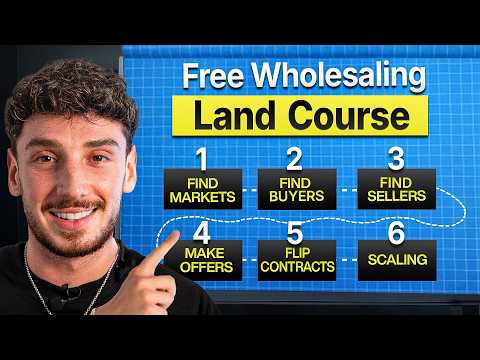
“How to Wholesale Land Step-by-Step (2026 FREE COURSE)”
What we found: The Land Wholesaling Blueprint: $150K a Month in Fees Averages $5K a Deal — Half the $10K Example, With No Costs Shown
A clear walkthrough from market research to title-company payout — built on data tools, mass texting and sellers who don’t know their land’s value, none of it priced.
- ~$150k/mo Creator’s fees
- ~$5,000 Average per deal
- $10,000 Worked example
- None Costs shown
The claim
That a beginner can go from zero to $10,000 a month wholesaling vacant land without a licence, loans or much money, closing a first $10,000 deal within 30 days.
- Creator’s monthly volume — "Around 30 deals"; elsewhere "30 to 40"
- Creator’s monthly assignment fees — "Around $150,000" (spoken, and as on-screen text at 0:38)
- Fee range in the on-screen outline — "$5k-$10k -$20k" per contract
- Average fee per deal — ~$5,000 (at 30 deals)
- Worked example — Buy at $40,000, assign at $50,000 → $10,000
- Deals done to date — "Around 600"
- Example owner list — ~1,500 parcels in one small city
- First deal — "$10,000 deal in the next 30 days… fully realistic"
- Costs: data, skip tracing, texting — Not given
- Coaching price — Not given
What is this income idea?
Act as a middleman: sign a contract to buy vacant land from an owner below what a home builder will pay, then assign that contract to the builder and take the difference as a fee at closing.
- The creator opens with their own business: "closing around 30 deals per month and averaging around $150,000 per month in assignment fees", with "5 10 even $20,000 per deal" possible. The $150,000 appears as on-screen text over footage of the creator at a laptop, and an outline slide lists "Assigning the contract for $5k-$10k -$20k". Later: "I have done around 600 of these deals."
- Step one is market research on a property site: filter for land sold in the last 90 days and look for clusters of sales — "we want to find the clusters". The creator suggests states in the West and South-west as starting points.
- Step two is finding buyers first: filter for newly built houses for sale, find the builder behind each, and call — "I see you’re a local builder… what are you currently buying and what prices are you paying". One builder per market, five markets, "you’re already doing 10 to 15 deals per month".
- Step three is lead generation: pull a list of off-market vacant land owned for 10 years or more — about 1,500 parcels in the example city — get contact details through a skip-tracing service, and text them all at once with mass-messaging software.
- Step four is the offer: if the builder pays $50,000 for an acre, offer owners $40,000. "Why would they take $40,000 if there’s a buyer willing to pay $50,000 well number one they do not know that buyer exists number two they don’t know it’s worth $50,000."
- Step five is closing through the builder’s title company: the builder pays $50,000, the seller receives $40,000, and "they’ll give you your $10,000 assignment fee". An animated graphic around 16:08 walks through this hypothetical example; it is an illustration, not a closing statement. The one-page contract is available only by booking a call with the creator’s team, which offers coaching and the chance to "partner on a deal".
Find a builder’s price, contract land below it, and assign the contract — a real model, with costs and fairness left unaddressed.
- Find active markets — 90-day land sales
- Find builders — New houses for sale
- Get their price — Call and ask
- Pull owner lists — Off-market, 10+ years
- Skip trace and mass text — ~1,500 owners
- Offer below builder price — $40K vs $50K
- Assign via title company — Fee at closing
- Book a call — For the contract
A clear process. What it costs, and what it asks of sellers, is not discussed.
The mechanics are clear; the margins and costs are not.
The lesson underneath the number
- As an explanation of how land wholesaling works, this is one of the clearer ones. Find markets where land is actually selling. Find the builders active there, call them, and learn what they buy and what they pay. Pull a list of long-held, off-market parcels matching those criteria, contact the owners, and offer below the builder’s price. Close through a title company that pays the seller and your fee from the builder’s funds. The "buyer first" sequencing is the smartest part, because it removes guesswork from the offer.
- The numbers are less tidy than the example. The creator reports around 30 deals and $150,000 in fees a month, which is about $5,000 a deal — half the $10,000 illustration used throughout. A beginner aiming for the title’s $10,000 a month would, on the creator’s own averages, need roughly two deals a month.
- And the costs are absent. Every deal starts with a data list, skip tracing and mass texting across markets, and the video gives no price for any of it, nor any response rate or cost per closed deal. The fee is gross; what remains after lead generation is unknown.
- The ethics deserve a sentence the video does not give them. The margin exists, in the creator’s words, because sellers "do not know that buyer exists" and "don’t know it’s worth $50,000". That is how wholesaling generally works, but viewers should go in knowing it, and should check the rules where they operate. The one-page contract that makes the whole thing work is available only by booking a call.
It’s much easier to find the buyer first and have the buyer tell you exactly what price they’re willing to pay.
The creator, on the step worth copying
The five steps, as the creator gives them
Specific and demonstrated on screen.
The steps as given in the video, published 4 January 2026. Property-site filters and a list-building tool are shown on screen; the skip-tracing and texting services are described generically here.
- Look for recent sales clusters — Sold land in the last 90 days, viewed on a map. Simple and sensible: demand is where land is actually changing hands.
- Find the buyer before the seller — New-build listings identify active builders; a short call gets their criteria and price. The strongest idea in the video.
- Target long-held, off-market land — Owners of vacant land for ten years or more, not listed for sale — people "tired of it… paying taxes on it every single year".
- Contact at scale — Skip-trace the list and text everyone at once rather than calling one by one.
- Price from the builder’s number — Offer the builder’s price minus your fee. In the example, $50,000 − $10,000 = $40,000.
- Close through a title company — Send both contracts; the title company pays the seller and your assignment fee from the buyer’s funds. A clear explanation of how wholesalers are paid.
The business model
Assignment fees paid at closing — the difference between the price agreed with the seller and the price paid by the builder.
Home builders needing lots; long-time owners of unused vacant land.
Builders get off-market land to their criteria; owners get a quick cash sale of land they have not used.
Mass texting to skip-traced owner lists, with builders found through new-build listings.
- Property data — Subscription; not priced
- Skip tracing — Per list; not priced
- Texting software — Not priced
- Time — Daily outreach and follow-up
- Legal — Contracts and local rules not discussed
- Tax — Not mentioned
No purchase capital is needed; lead generation is the real expense, and none of it is priced.
What you would actually need
Money
"You don’t need a ton of money to get started" — and "you do not need the $40,000" to contract the land.
True that no purchase money is needed. But the lead engine has costs the video does not mention: a property-data subscription, skip tracing on lists of around 1,500 owners, mass-texting software, and repeated campaigns across several markets. The contract itself is available only through a sales call, and the coaching price is not given.
Costs named or implied
- Property-data subscription — not priced
- Skip tracing for each owner list — not priced
- Mass-texting software — not priced
- Repeated campaigns across several markets
- A usable assignable contract — withheld for a call
- Coaching — price not given
Time
A first $10,000 deal "in the next 30 days… fully realistic". Scale by pulling lists weekly and texting daily.
The creator describes a volume business requiring daily outreach and follow-up across multiple markets. No response rate, contract rate or time from first text to closing is given, so the 30-day claim cannot be checked.
What the work involves
- Market research on property maps
- Calling builders for criteria and prices
- Pulling and skip-tracing lists weekly
- Texting and following up daily
- Negotiating with sellers
- Coordinating contracts with title companies
The part you must pay attention to
The creator’s own numbers average half the example deal — and nothing it costs is shown.
The creator reports around 30 deals and $150,000 in assignment fees a month. The worked example is a single $10,000 fee.
- Monthly assignment fees — $150,000
- Deals a month — 30
~$5,000 a deal
Half the $10,000 worked example — before any costs
On the creator’s own figures, the typical deal is about $5,000, not $10,000; at the "30 to 40" deals also mentioned, it is lower still. For a beginner, reaching the title’s $10,000 a month would therefore mean about two deals a month, not one. And those fees are gross. Each deal draws on a paid data list, skip tracing, mass texting and follow-up, repeated across markets; the video gives no response rate, no contract rate and no cost per deal, so the net figure — what the wholesaler keeps — is unknown.
The model’s margin also rests on an information gap, which the creator states plainly: sellers take $40,000 because "they do not know that buyer exists" and "don’t know it’s worth $50,000". Wholesaling is legal in many places, but viewers should know the business depends on buying below market from owners who are less informed, and should check local rules on licensing, assignment and mass texting, which the video does not discuss beyond saying people wrongly "think you need a license". The assignable contract itself is withheld for a sales call.
- THE CREATOR’S MONTH
- Deals ~30
- Assignment fees ~$150,000
- Per deal ~$5,000
- THE WORKED EXAMPLE
- Builder pays $50,000
- Seller offered $40,000
- Fee $10,000
- FOR THE TITLE’S $10K/MONTH
- At $10K/deal 1 deal
- At $5K/deal 2 deals
- NOT GIVEN
- List + skip-trace cost
- Texting cost
- Response / contract rate
The economics
Gross fees, a smaller real average, and no costs.
- Monthly assignment fees — ~$150,000
- Monthly deals — ~30 (also "30 to 40")
- Average fee — ~$5,000
- Example fee — $10,000
- Deals to date — ~600
- Example list size — ~1,500 parcels
- Student result — "Over $25,000" in one month
- Lead-generation costs — Not given
The creator’s real average
$150,000 ÷ 30 deals
About $5,000 per deal — half the $10,000 worked example, and gross of every lead-generation cost
IncomeIdeaLab calculation from figures stated in the video
At 40 deals, the average would be about $3,750. The creator also says fees can range from $5,000 to $20,000 per deal.
- Cost of data, skip tracing and texting per campaign
- Response and contract rates from texting
- Time from first contact to closing
- Deals that fall through before closing
- The coaching price and terms
- Tax
- The creator says one builder in each of five markets can yield "10 to 15 deals per month" — an assertion, not a shown result.
- The example city list returned "almost 1,500" parcels owned for ten years or more.
- A student is said to have closed "over $25,000 worth of deals in one month" — whether that is fees or deal value is not clear.
- The creator describes themself as "the best in the industry", which is self-assessment.
Evidence status
Every substantive claim in the video.
- ~30 deals and ~$150,000 in fees a month — Creator; on-screen text at 0:38 — ~$5,000 per deal. The $150,000 appears as on-screen text over b-roll; no statement or dashboard is shown at that point.
- ~600 deals to date — Creator — Not shown.
- $10,000 per deal (example) — Creator; animated example graphic — Twice the creator’s own average. The closing-day graphic is a hypothetical.
- First $10,000 deal in 30 days "fully realistic" — Creator — No response or close rates given.
- Find builders via new-build listings — Creator, on screen — Shown and sensible.
- ~1,500 off-market parcels in one city — Creator, on screen — Shown.
- Sellers don’t know the land’s value — Creator — The source of the margin.
- No licence needed — Creator, implied — Local rules not discussed.
- Student closed "over $25,000" in a month — Creator — Fees or deal value unclear.
- Costs of the lead engine — Nobody — Not given.
What is actually proven?
The process is shown; the economics are not.
- Market, buyer and list-building steps are shown on screen.
- How assignment fees are paid at closing is clearly explained.
- The creator’s average fee is ~$5,000, half the example.
- ~30 deals and ~$150,000 in fees a month, stated aloud and in on-screen text, with no supporting statement shown at that point.
- Lead-generation costs and conversion rates.
- Net income after costs.
- The coaching price.
What the headline doesn’t tell you
Clear mechanics; unpriced engine.
- ~$5K a deal, not $10K. — On the creator’s own numbers.
- Fees are gross. — Lead costs not given.
- Lists and texting cost money. — Unpriced.
- No response rates. — Or contract rates.
- Sellers are under-informed. — That’s the margin.
- Local rules not covered. — Licensing, texting.
- Contract withheld. — Book a call.
- Buyer-first is smart. — Worth copying.
Should you try it?
A clear explanation of the model — budget and check the rules first
Use the buyer-first sequence. Price the lead engine and learn the local rules before sending a single text.
- Clarity of process — 8 — Every step shown.
- Buyer-first sequencing — 9 — Removes guesswork.
- Consistency of figures — 4 — $5K average vs $10K example.
- Cost disclosure — 0 — None.
- Conversion data — 0 — None.
- Treatment of sellers — 3 — Margin relies on their not knowing value.
- Disclosure of interests — 5 — Coaching pitched; contract withheld.
- Beginner accessibility — 5 — No capital, but tools and outreach.
- If you want to understand land wholesaling, this is a clear walkthrough. The most useful idea is to start with the buyer: find the builders active in a market, ask what they buy and at what price, and only then look for land to match. That makes every offer grounded.
- Do the arithmetic the video skips. The creator’s own average is about $5,000 a deal, not $10,000. Then add the cost of data, skip tracing and texting for lists of around 1,500 owners, repeated across markets, and estimate how many texts become contracts and closings. That tells you what a deal really nets.
- Check the rules where you plan to operate — on wholesaling, contract assignment, and bulk text messaging — before you start. The video does not cover them.
- Be honest with yourself about the model. The margin exists because sellers do not know what a builder would pay. Deciding how you will deal fairly with them is part of starting this business.
Passive or automated?
Automation
Lists and texting are automated; negotiation and closing are not.
Passive potential
A volume business: "you pull lists weekly you text daily".
Data tools and mass texting automate the top of the funnel, but the creator is explicit that this is "a volume business" requiring weekly lists, daily texting and consistent follow-up. Every deal needs a negotiation with a seller, a relationship with a builder, and coordination with a title company.
- Researching markets and calling builders
- Following up with interested sellers
- Negotiating prices
- Managing contracts and title companies
- Maintaining builder relationships
Recommended beginner experiment
One market, one builder, one priced campaign.
- Find one active market. — 90-day sold-land clusters.
- Call three builders there. — Criteria and prices.
- Price the data and texting tools. — Before pulling a list.
- Check local rules. — Wholesaling, assignment, texting.
- Pull and contact one list. — Track response and contract rates.
- Get your own contract reviewed. — Rather than a withheld template.
- Budget for ~$5K per deal. — The creator’s real average.
- Calculate cost per closed deal. — Your true margin.
Our verdict: 5/10
A clear land-wholesaling walkthrough with unpriced costs $150K a month averages $5K a deal — half the example — and nothing it costs is shown
Credited for a clear, on-screen walkthrough of market research, finding builders, building off-market lists and closing through a title company; for the genuinely smart buyer-first sequence; and for plainly explaining how assignment fees are paid. Marked down because the creator’s own figures — about 30 deals and $150,000 a month — average about $5,000 a deal, half the $10,000 example used throughout; because no cost of data, skip tracing, texting or marketing is given, nor any response or contract rate; because the margin depends, as the creator says, on sellers not knowing their land’s value; because local rules on licensing, assignment and texting are not discussed; and because the contract is withheld for a sales call and the coaching is not priced.
This is a clear explanation of how vacant-land wholesaling works. Filter a property site for land sold in the last 90 days and look for clusters. Find the builders putting up new houses there, call them, and ask what they buy and what they pay. Pull a list of off-market parcels held for ten years or more, get contact details, text the owners, and offer the builder’s price minus your fee. Close through the builder’s title company, which pays the seller and your assignment fee from the builder’s funds. Starting with the buyer is the smartest part: it makes every offer grounded. The numbers deserve more care. The creator reports about 30 deals and $150,000 in fees a month — roughly $5,000 a deal, half the $10,000 illustration used throughout — and those fees are gross. The lead engine behind them — data, skip tracing, mass texting across markets — is not priced, and no response or contract rate is given, so what a deal nets is unknown. The margin itself, in the creator’s words, exists because sellers "do not know that buyer exists" and "don’t know it’s worth $50,000", and the rules on licensing, assignment and bulk texting are not discussed. The contract is available only by booking a call. Use the buyer-first method; price the tools; check the rules; and decide how you will treat sellers fairly before you start.
- Creator’s fees — ~$150,000/month
- Deals — ~30/month
- Average per deal — ~$5,000
- Example per deal — $10,000
- Example list — ~1,500 parcels
- Lead costs — Not given
- Conversion rates — Not given
- Coaching price — Not given
- Beginner suitability — Model yes, economics unclear
Sources
- How to Wholesale Land Step-by-Step (2026 FREE COURSE) — Alex Mineo — Source video, 2026-01-04