Local Services / Land Clearing · Claim Review
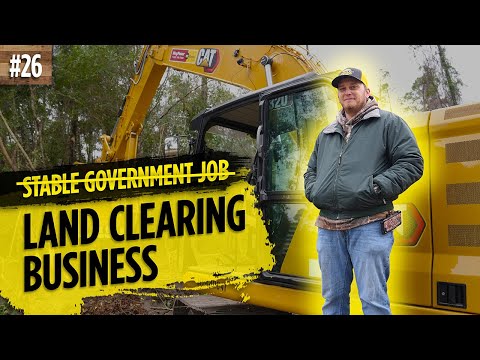
“Thomas Left a Stable Government Job to Launch a LAND CLEARING Business”
What we found: The Land-Clearing Day-Rate Maths Holds Up; the 16-Acre Job's Profit Comes With No Figure
Renting a skid steer at about $400 a day and charging $1,000 to $1,200 is a stated, checkable spread. The claim that one job beats a year of government pay is given without the job price, its costs or the salary.
- ~$400/day Skid steer rental
- $15,000 Side-hustle month
- ~$200s/month Insurance
- Not stated 16-acre job profit
The claim
That the profit from one 16-acre land-clearing job, over six to eight weeks, should be more than a full year of the owner's government salary.
- Profit expected on the 16-acre job — "More than I would make in an entire year working for the government"; no figure given
- Previous government salary — Not stated in the video
- Price of the 16-acre job — Not stated in the video
- Skid steer rental — ~$400 a day
- Day rate charged with the machine — $1,000 to $1,200
- Spread per working day — $600 to $800 before fuel, disposal, insurance and the truck
- A typical side-hustle month — $15,000 of work on a $5,000 rental; "I might make 10 grand minus expenses"
- First quarter-acre job price — $1,200, against $1,500 he saw others charging
- General liability policy — $2 million cover, "couple hundred bucks a month"
- New skid steer with mulcher — ~$150,000, which he chose not to buy
What is this income idea?
Clear and grade residential lots and larger parcels for builders and landowners, using rented equipment rather than owned machines.
- Thomas spent eight and a half years in his county parks department doing similar work, then filed an LLC on 14 February 2023 and ran the business on Fridays, Saturdays and Sundays around a four-day, 40-hour week. He left the government job the week before filming, with two children and a third on the way.
- His first work came from walking across the street to a small crew clearing a quarter-acre lot. That operator subcontracted him on the next job, then "I got five more." Cold calls to builders, contact numbers taken from site job boxes and mass emails to the top 50 local builders produced little at first; repeat builder relationships came later.
- He is candid that he priced too low. He quoted $1,200 to clear a quarter acre because he had seen others charging $1,500, and by the sixth or seventh job realised "I'm not making any money" once insurance, a blown truck tyre and trailer repairs came due.
- The model he recommends is to rent everything except a truck and trailer. A skid steer rents for about $400 a day and can be billed at $1,000 to $1,200 a day. In his side-hustle months he would line up about $15,000 of work, do it on a $5,000 rental and "might make 10 grand minus expenses", then return the machine.
- Sandy local soil matters to this. He says most quarter-acre lots in his area can be cleared with a skid steer alone, and that in other markets he researched the price per acre was too low to make renting worthwhile.
- The job being filmed is a 16-acre parcel being cleared and graded ready for seed with a rented loader and excavator. He says the profit from it over the next six to eight weeks should be more than a year of his government pay, and that if he did nothing else this year he would be better off.
Rent the machine, charge two to three times the rental for the day, keep only a truck and trailer, and learn pricing fast.
- Related job experience — 8.5 years in parks
- Weekends first — Around a 4×10 job
- Subcontract to start — 7–8 jobs, one client
- Rent the skid steer — ~$400 a day
- Bill the day — $1,000–$1,200
- Fix the pricing — After ~7 jobs
- Win builder repeats — 5–7 lots at a time
- Go full time — Week before filming
A low-capital trades model with a clear unit spread; the large job that justified going full time is described without numbers.
Renting turns a $150,000 decision into a $400 one
The lesson underneath the number
- The most useful idea in this video is a risk calculation. A new skid steer with a forestry head is about $150,000, and he points out that most new businesses do not survive five years, which is roughly how long the machine would take to pay off. A rental at about $400 a day billed at $1,000 to $1,200 makes each day of work profitable on its own terms, and when the work stops the machine goes back. That is a sound structure for someone testing a trades business, and he backs it with a figure: $15,000 of work done on a $5,000 rental.
- The second is his account of pricing. He did not undercut by much, $1,200 against $1,500, and still found he was making nothing once insurance, a truck tyre and trailer repairs arrived. The lesson he draws is not to charge less than people who have already found out what the job costs. He also describes, more than once, calling a client mid-job to say the price was going up, and clients replying that they had wondered why he was so cheap.
- The third is how the first work arrived. Cold calls and mass emails to builders produced almost nothing. A conversation with a small crew across the street produced a subcontract, which produced five more. For a trades business, the shortest route to the first customer is often another operator with more work than hands.
- Where the video is thin is the headline. The comparison with a year of government pay is about one large job in progress, and none of its numbers are given. The rental model makes a good living plausible; it does not, from the video alone, establish the size of this particular job.
You're going to put $150,000 of risk into something that may or may not work.
Thomas, on why he rents every machine
How he built it, as he describes it
A trades business started on weekends, with the risk kept in the rental company's fleet.
No price, cost or profit figure is given for the 16-acre job.
- Start with work you already know — Eight and a half years of land management for a county parks department meant equipment, chainsaws and site work were familiar. What was new, in his words, was business: "you can run equipment all day long but if you don't know how to handle your business and how to track your numbers… you're just never going to succeed."
- Keep the salary while it proves out — Roughly two years of weekend work around a four-day week before resigning. The risk was carried by the job, not by savings.
- Get the first jobs through someone already doing them — Calls and emails to builders produced nothing at first. A conversation with a crew across the street produced a subcontract, then five more lots, then seven or eight jobs for the same operator.
- Rent every machine — "I don't own any of them. I have zero interest in owning any of them." Breakdowns are the rental company's problem, and the machine goes back when the work runs out.
- Price from what the work costs, not what others quote — His first price was set $300 under someone else's. Insurance, tyres and trailer repairs showed it was too low. He now tells clients when a job will cost more, by phone rather than text, and says most accept it.
- Carry the insurance rental fleets ask for — A $2 million general liability and equipment policy at "a couple hundred bucks a month", plus rental waivers and, for forestry mulching heads, a separate inland marine policy at full replacement value that he says was hard to find and "not cheap".
The business model
Per-job and per-day fees for lot clearing, land clearing, grading, root raking and forestry mulching.
Home builders with batches of residential lots, plus landowners with larger parcels.
Reliable clearing that is ready for building or seeding, from an operator who communicates the way each builder prefers.
Subcontracting at first, then direct builder relationships built through calls, texts and repeat work.
- Equipment rental — ~$400 a day for a skid steer; ~$5,000 for a month of work
- Insurance — $2M general liability at a couple of hundred dollars a month; inland marine and rental waivers not priced
- Truck and trailer — Owned; repairs named as a cost
- Debris disposal — Landfill or grapple trucks. Not priced
- Delivery and fuel — Delivery named; fuel not mentioned
- Owner's labour — All of it, as a sole operator
Costs are named more often than in most interviews, and two are priced. The large job at the centre of the video is not.
What you would actually need
Money
A truck and a trailer, rental fees, and insurance. Buying a new skid steer with a forestry head would be about $150,000, which he calls "way too much risk".
Credibly low for a trades business. The real outlay is per-job rental (about $5,000 for a month of skid steer work in his example), insurance, fuel, delivery, and debris disposal at a landfill or by grapple truck. None of those except the rental and liability policy is priced.
Costs named in the video
- Skid steer rental, ~$400 a day or ~$5,000 for a month of work
- Delivery fees when renting without a trailer
- General liability, ~a couple of hundred dollars a month
- Rental waivers and the inland marine policy, not priced
- Truck and trailer, including repairs and tyres
- Debris disposal: landfill fees or grapple truck companies
- Fuel (not mentioned)
Time
About two years of weekends alongside a 40-hour week before going full time.
An honest timeline. The weekend constraint is real: he says the landfill closes early on Saturday and not at all on Sunday, so disposal had to be paid out to others.
Where the two years went
- February 2023: LLC filed
- First seven or eight jobs for one subcontracting client
- Pricing corrected after about the seventh job
- Builder relationships built through calls and texts
- March 2025: left the government job
- Next: a 16-acre clearing and grading job
The part you must pay attention to
The job-versus-salary comparison has no number on either side.
The video opens and turns on one line: "What I should profit off of this job in the next month and a half to two months is more than I would make in an entire year working for the government." The job price, its costs and the salary are not stated.
- Day rate charged — $1,000–$1,200
- Skid steer rental per day — $400
- Not priced — fuel, disposal, insurance
$600–$800 a day
Before the unpriced costs (our arithmetic)
The headline rests entirely on the 16-acre job, and the video gives no figure for it at all: not the contract price, not the cost of the rented loader and excavator with their insurance and waivers, and not the annual salary it is compared with. The profit is also stated in the future tense, "should", for work that was in progress. It may well be true, but it cannot be checked from the video, and it is one job rather than a repeatable month.
The figures that are given hold together. A $400 rental billed at $1,000 to $1,200 leaves $600 to $800 a working day before fuel, disposal and insurance; three or four such days a week is $1,800 to $3,200 (our arithmetic). His side-hustle month, $15,000 of work on a $5,000 rental leaving "10 grand minus expenses", is consistent with that spread. One caution: he twice calls the rental model "no overhead", while describing insurance, truck and trailer repairs, delivery fees and debris disposal elsewhere in the video. Those are the costs that made his first jobs unprofitable.
- THE DAY-RATE SPREAD (OUR ARITHMETIC)
- Charged per day $1,000-$1,200
- Rental per day $400
- Spread per day $600-$800
- x 3-4 days/week $1,800-$3,200
- before fuel, disposal, insurance
- HIS SIDE-HUSTLE MONTH
- Work lined up $15,000
- Rental -$5,000
- "10 grand minus expenses" $10,000
- Rental share of revenue 33%
- THE HEADLINE
- 16-acre job price not stated
- Job costs not stated
- Government salary not stated
- Profit "should" be
- > one year's pay
The economics
A clear unit spread, and one large job without figures.
- Skid steer rental — ~$400/day
- Day rate charged — $1,000–$1,200
- Spread per day — $600–$800
- Side-hustle month: work — $15,000
- Side-hustle month: rental — $5,000
- Side-hustle month: before other expenses — $10,000
- General liability — ~a couple of hundred dollars a month
- First quarter-acre price — $1,200
- 16-acre job price, costs and profit — Not stated
- Government salary — Not stated
Weekly gross from the rental spread
($1,000 to $1,200 − $400) × 3 to 4 days
$1,800 to $3,200 a week before fuel, disposal, insurance, delivery and truck costs
IncomeIdeaLab calculation from the day rates stated in the video
This assumes the day can be billed at the stated rate and that work is available three or four days a week; he gives that as an example, not as his own average. Quarter-acre lots are also priced per job, at $1,200 to $1,500, rather than per day.
- The price of the 16-acre job and the rental cost of its loader and excavator
- His previous government salary
- Annual revenue or profit in either year of part-time trading
- Fuel, disposal and delivery costs
- The cost of the inland marine policy and rental waivers
- His side-hustle month is internally consistent: a $5,000 rental against $15,000 of work is a third of revenue, leaving $10,000 before the other expenses he mentions.
- Quoting $1,200 for a quarter acre against the $1,500 he saw elsewhere was a 20 per cent discount (our arithmetic). By his own account it left no money once insurance and repairs were paid.
- The rental model depends on local conditions he names: sandy soil that lets a skid steer do most lots, and a market where the price per acre justifies renting. He says other markets he researched did not.
- He describes the model as "no overhead" while also listing insurance, truck and trailer repairs and disposal. A reader should budget for those.
Evidence status
Every substantive figure in the video.
- 16-acre job profit > a year of government pay — Thomas — Stated as what he "should" make. No job, cost or salary figure given.
- Skid steer rents for ~$400 a day — Thomas — Plausible for a local rental. Given twice.
- Can be billed at $1,000–$1,200 a day — Thomas — Leaves $600–$800 a day before other costs (our arithmetic).
- $15,000 of work on a $5,000 rental, "10 grand minus expenses" — Thomas — Consistent with the day-rate spread.
- First quarter-acre job at $1,200 — Thomas — Against $1,500 elsewhere; he says it was too low.
- $2M liability cover at "a couple hundred bucks a month" — Thomas — A useful cost benchmark for this trade.
- New skid steer with mulcher ~$150,000 — Thomas — The figure behind his case for renting.
- Started 14 February 2023; left the job in March 2025 — Thomas — About two years of part-time trading, stated plainly.
- "No overhead" when renting — Thomas — Does not match the insurance, truck, trailer and disposal costs he names.
What is actually proven?
The unit economics are stated; the headline outcome is not.
- A rental day rate and a billing day rate, giving a clear spread.
- $600–$800 a working day before unpriced costs.
- A side-hustle month of $15,000 work on a $5,000 rental.
- Underpricing on early jobs, volunteered.
- An insurance cost and the policies rental fleets ask for.
- A 16-acre job expected to beat a year of salary.
- The job price, its costs and the salary.
- Annual revenue or profit in either year.
What the headline doesn’t tell you
A practical, low-risk model with an unpriced headline.
- The salary is not stated. — So the comparison cannot be checked.
- The job price is not stated. — Nor its rental costs.
- The profit is a "should". — Work was in progress.
- He kept the job for two years. — Weekends only until now.
- He had 8.5 years of related work. — In a county parks department.
- "No overhead" has costs. — Insurance, truck, trailer, disposal.
- Sandy soil helps. — He says other markets do not pay enough.
- Underpricing cost him early. — He says so himself.
Should you try it?
A sensible way to start a trades business, if your local prices support it
Rent, keep your job while you test it, and price from your real costs. Do not treat the headline job as typical.
- Capital required — 8 — Truck, trailer, insurance and per-job rentals; no machine purchase.
- Specificity of unit economics — 7 — Rental and billing day rates and a monthly example are given.
- Candour — 8 — Underpricing, pricing calls and early losses all volunteered.
- Evidence for the headline — 2 — No figure for the job, its costs or the salary.
- Cost disclosure — 5 — Rental and liability priced; disposal, fuel and waivers not.
- Disclosure of advantages — 7 — Prior equipment experience and sandy local soil both stated.
- Beginner replicability — 6 — Depends on local rates and on learning to operate safely.
- The model is a good one to copy in principle. Renting rather than buying makes each day of work stand on its own: about $400 for the machine against $1,000 to $1,200 billed, with nothing owed to a lender when the work runs out. He ran it for two years on weekends before leaving a salaried job, which kept the downside small.
- Check two things first. The first is your local market: he says the soil in his area lets a skid steer handle most lots, and that in other markets he looked at, the price per acre would not cover a rental. The second is experience: he came from eight and a half years of similar work and says operating skill comes from "seat time". He also says no licence is needed to run a skid steer, but rental fleets will ask for insurance.
- Then price from costs. His first quote was only $300 under the market and still left nothing once insurance, tyres and trailer repairs were paid. Budget for disposal, fuel, delivery and waivers before you quote.
- Treat the headline as one job, not a forecast. The 16-acre project may produce what he expects, but the video gives no figure for it or for the salary it is measured against. The side-hustle month of $15,000 in work on a $5,000 rental is the more useful benchmark.
Passive or automated?
Automation
Every hour of revenue is an hour in the machine.
Passive potential
A sole operator selling his own labour and a rented machine.
This is a trade, not a passive income. Revenue comes from the owner operating rented equipment, hauling debris, walking sites and calling builders, and he says he prefers to stay a sole operator or hire only people he knows well. The rental model removes capital risk and repair worries, which is a real advantage, but it adds nothing that runs without him.
- Operating every machine on every job
- Quoting and repricing work with builders
- Hauling and disposing of debris
- Arranging rentals, delivery and insurance
- Finding the next batch of lots
Recommended beginner experiment
One rented weekend before any purchase.
- Ask local rental fleets for day and monthly rates. — His were ~$400 a day.
- Find what builders actually pay per lot. — He saw $1,500 for a quarter acre.
- Price disposal before quoting. — Landfill hours and grapple trucks.
- Get liability cover in place. — His: $2M for a couple of hundred a month.
- Ask an existing crew for overflow work. — How his first jobs arrived.
- Do one lot on a rented machine. — Track every cost against the price.
- Keep your job while you test it. — He kept his for two years.
- Buy nothing you cannot pay cash for. — His own rule.
Our verdict: 6/10
A sound, low-capital trades model with an unpriced headline the rental spread is clear; the big job and the salary are not stated
Credited for specific unit economics (a $400 rental day billed at $1,000 to $1,200, and a $15,000 month done on a $5,000 rental), for pricing a liability policy, for a well-argued case for renting over buying, for volunteering that his first seven or eight jobs were underpriced, and for building the business on weekends for two years before leaving a salaried job. Marked down because the headline comparison, one 16-acre job against a year of government pay, comes with no figure for the job price, its costs or the salary, and is stated as what he "should" make; and because the rental model is described as "no overhead" while insurance, truck and trailer repairs, delivery and disposal are named elsewhere and mostly not priced.
This is a practical account of starting a trades business without buying equipment. Thomas kept his county job for about two years, cleared lots on weekends with rented machines, and gives figures that can be checked against each other: a skid steer at about $400 a day billed at $1,000 to $1,200, and a month of $15,000 work done on a $5,000 rental leaving "10 grand minus expenses". He argues clearly against buying a $150,000 machine for a business that may not last five years, and he is frank that his early prices were too low to cover insurance and repairs. The headline needs more care. The claim that one 16-acre job should earn more than a year of his government salary is stated without the job price, its rental costs or the salary, and in the future tense for work that was under way. It may hold, but it cannot be checked from the video, and the monthly side-hustle example is the more useful figure for anyone considering the same model. Budget for the costs he names but does not price, and check local rates and soil before assuming his spread applies where you live.
- Rental per day — ~$400
- Billed per day — $1,000–$1,200
- Spread per day — $600–$800
- Side-hustle month — $15,000 work, $5,000 rental
- Liability insurance — ~a couple of hundred a month
- 16-acre job profit — Not stated
- Government salary — Not stated
- Beginner suitability — Good, where local prices allow
Sources
- Thomas Left a Stable Government Job to Launch a LAND CLEARING Business — Sweat Venture — YouTube video, 2025-03-27