Digital Products / Self-Publishing · Claim Review
“KDP Has Changed Forever: What Is Actually Working in 2026”
What we found: Three KDP Income Figures From One Publisher That Do Not Agree
"$1.2 million in book sales", "multiple seven figures" and "30K every month" — sound publishing advice wrapped around numbers that do not reconcile with one another.
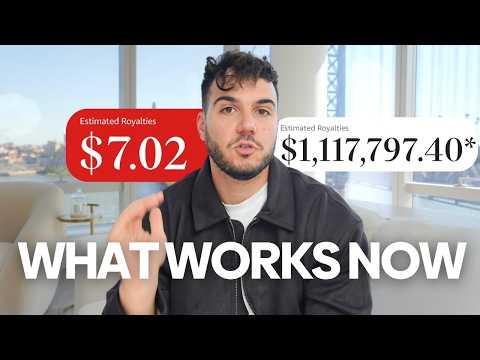
- $1.12M KDP royalties on screen
- $30k Monthly income now
- $800–1k Per book, "done well"
- None Costs or royalty rate
The claim
That non-fiction KDP still works in 2026 for publishers who research properly, price high and build a portfolio — evidenced by the presenter’s $1.2 million in book sales, $30,000 a month now, and students earning $5,000–$10,000 a month.
- Lifetime book sales, spoken — $1.2 million — "actual sales"
- Amazon KDP royalties report on screen at 1:18 — $1,117,797.41 total royalties (eBook $220,112.36, print $868,416.78, KENP $29,268.26); date range not visible
- Print share of the royalties shown — ~78%
- Lifetime earnings, as also stated — "Multiple seven figures"
- Current monthly income — "I still make 30K every month"
- Years publishing — Almost 12 (since 2014)
- Average across 12 years — ~$8,300 a month on $1.2M
- Beginner students — $5,000–$10,000 a month from "a few books"
- Typical book "done well" — $800–$1,000 a month
- Ad spend, royalty rate, production cost — Never stated
What is this income idea?
Publish practical non-fiction books for beginners on Amazon KDP, priced high, researched carefully and packaged well, and build a catalogue rather than betting on one title.
- The argument is that AI has made writing a book easy, so execution no longer separates winners from losers. What does is judgment: "knowing what to build why to build it how to package it how to price it … how to test it on the market." They say low-content books — colouring books, puzzles, journals — "had a short window" and are over.
- Research means going a layer below crowded topics: a narrower reader, a more urgent problem, an unglamorous subject, or a niche where weak-looking books still sell. "When I see a weak book still making sales I don't see saturation, I see permission."
- AI is endorsed as an assistant, not a decision-maker. They show KDP’s AI-disclosure questions, say they declare their own use, and tell viewers not to lie on them. The human effort should go into the title, subtitle and cover — "the cover design does 80% of the work."
- Pricing advice is the strongest section. In non-fiction, "low pricing can hurt you": a buyer choosing a tax book at $10 or $30 may read the higher price as higher quality, and the margin has to "support advertising".
- The business is a portfolio. Publish five to ten books; expect a small number to carry the income — "20% of your books will make 80% of your income" — and extend winners with bundles, audio, translations and other marketplaces. The video ends by describing three paid paths: a masterclass, a mentorship, and a done-for-you portfolio built by "me and my team".
Research a narrow non-fiction need, publish a well-packaged, higher-priced beginner book, and keep publishing until a couple of titles carry the rest.
- Research below the surface — Narrower reader or problem
- Spot weak books still selling — "Permission" to enter
- Draft with AI as assistant — Declared on KDP
- Human title and cover — "80% of the work"
- Price for margin — Enough to fund ads
- Test with ads — Spend never stated
- Publish 5–10 books — 2 in 10 carry it
- Extend the winners — Audio, translations
A coherent publishing method. The income figures attached to it are the weak part.
Better advice than the income claims deserve
The lesson underneath the number
- Most of what this video teaches is sound and some of it is genuinely useful. Diagnosing a failed book by its niche, angle, cover, title, price and listing — rather than declaring the platform dead — is the right habit. The point that a weak book still selling is evidence of demand, not saturation, is a good research heuristic. The pricing argument for non-fiction is coherent: a buyer with a tax problem is not optimising for three dollars, and a price too low to fund advertising starves the book of the visibility it needs. And "one book is a test, the portfolio is the business" is the most honest thing a KDP teacher can tell a beginner.
- They are also straightforward about AI in a way that matters. They show KDP’s disclosure questions, say they declare their own use, and tell viewers not to lie on the form. In a genre where AI-generated books are often sold as a loophole, that is the responsible position.
- The trouble is the figures offered as proof. "$1.2 million in book sales", "multiple seven figures" and "30K every month" are three different claims, and they do not reconcile: the first is a single seven-figure sum, the second implies at least two, and the third would exceed the first in about three and a half years. The royalties report on screen, $1,117,797.41 with its period cropped, settles one point — the seven-figure total is royalties paid to the author, not reader spend — but not the others. Without knowing the period it covers, and whether $30,000 includes the masterclass, mentorship and done-for-you business the video promotes, a viewer cannot tell which figure describes publishing.
- The per-book benchmark undermines itself in the same way. They call $800 to $1,000 a month "a realistic expectation for a book done well", then explains that two books in ten earn most of a portfolio’s income. Apply their own rule and the typical book earns about a quarter of that. The honest version of their advice is the 80/20 version — and it is the one a beginner with their first book most needs to hear.
One book is not the business. One book is a test. The portfolio is the business.
The presenter’s best line, and the one their per-book average contradicts
The method, as they give it
Sober and practical, with the costs left out.
Based on what is said and shown in the video, published 8 July 2026. At 1:18 an Amazon KDP royalties report is shown on screen with a top-row total of $1,117,797.41 (eBook $220,112.36, print $868,416.78, KENP $29,268.26); its row labels and date range are cropped. The other income figures — "multiple seven figures", "30K every month" and the per-book averages — are spoken.
- Diagnose a failed book honestly — Wrong niche, angle too broad, weak cover, generic title, a page that did not convert, or "the price too low to support advertising". A failed book proves the product failed, not the model.
- Research by hand, for hours — Amazon covers, reviews, prices, rankings and complaints, then Google, Reddit, Quora and YouTube comments. "They'll ask AI for a list and call it research but that's outsourcing your judgment."
- Write for beginners — Buyers of Amazon non-fiction are usually new to a topic; the author needs to be "a couple of steps above the reader", not an expert.
- Disclose AI use to KDP — They show KDP’s questions on AI-generated text, images and translations and say they answer them honestly. "I don't recommend you lie."
- Price as a premium product — "If you're looking for a book on saving taxes and one is 10 bucks and the other one is 30, most likely the $30 book is at least perceived to be of a higher quality."
- Treat one book as a test — "One book is not the business. One book is a test. The portfolio is the business." Aim for five to ten titles.
- Squeeze proven titles — Bundles, audiobook versions, translations and other marketplaces from a book that already sells, rather than chasing a new idea.
The business model
Royalties on ebook, print and audiobook sales through Amazon KDP and Kindle Unlimited page reads.
Readers new to a practical topic — tax, investing, exams, health, relationships, travel, languages, spirituality.
A well-packaged beginner’s book on a specific, urgent problem, priced as the premium option.
Amazon search and Amazon advertising; extension to audio, translations and other marketplaces.
- Amazon advertising — Required by their own pricing logic. Never priced
- Cover design — "80% of the work". Cost not stated
- AI tools — Named as essential. Cost not stated
- Amazon’s share of each sale — Not discussed; the report on screen shows royalties, after Amazon’s share and print costs
- Audio and translation production — Recommended for winners. Not priced
- Coaching or done-for-you service — Three paid paths offered. Prices not given
They insist margins matter — "any business that doesn't … have a high margin is destined to fail" — and never states a margin, a royalty rate or a cost.
What you would actually need
Money
Never quantified. Advertising is described as essential — price must be high enough "to support advertising" and "testing works with ads" — but no budget is given.
The method implies a real outlay per title: Amazon ads, a cover good enough to do "80% of the work", AI subscriptions, and possibly audio production and translation. Multiplied across five to ten books, that is a meaningful sum before the winners emerge, and the video never estimates it.
Costs implied but never priced
- Amazon advertising to test each title
- Professional or carefully made cover design
- AI writing tools
- Editing and formatting
- Audiobook production and translation, for winners
- Masterclass, mentorship or done-for-you fees, if bought
- Amazon’s share of each sale, never mentioned
Time
A book can be created "in a day"; research needs "a couple of hours"; the goal is five to ten books, "not immediately".
Writing time is no longer the constraint, by their own argument. The time cost is research, packaging and testing across a catalogue, and waiting to learn which two of ten titles will carry the income.
Where the hours actually go
- Hours of manual niche research per title
- Title, subtitle and cover iteration
- Running and reading ad tests
- Publishing five to ten titles over time
- Extending winners into audio and translations
The part you must pay attention to
The presenter gives three figures for their own success, and they describe different businesses.
Within the first three minutes: "the best strategies that took me to $1.2 million in book sales", then "I started in 2014, I made multiple seven figures with it". Four minutes later: "I still make 30K every month."
- Book sales, ~12 years — $1.2M
- Months since 2014 — ÷ ~144
~$8,300/month
The lifetime average — against "30K every month" now
The figures cannot all describe the same thing. "Multiple seven figures" implies at least $2 million; $1.2 million is a single seven-figure sum. And $30,000 a month is $360,000 a year — at that rate, about three and a half years would exceed the entire $1.2 million they credit to their books. If $1.2 million is gross book sales over twelve years, the lifetime average is near $8,300 a month, so $30,000 a month would have to be either very recent or include something other than book sales; the video also sells a masterclass, a mentorship and a done-for-you service. None of this is explained. There is also a difference in wording. The report shown on screen at 1:18 is a KDP royalties report totalling $1,117,797.41 — what Amazon pays the author after its share and print costs, not what readers paid — while the figure spoken is "$1.2 million in book sales". Its date range is cropped, so the screen does not show whether that total covers the whole twelve years.
The per-book benchmark has the same problem. "Most book … on average of me and my clients makes between 800 to $1,000 per month. That's a realistic expectation for a book done well." Minutes later: "20% of your books will make 80% of your income … if you have 10 books out there two of those will make most of the income." If ten books earn $8,000–$10,000 in total and two of them earn 80% of it, those two make about $3,200–$4,000 each and the other eight about $200–$250 each. Under their own rule, the typical book in a portfolio earns closer to $200 than to $800. The $800–$1,000 figure can only be an average if the winners are counted in it — which is exactly what a beginner with one or two books cannot rely on.
- HIS THREE FIGURES
- Book sales since 2014 $1,200,000
- KDP royalties on screen $1,117,797.41
- "Multiple seven figures" >= $2,000,000
- "Still make 30K every month"
- RECONCILING THEM (ours)
- $1.2M / ~144 months = ~$8,300/mo
- $30K x 12 = $360,000/yr
- $1.2M / $360K = ~3.3 years
- HIS 80/20 RULE, 10 BOOKS
- Portfolio at $800-$1,000/book
- = $8,000-$10,000
- 2 winners (80%) = $3,200-$4,000 each
- 8 others (20%) = $200-$250 each
- -> typical book ~ $200, not $800
The economics
Margin is called essential. No margin, royalty or cost is given.
- Lifetime book sales, spoken — $1.2 million
- KDP royalties on screen (period cropped) — $1,117,797.41
- Print / eBook / KENP royalties on screen — $868,416.78 / $220,112.36 / $29,268.26
- Years publishing — ~12 (since 2014)
- Lifetime monthly average — ~$8,300
- Stated current income — $30,000 a month
- Per book "done well" — $800–$1,000 a month
- Typical book under their 80/20 rule — ~$200–$250 a month
- Kindle Unlimited monthly fund — "About 70 millions" — "I believe"
- Ad spend, royalty rate, production cost — Never stated
Applying their 80/20 rule to their per-book average
10 books × $800–$1,000 = $8,000–$10,000; 80% to 2 books = $3,200–$4,000 each; 20% across 8 books = $200–$250 each
Under their own rule, most books in a portfolio earn about a quarter of the "realistic" per-book figure
IncomeIdeaLab calculation from two statements in the video
The 80/20 split is their rule of thumb, not a measured distribution, and the per-book average is drawn from "me and my clients" — people who bought their programmes. Neither is a sample of KDP publishers in general.
- The period covered by the royalties report on screen
- Which books the cropped rows of that report belong to
- What the $30,000 a month consists of
- Amazon ad spend per book or per month
- Cover, editing and AI tool costs
- Prices of the masterclass, mentorship and done-for-you portfolio
- How many students publish and earn nothing
- KDP pays a royalty per sale rather than the sale price; on its standard ebook terms, list prices above $9.99 fall into a lower royalty band, which matters for their "$30 book" example if it refers to an ebook.
- The Kindle Unlimited fund figure is introduced with "I believe" and is not supported further in the video.
- The royalties report at 1:18 lists further rows below the total — $85,668.86, $50,641.56, $49,906.14 and others — whose labels are cropped, so per-book or per-period figures cannot be read from it. The eBook, print and KENP columns add up to the total shown (our arithmetic).
- "Amazon gets 11,000 orders per minute" is offered without a source and is not specific to books.
- Student results — "a few hundred to a few thousands per month with the first book" and "$5,000 to $10,000 per month" from "a few books" — come from clients of their paid programmes.
- They acknowledge that low-content publishing "had a short window" and that "the days of treating this like a weekend trick are fading" — fair warnings in a genre that rarely gives them.
Evidence status
Every substantive claim in the video.
- "$1.2 million in book sales, actual sales" — Presenter — Spoken. The KDP report on screen at 1:18 shows $1,117,797.41 in royalties, period cropped.
- KDP royalties report total $1,117,797.41 — Amazon KDP report on screen, 1:18 — Royalties, not sales; print $868,416.78 of it; date range not visible.
- "I made multiple seven figures with it" — Presenter — Implies ≥$2M — larger than the $1.2M stated minutes earlier.
- "I still make 30K every month" — Presenter — Would exceed $1.2M in ~3.3 years. Source of income not specified.
- Students earn $5,000–$10,000 a month from a few books — Presenter — Clients of their programmes. No count or failure rate.
- A book "done well" averages $800–$1,000 a month — Presenter and clients — Conflicts with their own 80/20 rule.
- 20% of books make 80% of income — Presenter — A rule of thumb. Implies typical books earn ~$200.
- Kindle Unlimited fund "about 70 millions" this month — Presenter, "I believe" — Hedged by them; not supported in the video.
- Higher non-fiction prices raise perceived quality — Presenter — Plausible reasoning; no test data given.
- KDP asks publishers to disclose AI use — Presenter, shown on screen — Shown during upload; they advise honest answers.
- Ad spend, royalties, production costs — Nobody — Never stated, despite "margins work".
What is actually proven?
The method is explained well. The income behind it is asserted three ways.
- A clear, practical research and packaging method for non-fiction.
- KDP’s AI-disclosure questions, with advice to answer honestly.
- Portfolio thinking: one book is a test, five to ten is the business.
- A KDP royalties report totalling $1,117,797.41, period not visible (1:18).
- The spoken "$1.2 million in book sales" since 2014.
- "Multiple seven figures" and "$30K a month" do not reconcile with $1.2M.
- Their 80/20 rule implies the typical book earns ~$200–$250 a month.
- Ad spend, royalties, costs and programme prices.
What the headline doesn’t tell you
The advice is better than the figures that sell it.
- The report shows royalties. — $1,117,797.41, period cropped.
- "Multiple seven figures". — Bigger than $1.2M.
- $30K a month. — Would pass $1.2M in ~3 years.
- $800–$1,000 per book. — Their 80/20 rule says ~$200.
- Ads are essential. — Their cost is never given.
- Students are clients. — Of three paid programmes.
- Margin is "everything". — No margin is ever stated.
- AI disclosure is honest. — Credit where it is due.
Should you try it?
Worth trying with their method and their 80/20 rule — not their per-book average
Plan for most books to earn little and a few to carry the catalogue, and budget for ads before you publish.
- Quality of the publishing advice — 8 — Research, packaging, pricing and portfolio logic are all sound.
- Honesty about AI — 8 — Shows KDP’s disclosure form and advises truthful answers.
- Consistency of their own figures — 3 — $1.2M spoken, $1.12M royalties shown; "multiple seven figures" and $30K/month do not reconcile.
- Realism of the per-book benchmark — 3 — Contradicted by their own 80/20 rule.
- Cost disclosure — 1 — Ads urged repeatedly; no budget, royalty or margin given.
- Conflict disclosure — 6 — Three paid paths described openly; prices not given.
- Beginner accessibility — 5 — Low barrier to publish; slow, uneven path to income.
- The method is worth following. Research by hand rather than by asking an AI for ideas; look for narrower readers and more urgent problems beneath crowded topics; treat a weak book that still sells as a sign of unmet demand; put your own judgment into the title, subtitle and cover; and price non-fiction as the premium option rather than the cheapest. If a book does not sell, diagnose it rather than the platform.
- Then plan around their 80/20 rule, not their average. They say two books in ten will earn most of a catalogue’s income. That means your first one or two books are likely to earn far less than the "$800 to $1,000 a month" they call realistic — on their own arithmetic, closer to $200. Set expectations for the first year accordingly, and judge success by the catalogue, not by book one.
- Budget before you publish. They are clear that price must be high enough to support advertising and that testing works through ads, but they never say what that costs. Decide your per-title ad budget and your stopping point in advance, and work out your royalty per sale at your chosen price and format — Amazon pays a royalty, not the list price, and ebook royalty terms change above certain prices.
- Finally, weigh the income figures separately. The KDP royalties report on screen — $1,117,797.41, with its period cropped — is a substantial record and the best-evidenced figure in the video; "multiple seven figures" and "$30K every month" are larger claims that the video does not reconcile with it, and the channel sells a masterclass, a mentorship and a done-for-you service alongside the books.
Passive or automated?
Automation
Amazon handles sales and delivery; research, packaging and ads do not run themselves.
Passive potential
Books can earn for years, as they say their 2014–2016 titles do — once a winner exists.
Published books can earn without daily work, and their claim that titles from 2014 to 2016 still pay them is the most credible form of passive-income evidence in the video. But the passive phase follows an active one: researching niches, packaging and testing five to ten titles, running ads on each, and then building audio versions and translations of the winners. The tail is passive; the search for the two books that will produce it is not. Ongoing advertising, which they treat as part of the model, also makes the income less passive than "Amazon is selling them for you" suggests.
- Niche research and angle selection for each title
- Title, subtitle and cover decisions
- Running and adjusting Amazon ads
- Deciding which titles to extend into audio and translations
- Answering KDP’s disclosure and quality requirements
Recommended beginner experiment
One niche, a small catalogue, and a fixed ad budget.
- Research one niche for a full week. — Reviews, complaints, weak covers still selling.
- Write for a specific beginner. — A narrow reader with an urgent problem.
- Calculate royalty per sale first. — At your price and format.
- Set a per-title ad budget. — And a date to stop.
- Declare AI use honestly on KDP. — As they advise.
- Publish three to five titles. — Before judging the model.
- Expect one or two to carry it. — Their 80/20 rule.
- Extend only proven winners. — Audio and translations later.
Our verdict: 6/10
Sound publishing advice, inconsistent proof three income figures that describe different businesses, and a per-book average their own rule contradicts
Credited for a practical, well-argued method — manual research below crowded topics, treating weak-but-selling books as demand signals, human judgment on title and cover, premium pricing for non-fiction, and portfolio thinking that treats one book as a test; for showing KDP’s AI-disclosure questions and telling viewers to answer honestly; for warning that low-content publishing had "a short window"; for showing a KDP royalties report totalling $1,117,797.41; and for describing their paid offers openly. Marked down because "$1.2 million in book sales", "multiple seven figures" and "I still make 30K every month" cannot all describe the same publishing income and are never reconciled; because the spoken "$1.2 million in book sales" differs from the $1,117,797.41 in royalties on screen, whose period is cropped; because the "$800 to $1,000 per month" per-book average contradicts their own statement that two books in ten earn most of the income; and because advertising is presented as essential while no ad budget, royalty rate, margin or programme price is given.
As publishing advice, this is better than most of what the KDP genre produces. Diagnose a failed book by its niche, angle, cover, title, listing and price rather than blaming the platform. Research by hand, below the crowded surface, and treat a weak book that still sells as evidence of demand. Use AI as an assistant, put your own judgment into the title and cover, and declare your AI use honestly — they show KDP’s questions and tells viewers not to lie. Price non-fiction high enough to look credible and to fund advertising. Treat one book as a test and the catalogue as the business. The weakness is the evidence offered for all of it. A KDP royalties report on screen at 1:18 shows $1,117,797.41 in total royalties, most of it from print, with its date range cropped. The presenter describes their own results as $1.2 million in book sales, as multiple seven figures, and as $30,000 every month, and those three statements do not fit together: multiple seven figures is at least $2 million, and $30,000 a month would pass $1.2 million in about three and a half years against a twelve-year career whose average, on their own figure, is about $8,300 a month. The report settles that the seven-figure total is royalties rather than reader spend, but not its period, and whether $30,000 includes the masterclass, mentorship and done-for-you business promoted at the end is never said. Their per-book benchmark — $800 to $1,000 a month for a book done well — then collides with their own rule that two books in ten earn most of the income, which puts the typical book nearer $200. Follow the method. Plan by the 80/20 rule. Budget for ads they never price. And treat the income figures as unreconciled.
- KDP royalties on screen — $1,117,797.41 (period cropped)
- Spoken book sales — $1.2 million
- "Multiple seven figures" — Implies ≥ $2 million
- Current income — $30,000/month, source unspecified
- Lifetime average — ~$8,300/month
- Per book "done well" — $800–$1,000/month
- Typical book under their 80/20 rule — ~$200–$250/month
- Ad spend, royalties, costs — Never stated
- Beginner suitability — Yes, with 80/20 expectations
Sources
- KDP Has Changed Forever: What Is Actually Working in 2026 — Accelerated Publishing — YouTube video, 2026-07-08
- FTC — Guides Concerning the Use of Endorsements and Testimonials — Regulatory guidance on earnings claims and testimonials