Local Services / Construction Trades · Claim Review
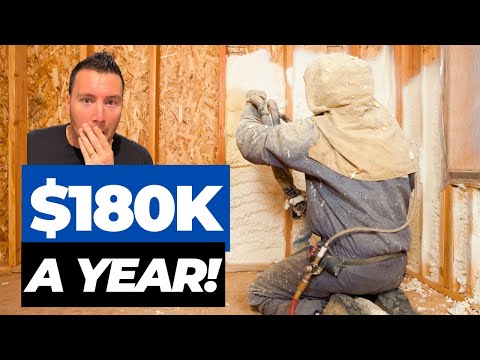
“How to Start an Insulation Business ($675K/Year)”
What we found: Insulation Business: The $675K Is Two $7,000 Jobs a Week, Every Week — on Paper
The loan payment is calculated correctly to the dollar. The revenue is a forecast on an assumed job price and volume, it multiplies to $672,000, and nobody in the video reports insulating a house.
- $675k/yr Headline revenue
- ~$270k/yr Projected profit
- $64k Startup cost
- $676/mo Loan payment
The claim
That a spray foam insulation business started for $64,000 can bring in about $675,000 a year and about $270,000 in profit from two jobs a week.
- Used spray foam rig trailer — ~$40,000
- Truck and trailer together — $60,000
- Website, formation, bond — ~$500
- Tools — ~$2,500
- Insurance — $1,000–$2,000 a year; low end used
- Total startup cost — $64,000
- Loan at 20% down, 10 years, 10% — $676 a month
- Average job price — ~$7,000 (range $3,000–$10,000)
- Jobs per week — Two
- Monthly revenue — $56,000
- Annual revenue from the stated monthly — $672,000
- Profit margin — ~40%
- Monthly / annual profit — $22,400 / ~$270,000
- Jobs the narrator has personally completed — Never stated
What is this income idea?
Install insulation — mainly spray foam — in new builds, renovations and flips, using a trailer-mounted spray rig and selling to builders, contractors, investors and homeowners.
- The video opens with its headline: "how to start an insulation business and make $675,000 a year." The narrator explains that spray foam is "all the rage" with builders and that a successful contractor needs a spray foam rig trailer.
- The startup budget is itemised. A used spray foam rig trailer is about $40,000, and truck plus trailer together come to $60,000. Add about $500 for a website, formation fees and any bond, about $2,500 for tools, and about $1,000 a year for insurance, placed "on a lowend" of a $1,000 to $2,000 range. Total: $64,000.
- Financing is worked through: 20% down is $12,800, the balance on a ten-year note at 10% is $676 a month. We checked it, and it is correct.
- Jobs pay "anywhere from $3,000 to $10,000"; the narrator takes $7,000 as the average. Three jobs a week is possible "if you were fed enough jobs", but the model uses two. That gives $56,000 a month and, in the narrator's words, "that's 675,000 a year there's our 675."
- Profit is taken at about 40% after labour, equipment and spray foam materials: $22,400 a month and "270,000 a year." The narrator then suggests paying off the debt and adding trailers, projecting "over a million doll in profit" at four to five rigs.
- The narrator describes the business as one they found "very interesting... when I was reviewing it", and states owning an insurance agency that works with insulation contractors. Nothing in the video describes the narrator running an insulation business.
A carefully costed start-up plan and a correct loan calculation, attached to a revenue forecast that assumes the jobs arrive.
- Used spray foam rig — ~$40,000
- Truck to tow it — $60,000 with the rig
- Finance 80% — $676 a month
- Network with builders — GCs, flippers, investors
- $7,000 average job — Assumed
- Two jobs a week — Assumed
- 40% margin — Assumed
- Add rigs to scale — "Over a million" projected
The costs and the finance are specific. The demand is a single sentence: "if you were fed enough jobs."
The loan is real. The jobs are imagined.
The lesson underneath the number
- This video gets more right than most in its genre. It itemises a startup budget, adds it correctly to $64,000, and then does something almost nobody does — it works through financing. Twenty per cent down is $12,800, and a ten-year note at 10% on the remaining $51,200 is $676 a month. We ran the amortisation and the figure is right to the dollar. It also separates revenue from profit explicitly: "gross revenue doesn't matter if we're not retaining anything." That is the right instinct.
- The weakness is on the other side of the ledger, and it is a structural one. The loan payment is a certainty the day the rig is bought. The revenue is two assumptions multiplied together: a $7,000 average job, chosen from the upper half of a $3,000–$10,000 range, and two jobs every week, which the narrator qualifies with "if you were fed enough jobs." The second half of the video is essentially an explanation of why getting fed jobs is the hard part — networking with builders, contractors and flippers, trade magazines, websites, reputation. The first failure mode listed is simply not getting work.
- That asymmetry is what a viewer should take away. A beginner who finances $51,200 of equipment takes on a fixed $676 a month and a rig that only earns when it is on a job. In the months before builders trust a new contractor, the business carries debt, insurance and a truck on little or no revenue. The video's $675,000 describes what happens once the phone rings twice a week, every week; it does not describe getting there.
- The smaller details fit the same pattern. Twelve months of $56,000 is $672,000, not $675,000. The 40% margin is applied to revenue and the result called profit, without saying whether the loan, insurance, marketing and the owner's pay are inside it. "Three to four jobs" to recover the down payment becomes about 4.6 at the stated margin. And "over a million" at four to five rigs assumes each rig finds the same work at the same margin with its own crew. The narrator says they were "reviewing" this business and discloses owning an insurance agency that works with insulation contractors. The maths is careful; the experience behind it is not claimed.
Gross revenue doesn't matter if we're not retaining anything.
The narrator — right, and worth applying to the headline
The plan, as the video gives it
Costs, finance, pricing, then the ways it can fail.
- Buy into spray foam — A used rig trailer at about $40,000 is the core asset. The narrator frames spray foam as what builders want now, which is why the trailer is non-negotiable in this plan.
- Finance the equipment — 20% down ($12,800), ten-year note at 10%, $676 a month. Stated clearly and computed correctly — rarer in this genre than it should be.
- Price by the job — Jobs range from $3,000 to $10,000 depending on whether old insulation is torn out. The model uses $7,000, above the midpoint of that range.
- Get fed jobs — Network with home builders, custom builders, commercial general contractors, investors and flippers; Facebook groups; a local website; trade magazines; and energy-saving pitches to homeowners.
- Guard quality and punctuality — Named as the second and third ways the business fails, after lack of jobs. Good advice, with no cost of training attached.
- Legal, insurance, contracts — An LLC or corporation via a local attorney, insurance with an agent who knows contracting, and a written scope with homeowners. The narrator discloses owning an agency that insures insulation contractors.
- Reinvest into more rigs — Pay off the debt after year one, add trailers, and aim for "over a million doll in profit" with four to five in operation.
The business model
Per-job pricing for spray foam and traditional insulation, $3,000 to $10,000 a job, modelled at a $7,000 average.
Home builders, custom builders, commercial general contractors, investors, flippers, and homeowners with old insulation.
Energy-efficient insulation, with spray foam positioned as what builders now prefer.
Networking with builders and investors, Facebook groups, a local website, trade magazines, referrals.
- Spray foam rig trailer — ~$40,000 used
- Truck
- Loan repayment — $676 a month over ten years
- Labour and spray foam materials — Inside the assumed 40% margin. Never itemised
- Insurance — $1,000–$2,000 a year stated; the narrator sells insurance
- Marketing — Several channels named. None priced
- Training — Quality is named as a failure point. Training never priced
Startup and financing are costed carefully. Operating costs are collapsed into one assumed margin.
What you would actually need
Money
$64,000 total, or $12,800 down with the rest on a ten-year loan at $676 a month.
The line items add up and the loan is computed correctly. What sits outside the $64,000 is everything needed to operate the rig: training, crew wages, spray foam chemicals for the first jobs, and working capital while builders pay on their terms.
Named or implied, never priced
- Training to operate a spray foam rig
- Crew labour — inside the 40%, never itemised
- Spray foam material for the first jobs before payment arrives
- Insurance above the $1,000 low end the narrator chose
- Fuel and towing a rig to every job
- Marketing: website, trade magazines, networking
- Attorney fees for entity and contracts
Time
One to two days per job; two jobs a week in the model, three possible. Pay off the down payment in "three to four jobs."
Two jobs a week at one to two days each is two to four working days, which is plausible capacity. The unknown is how long before builders and flippers send two jobs every week. At the narrator's own 40% margin, $12,800 takes about 4.6 jobs of profit to recover, not three to four.
What the forecast assumes
- Two $7,000 jobs every week from the start
- 48 working weeks a year
- Relationships with builders already producing work
- Crew trained and reliable
- No slow season in construction
- No time for quoting or travel outside job days
The part you must pay attention to
The headline is a forecast built on two assumed inputs — and it does not quite multiply to $675,000.
"If we're doing two jobs per week... 7,000 a job... on a monthly basis that's $56,000 a month and that's 675,000 a year there's our 675."
- Revenue per week — 2 × $7,000
- Per month = $56,000 — 4 weeks
- Per year — 12 months
$672,000
Not $675,000 — and revenue, before any cost
The load-bearing inputs are the job price and the job count. $7,000 is chosen from a $3,000–$10,000 range, above the $6,500 midpoint. Two jobs a week is qualified only by "if you were fed enough jobs", and the whole second half of the video is about how hard getting jobs is: the first failure mode the narrator lists is "you're not getting jobs." Two jobs a week every week is about 96 jobs a year. Nothing in the video reports the narrator doing one; the business is described as something the narrator was "reviewing."
The $3,000 gap between $672,000 and the $675,000 in the title is small and not material on its own. The profit figure needs more care. Forty per cent of $56,000 is $22,400 a month, and twelve of those is $268,800, rounded to "270,000." The margin is said to cover labour, equipment and spray foam materials; the video does not say whether the $676-a-month loan, insurance, marketing, fuel and the owner's own pay sit inside it. The narrator later calls $270,000 "profit" earned by "somebody who's going out and insulating houses", which reads as the owner's income. It is a projected pre-tax margin on projected revenue. The "over a million doll in profit" at four to five trailers is a straight multiplication of that projection by the number of rigs, with no allowance for extra crews, managers, or finding four to five times the work.
- STARTUP, AS STATED
- Truck + rig trailer $60,000
- Website, formation, bond $500
- Tools $2,500
- Insurance (low end) $1,000
- --------------------------------
- Total $64,000
- THE LOAN (CHECKED)
- 20% down $12,800
- Financed $51,200
- 10 yrs @ 10% $676/mo
- THE REVENUE
- 2 jobs x $7,000 $14,000/wk
- x 4 $56,000/mo
- x 12 $672,000/yr
- -> title says $675,000
- THE PROFIT
- $56,000 x 40% $22,400/mo
- x 12 $268,800/yr
- Loan, overheads, owner pay: ???
The economics
Startup and finance are verified by arithmetic. Everything after is assumed.
- Startup cost — $64,000
- Down payment — $12,800
- Monthly loan payment — $676
- Average job price — $7,000
- Jobs per week — 2
- Monthly revenue — $56,000
- Annual revenue — $672,000
- Margin — ~40%
- Annual profit — $268,800
- Jobs a year implied — ~96
- Jobs to recover the down payment at 40% — ~4.6
Checking the financing
$51,200 × (0.10/12) ÷ (1 − (1 + 0.10/12)^−120)
$676.61 a month — matching the narrator's $676 exactly. Over ten years that is ~$81,200 repaid on $51,200 borrowed
IncomeIdeaLab calculation from the loan terms stated in the video
- Whether the narrator has operated an insulation business
- What the 40% margin excludes — loan, insurance, marketing, owner pay
- Crew size and wages
- Spray foam material cost per job
- Training or certification cost
- How long before two jobs a week is reached
- Payment terms when working for builders and general contractors
- Annual figures use four weeks a month, so 48 working weeks. At 52 weeks the same inputs would give $728,000, so the narrator's method is the more conservative one — but it still assumes no slow season.
- Over the full ten-year term the stated loan repays about $81,200 on $51,200 borrowed, around $30,000 in interest. The narrator suggests paying it off after year one, which only works if the year-one forecast is met.
- The narrator owns an insurance agency, says it works with insulation contractors, and recommends working with an agent who knows contracting. That is disclosed ("transparently"). No course, coaching programme or affiliate link is mentioned.
Evidence status
Every substantive claim in the video.
- $675,000 a year — Title and narrator — The narrator's own monthly figure gives $672,000. A forecast either way.
- ~$270,000 a year profit — Narrator — 40% of $672,000 is $268,800. Margin assumed; contents unclear.
- Startup cost of $64,000 — Narrator — Itemised lines add correctly.
- Used spray foam rig ~$40,000 — Narrator — Not checked by us. The largest single cost.
- $676 a month on a 10-year, 10% note — Narrator — Correct for $51,200 financed.
- Average job ~$7,000 — Narrator — Chosen from a $3,000–$10,000 range, above its midpoint.
- Two jobs a week — Narrator — "If you were fed enough jobs." The load-bearing assumption.
- Down payment recovered in 3–4 jobs — Narrator — About 4.6 jobs at the stated 40% margin.
- "Over a million" profit with 4–5 rigs — Narrator — A multiplication of a projection. Crews and demand not addressed.
- Narrator runs an insulation business — Nobody — Not stated. The narrator describes "reviewing" it.
What is actually proven?
The arithmetic, including the loan. Not the demand.
- Startup costs sum to $64,000.
- The $676 monthly payment is correct for the stated terms.
- $56,000 a month for a year is $672,000.
- 40% of that is $268,800, rounded to $270,000.
- The narrator's insurance agency is disclosed.
- Every revenue and profit figure is a forecast.
- Whether any insulation job has been done by the narrator.
- What costs sit inside the 40% margin.
What the headline doesn’t tell you
Fixed debt on one side, assumed jobs on the other.
- The maths gives $672K. — Not the $675K in the title.
- It is revenue. — Profit is projected at ~$270K.
- Two jobs a week is assumed. — "If you were fed enough jobs."
- $7,000 is above the midpoint. — Of a $3,000–$10,000 range.
- The loan starts on day one. — $676 a month, jobs or not.
- The margin's contents are unclear. — Loan and owner pay may be outside it.
- Training is not priced. — Yet quality is a named failure point.
- The narrator sells insurance. — To insulation contractors. Disclosed.
Should you try it?
A capital-heavy trade with a careful startup plan and an untested income forecast
Reuse the budget and the financing method. Do not borrow against the revenue figure until builders are already sending you work.
- Startup cost detail — 8 — Itemised and correctly totalled.
- Financing transparency — 9 — Down payment, term, rate and payment — all correct.
- Evidence of real results — 0 — No job, client or month of revenue reported.
- Realism of the volume — 4 — Two jobs a week is modest, but explicitly conditional.
- Revenue arithmetic — 7 — Correct except the $672K vs $675K rounding.
- Margin clarity — 4 — 40% stated; what it excludes is not.
- Conflict disclosure — 8 — Insurance agency named as the narrator's, "transparently".
- Beginner accessibility — 3 — $64,000 of equipment, much of it borrowed, plus skills.
- The cost side of this video is worth keeping. It tells you the core asset is a spray foam rig, that a used one costs about $40,000, and it shows how to finance it. The $676-a-month payment is exactly right for the terms given. If you are seriously weighing this trade, that gives you a monthly fixed cost to plan around from day one.
- Plan around it before you plan around the income. Two jobs a week at $7,000 is the entire revenue model, and the narrator makes it conditional on being "fed enough jobs." New contractors are not fed jobs by builders they have never worked for. Model your first six months at a fraction of that pace — and ask whether you can carry the loan, insurance and truck through them.
- Get the skills priced. Quality is named as the second way this business fails, but there is no training, certification or apprenticeship cost anywhere in the budget. Spray foam application is a skilled trade; the video assumes you already "know how to insulate."
- Finally, rebuild the profit figure yourself. The 40% margin is said to cover labour, equipment and materials. List the loan, insurance, fuel, marketing and your own wage separately and see what is left. And note that the narrator describes reviewing this business rather than running it, and owns an insurance agency that serves insulation contractors — get your insurance quotes from more than one source.
Passive or automated?
Automation
Every dollar comes from a crew spraying foam in a building.
Passive potential
Scaling means more rigs, more crews and more management.
The narrator's scaling plan — pay off the debt, add trailers, reach four to five rigs — is a plan to become an employer and manager, not to earn passively. Each rig needs a trained crew, a steady supply of jobs, materials and insurance, and the owner's time shifts from spraying to selling, scheduling and quality control. The narrator treats referrals as the growth engine, which depends on consistent workmanship on every job. At any size described in the video, revenue stops when the rigs stop.
- Operating the spray foam rig on every job
- Networking with builders, contractors and investors
- Quoting and scoping jobs, including tear-outs
- Showing up on time — a named failure point
- Hiring and supervising crews for additional rigs
Recommended beginner experiment
Prove the demand before you finance the rig.
- Work for an insulation contractor first. — Learn the trade and the local prices.
- Ask builders what they pay. — Test the $7,000 average.
- Line up job commitments. — Before signing a $51,200 loan.
- Model three slow months. — Can you carry $676 plus insurance?
- Price training and materials. — Both missing from the $64,000.
- List costs outside the margin. — Loan, insurance, fuel, your wage.
- Get several insurance quotes. — The low end was assumed.
- Add a second rig only on real demand. — When you are turning work away.
Our verdict: 5/10
Careful costs, correct loan, and a revenue line built on "if you were fed enough jobs" $675,000 is two assumed $7,000 jobs a week, and the arithmetic gives $672,000
Credited for itemising a $64,000 startup budget that adds up; for working through financing and stating a monthly payment that is correct to the dollar; for separating revenue from profit and saying why it matters; for choosing a conservative two jobs a week over three; for practical advice on networking, quality, punctuality, contracts and entity setup; and for disclosing the narrator's ownership of an insurance agency that works with insulation contractors. Marked down because the title presents a revenue forecast as what the business makes; because two $7,000 jobs a week is explicitly conditional on being "fed enough jobs" and is never supported by any reported experience; because $56,000 a month multiplies to $672,000, not the $675,000 in the title; because the 40% margin is applied without saying whether debt service, insurance, marketing and the owner's pay are inside it; because training is not priced despite quality being a named failure point; and because the narrator describes reviewing the business rather than running it.
The strongest part of this video is the part that commits money. It prices a used spray foam rig at about $40,000, adds a truck, tools, setup costs and insurance to reach $64,000, and then works through a loan: $12,800 down and $676 a month over ten years at 10%. We checked the payment and it is correct. Few income videos show the financing at all, and fewer get it right. The revenue side is where the certainty stops. Two jobs a week at $7,000 — an average chosen above the midpoint of the stated range — gives $56,000 a month, and twelve of those is $672,000, a little short of the headline. Forty per cent of it is about $270,000, which the narrator presents as what someone insulating houses would take home, without saying whether the loan, insurance, marketing or the owner's wage sit inside that margin. More importantly, the two jobs a week is explicitly conditional on being "fed enough jobs", and the entire second half of the video explains that getting jobs is the first way this business fails. The narrator describes having reviewed the business rather than having run it, and owns an insurance agency serving the same trade, which is disclosed. Take the startup list and the financing method, and model your first year on the jobs you can actually secure. The loan payment starts on the first month regardless.
- Headline revenue — $675,000/yr
- Our recomputation — $672,000/yr
- Projected profit — $268,800/yr
- Startup cost — $64,000
- Loan payment — $676/mo
- Jobs a year implied — ~96
- Jobs actually reported — None
- Beginner suitability — Only with trade experience and capital
Sources
- How to Start an Insulation Business ($675K/Year) — Nate Jones — YouTube video, 2023-10-09
- FTC — Guides Concerning the Use of Endorsements and Testimonials — Regulatory guidance on earnings claims