Local Services / Handyman · Claim Review
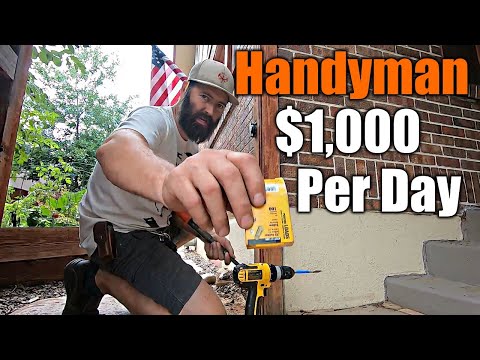
“Handyman Easily Makes $1,000 Per Day | Easy Money | What He does | THE HANDYMAN |”
What we found: One Job Is Priced at $125; the Other $875 of the "$1,000 Day" Is Never Shown
A genuine day of landlord repairs, filmed start to finish — with a closing estimate in place of a tally, and no line between revenue and pay.
- ~$1,000 Day total claimed
- $125 Priced in the video
- $875 Unaccounted
- 4 Stops filmed
The claim
That a handyman easily makes $1,000 per day doing small repairs.
- Day total — "Be an easy thousand dollar day"
- First stop: smoke detector — $125
- Time from leaving home to first $125 — "Exactly 30 minutes"
- Drive to first stop — 13 miles, 24 minutes
- Charges for stops 2–4 — Never stated
- Unitemised remainder — $875
- Hours worked that day — Never stated
- Costs: fuel, parts, vehicle, insurance — Never stated
- Is $1,000 revenue or take-home? — Never distinguished
What is this income idea?
Run a handyman business serving landlords and property managers, stacking several small repair jobs at rental properties into one day.
- The video is a filmed "day in the life", with a tool trailer hitched to a pickup and four stops. The first is "13 miles away it's going to take me 24 minutes."
- Stop one is a smoke detector for a landlord's tenant: "I didn't even have to change the battery just had to plug it in and put it up." He then says "it is exactly 30 minutes since I left my house and I've made my first 125 dollars."
- Stop two is a garbage disposal, collected from the landlord and installed at a rental. It needs a GFI outlet added because the old unit was hardwired. He tests for leaks on camera.
- Stop three is a multi-job visit sent by text "in broken English": a loose fence post fastened to a brick wall, loose tiles glued back, and outdoor lights a tenant and property manager could not switch off, which he rewires and recommends be redone properly later.
- Stop four is capping a sprinkler line below grade so a house can pass a water meter inspection, photographed for the city, with the possibility of being called back to reconnect it afterwards.
- He closes with "that's it for the day be an easy thousand dollar day." No charge is given for stops two, three or four, and nothing is said about hours, costs or whether the figure is before or after expenses.
A real day of small rental repairs, with one $125 price shown and a $1,000 total asserted at the end without the arithmetic.
- Drive 13 miles — 24 minutes
- Smoke detector — $125, stated
- Garbage disposal — Plus GFI outlet; unpriced
- Fence, tile, lights — One visit; unpriced
- Cap sprinkler line — For inspection; unpriced
- "Easy thousand dollar day" — Estimate, not itemised
Four stops filmed. One priced. The total arrives as a sentence.
The client list is the business. The $1,000 is a sign-off.
The lesson underneath the number
- The most useful thing in this video is not a number; it is who the customers are. Every stop comes from a landlord or a property manager: a tenant's smoke detector, a rental's disposal, lights that nobody managing the property could switch off, a sprinkler line in the way of a city inspection. These are clients with a steady stream of small, unglamorous jobs, a need to get them done quickly, and parts they will sometimes supply. A handyman who becomes the reliable number for a few of them has recurring work without advertising — which is the real model on display.
- The headline figure is much weaker than the footage. One job carries a price: $125 for mounting a plug-in smoke detector, thirty minutes after leaving home, most of it driving. That is a striking pace, and it is honestly framed — he calls it an easy job and says the day will "get progressively worse and worse". The other three stops are filmed in detail and never priced. Then the day ends with "be an easy thousand dollar day", a rounded estimate with no breakdown behind it.
- The title then does two things the audio does not. It turns one day into a daily rate — "Makes $1,000 Per Day" — and it turns revenue into income without saying so. Nothing in the video indicates how many days are like this one, how long this day lasted, or what the truck, trailer, tools, fuel and parts cost against it. A $1,000 billing day for an established tradesman with a book of landlord clients is entirely plausible. It is not shown here, and it is not take-home pay.
- There is also a second business visible in the video. He mentions that one of his "most successful videos was filmed here", runs a disclosed sponsor read for a lubricant brand, and plugs his merchandise store. None of that income is part of the $1,000, but it is a reminder that the day was planned with a camera present, and that the channel itself is a revenue stream separate from the repairs.
It is exactly 30 minutes since I left my house and I've made my first 125 dollars.
The only priced job in the video
The day, stop by stop
What was shown, and what was charged where we are told.
Several stretches have no speech; we describe only what is said.
- Stop 1: smoke detector — $125 — Plugged in and mounted; no battery change needed. "Exactly 30 minutes since I left my house", including a 24-minute drive. The only priced job in the video.
- Stop 2: garbage disposal swap — Collected from the landlord, installed at the rental, with a GFI outlet added because the old unit was hardwired. Leak-tested on camera. No charge given.
- Stop 3: fence post, tiles and outdoor lights — Fence post fastened to a brick wall, loose tiles glued back, and lights nobody could switch off rewired, with a recommendation to the property manager that the run be redone. No charge given.
- Stop 4: cap a sprinkler line for inspection — A hose-spigot sprinkler setup capped below grade and photographed for a water meter inspection; he may be called back to reconnect it. No charge given.
- The close — "That's it for the day be an easy thousand dollar day." An estimate for this day, not a breakdown, and not a claim about every day.
The business model
Per-job charges for small repairs at rental properties, booked by landlords and property managers.
Landlords and property managers with tenants who need smoke detectors, disposals, lighting, fences and inspection fixes.
One person who will handle a mixed list of small, awkward jobs — including ones "you wouldn't believe how many people came and looked at" and could not solve.
Repeat landlord and property-manager clients who text jobs directly; the video does not describe marketing.
- Pickup truck and tool trailer — Shown; never costed
- Tools across several trades — Never itemised
- Consumables — GFI outlet, adhesive, fasteners, caps
- Fuel — 13 miles to stop one alone
- Insurance and licensing — Never mentioned
Some parts are supplied by the client — the landlord provided the disposal — which keeps material costs down. Everything else is unstated.
What you would actually need
Money
Not discussed. He mentions a "new truck", a tool trailer and a drop-down hitch that is "kind of expensive".
The day rests on a pickup, a tool trailer and tools for plumbing, electrical, tiling and fencing work — a meaningful capital outlay before the first $125. None of it, nor fuel, parts or insurance, is costed.
Shown or implied, never priced
- Pickup truck — "the new truck"
- Tool trailer and drop-down hitch
- Tools across plumbing, electrical, tile and fencing
- Consumables: GFI outlet, adhesive, fasteners, caps
- Fuel for a 13-mile first leg and three more stops
- Liability insurance and any required licences
Time
First $125 within 30 minutes of leaving home. "Most of the day is done" before the last stop, in 94-degree heat.
The video never gives the length of the day. Four stops, one 24-minute drive stated and three more unstated, plus a parts collection from the landlord, suggest a full working day — which is the denominator the $1,000 needs.
Time on the clock
- 24-minute drive to stop one (stated)
- Collecting the disposal from the landlord
- Three further drives, never timed
- Multi-job visit with glue left to cure
- Digging and capping a buried line in the heat
- Possible return visit to reconnect it
The part you must pay attention to
One job is priced. The $1,000 total is asserted, not added up.
The only charge stated is $125 for the smoke detector. The day ends with "be an easy thousand dollar day" and no further figures.
- Day total, his estimate — ~$1,000
- Stop 1, stated — $125
$875
Across stops 2–4, never broken down
Seven-eighths of the headline figure is never itemised. A disposal swap with an added outlet, a three-part repair visit and a buried line capped for inspection could plausibly come to $875 between them at landlord rates, but the video never says what any of them cost the client, so the total cannot be checked. "Be an easy thousand dollar day" is phrased as a rough estimate, and the title upgrades it to "Easily Makes $1,000 Per Day" — a rate for every day, from a remark about one.
Even taking $1,000 at face value, it is billed revenue for one day. The truck, trailer, tools, parts, fuel, insurance and tax all come out of it, and the video gives none of those figures. The first stop is impressive on its own terms — $125 for 30 minutes from leaving home is a $250-an-hour pace, on our arithmetic — but it is also the easiest job of the day by his own account, and he says the rest will "get progressively worse and worse". The effective rate for the whole day depends on hours the video does not give.
- WHAT WE ARE TOLD
- Stop 1 smoke detector $125
- Stop 2 disposal + GFI ?
- Stop 3 fence/tile/lights ?
- Stop 4 sprinkler cap ?
- "Easy thousand dollar day" ~$1,000
- -------------------------------
- Unaccounted $875
- STOP 1 PACE (OURS)
- $125 in 30 min $250/hr
- (24 of 30 min driving)
- IF THE DAY WAS 8-10 HOURS (OURS)
- $1,000 / 8 hrs $125/hr
- $1,000 / 10 hrs $100/hr
- Before truck, fuel, parts, tax
The economics
One price, one estimate, and no costs.
- Stop 1 charge — $125
- Time from home to stop 1 complete — 30 minutes
- Drive to stop 1 — 13 miles, 24 minutes
- Charges for stops 2–4 — Never stated
- Day total — ~$1,000
- Unitemised remainder — $875
- Length of the working day — Never stated
- Business costs — Never stated
Effective hourly rate at plausible day lengths
$1,000 ÷ 8 hours = $125/hr; $1,000 ÷ 10 hours = $100/hr (gross, before any costs)
A strong but ordinary trade rate once the whole day is the denominator, not the $250/hr pace of the first stop
IncomeIdeaLab calculation; the day lengths are our assumptions, as the video gives none
The $1,000 is the creator's rounded estimate, not a total of stated charges. If the true figure or the true hours differ, so does the rate. Costs for the truck, trailer, fuel, parts, insurance and tax are not deducted because none are given.
- What stops 2, 3 and 4 were billed
- How long the working day was
- How many days a week look like this one
- Vehicle, trailer and tool costs
- Fuel, parts and consumables
- Insurance, licensing and tax
- Whether $1,000 is revenue or take-home pay
- $125 for 30 minutes, door to door, is a $250-an-hour pace on our arithmetic. He describes that job as unusually easy and says the rest of the day gets harder.
- The landlord supplied the disposal, so that job's material cost to him was mostly the added GFI outlet. The video does not say whether parts are marked up or billed at cost.
- The sprinkler job may produce a second paid visit — "they may or may not be calling me to come back to re-hook it" — a useful example of how property work can recur.
- The title says "per day". The audio says "be an easy thousand dollar day" about this one day. No other day is described.
Evidence status
Every substantive claim in the video.
- Makes $1,000 per day — Video title — The audio describes one day, as an estimate.
- "Be an easy thousand dollar day" — Creator — Rounded estimate; $875 of it never itemised.
- $125 within 30 minutes of leaving home — Creator — The one priced job. Consistent with the 24-minute drive stated.
- Four jobs completed in the day — Footage — Each stop is filmed through to completion.
- Lights "nobody could figure out" fixed — Creator — Shown; he also recommends the circuit be redone properly.
- Costs of running the business — Nobody — Never mentioned.
- Sponsor and merchandise — Creator — Both disclosed in the video.
What is actually proven?
The work is shown. The money mostly is not.
- Four landlord and property-manager jobs are filmed through to completion.
- The first job was billed at $125, thirty minutes after leaving home.
- He estimates the day at about $1,000.
- $875 of that estimate is never broken down.
- The sponsor read and merchandise plug are disclosed.
- Hours worked, costs, and how many days look like this one.
What the headline doesn’t tell you
A day is shown. A daily rate is claimed.
- One job is priced. — $125 for a smoke detector.
- $875 is never itemised. — Three stops, no charges.
- "Be an easy thousand." — An estimate, not a tally.
- One day, not every day. — The title says per day.
- Hours are never given. — So no hourly rate either.
- Revenue, not pay. — Truck, trailer, fuel, parts unpaid.
- The camera was there. — Sponsor and merch included.
Should you try it?
A credible model, an unproven headline
Landlord and property-manager work is a solid foundation. Do not plan on $1,000 days without your own job prices, hours and costs.
- Realism of the work shown — 8 — Four genuine, ordinary rental-repair jobs.
- Evidence for the $1,000 — 2 — One $125 price; the rest asserted.
- Accuracy of the title — 2 — Turns one estimated day into a daily rate.
- Cost disclosure — 0 — No cost of any kind is given.
- Sponsor disclosure — 8 — Sponsor and merchandise both stated plainly.
- Beginner accessibility — 4 — Needs a vehicle, tools across trades and landlord clients.
- The model in this video is worth copying: become the go-to repair person for a handful of landlords and property managers. They have a constant supply of small jobs, they value speed and reliability over the lowest price, and they sometimes supply the parts. Every stop in this day came from that kind of client, and none of them required advertising on the day.
- The figure is not worth copying as a plan. Only one job is priced, and it is the easiest job of the day by the creator's own description. The $1,000 is his rounded estimate for this day, and the video gives no hours, no other day and no costs. Spread across an eight- to ten-hour day, $1,000 would be $100 to $125 an hour gross — a good trade rate, before the truck, trailer, fuel, tools, insurance and tax that this day visibly depends on.
- Look carefully at the skill range, too. In one day he replaces a disposal and adds an outlet, rewires outdoor lighting, fastens a fence post to brick, glues tile and caps a buried irrigation line for an inspection. That breadth is what lets one person collect $1,000 from four stops, and it takes years to build. Some of it, particularly the electrical work, may also need a licence where you live.
Passive or automated?
Automation
Every stop is a drive and a hands-on job.
Passive potential
Income stops when he stops driving to jobs.
Nothing about the repair business is passive. Each dollar comes from driving to a rental and doing the work, often in difficult conditions — the last stop is dug in 94-degree heat. Repeat landlord clients reduce the effort of finding work, which is valuable, but not the effort of doing it. The only income here that continues without his labour is the video itself, which is a separate business from the one the title describes.
- Driving between rental properties
- Collecting parts from clients
- Every repair, from smoke detectors to buried lines
- Diagnosing problems others could not
- Reporting back to property managers
Recommended beginner experiment
Copy the client base; measure your own day.
- Approach three local property managers. — Offer fast turnaround on small jobs.
- Check licensing for electrical and plumbing work. — Before taking those jobs.
- Set a minimum call-out charge. — His $125 stop shows why.
- Batch stops by area. — His first leg was 13 miles.
- Record every charge and every hour. — The figures this video leaves out.
- Deduct fuel, parts and vehicle costs weekly. — Revenue is not pay.
- Judge the rate across a month. — Not from one good day.
Our verdict: 4/10
A real day of rental repairs, and a $1,000 nobody adds up the client model is the lesson; the daily figure is an unitemised estimate
Credited for filming four genuine landlord and property-manager jobs through to completion; for giving a specific price and time for the first job; for framing that job honestly as unusually easy; for showing the breadth of skills that makes multi-stop days possible; and for disclosing both the sponsor and the merchandise plug. Marked down because the "$1,000" is a rounded estimate for one day with $875 of it never itemised; because the title turns that single remark into a daily rate; because the length of the working day is never given; and because no cost of any kind — truck, trailer, tools, fuel, parts, insurance or tax — is mentioned, so revenue and take-home pay are never distinguished.
As a portrait of the work, this video is honest and useful. Every stop comes from a landlord or property manager — a tenant's smoke detector, a disposal at a rental, outdoor lights nobody could switch off, a sprinkler line in the way of a city inspection — and each job is filmed through to the end. That client base, with its steady flow of small, urgent jobs and the occasional supplied part or follow-up visit, is the real business model on show, and it is a sound one. The money is far less documented. One job is priced: $125 for mounting a plug-in smoke detector, thirty minutes after leaving home, which he fairly calls the easy start to a day that gets harder. Nothing is said about what the disposal swap, the three-part repair visit or the irrigation cap were billed. The day ends with "be an easy thousand dollar day", leaving $875 of the headline unexplained. The title then turns that estimate into "Makes $1,000 Per Day", and nothing in the video separates billed revenue from pay. With no hours given, the effective rate is unknown; across an eight- to ten-hour day it would be $100 to $125 an hour gross, before the truck, trailer, tools, fuel, parts and insurance the footage shows him relying on. Take the client model. Build the numbers from your own days.
- Day total — ~$1,000 (estimate)
- Priced jobs — 1 of 4 ($125)
- Unitemised — $875
- Stop 1 pace — ~$250/hr
- Day length — Never stated
- Costs — Never stated
- Sponsor — Disclosed
- Beginner suitability — Model yes, figure unproven
Sources
- Handyman Easily Makes USD 1,000 Per Day | Easy Money | What He does | THE HANDYMAN | — YouTube video, 2020-08-09
- FTC — Guides Concerning the Use of Endorsements and Testimonials — Regulatory guidance on sponsored content and earnings claims