Reselling / Thrift Flipping · Claim Review
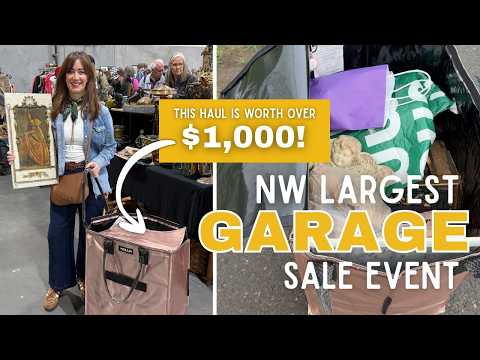
“I SCORED HUGE at the NW Largest Garage Sale Event | Thrift with Me!”
What we found: The $1,140 From a $100 Garage Sale Challenge Is Assigned Resale Value, and the Rest of a $600 Weekend Is Not Valued
The reseller values ten items bought for $100 at $1,140, with $325 of that on one piece. They also spent $600 on inventory that weekend; the other purchases are not given a value, and nothing has sold yet.
- $100 $100 challenge spend
- $1,140 Assigned value
- $600 Weekend inventory spend
- Not stated Booth and selling costs
The claim
That $100 spent at a garage-sale event bought items worth $1,140 at resale, and that the haul overall was a big score.
- Spent on the $100 challenge — $100 across ten items
- Value assigned to those items — $1,140
- Largest single value — $325 on a piece bought for $40
- Share of the $1,140 in that piece — About 29%
- Value multiple on cost — 11.4×
- Inventory spend across the weekend — $600 in 24 hours
- Value of the other ~$500 of purchases — Not stated
- Items sold at the time of the video — None stated
What is this income idea?
Buy vintage decor cheaply at garage-sale and estate-sale events, then resell it in antique-mall booths and on Etsy during the holiday season.
- The video opens at a regional garage-sale event the reseller describes as having "600 vendors here two buildings". They say they have been there "since 6:00 in the morning" and are also doing the event's "$100 challenge to see what I can buy for 100 bucks".
- Prices are called out as they shop: a stool for $10, a Florentine piece for $5, a carved wood bird for $15, a cherub for $4, an original painting for $5, and a heavy metal planter for $40. Several pieces are passed on for price, including a black cat lamp at $75 and a small enamel box at $25.
- Back in the studio, the reseller adds purchases from a friend's pop-up, an estate-sale marketplace on its half-off day, and a private seller. They say "I basically spent USD 600 this weekend on new inventory, USD 600 in a 24-hour period", because November and December are "when I make the most of my business".
- Some of those purchases come with resale reasoning. Six horse brasses cost $24 after the half-off discount and "on their own they sell for about USD 25 each". A mid-century tray cost $18 after the discount, and "usually these trays sell for 60 or more bucks". A Wedgwood vase cost $12 with "still a lot of margin in this".
- At the end they value only the $100 challenge: ten items that "added up to 100 bucks", given values "based on my own past sales and comps" that total "USD 1,140 in value". Of that, $325 is the metal piece bought for $40, which they say could be "closer to USD 1,000" and plan to have looked at by an antique dealer.
- The rest of the $600 weekend is not valued. Some of it is kept for personal use (a sweater, a shirt, a painting now hanging in the living room), and the reseller says there is "more stuff on this table that I haven't even assigned a price to".
They paid $100 for ten items they think will sell for about $1,140 in total, and spent another $500 that weekend on stock they have not valued yet.
- Shop a large sale event — From 6 a.m., 600 vendors
- Buy on price and demand — Brass, Wedgwood, bookends
- Add other sources — Pop-up, estate sale, private seller
- Assign values — Past sales and comps
- Stock booths and Etsy — Booths for small items
- Wait for holiday buyers — Not yet in the video
The video ends at the valuation step for one part of the haul. Selling, and what selling costs, come after it.
One part of the haul valued, and one item carrying a third of it
The lesson underneath the number
- The $100 challenge is a neat format. It fixes the spend and asks what it can buy, and the reseller answers with a total: $1,140 of value on ten items, "based on my own past sales and comps". On the stated figures that is an 11.4× multiple before any cost, which would be a strong morning by any reseller's standard.
- The total is less itemised than it looks. Only one of the ten values is stated: the metal piece bought for $40 and entered at $325, about 29% of the total. The reseller is careful about it, entering the low end of what their search found and saying they want an antique dealer's view before pricing it higher. That is a sensible way to treat an uncertain piece, and it also means the headline multiple depends heavily on one valuation still being checked.
- The more useful number may be the $600. The reseller says they spent that on inventory in 24 hours because November and December are when they make the most, and that they are "feeling the overwhelm of stuff". Some of the stated buys have clear margins: six horse brasses for $24 that sell for about $25 each, a tray for $18 that usually sells for $60 or more. But the weekend as a whole is not valued, some of it is kept for personal use, and the opening promise to show "how much everything is worth" is met only for the $100 challenge.
- None of the figures is money received yet. The items are bound for booths and Etsy during the holiday season, and the video ends before any of them sells. Booth rent or commission, Etsy fees, shipping and the repairs several pieces need are not mentioned.
So from USD 100 to over USD 1,000, which is amazing, and I still have more stuff on this table that I haven't even assigned a price to.
The reseller, closing the $100 challenge. The values are assigned to unsold items.
How the inventory is sourced and valued, as described
A walk-through of buying at events and estate sales ahead of the holiday season.
No sale is made in the video, and only the $100 challenge items are given a total value.
- Go early to the big events — They arrive at the opening of a 600-vendor event and stay from 6 a.m. through the morning, describing it as the best-priced event in their area.
- Buy the categories that sell for you — Bookends are "a bestseller in my booth", Wedgwood is "a bestseller for me", and they say they have "sold every ikebana vase I've ever put in a booth". The buying is tied to their own sales history.
- Walk away when the price leaves no margin — A black cat lamp at $75 and a small enamel box at $25 are left behind as outside the budget, and matches are bought only when they can be had cheaply enough "where I can flip and make a profit".
- Use half-off days at estate sales — They shop the estate-sale marketplace on its Sunday half-off day: horse brasses at $24 for six, a tray at $18, a Wedgwood vase at $12.
- Check one piece against the cost of the set — Of the horse brasses they say "just one of them basically covers the cost of the whole set". At $25 each against $24 for six, that checks out as stated.
- Route small items to the booth — Small figures go to the booth when "it doesn't make sense to list them on Etsy because I'm just not going to be able to get the price point", which "saves me from having to ship them and list them".
- Value conservatively, then get an expert view — The $40 metal piece is entered at $325, "on the lowest end based on my Google search", with a plan to ask an antique dealer before pricing it higher.
The business model
Resale of vintage home decor, brass, ceramics, ornaments and small collectibles through antique-mall booths and an Etsy shop.
Holiday gift shoppers and collectors at the booths; online buyers for items worth shipping.
Curated vintage pieces sourced from events and estate sales, sorted by what sells in each channel.
Booths for small and local-only items (most ornaments are "not going to be listed on Etsy"); Etsy for items like bookends that "sell really well on Etsy".
- Stock — $100 for the challenge; $600 across the weekend
- Booth rent or commission — Not mentioned
- Etsy fees — Not mentioned
- Shipping and packaging — Cited as a reason to route small items to the booth; no figure
- Repairs and conversion supplies — Several mentioned; no cost
- Time — From 6 a.m. at the event plus three other sources; not totalled
The buying spend is stated. Every cost of selling the stock is left out of the $1,140.
What you would actually need
Money
$100 for the challenge items, and $600 on inventory across the weekend.
The challenge shows what $100 can buy at a good event. The weekend figure is the more realistic stocking cost for a reseller filling booths before the holidays. Neither comes with the costs of selling: booth rent or commission, Etsy fees, shipping, and the repairs several pieces need.
Costs the video does not price
- Booth rent or commission across the reseller's booths
- Etsy listing, transaction and payment-processing fees
- Packaging and shipping for online sales
- Repairs: restringing a pendant, replacing shells, re-fixing a brass piece
- Ribbon and supplies to turn horse brasses into ornaments
- Event entry, fuel and travel to four sources
Time
"I have been here since 6:00 in the morning", plus an estate-sale trip, a pop-up visit and a private meet-up the same weekend.
The buying took most of a weekend. Cleaning, repairing, researching, tagging, stocking booths and listing online all follow, and none of that time is counted.
Where the hours go
- A morning at the garage-sale event from 6 a.m.
- Estate-sale marketplace, pop-up and private seller visits
- Researching comps for each piece
- Repairs and conversions (ornaments, pendants)
- Tagging and stocking booths
- Photographing, listing and shipping online sales
The part you must pay attention to
The $1,140 is assigned value on ten unsold items, and almost a third of it is one piece.
In the video: "when I assigned a value to each of them based on my own past sales and comps I got USD 1,140 in value so from USD 100 to over USD 1,000".
- Assigned value of challenge items — $1,140
- Paid for those items — $100
- Selling costs — Booth, fees, repairs
Under $1,040
Only if all ten items sell at their assigned values
The individual values behind the $1,140 are not stated, except one: the metal piece bought for $40 is entered at $325. That single item is about 29% of the total. Its value comes from an online search rather than a stated past sale, and the reseller says they still need an antique dealer's opinion on it. The other nine items share the remaining $815, about $91 each on average, against purchase prices mostly between $4 and $15. We could not check any of these values from the video. The figure also leaves out the larger part of the weekend: of $600 spent on inventory, only $100 is valued.
The arithmetic that can be checked holds: the challenge items add up to the $100 stated, and $1,140 on $100 is an 11.4× multiple before any cost. Two other stated comparisons also check out (one horse brass at $25 covers the $24 set; a tray bought for $18 against stated sales of $60 or more). But the $1,140 is a total of values assigned to unsold stock, with most of its parts not itemised, and nearly a third of it rests on one piece still awaiting an expert view. The video says "$1,140" and, a moment later, "$1,100 in value"; both describe the same estimate. Read it as the top of the range for those ten items, before booth costs, fees and repairs, and not as a result for the $600 weekend.
- THE $100 CHALLENGE
- Stated cost $100
- Assigned value $1,140
- Multiple 11.4x
- Value less cost $1,040
- HOW MUCH RESTS ON ONE PIECE
- Metal piece: cost $40, value $325
- $325 / $1,140 = 29%
- Other 9 items: $815 / 9 = ~$91
- (their cost: $60 in total)
- THE REST OF THE WEEKEND
- Stated spend $600
- Valued in the video $100
- Not valued $500
- (part of it kept for personal use)
The economics
A clear buying spend, one headline valuation, and no selling side.
- Spent on the $100 challenge — $100
- Assigned value of those items — $1,140
- Value multiple on cost — 11.4×
- Largest single value — $325 (cost $40)
- Share of total in that piece — About 29%
- Weekend inventory spend — $600
- Horse brasses: cost vs stated resale — $24 for six vs ~$25 each
- Implied horse-brass value — About $150 for six
- Booth costs, Etsy fees, repairs — Not stated
From assigned value to what could be kept
$1,140 assigned value − $100 stock = $1,040 before any selling cost; $1,040 − $285 (the metal piece's value above its cost) = $755 from the other nine items
An upper limit of about $1,040 if all ten items sell at their assigned values, reduced by booth costs, fees, repairs and any piece that sells for less
IncomeIdeaLab calculation from the figures given in the video
If the metal piece sold for its $40 cost rather than $325, the challenge value would fall to about $855, still more than 8× the spend before costs. Etsy charges listing, transaction and payment-processing fees on any item sold there, and the booth terms are not stated, so those costs cannot be estimated from the video.
- The individual values of nine of the ten challenge items
- Whether any item has sold, and at what price
- The value of the other ~$500 of weekend purchases
- Booth rent or commission
- Etsy fees and shipping on items sold online
- Repair and conversion costs
- Hours spent sourcing, processing and selling
- The challenge items are listed as a pitcher, the stool, three metal pieces, the Florentine cabinet, the duck, a large metal bowl, the cherub, the matches and the painting. Several of their prices are called out during shopping (stool $10, Florentine piece $5, carved bird $15, cherub $4, original painting $5, metal planter $40), which together come to $79 by our count and fit inside the stated $100.
- The horse-brass figures check out as stated: $48 for six, halved to $24, against about $25 each on their own. Six at that price would be about $150, by our arithmetic, before the ribbon and work to turn them into ornaments.
- The tray was $18 after the half-off discount; the reseller says such trays "usually sell for 60 or more bucks". That would be more than 3× cost, by our arithmetic, before fees.
- The $600 is described as "new inventory", but some of the weekend's buys are kept: a sweater, a shirt, a $17 painting now in the living room, and a few collectibles. The share of the $600 that is resale stock is not stated.
- No course, coaching, affiliate link or sponsor is mentioned. The reseller thanks a private seller and two people who gave them a gift; neither is described as a paid arrangement.
Evidence status
Every figure that bears on the headline claim.
- $1,140 in value from $100 — Reseller — Assigned values on unsold items. Only one of the ten values is stated.
- "USD 1,100 in value" (later in the video) — Reseller — The same estimate, rounded. It is expected to rise if the metal piece is valued higher.
- Challenge items added up to $100 — Reseller — The prices called out during shopping fit within it.
- Metal piece worth $325, possibly near $1,000 — Reseller — Low end of an online search; an expert opinion is still to come.
- $600 spent on inventory in 24 hours — Reseller — Stated once. Most of it is not valued in the video.
- Horse brasses sell for about $25 each — Reseller — Their stated experience. We could not check it from the video.
- Trays like this usually sell for $60 or more — Reseller — Stated without a specific comparable sale.
- Every ikebana vase put in a booth has sold — Reseller — Their own sales history, as stated.
- November and December are the best months — Reseller — No sales figure is given for any period.
- Booth costs, Etsy fees, repairs — Nobody — Not stated in the video.
What is actually proven?
The buying is described in detail. The value total is mostly not itemised, and nothing has sold.
- Ten challenge items cost $100 in total.
- The reseller assigns those items $1,140 of value from past sales and comps.
- One piece accounts for about 29% of the $1,140.
- The horse-brass and tray comparisons check out on the stated figures.
- $600 was spent on inventory over the weekend; only $100 of it is valued.
- Whether any item has sold, or for how much.
- Booth costs, Etsy fees, repair costs and selling time.
What the headline doesn’t tell you
The challenge total is clear. Most of what sits behind it is not.
- Nothing has sold yet. — The $1,140 is assigned value.
- One piece is 29% of it. — $325 on a $40 buy.
- Nine values are not stated. — Only the total is given.
- The weekend cost $600. — Only $100 of it is valued.
- Some buys are kept. — Sweater, shirt, a painting.
- Booths have terms. — Not stated in the video.
- Several pieces need work. — Repairs are not costed.
- The day started at 6 a.m. — Time is not counted.
Should you try it?
A good event can stock a booth cheaply, if you know what sells
The buying prices are low and stated. The value depends on a reseller's sales history and on booths to sell through, which a beginner does not start with.
- Startup cost — 8 — $100 bought ten items; a holiday restock took $600.
- Pricing transparency — 4 — A total is given for the challenge, but only one of its ten values.
- Method shown — 7 — Category choice, walk-away prices, half-off days and channel routing are explained.
- Match between promise and figure — 5 — The opening promises what "everything" is worth; only the $100 challenge is valued.
- Cost disclosure — 3 — Buying spend is stated. No selling cost is.
- Time disclosure — 4 — A 6 a.m. start is stated; total hours are not.
- Beginner accessibility — 5 — The buying rules rest on the reseller's own sales history.
- The habits in this video are practical. Buy the categories that already sell for you, walk away when a price leaves no margin, shop estate sales on their half-off day, and send small, low-price items to a booth rather than paying to list and ship them. The horse brasses are a clean example: six bought for $24, each of which the reseller says sells for about $25.
- What a beginner does not have is the sales history those rules come from. The reseller knows that bookends and Wedgwood are bestsellers in their booth and that every ikebana vase they have stocked has sold. Someone starting out would be guessing at the same tables.
- Then read the $1,140 for what it is: a total of values assigned to ten unsold items, with $325 of it on one piece still awaiting an expert view. A beginner should judge a haul by what comes back after it sells, less booth rent or commission, fees and repairs, and should count the whole spend, not only the part that went into a challenge.
- Finally, count the time. The weekend took a 6 a.m. start at the event, an estate-sale trip, a pop-up and a private meet-up, and the cleaning, repairing, tagging and stocking all come after. The video does not put a number on any of that.
Passive or automated?
Automation
Sourcing, valuing, repairing, tagging and listing are all hands-on.
Passive potential
Booths sell while you are away, but they need constant restocking in the holiday season.
This is active reselling. The weekend's stock came from four separate sources, starting at 6 a.m., and the reseller says they need booth stock "really bad right now because I just got to keep filling it up and up and up as people buy for gifts". The booths are the closest thing to passive income in the model, since they sell while the reseller is elsewhere, but they depend on that restocking and their rent or commission is not stated. Several pieces also need repair or conversion before they can be sold.
- Early starts at sale events and estate sales
- Judging what will sell and at what price
- Repairs and conversions such as ornaments and pendants
- Tagging and restocking booths
- Listing and shipping online sales
Recommended beginner experiment
Use the buying rules, and measure the result on the whole spend, after it sells.
- Pick categories you can price. — Bookends and brass sell for them.
- Set a walk-away price per item. — They pass on $25 and $75 pieces.
- Shop half-off days. — Estate-sale prices halve on Sundays.
- Value uncertain pieces low. — Then get an expert opinion.
- Know your booth and Etsy terms. — Before you buy for them.
- Track the whole spend. — Not only the challenge items.
- Judge the haul after it sells. — Not on the day you buy it.
Our verdict: 5/10
A clear buying record, with one part of the haul valued and nothing sold the $1,140 is assigned value on ten items, nearly a third of it on one piece, and the rest of a $600 weekend is not valued
Credited for stating prices as items are bought, for a fixed $100 challenge with a stated total, for valuing the most uncertain piece at the low end and seeking an expert view, for stating the $600 weekend spend, and for resale comparisons that check out on the stated figures. Marked down because nine of the ten values behind the $1,140 are not stated, because one piece carries about 29% of it, because the opening promise to show what "everything" is worth is met only for the $100 challenge, and because no booth cost, fee, repair cost or selling time is given.
The buying in this video is well documented. At a 600-vendor garage-sale event from 6 a.m., the reseller calls out prices as they go, passes on pieces that leave no margin, and later adds purchases from an estate sale on its half-off day, a friend's pop-up and a private seller. Some stated comparisons check out on their own figures: six horse brasses for $24 that sell for about $25 each, a tray bought for $18 that usually sells for $60 or more. The headline number is narrower than the haul. Only the $100 challenge is valued, at $1,140 "based on my own past sales and comps", and only one of its ten values is stated: $325 on a metal piece bought for $40, entered at the low end of an online search and still awaiting a dealer's view. That piece is about 29% of the total. The weekend's full $600 spend is not valued, some of it is kept for personal use, and nothing has sold by the end of the video. Booth rent or commission, Etsy fees, repairs and the hours behind the weekend are not mentioned. The figure shows a strong buying morning by the reseller's own valuation; it does not show what the $600 of stock will return after it sells.
- Spent on the challenge — $100
- Assigned value — $1,140
- Largest single value — $325, about 29%
- Most that could remain after stock — $1,040, before costs
- Weekend inventory spend — $600; $100 valued
- Items sold in the video — None stated
- Selling costs — Not stated
- Beginner suitability — Low cost, high skill
Sources
- I SCORED HUGE at the NW Largest Garage Sale Event | Thrift with Me! — All Put Together — YouTube video, 2026-11-10