AI Businesses / Print on Demand · Claim Review
“4 EASIEST AI Businesses To Start in 2026 (Beginner)”
What we found: The Four "Easiest" AI Businesses Rest on Sales Estimates for Other People's Shops, and Two of the Video's Own Sums Do Not Match Their Inputs
Screen-saver channels, print on demand, AI art downloads and AI books, each with a monthly income range. The examples are estimates for other sellers, the creator's own results are stated without a breakdown, and platform fees are left out of every profit figure.
- $1M+/year Creator's stated income
- $13K–$48K/month Example shops
- 2 Stated sums that do not match
- None Platform fees counted
The claim
That four AI businesses (screen-saver and sleep-story YouTube channels, print on demand, AI art digital downloads and AI-made books) are easy for a beginner to start for $0 to $100 a month and can each make from about $1,000 to $30,000 a month.
- Creator's own income — "Over a million dollars per year for the last 3 years"
- Creator's channel — "A few million dollars just over the last couple years"
- Creator's digital products last year — "A little bit over $600,000"
- Screen-saver channel (SocialBlade estimate) — ~1M views/month, $300–$500/month
- Same channel at a $1 RPM, as stated — $1,300/month
- Same channel at a $1 RPM, our arithmetic — $1,000/month
- Etsy print-on-demand shops — Est. $27,000 and $48,000/month
- AI art download shops — Est. $13,000 and $22,000/month
- Income ranges for the four businesses — $1,000 to $30,000/month
- Platform fees, ad spend, refunds, tax — Not stated
What is this income idea?
Use AI image, story and voice tools to make products that sell or earn without inventory: YouTube screen-saver videos, print-on-demand shirts, printable wall art and simple books.
- The creator opens with their own track record: "after making over a million dollars per year for the last 3 years I've shifted my entire focus to AI." They say their YouTube channel "has made me a few million dollars just over the last couple years", that print on demand "made me my first ever million dollars", and that "last year alone I made a little bit over $600,000 just selling digital products." None of these is broken down into revenue, costs or profit in the video.
- Business one is YouTube channels that loop AI-generated art for hours as a TV screen saver, or read AI-written sleep stories over AI images. The examples are other people's channels, with view counts and earnings estimated by SocialBlade. The creator says their own finance-oriented channel earns "anywhere from 15 to $20 per 1,000 views" and gives this business a range of "a couple thousand all the way up to maybe $10,000 per month".
- Business two is print on demand: AI-generated designs on shirts and sweatshirts, printed and shipped by a supplier only after a sale. The examples are Etsy shops estimated at $27,000 and $48,000 a month and TikTok Shop listings with thousands of sales. Startup is put at $50 to $100 a month.
- Business three is AI art sold as digital downloads. The examples are Etsy shops estimated at $13,000 and $22,000 a month, one with "a little over $800,000 in total revenue" over two and a half years. The creator puts the profit margin at "around 90 to 95%" and the income range at "a few thousand all the way up to 20 or even $30,000 a month".
- Business four is AI-made books on Amazon KDP or as custom storybooks on Etsy. The one figure is an Etsy custom book estimated at $8,000 "just this month". The creator expects most people to "cap out at between $1 to $4,000 per month" and calls it "basically completely free to start".
- The creator also credits limits: digital products face "more competition", single prints "might only make you a few dollars", the book business has "a lot more competition", and success needs "hundreds and sometimes even thousands of listings".
Four ways to use AI to make things that sell, each illustrated with estimated earnings for someone else's shop or channel, not with the creator's own numbers.
- Pick a niche — From best sellers
- Generate with AI — Art, stories, voice
- List or upload — Etsy, TikTok Shop, YouTube, KDP
- Supplier fulfils — Print on demand only
- Grow the catalogue — Hundreds of listings
- Income range — $1K–$30K/month, stated
Each stage is described in the video. No stage comes with a result from a beginner who followed it.
Estimates for other shops are a map of demand, not a forecast of your income
The lesson underneath the number
- The video's method is to show a shop or channel, put an estimated monthly figure on it, and present that figure as the potential of the business. This is a reasonable way to show that demand exists. Screen-saver videos do get watched, AI-looking shirts do sell on TikTok Shop, printable art does sell on Etsy. It is not evidence of what a new seller will earn, because the examples are selected for being successful, and the estimates come from outside tools whose accuracy the video does not discuss.
- The sums built on the estimates need care too. A million views at $1 per thousand is $1,000, not $1,300. Seventy-three thousand shirts at $5 profit is $365,000, not $216,000. A shop with "a little over $800,000 in total revenue" over two and a half years averaged about $26,700 a month, double the $13,000 a month it is shown at now. None of these changes the point that the shops are busy. Each shows that the figures in the video are rough and are not reconciled with each other.
- The profit margins leave out the platform. The creator says digital downloads keep "around 90 to 95% in profit" and that TikTok Shop is "a completely free platform to sell on". Etsy charges a listing fee, a transaction fee on the sale price and a payment-processing fee on every order, and TikTok Shop takes a commission on each sale. On a shirt where the stated margin is about $5 to $7, fees of a few dollars are a large share of the profit.
- The creator is clear about what makes these shops work: hundreds or thousands of listings, real niche research, and in the digital case better prompting and more technical file preparation. They also rank the businesses by difficulty and say the book business has the lowest ceiling. That framing is useful. It is the income ranges attached to each business that rest on other people's shops.
The real key to success here is not stopping after you've only posted 50 listings for sale these shops post hundreds and sometimes even thousands of listings.
The creator, on what the example shops have in common
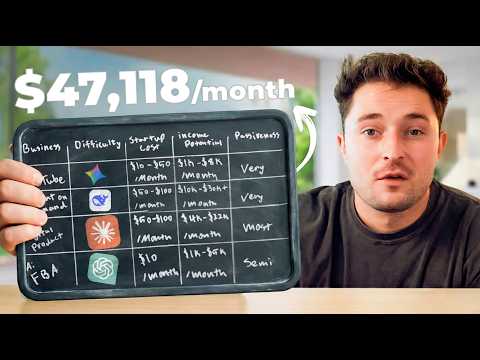
The four businesses, as the video ranks them
Start cost, income range and passiveness are the creator's own scores.
The income ranges are the creator's estimates; no cost or profit figure is given for any example shop.
- AI screen-saver and sleep-story channels — Still or slowly changing AI art played for hours, or an AI-written history story read by an AI voice. Startup "$10 to $50 a month"; income "a couple thousand all the way up to maybe $10,000 per month". The example channel is estimated by SocialBlade at $300 to $500 a month.
- Print on demand — AI designs on shirts, printed and shipped by a supplier after each sale, sold on Etsy, TikTok Shop and Shopify. Startup "$50 to $100 a month". The creator calls it "one of the most reliable predictable businesses" once a catalogue is built.
- AI art digital downloads — Printable paintings generated from a reverse-engineered prompt and sold on Etsy. The creator rates this "the most passive" and harder than print on demand, because of prompt-writing, print-ready file preparation and "more competition".
- AI-made books — An AI outline, AI illustrations, then publishing on Amazon KDP or selling a custom storybook on Etsy. The creator expects a cap of "$1 to $4,000 per month" unless you open more shops or product types.
- The common requirement: volume — "The real key to success here is not stopping after you've only posted 50 listings for sale these shops post hundreds and sometimes even thousands of listings." This is the most useful sentence in the video for a beginner.
The business model
YouTube ad revenue share; per-sale margin on print-on-demand products; digital download sales; book royalties or custom book sales.
Etsy, TikTok Shop and Amazon shoppers looking for niche gifts, decor and books; YouTube viewers wanting background visuals or sleep stories.
Cheap, fast AI production of products that already sell in a proven niche.
Marketplace search on Etsy, TikTok Shop and Amazon, and YouTube recommendations. The creator says no paid ads are needed.
- AI and research tools — $0–$100 a month, stated
- Print-on-demand base cost — $14.71 per shirt with shipping, stated
- Etsy fees — Listing, transaction and payment fees. Not mentioned
- TikTok Shop commission — Not mentioned; the creator calls it "a completely free platform"
- Refunds and reprints — Not mentioned
- Tax — Not mentioned
Every per-sale profit figure in the video is sale price minus supplier cost. Marketplace fees come out of the same sale and are not deducted anywhere.
What you would actually need
Money
From "basically completely free" for books to $10–$50 a month for YouTube and $50–$100 a month for print on demand, mainly AI tools and research tools. ElevenLabs is priced at $11 a month.
The tool budgets are plausible. What is missing is the cost of each sale: Etsy's listing, transaction and payment fees, TikTok Shop's commission, samples, refunds and reprints for print on demand, and any advertising. These come out of every sale, so they matter more than the monthly tool bill.
Costs not counted in the video
- Etsy listing, transaction and payment-processing fees
- TikTok Shop's commission on each sale
- Refunds, reprints and lost parcels on physical products
- Product samples for listing photos
- Income tax on profit
- Your time to make hundreds of listings
Time
Startup is fast. The example shops are four months to a year old, and once listed, products "continue selling while you're sleeping".
The time cost is the catalogue. The creator says winning shops post "hundreds and sometimes even thousands" of listings. No hours per listing are given, so the real time cost cannot be worked out from the video.
Where the time goes
- Niche research before each design
- Prompting and fixing AI images to print standard
- Writing listings for each marketplace
- Building to hundreds of listings
- Customer service on custom and physical orders
The part you must pay attention to
The YouTube example: $1,300 a month is stated, the stated inputs give $1,000, and SocialBlade's own estimate is $300 to $500.
The creator cites SocialBlade's estimate for a screen-saver channel ("a little over a million views per month and is making between $300 and $500 a month"), then says "just to be conservative if they're getting a million views a month at a $1 RPM that'd be around $1,300 a month."
- Monthly views, SocialBlade estimate — 1,000,000
- RPM per 1,000 views, as stated — $1
- Thousands of views — 1,000
$1,000/month
Not $1,300; and 2–3× SocialBlade's own $300–$500
The RPM. The SocialBlade estimate the creator quotes works out to $0.30 to $0.50 per 1,000 views for this channel. The "conservative" $1 is two to three times that, and the result is then rounded up to $1,300. The same assumed RPM drives the second example: 2 million views a month "easily making between 2 to $7,000", which needs $1 to $3.50 per 1,000 views. If the first channel's estimate is the better guide for still-image screen savers, the second channel would earn $600 to $1,000.
This matters because the YouTube income range, "a couple thousand all the way up to maybe $10,000 per month", leans on the higher RPM. The creator's own channel figure, $15 to $20 per 1,000 views, comes from a finance audience, and they say so: their viewers "are more interested in buying products". A screen-saver video played on a TV overnight is a different audience. The video gives no RPM from a screen-saver channel the creator runs.
- SCREEN-SAVER CHANNEL
- Views per month ~1,000,000
- SocialBlade estimate $300-$500
- Implied RPM $0.30-$0.50
- At the stated $1 RPM:
- 1,000 x $1 = $1,000
- Stated $1,300
- SECOND CHANNEL
- Views per month ~2,000,000
- Stated $2,000-$7,000
- RPM needed $1.00-$3.50
- At $0.30-$0.50 $600-$1,000
- TIKTOK SHOP SELLER
- Shirts sold 73,000+
- x $5 profit, as stated = $365,000
- Stated "$216,000"
- (All IncomeIdeaLab arithmetic)
The economics
Estimated revenue for other sellers, per-sale margins before fees, and no costs from the creator's own businesses.
- Creator's income, each of the last 3 years — Over $1,000,000
- Creator's digital product sales, last year — A little over $600,000
- Creator's RPM, finance-style channel — $15–$20 per 1,000 views
- TikTok Shop shirt price — $17 plus $4 shipping
- Printify cost of the same shirt, shipped — $14.71
- Margin per shirt, our arithmetic — $6.29 before TikTok Shop's commission
- Margin per shirt, as stated — $7.34
- Digital download profit margin — 90–95%
- Fees, refunds, ad spend, tax — Not stated
The TikTok Shop best seller
9,900 sales × ($17 + $4) = $207,900 revenue; ($21 − $14.71) × 9,900 = $62,271 margin
Revenue matches the stated "over $200,000"; margin comes to about $62,000 before fees, against the stated "over $70,000"
IncomeIdeaLab calculation from the price, shipping, sales count and supplier cost stated in the video
The video assumes the seller uses the same supplier at the same cost; the actual seller's supplier is not stated. TikTok Shop's commission on each sale would reduce the margin further.
- Revenue, costs and profit for any business the creator runs
- Which tool produced the Etsy shop estimates, and how accurate it is
- Etsy and TikTok Shop fees on any example
- Refund and reprint rates on print-on-demand orders
- How many new shops or channels in these niches earn nothing
- Whether any supplier or tool named is a sponsor or affiliate link
- Profit at "a 20 and 30% profit margin" on a $40,000-a-month shop is $8,000 to $12,000, not "10 to $12,000"; the lower end of the stated range assumes 25%.
- The four-month-old art shop sold "almost 2,000" items while estimated at "approximately $22,000 a month"; if both hold, the average sale is near $44, which fits bundles rather than single prints.
- The book business is called "basically completely free to start" in the same paragraph that names AI image generators as its "only real expense".
- The creator points viewers to a free 10-hour print-on-demand course on YouTube and to "free resources right below the subscribe button". Whether those links earn the creator a commission is not stated in this video.
Evidence status
Every substantive figure in the video.
- Over $1 million a year for the last 3 years — Creator — No revenue, cost or profit split. We could not check it from the video.
- The channel has made "a few million dollars" — Creator — Whether this is AdSense, sponsors or product sales is not stated.
- From $7 an hour to over $10,000 a month profit in under a year — Creator — The creator's own history, stated as profit.
- Over $600,000 from digital products last year — Creator — Revenue or profit is not stated.
- Screen-saver channel: ~1M views, $300–$500/month — SocialBlade, as cited — A third-party estimate; implies $0.30–$0.50 per 1,000 views.
- 1M views at $1 RPM is ~$1,300/month — Creator — Our arithmetic gives $1,000.
- 2M views is "easily" $2,000–$7,000/month — Creator — Needs $1–$3.50 RPM, above the first channel's estimate.
- TikTok listing: 9,900+ sales, over $200,000 — Creator, from listing — Our arithmetic from $17 + $4 gives $207,900. Consistent.
- That listing made over $70,000 profit — Creator — Our arithmetic gives about $62,000 before TikTok Shop's commission.
- 73,000+ shirts at $5 = over $216,000 — Creator — Our arithmetic gives $365,000. The inputs and result do not match.
- Etsy shops at $27,000 and $48,000/month — Estimate, tool not named — Other sellers' revenue, not profit.
- Art shop: $13,000/month now, $800,000 over 2.5 years — Estimate, tool not named — Lifetime average is ~$26,700/month, double the current figure.
- Digital products keep 90–95% as profit — Creator — Etsy's fees alone take a meaningful share of each sale.
- TikTok Shop is "a completely free platform to sell on" — Creator — Listing is free; TikTok Shop takes a commission on sales.
- Income ranges for the four businesses — Creator — The creator's estimates, not results from beginners.
What is actually proven?
That demand exists in these niches. Not what a new seller earns.
- Screen-saver, sleep-story, print-on-demand, AI art and AI book products sell, per third-party estimates.
- The creator states large personal earnings from YouTube, print on demand and digital products.
- The $1,300 and $216,000 figures do not match the inputs stated alongside them.
- One art shop's current estimate is about half its lifetime monthly average.
- Per-sale profit figures do not deduct any marketplace fee.
- Costs and profit for any business the creator runs.
- How many beginners reach the ranges given.
What the headline doesn’t tell you
Easy to start and easy to earn from are different claims.
- The shops are someone else's. — Every example is another seller.
- The numbers are estimates. — SocialBlade and an unnamed tool.
- 1M views at $1 RPM is $1,000. — Not $1,300.
- 73,000 x $5 is $365,000. — Not $216,000.
- TikTok Shop charges commission. — Free to list is not free to sell.
- 90–95% is before Etsy fees. — And before ads, if any.
- The real work is volume. — Hundreds of listings, by their account.
- Your own costs are not given. — For any business the creator runs.
Should you try it?
Worth testing at the creator's start costs; do not plan on the income ranges
All four are cheap to try. Budget for marketplace fees from the first sale, and judge progress by your own listings, not by the example shops.
- Low startup cost — 8 — $0–$100 a month, mainly tools. Plausible.
- Evidence for the example earnings — 4 — Third-party estimates for other sellers.
- Evidence for the creator's own results — 3 — Large figures stated without a breakdown.
- Arithmetic accuracy — 4 — Two stated sums do not match their inputs.
- Cost disclosure — 2 — Tool budgets given; per-sale fees not counted.
- Candour about difficulty — 6 — Competition, volume and the book ceiling are all stated.
- Beginner accessibility — 6 — Easy to start; earning depends on volume and research.
- The start costs in this video are believable. Each of these businesses can be tested for under $100 a month, and print on demand removes the inventory risk because the supplier only charges after a sale. That is a fair basis for an experiment.
- The income ranges are a different matter. They are the creator's view, built from estimates for shops and channels chosen because they are doing well. The YouTube range relies on an RPM two to three times the one SocialBlade gives for the example channel. The print-on-demand margins leave out Etsy's and TikTok Shop's fees, which take a few dollars from a sale that earns about $5 to $7.
- The most useful guidance in the video is about effort. The creator says the shops that work post "hundreds and sometimes even thousands of listings", that digital art needs technical file preparation, and that book publishing is crowded and capped. If you start one of these, plan for that volume and track your own sales per listing.
Passive or automated?
Automation
AI makes the designs and fulfilment is outsourced; research and listing are manual.
Passive potential
Listings and videos can keep selling, but the catalogue must keep growing.
The creator rates digital downloads "the most passive", and once a listing exists it can sell without further work. The print-on-demand supplier handles printing and shipping. What stays manual is everything that decides whether anything sells: finding a niche, writing prompts that produce print-ready files, writing listings for each marketplace, and building to hundreds or thousands of listings. Custom books and custom products add per-order work, which the creator acknowledges.
- Niche and best-seller research
- Prompting and fixing AI art to print standard
- Writing and uploading hundreds of listings
- Customer service on physical and custom orders
- Watching which listings sell and making more like them
Recommended beginner experiment
Test one business with fees counted from day one.
- Pick one business, not four. — Volume is the stated success factor.
- Look up the real fees first. — Etsy and TikTok Shop each take a cut.
- Order one sample. — Check print quality before listing.
- Publish 50 listings, then measure. — The creator's own minimum.
- Track sales per listing. — Not total views or estimates.
- Check RPM on your own channel. — Before assuming $1 or more.
- Count your hours. — They are the main cost.
Our verdict: 5/10
A fair map of four cheap AI businesses, priced with other sellers' estimates and per-sale profits that leave out the marketplace
Credited for low, specific start costs for each business; for naming SocialBlade as the source of the YouTube estimates; for stating that the shops that work post hundreds or thousands of listings; and for ranking the four businesses by difficulty and saying the book business is capped. Marked down because every example earnings figure is an estimate for another seller; because the $1,300 YouTube figure and the $216,000 TikTok Shop figure do not match the inputs stated with them; because the 90–95% digital margin and every print-on-demand margin leave out Etsy and TikTok Shop fees; and because the creator's own income figures are stated without any cost or profit breakdown.
This video is a reasonable introduction to four ways of using AI to make things that sell: looping art and sleep stories on YouTube, print-on-demand shirts, printable wall art, and AI-made books. The start costs are specific and believable, and the creator is direct about the effort, saying the shops that work post hundreds or thousands of listings, that digital art takes better prompting and technical file preparation, and that the book business is crowded and capped at about $1,000 to $4,000 a month. The income figures are weaker. Every example is someone else's channel or shop, priced by SocialBlade or an unnamed estimate tool. Several of the sums built on them do not hold: a million views at $1 per thousand is $1,000, not $1,300, and SocialBlade's own estimate for that channel is $300 to $500; 73,000 shirts at $5 profit is $365,000, not $216,000; one art shop's current $13,000 a month is half its lifetime average. Every per-sale margin is sale price minus supplier cost, with no Etsy fee or TikTok Shop commission taken off, and the creator calls TikTok Shop "a completely free platform to sell on". The creator's own results (over $1 million a year, a few million from the channel, $600,000 from digital products) are stated without a breakdown and cannot be checked from the video. Treat the start costs as the reliable part and test one business with fees counted.
- Creator's income — $1M+/year, stated
- Example shops — $13K–$48K/month, estimates
- Screen-saver channel at $1 RPM — $1,000, not $1,300
- 73,000 shirts at $5 — $365,000, not $216,000
- TikTok best seller margin — ~$62,000 before fees
- Start costs — $0–$100/month
- Marketplace fees — Not counted
- Beginner suitability — Cheap to test
Sources
- 4 EASIEST AI Businesses To Start in 2026 (Beginner) — YouTube video, 2026-02-23
- Etsy — Fees & Payments Policy — Platform documentation on seller fees
- FTC — Guides Concerning the Use of Endorsements and Testimonials — Regulatory guidance on earnings claims