E-commerce / Print on Demand · Claim Review
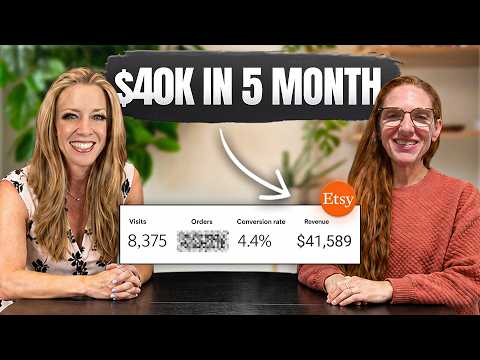
“She Made USD 40K PROFIT in 5 Months from Etsy Print On Demand”
What we found: Etsy Print on Demand: The $40,000 Profit Adds Up From Her Recalled Monthly Figures, Before Tax and Led by a Seasonal Peak
January to May profit of $37,800 to $39,800 on her own numbers, after ads, a VA and production costs. Two of the five months carry most of it, and the figures are given from memory.
- $37.8k–$39.8k Profit, Jan–May 2026
- ~$49,990 May revenue
- $142k / $28k 2025 full year
- Not deducted Tax
The claim
That an Etsy print-on-demand seller made $40,000 in profit in five months.
- January profit — $3,000 to $4,000
- February profit — "Right around the same"
- March profit — About $7,000
- April profit — $11,000
- May profit — About $13,800 ("200 bucks short of 14,000")
- Five-month total, our sum — $37,800 to $39,800
- Her own estimate — "Probably done 35 or 40,000"
- May revenue — Just under $50,000
- What profit is after — Ads, VA pay, Printify and every cost in her spreadsheet; not tax
- All-time revenue since March 2024 — About $300,000
- Another $100,000 profit by year end — The host's prediction
What is this income idea?
Sell personalised, print-on-demand gifts on Etsy (journals, ornaments, shirts) aimed at niches with strong buying seasons, fulfilled through a print provider.
- The guest opened her Etsy shop in March 2024 while working as a nurse, joined the host's paid community, the Learn and Earn Academy, that summer, and is appearing for a third time. The host introduces her as someone she has worked with personally.
- The host recaps the previous interviews: about 1,700 total sales a year earlier, and 2025 closing at over $142,000 in revenue and about $28,000 in profit, of which about $8,000 came across January to October and about $10,000 in each of November and December.
- For 2026 the guest gives monthly profit from memory: January $3,000 to $4,000, February about the same, March about $7,000, April $11,000 and May about $13,800, on revenue just under $50,000 in May. She says the profit is after ads, her virtual assistant's pay, Printify and "anything that I put in my spreadsheet", but not after tax.
- She explains the spring jump herself: teacher appreciation, nurse appreciation and Mother's Day make April and May "kind of a mini Q4" for her niches, and she expects some dip in summer.
- The product history is candid. A couple of hundred tumblers "did nothing" and were deactivated; her first 200 shirt listings produced four or five sales; ornaments did well in Q4 but sell little now; personalised giftable items, including journals, are where she has shifted the shop.
- Operations are described in detail: Etsy ads at $100 a day, a virtual assistant from the Philippines who handles fulfilment and customer messages, password-manager access to shared accounts, Loom videos for training, and an order-automation tool to cut manual copy-paste errors. She has given notice at her nursing job.
A rare interview that gives profit after costs; the $40,000 holds up on her own monthly numbers, before tax, with a seasonal peak doing much of the work.
- Vet a product — Newer shops selling it well
- Check the margin — Print cost vs selling price
- List 200+ designs — Per product tested
- Target buying seasons — Teacher, nurse, mum, Q4
- Run Etsy ads — $100 a day
- Fulfil through a VA — Plus an automation tool
- Double down on winners — Drop what does not sell
A volume model: hundreds of listings per product, with seasonal niches carrying the strongest months.
A profit figure that holds up, and a calendar that explains it
The lesson underneath the number
- Most income videos give revenue and leave the reader to guess the rest. This one gives profit, says what has been deducted (ads, the assistant, production and everything in her spreadsheet), and says what has not, which is tax. Her recalled monthly figures add to $37,800 to $39,800, so the $40,000 in the title is the top of her own range rather than a rounded-up revenue number.
- What the title does not convey is how uneven those five months are. January and February, with no gift season, were $3,000 to $4,000 each. March was about $7,000. April and May, which she calls a mini Q4 because of teacher appreciation, nurse appreciation and Mother's Day, were $11,000 and about $13,800. Those two months account for nearly two-thirds of the total. She is clear about this herself and expects a summer dip; the host's prediction of another $100,000 by year end needs peak-month results to continue.
- The record also includes what did not work. A couple of hundred tumblers sold almost nothing, the first 200 shirts brought four or five sales, and ornaments faded after Q4. In 2025, the host notes, about $8,000 of the year's $28,000 profit came in the first ten months. The path to $11,000 a month went through roughly a year and a half of small returns.
- Two things to weigh. The guest is a member of the host's paid community and recommends joining one at the end, though she says unprompted that the host did not ask her to; the host says the same. And the figures are given from memory, without a written breakdown. Neither changes the arithmetic, but a reader should hold them as the seller's own account.
That's all profit that's not my revenue numbers.
The guest, on her April and May figures
How she runs the shop, as she describes it
From picking a product to handing fulfilment to an assistant.
Profit is given monthly from memory; the VA's pay and the ad total are not broken out.
- Vet the product first — Search the product type on Etsy, open a few non-ad listings, and use a research extension to find newer shops that mostly sell that product and have strong sales. Then price it at the print provider against what those shops actually charge.
- Give each product a fair test — "I put up at least 200 of everything." She notes her first 200 shirt listings brought four or five sales, and a couple of hundred tumblers did little before she removed them.
- Build around buying seasons — Teacher, nurse and mum niches made April and May her strongest months outside Q4. She is preparing other niches for summer and autumn, which she says have weaker buying seasons.
- Run ads with a cut-off rule — Etsy ads at $100 a day, down from $115 two weeks earlier. She now stops advertising a listing after $10 of spend with no sale, up from $5.
- Hire and train a virtual assistant — Hired from the Philippines after filtering hundreds of applicants with questionnaires, interviewing three and using ChatGPT to help compare finalists. Trained with Loom videos and paid through a transfer service. Pay is not stated.
- Automate order handling — An order-automation tool carries buyers' personalisation text straight into production files, which she says is faster than editing in Canva and re-uploading to Printify, and reduces errors and refunds.
The business model
Personalised print-on-demand gifts on Etsy, mainly journals, ornaments and shirts, aimed at teachers, nurses, mothers and holiday buyers.
Etsy gift buyers, with peaks around teacher and nurse appreciation, Mother's Day and Q4.
Personalised, niche-specific gifts with separate personalisation fields for each section.
Etsy search and Etsy ads at about $100 a day.
- Etsy ads — $100 a day, down from $115. Included in profit
- Virtual assistant — Included in profit. Pay not stated
- Printify production — Included in profit. Per-item cost not stated
- Etsy fees — Not mentioned by name; she says every expense is counted
- Software and automation tool — Named. Not priced
- Community membership — The host's Academy. Fee not stated
- Income tax — Not deducted, she says
Costs are disclosed as a category, inside the profit figure, rather than itemised, so the margin is known for May and for 2025 but no single cost can be checked.
What you would actually need
Money
Stated costs are folded into profit: ads at about $100 a day, the VA, Printify and everything in her spreadsheet. Tax is not deducted.
The cost disclosure is better than usual: profit is after costs by her account. What a beginner cannot get from the video is the size of each cost. $100 a day in ads is about $3,000 a month on our arithmetic, and the VA's pay, tool subscriptions and community fee are not given.
Costs named, amount not given
- Etsy ads, about $3,000 a month at $100 a day (our arithmetic)
- Virtual assistant pay
- Printify production and shipping
- Etsy listing, transaction and processing fees
- Research extension, Canva, Loom, automation tool
- The host's paid community
- Income tax, not deducted from the figures
Time
Hard work up front; the shop now sells "several times today whether I touch it or not", and she is leaving nursing.
The time cost is front-loaded and large: over two years, hundreds of listings per product, a part-time shop alongside 12-hour nursing shifts, and constant community participation in the first months. Her hours are not quantified.
Where the two years went
- Hundreds of listings per product tested
- Mockups and designs for each listing
- Daily community participation early on
- Hiring and training a VA
- Setting up order automation
- Preparing niches ahead of each season
The part you must pay attention to
The $40,000 is real on her own numbers, but two seasonal months carry most of it.
Her five monthly profit figures add up to the title. They are recalled rather than read from a report, and they are not evenly spread.
- January and February — $6k–$8k
- March — ~$7k
- April — $11k
- May — ~$13.8k
$37.8k–$39.8k
Profit after ads, VA and production; before tax
The figure most likely to be extrapolated is the April–May run rate of $11,000 to $14,000 a month. She explains that those months are driven by teacher appreciation, nurse appreciation and Mother's Day, and she expects a summer dip. January and February, the months without a gift season, were $3,000 to $4,000 each. The host's prediction of another $100,000 in profit by the end of the year, about $14,300 a month for seven months on our arithmetic, assumes peak-month results continue through summer.
The title is consistent with what the guest says, and she gives profit rather than revenue, which is uncommon. Read it as about $38,800 at the midpoint of her range, before income tax, earned mostly in two gift-season months, by a seller in her third year with a VA, $100 a day of ads and a shop of hundreds of listings. Her May margin, about $13,800 on just under $50,000 of revenue, is roughly 28%; her 2025 margin was about 20% (our arithmetic).
- FIVE MONTHS OF PROFIT
- Jan $3,000 – $4,000
- Feb $3,000 – $4,000
- Mar ~$7,000
- Apr $11,000
- May ~$13,800
- Total $37,800 – $39,800
- Apr + May share ~64%
- MARGINS
- May $13,800 / $49,990 ~28%
- 2025 $28,000 / $142,000 ~20%
- ADS
- $100/day x 30 $3,000/mo
- HOST PREDICTION
- $100,000 / 7 months ~$14,300/mo
- -> peak-month pace all year
The economics
Profit after costs is given; the size of each cost is not.
- Profit, January–May 2026 — $37,800–$39,800
- May revenue — Just under $50,000
- May profit — ~$13,800
- May margin — ~28%
- 2025 revenue / profit — $142,000+ / ~$28,000
- 2025 margin — ~20%
- Etsy ads — $100 a day (~$3,000 a month)
- All-time revenue — ~$300,000
- VA pay, Etsy fees, tools, community fee — Not stated
- Income tax — Not deducted
Adding up the five months
($3,000–$4,000) × 2 + $7,000 + $11,000 + $13,800 = $37,800–$39,800
The title's $40,000 is the top of the range given by the guest; $38,800 at the midpoint
IncomeIdeaLab calculation from the monthly profit figures stated in the video
She says she did not write the figures down for this interview and gives several as approximations. Profit is before income tax and its cost basis is described, not itemised.
- The virtual assistant's pay
- Etsy listing, transaction and payment fees as a share of revenue
- Printify cost per item and shipping
- Software and automation subscriptions
- The host's community membership fee
- Revenue for January to April 2026
- Hours worked
- The host's 2025 breakdown reconciles: about $8,000 across January to October plus about $10,000 in each of November and December gives $28,000.
- On revenue of just under $50,000, May profit of about $13,800 is a margin of roughly 28%, higher than 2025's roughly 20%, consistent with her move away from low-selling products and toward personalised gifts.
- May revenue is given as "$20 short of a 50k revenue month" and then as "$49,992 or something"; the two differ by $12 and both put May just under $50,000.
- All-time revenue of about $300,000 since March 2024 is broadly consistent with $142,000 in 2025 plus a strong first five months of 2026; 2026 revenue for January to April is not given, so the split cannot be checked.
- The target of becoming the host's first $1 million student by Q4 2027 is a projection; a year earlier the stated goal was $1.5 million.
Evidence status
Every substantive figure in the video.
- $40,000 profit in five months (title) — Title; guest's "35 or 40,000" — Her monthly figures add to $37,800–$39,800. Consistent with the title, before tax.
- January and February profit $3,000–$4,000 each — Guest, from memory — The non-seasonal baseline.
- March ~$7,000, April $11,000, May ~$13,800 profit — Guest, from memory — April and May are her teacher, nurse and Mother's Day season.
- May revenue just under $50,000 — Guest — A margin of about 28% with May profit.
- Profit is after ads, VA, Printify and all expenses; before tax — Guest — A clear cost basis; individual amounts not given.
- 2025: $142,000+ revenue, ~$28,000 profit — Host recap — Monthly split reconciles to $28,000. Margin about 20%.
- About 1,700 total sales a year earlier — Host — Could not be checked from the video.
- Etsy ads at $100 a day — Guest — About $3,000 a month on our arithmetic, included in profit.
- All-time revenue about $300,000 — Guest — Broadly consistent with the yearly figures.
- Another $100,000 profit by year end — Host — About $14,300 a month for seven months, near the May peak.
- First $1 million student by Q4 2027 — Guest — A goal; a year earlier it was $1.5 million.
What is actually proven?
The figures are consistent with each other; they are the seller's own account.
- The five monthly profit figures add up to the title within her range.
- The 2025 monthly split reconciles with the $28,000 annual profit.
- Profit is after ads, VA, production and listed expenses, and before tax.
- Products that failed, with listing counts and sales.
- April and May supply about 64% of the five-month profit.
- The host's $100,000 prediction and the guest's $1 million goal.
- The amount of each cost, and income tax.
What the headline doesn’t tell you
The number checks out; its shape matters.
- It is before tax. — She says so herself.
- Two months carry it. — April and May, about 64%.
- Jan and Feb were $3k–$4k. — The months without a gift season.
- It is recalled. — "I didn't write them down this time."
- Ads run $100 a day. — About $3,000 a month, inside profit.
- There is a paid VA. — Pay not stated.
- Year one was thin. — $8,000 profit in ten months of 2025.
- She is the host's student. — Stated at the start.
Should you try it?
A credible path, slow at the start and seasonal once it works
Expect a long stretch of small months, test each product with hundreds of listings, and plan around gift seasons.
- Figures reconcile — 8 — Monthly profit adds to the title; 2025 split adds to its total.
- Cost disclosure — 6 — Profit after costs and before tax; costs not itemised.
- Honesty about failures — 9 — Tumblers, early shirts and fading ornaments all named.
- Seasonality explained — 8 — She attributes the spring peak to specific gift seasons.
- Process detail — 7 — Product vetting, ad cut-offs, VA hiring and automation covered.
- Independence of the source — 4 — A student interviewed by her community's host.
- Beginner accessibility — 5 — Low startup cost, but two years and a large listing volume.
- This is one of the more useful Etsy interviews we have reviewed, because the money is given as profit and the cost basis is described. On her own figures the shop made $37,800 to $39,800 in the first five months of 2026, after ads at $100 a day, an assistant and production, and before tax.
- The shape of that money is the lesson for a beginner. Her first full year, 2025, made about $28,000 profit, and $8,000 of it came across ten months before Q4. In 2026 the months without a gift season ran at $3,000 to $4,000; the teacher, nurse and Mother's Day season lifted April and May to $11,000 and $13,800. A beginner should plan for the small months and treat seasonal peaks as the reward for listings built well in advance.
- Her testing rule is worth copying exactly: at least 200 listings for any product before judging it, and product vetting based on newer shops already selling it well. She also shows that most experiments fail; tumblers and early shirts barely sold.
- Weigh the source. She is a member of the host's paid community, the figures are from memory, and the closing section recommends joining a community. The arithmetic is consistent, which is a good sign, but none of it can be checked independently from the video.
Passive or automated?
Automation
Printing and shipping are outsourced; a VA and an automation tool handle orders.
Passive potential
Existing listings keep selling, but each season needs new work.
She says the shop sells several times a day whether she touches it or not, and fulfilment runs through a print provider, a VA and an automation tool. That is real leverage. It is not passive: she is preparing new niches for each season, still makes designs and mockups herself, manages ads daily, and supervises an assistant who handles customer messages. Leaving nursing is about having time for that work, not about stopping it.
- Designing and listing new products
- Planning niches ahead of each buying season
- Managing Etsy ads and cut-offs
- Supervising the VA and customer messages
- Checking personalisation before production
Recommended beginner experiment
One product, 200 listings, and a spreadsheet from day one.
- Vet one product. — Find newer shops selling mostly that product well.
- Price it at the print provider. — Against real selling prices, not loss leaders.
- List at least 200 designs. — Her minimum for a fair test.
- Pick a niche with a buying season. — And list well ahead of it.
- Track profit monthly, in writing. — Every cost, then set aside tax.
- Test ads with a cut-off. — Her rule: stop at $5–$10 spent with no sale.
- Expect thin early months. — Her first ten months of 2025: ~$8,000.
- Hire help once orders demand it. — Train with screen recordings.
Our verdict: 7/10
A profit figure that adds up, with the season doing much of the lifting before tax, from memory, by a student of the host's community
Credited for giving profit rather than revenue, stating that it is after ads, the VA, production and every expense in her spreadsheet and before tax; for monthly figures that add up to the title within her stated range; for a 2025 breakdown that reconciles; for naming failed products with listing counts; and for explaining the spring peak by its gift seasons. Marked down because the figures are recalled rather than read from a record, because individual costs including the VA's pay and Etsy fees are not given, because April and May supply about two-thirds of the five-month total, and because the guest is a member of the host's paid community.
The title says $40,000 profit in five months, and the guest's own monthly figures support it: $3,000 to $4,000 in each of January and February, about $7,000 in March, $11,000 in April and about $13,800 in May, for $37,800 to $39,800. She says this is profit after ads at $100 a day, her virtual assistant, production and everything in her spreadsheet, and that tax has not been deducted. That is a clearer basis than most income videos give. Three things put it in context. First, the five months are uneven: April and May, her teacher, nurse and Mother's Day season, supply about 64% of the total, and she expects summer to dip. Second, it took time to get here. Her 2025 profit was about $28,000, with $8,000 of it across the first ten months, and her product history includes tumblers and early shirts that barely sold. Third, the figures are recalled, not read from a report, and she is a member of the host's paid community, which the host states. The arithmetic is consistent throughout, and her testing and seasonal planning advice is practical. The host's prediction of another $100,000 by year end would need peak-month results to continue.
- Profit, Jan–May 2026 — $37,800–$39,800
- Peak months — April $11,000, May ~$13,800
- Off-season months — $3,000–$4,000
- May margin — ~28%
- 2025 profit — ~$28,000 on $142,000+
- Tax — Not deducted
- Individual costs — Not stated
- Beginner suitability — Yes, with patience and volume
Sources
- She Made USD 40K PROFIT in 5 Months from Etsy Print On Demand — YouTube video, 2026-07-01
- FTC — Guides Concerning the Use of Endorsements and Testimonials — Regulatory guidance on endorsements and earnings claims