Digital Products / Etsy · Claim Review
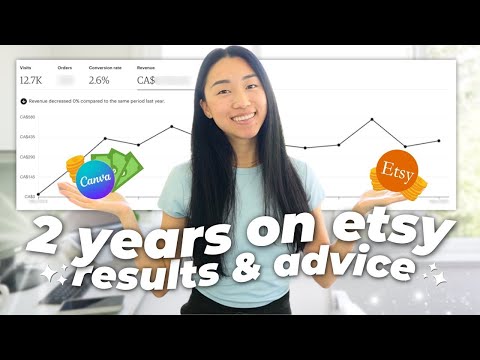
“2 year Etsy shop results + should you start an Etsy shop in 2026? Advice for digital product sellers”
What we found: Two Etsy Shops After Two Years: About $5,000 a Year in Sales From One, One Sale From the Other, and No Net Figure After Fees
A digital product seller gives year-by-year revenue for a Canva template shop and is candid that a second, AI wall art shop failed. The figures are sales, not profit, and Etsy fees, software and the hired help are not priced.
- ~$5,000 2023 revenue, shop one
- CA$1,930.45 2025 so far
- ~$400 Monthly, by our arithmetic
- 1 Shop two sales
The claim
That a Canva template shop on Etsy has brought in roughly $5,000 a year for two years and keeps selling about $300 a month with no new work, and that Etsy remains a good first business for digital product sellers.
- Shop one started — October or November 2022
- Shop one listings — About 80 Canva templates
- Work on shop one — Stopped about six months before the video
- 2023 revenue — Almost $5,000
- 2024 revenue — "Almost the same" as 2023
- 2025 revenue to late May — CA$1,930.45 on the Etsy Stats page at 0:35 (spoken: almost $2,000)
- Typical month — About $300; last 30 days $400
- Five months at $300 — $1,500
- "Almost $2,000" over five months — About $400 a month
- All-time revenue, shop one — CA$12,377.85 on the Etsy Stats page at 1:25 (2022 to 2025, 824 orders); 2023 point CA$4,878.95
- Shop two — About 30 AI wall art listings, one sale from a stranger
- Net profit after fees and costs — Not given as a usable figure
What is this income idea?
Design digital templates in Canva for a specific niche, list them on Etsy, optimise the listings for Etsy search, and let the marketplace bring the buyers.
- The creator runs two Etsy shops. The first, started in the autumn of 2022, sells Canva templates for "a specific kind of business owner" and has about 80 listings. They say they stopped working on it about six months before the video, and it still sells.
- The revenue they give for that shop: almost $5,000 in 2023, "almost the same" in 2024, and almost $2,000 in 2025 up to the end of May. They describe the monthly figure as about $300, with $400 in the last 30 days, and call it "pretty passive".
- The second shop, started in 2024, sold wall art made with Midjourney in a narrow niche. About 30 listings produced "only one sale from a stranger". The creator says they spent "a whole lot of money" on it, including hiring a Photoshop assistant, and that it "flopped".
- The rest of the video is advice: pick a niche you know as a user, research it with a paid Chrome extension (for which the creator has an affiliate deal), make more complex products that are harder to copy, and treat a first shop as a way to learn product design, SEO and marketing.
- The creator says they have since stopped working on Etsy to focus on another business, and that digital products usually sell for about $10 to $20.
One template shop sells roughly $300 to $400 a month with no new work; a second shop failed. Neither figure is profit.
- Pick a niche you use — Business owners, in this case
- Research demand — Paid Chrome extension
- Design in Canva — Some 10 to 15 pages
- List on Etsy — About 80 listings
- Optimise for search — Etsy SEO
- Sell at $10 to $20 — ~$300 to $400 a month
The revenue figures are given. Etsy fees, Canva Pro, the research tool and the hours spent building 80 listings are not priced.
A small, steady template shop and an honest failure
The lesson underneath the number
- This is a more measured video than most in the genre. The headline result is about $5,000 a year in sales, not a monthly figure in five digits, and the creator puts a failed shop next to the successful one rather than leaving it out.
- The template shop's strongest point is durability: by the creator's account it sold about the same in 2024 as in 2023, and kept selling after they stopped adding listings. For a beginner, that is the useful finding. A catalogue of about 80 detailed templates in a niche the seller knows can keep earning without daily work.
- Its limit is size. Spread over 80 listings, $5,000 a year is about $62 a listing a year in sales (our arithmetic), before fees. Whether that repays the time depends on how long the listings took, and the video does not say.
- The second shop is the counterweight. A carefully chosen niche, a distinctive look, paid help and about 30 listings produced one sale. The creator's conclusion, that you cannot know in advance which shop will work, is the most practical advice in the video.
I've like lost money making that shop.
Dina Lu, on the AI wall art shop
The approach, as the creator gives it
Clear on what worked and what did not; light on costs.
No cost or net figure is given for either shop.
- Choose a niche you know — The template shop sells products the creator says they would use themselves, which they credit for products that are "more thorough than what is already on Etsy".
- Research before building — The creator recommends a paid Chrome extension for estimating listing sales, trends and keyword competition, and offers a second month free through their link.
- Build detailed products — Some templates run to 10 to 15 pages. The creator says these take "a long time to make" but are harder for competitors to copy. Hours are not given.
- List and optimise — About 80 listings in the first shop. The creator says Etsy brings buyers without an audience, provided listings are optimised for search.
- Stop, and let it run — No new listings for about six months; revenue of about $300 a month continues, by the creator's account.
- Expect some shops to fail — The AI wall art shop, with about 30 listings and paid help, made one sale. The creator calls the niche and look "very specific" and still unsuccessful.
The business model
One-off sales of digital Canva templates on Etsy, typically $10 to $20 each by the creator's description.
A specific type of small business owner, the niche the creator says they belong to.
More thorough, multi-page templates than competing listings, made by someone who uses them.
Etsy search. The creator says no audience or email list was needed.
- Etsy fees — Mentioned; not priced in the video
- Etsy opening fee — "USD 30 or USD 50", the creator is unsure
- Canva Pro — Named; price not given
- Research tool — Recommended with an affiliate offer; price not given
- Design help — A Photoshop assistant for the second shop; cost not given
- Creator's time — Described as substantial; hours not given
- Tax — Not mentioned
The creator says the second shop lost money but does not say how much, and gives no net figure for the first.
What you would actually need
Money
A low startup cost: an Etsy opening fee the creator puts at "USD 30 or USD 50" (they say they cannot remember which) and a Canva Pro subscription.
That covers getting started. Running the shop also costs Etsy listing and transaction fees and payment processing on every sale, the Canva Pro subscription each month, and the research tool if you follow the recommendation. The creator's second shop shows a further cost they mention but do not price: paying for design help.
Costs the video names or leaves out
- Etsy opening fee: "USD 30 or USD 50", uncertain (named)
- Canva Pro subscription (named, price not given)
- Etsy listing, transaction and payment processing fees (mentioned, not priced)
- Research Chrome extension (recommended, price not given)
- Photoshop assistant for the second shop (named, cost not given)
- Income tax on profit (not mentioned)
Time
Selling digital products "could be very very slow", and you will spend "a lot of time making the products and making the listing photos".
The creator is direct that the time goes in up front and that results are slow. The video does not say how many hours the 80 listings took, so the hourly return on the template shop cannot be worked out. The six months of sales with no new work are the strongest point in its favour.
Time the model requires
- Niche and keyword research
- Designing each template, some 10 to 15 pages
- Making listing photos
- Writing and optimising listings
- Customer questions (not discussed)
- Keeping up with Etsy search changes
The part you must pay attention to
Every figure in the video is revenue. What the creator kept after Etsy fees and software is not given.
The template shop's result is modest and consistent: about $5,000 a year in sales, by the creator's account. Our arithmetic puts the 2025 pace at about $400 a month. That is gross, before Etsy takes its fees on each sale and before the monthly software bill.
- Revenue, January to late May 2025 — ~$2,000
- Months — 5
~$400
Revenue a month, before fees and software
The load-bearing assumption is that the shop's revenue keeps arriving with no further work. The creator says it has for about six months, and 2024 roughly matched 2023. But the monthly figure is given two ways: "about USD 300" a month over five months would be $1,500, while "almost USD 2,000" for the year so far works out at about $400 a month (our arithmetic). The difference is small; the stated $400 for the last 30 days may account for part of it.
To get from revenue to what a seller keeps, take off Etsy's fees. Etsy's published fee schedule lists a listing fee for each listing and its renewals, a transaction fee on each sale and a payment processing fee that varies by country. Then take off Canva Pro and any research tool. The creator mentions Etsy fees but does not give a net amount we can report, so the take-home figure for this shop is not stated in the video.
- OUR ARITHMETIC
- 2025 to late May
- $2,000 / 5 months = ~$400/mo
- $300 x 5 months = $1,500
- Shop one, years
- 2023 = ~$5,000
- 2024 = ~$5,000
- 2023 per month = ~$415
- 2025 pace, 12 months = ~$4,800
- All time (excl. late 2022)
- 5,000 + 5,000 + 2,000 = ~$12,000
- Orders at $10 to $20
- $400 / $20 = 20 a month
- $400 / $10 = 40 a month
- Revenue per listing
- $5,000 / 80 = ~$62/yr
The economics
What the stated revenue figures add up to, and what is missing to turn them into profit.
- 2023 revenue — Almost $5,000
- 2024 revenue — Almost the same as 2023
- 2025 to late May — Almost $2,000
- Typical month — About $300
- Last 30 days — $400
- 2025 monthly pace — About $400
- Listings — About 80
- Typical price — $10 to $20
- Net after fees and software — Not stated
Approximate all-time sales, template shop
~$5,000 (2023) + ~$5,000 (2024) + ~$2,000 (2025 to May)
About $12,000 in sales over about two and a half years, plus an unstated amount from late 2022
IncomeIdeaLab calculation from figures stated in the video
Every input is given as "almost", and 2024 as "almost the same" as 2023, so this is an upper-end estimate of gross sales, not profit.
- Net profit for either shop after Etsy fees
- The cost of Canva Pro and the research tool over the period
- How much the second shop lost, including the Photoshop assistant
- Hours spent building the 80 template listings
- Revenue for late 2022
- Refunds or disputes, if any
- Whether any sales came from the creator's YouTube audience rather than Etsy search
- Tax
- The two monthly figures differ slightly. "About $300" a month for five months is $1,500; "almost $2,000" for the same period is about $400 a month (our arithmetic). The creator also says the last 30 days were $400, so the gap may come from a stronger recent month.
- At $10 to $20 a template, $400 a month is 20 to 40 orders (our arithmetic).
- The creator also runs a YouTube channel about starting a business and says many of their videos are about this shop. The video does not say whether any template sales came from viewers, so we cannot say how much of the result came from Etsy search alone.
- The title refers to 2026; in the video the creator says "right now in 2025". The advice is given for 2025.
- Conflicts of interest: the creator recommends a paid Chrome extension for Etsy research and offers a second month free "if you use my link below", which is an affiliate arrangement stated in the video. They also offer a free planning document in the description and link to their other videos.
- Credit: the creator states a failed shop, says it lost money, admits it is "kind of embarrassing", and tells viewers that many first shops do not do well.
Evidence status
Every substantive figure in the video.
- Shop one made almost $5,000 in 2023 — Creator — Revenue, not profit.
- 2024 was almost the same — Creator — No separate figure given.
- Almost $2,000 so far in 2025 — Creator — About $400 a month over five months by our arithmetic.
- About $300 every month — Creator — Gives $1,500 over five months, a little under the year-to-date figure.
- Last 30 days were $400 — Creator — Described as a good month.
- No work on the shop for six months — Creator — The strongest point for the passive claim.
- About 80 listings — Creator — About $62 a listing a year in sales by our arithmetic.
- Shop two: about 30 listings, one sale — Creator — Stated openly as a failure.
- Shop two lost money — Creator — Amount not stated.
- Etsy opening fee is $30 or $50 — Creator — The creator says they cannot remember which; check Etsy's fee page.
- Digital products sell for about $10 to $20 — Creator — A general description, not this shop's average order.
- Etsy needs no audience — Creator — Plausible for search-led sales; the role of the creator's own channel is not stated.
What is actually proven?
The revenue figures are stated; the profit is not.
- About $5,000 a year in sales from the template shop in 2023 and 2024.
- Almost $2,000 in sales from January to late May 2025, with no new work.
- About $400 a month in 2025, a little above the stated "about $300".
- A second shop with about 30 listings made one sale and lost money.
- Net profit after Etsy fees, software and paid help.
- Hours spent building the template catalogue.
What the headline doesn’t tell you
A modest, credible result with the profit side left open.
- The figures are sales. — Not what is left after Etsy fees.
- About $400 a month. — Our arithmetic from the year-to-date figure.
- One shop failed. — About 30 listings, one sale.
- Failure cost money. — Including a paid assistant; amount not given.
- Hours are not given. — For the 80 listings that do sell.
- There is an affiliate link. — For the research tool recommended.
- The creator has an audience. — Its effect on sales is not stated.
- The title says 2026. — The video discusses 2025.
Should you try it?
A reasonable low-cost experiment, with realistic expectations
The creator's own framing is fair: low startup cost, slow results, and a real chance the first shop does not work.
- Revenue disclosure — 7 — Year-by-year figures given.
- Cost disclosure — 3 — Fees and software named, not priced.
- Internal consistency — 7 — Monthly and year-to-date figures differ slightly.
- Candour about failure — 9 — A failed shop is stated plainly.
- Title match — 7 — Two-year results are given; 2026 is not discussed.
- Disclosure of interests — 7 — The affiliate link is called "my link".
- Startup cost — 8 — An opening fee and Canva Pro.
- Beginner replicability — 6 — Depends on niche knowledge.
- The video's best advice for a beginner is to build products for a niche you belong to. The creator credits that for templates more thorough than competing ones, and the shop built on it is the one that worked.
- Expect a result closer to this shop's than to the large monthly figures common in videos about Etsy. About $5,000 a year in sales from about 80 listings is a real side income after two years, not a replacement salary, and Etsy's fees come out of it.
- Expect a real chance of the other result too. The creator's second shop had a chosen niche, a distinctive style and paid help, and sold once.
- Before starting, read Etsy's current fee schedule so you can work out what a $10 or $20 sale leaves you, and decide whether you need a paid research tool at all before you have made a sale.
Passive or automated?
Automation
Etsy handles delivery and payment for digital files; designing and listing are manual.
Passive potential
About six months of sales with no new work, by the creator's account.
Digital templates are one of the more genuinely passive models once built: Etsy delivers the file and takes payment, and the creator says the shop kept selling for months without new listings. The work is front-loaded into research, design and listing photos, which the creator says takes a long time. Customer questions and Etsy search changes are not discussed, so ongoing upkeep may be a little higher than the video suggests.
- Choosing and researching the niche
- Designing each template
- Making listing photos
- Writing and optimising listings
- Answering buyer questions
- Adjusting to Etsy search changes
Recommended beginner experiment
Test a niche cheaply before building a large catalogue.
- Pick a niche you work in. — Templates you would use yourself.
- Read Etsy's fee page. — Work out the net on a $10 and a $20 sale.
- Search Etsy by hand first. — Check competing listings before paying for tools.
- Build ten listings. — Track the hours each one takes.
- Give it three months. — The creator says results are slow.
- Record net, not sales. — After fees and subscriptions.
- Expand what sells. — Toward the 80 listings of the shop that worked.
- Cap what you spend on help. — The failed shop included a paid assistant.
Our verdict: 6/10
A modest, steady template shop and a candid failure; sales figures only about $5,000 a year in sales from one shop, with fees and profit left open
Credited for giving year-by-year revenue rather than a single best month; for stating that the second shop made one sale and lost money; for being realistic about slow results and first-shop failure; for a low, specific startup cost; and for calling the affiliate link "my link". Marked down because every figure is revenue and no net amount after Etsy fees, Canva Pro or paid help is given; because the monthly and year-to-date figures differ slightly; because the hours behind 80 listings are not given; and because the role of the creator's own audience in sales is not stated.
The video reports a realistic result for a digital template shop: almost $5,000 in sales in 2023, about the same in 2024, and almost $2,000 in the first five months of 2025 after the creator stopped adding listings. Our arithmetic puts the 2025 pace at about $400 a month, a little above the "about $300" the creator gives, and the shop's all-time sales at about $12,000. All of these are revenue. Etsy's fees, Canva Pro and the research tool come out before anything is kept, and the video does not give a net figure we can report. The creator is notably candid about the second shop, AI wall art with about 30 listings and a paid assistant, which made one sale and lost money. The affiliate link for the recommended research tool is identified as the creator's. For a beginner, the useful lessons are to build for a niche you know, to expect slow results, and to measure what a shop keeps rather than what it sells.
- 2023 revenue — ~$5,000
- 2024 revenue — About the same
- 2025 monthly pace — ~$400
- All-time sales, shop one — ~$12,000
- Shop two — One sale, a loss
- Net profit — Not stated
- Beginner suitability — Low-cost experiment
Sources
- 2 year Etsy shop results + should you start an Etsy shop in 2026? Advice for digital product sellers — Dina Lu — YouTube video, 2025-05-31
- Etsy — Fees and payments policy — Platform fee documentation
- FTC — Guides Concerning the Use of Endorsements and Testimonials — Regulatory guidance on endorsements and earnings claims