Local Services / Dumpster Rental · Claim Review
“How To Start a Dumpster Rental Business - $100K/Year”
What we found: The $100K Dumpster Side Hustle Is Surge-Priced Revenue — and by the Host’s Own Numbers Year One Only Pays Back the Equipment
A $50,000 start, $500 a rented week, 30 weeks a year — with a fifth dumpster the budget doesn’t buy, disposal fees never priced, and a financing claim that our reading does not support.
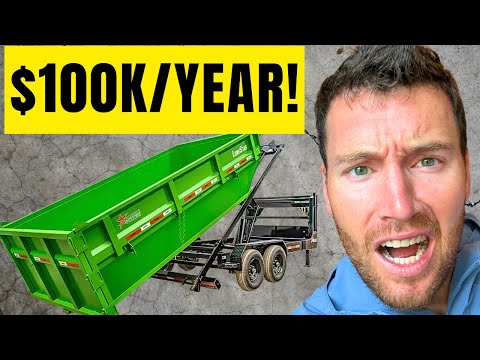
- ~$50k Startup
- $75k–$100k Revenue model
- $60k Four dumpsters
- Not priced Disposal fees
The claim
That a dumpster rental side hustle started with about $50,000 can bring in an extra $75,000 to $100,000 a year without requiring much time.
- Roll-off trailer — $20,000–$25,000
- Dumpsters — $4,000–$5,000 each; four to start
- Website / insurance / marketing — $500 / $2,000–$3,000 / $2,000 a year
- Total startup — ~$50,000, truck excluded
- Rental rate — ~$500 per dumpster per week
- Rented weeks per dumpster — 30 a year
- Revenue with five dumpsters — $75,000
- Revenue with four dumpsters (the budget) — $60,000
- Gas and maintenance — ~$25,000 a year
- Profit from year two — $50,000–$75,000
What is this income idea?
Buy a roll-off trailer and a few dumpsters, rent them by the week to homeowners and contractors, and haul the waste to a transfer station.
- The host owns an insurance agency that, they say, works with over a hundred dumpster rental companies — "probably most of the dumpster rental companies in our country". The host presents what they see across those clients rather than a business of their own.
- Startup, assuming you already own a pickup able to pull it: a roll-off trailer at $20,000–$25,000, dumpsters at $4,000–$5,000 each, four to start — "about $45,000" — plus a $500-a-year website, $2,000–$3,000 of annual insurance and $2,000 of local marketing, for "about 50,000 in to start". Financing is an option.
- Revenue: "the average cost to rent a dumpster is about $500 a week". One dumpster rented 30 weeks a year earns $15,000. "With five dumpsters … that's where you're going to get 75,000", and "surge pricing" could take it toward $100,000.
- After "gas maintenance all that" of about $25,000, year one's $75,000 leaves $50,000, and "you made your money back first year". From year two, with equipment paid off, "$75, $100,000 extra a year minus maintenance of 25 grand" gives "50 to 75,000 in profit" — "not bad for a side hustle that doesn't require a lot of upkeep".
- The host suggests adding junk removal or dump-trailer rental, hiring a driver to make it "semi-passive", and says sales — Google, referrals, builders, contractors — is what keeps the phone ringing. They also mention people calling "2 months after starting" to say there is no need locally, and say that is only true in very small towns.
- Along the way the host promotes their insurance agency (disclosed as theirs), a website provider, a $10 book on dumpster rental, a $5 book on choosing a business, and a paid mentorship. A cover reading “The Complete Guide — How to Start a Dumpster Rental Business — Nate Jones” sits in the corner of the screen at 0:06, 1:34 and 3:18, while the startup and revenue figures are given; it is the host’s own guide, and no price is shown on it.
A clear, checkable spreadsheet: $50,000 in, equipment paid back in year one, then $50,000–$75,000 a year — if 30 rented weeks and unpriced disposal costs hold.
- Own a pickup — Assumed, not costed
- Buy roll-off trailer — $20k–$25k
- Buy four dumpsters — $16k–$20k
- Insure and market — ~$5k a year
- Rent at $500 a week — Assumed
- 30 rented weeks each — Assumed
- Haul to transfer station — Fees unpriced
- Pay back equipment — Year one
An unusually complete cost list — missing the cost incurred on every single rental.
A checkable model that mostly checks out — except where the headline lives
The lesson underneath the number
- This is one of the more transparent business-idea models we have reviewed. The equipment is itemised with ranges, insurance and marketing are included, and the rental assumption — $500 a week, 30 weeks a year — is explicit enough to test. The host also says the uncomfortable things: that you should be ready to lose the money, that people come and go from this business, and that year one only pays back the equipment.
- The trouble is at the top of the range. The costed budget buys four dumpsters; the revenue example uses five. The $100,000 in the title depends on "surge pricing" that is never quantified — at 30 weeks it would mean about $667 a week per dumpster, a third above the host's own average. And the profit of $50,000–$75,000 applies from year two, after a first year that, on the host's arithmetic, ends at roughly zero for a cash buyer and negative on four dumpsters.
- Two further points deserve care. The host's financing remark — that if you finance "you probably will end up with some more profit" — does not match our reading: borrowing spreads the cost and preserves cash, but interest makes total profit lower, which the host half-acknowledges in the next breath. And the per-load disposal fee, the one cost that rises with every rental, is never priced for dumpster rental at all.
- The conflicts are disclosed, which is to the host's credit. The host owns an insurance agency serving these businesses and says so "transparently"; they promote it, two low-priced books and a mentorship, and a website provider whose relationship to them is not stated. The cover of the host's own dumpster-rental guide stays on screen while the model is explained. Their vantage point — insuring many operators — is genuinely informative. It also means every new dumpster business is a potential client.
You made your money back first year.
The host’s own summary of year one — before any profit
The setup, as the host gives it
Specific on equipment and paperwork; the operating costs are compressed into one number.
Figures are taken from what is said and shown on screen in the video, published 31 July 2025. The figures are spoken; the screen shows the host and the cover of the host's own guide. The insurance agency is not named here.
- Save for down payments and accept the risk — "Get that money saved up ready to risk that money because that's what business is." A franker opening than most side-hustle videos.
- Buy a roll-off trailer and a few dumpsters — $20,000–$25,000 for the trailer and $4,000–$5,000 per dumpster. The host names one trailer maker and says they are not paid by any of them.
- Form an entity and insure — LLC at state level, a federal tax ID, business insurance — from the host's own agency, if you choose, which they disclose.
- Get a lawyer-drafted rental contract — Specify what can and cannot go in the dumpster, and fees for paint or pollutants. A concrete, protective step.
- Make the phone ring — "It's the sales that keeps your business going not your expertise." Google, referrals, builders and contractors.
- Add junk removal — Fill your own dumpster from customers' garages, with loads the host puts at $1,000–$2,000 — "make sure it's worth your money" after transfer station fees.
- Hire a driver to scale — Makes the business "semi-passive" and lets you add dumpsters; the host cites clients with 40 to 100.
The business model
Weekly dumpster rentals, assumed at $500 per dumpster per rented week, plus optional junk removal.
Homeowners, builders and contractors in a mid-to-large city.
On-site waste containers dropped off and collected on the customer's schedule.
Google presence, referrals, and direct outreach to builders and contractors.
- Roll-off trailer — $20,000–$25,000
- Dumpsters — $4,000–$5,000 each
- Truck — Assumed already owned
- Insurance — $2,000–$3,000 a year — from the host’s agency, if chosen
- Gas and maintenance — ~$25,000 a year, unitemised
- Transfer station fees — Incurred on every load; never priced for dumpster rental
- Financing interest — If financed; presented confusingly as raising profit
The equipment is costed carefully. The per-load disposal fee, the cost that scales with every rental, is the gap.
What you would actually need
Money
"About 50,000 in to start", or less with financing or fewer dumpsters, assuming you already own a suitable pickup.
A reasonably itemised figure, and more complete than most in the genre. It excludes the truck, disposal fees on every load, a legal contract, entity formation, and working capital for the months before rentals build.
In, and out, of the $50,000
- Roll-off trailer — $20,000–$25,000
- Four dumpsters — $16,000–$20,000
- Website — $500 a year
- Insurance — $2,000–$3,000 a year
- Local marketing — $2,000
- Pickup able to pull loaded dumpsters — excluded
- Transfer station fees on every rental — not priced
- Lawyer-drafted rental contract — recommended, not priced
Time
"Doesn't require a lot of your time … not a ton of stuff": drop off, pick up days or weeks later, dump.
Five dumpsters at 30 rented weeks each is 150 rental-weeks a year. Every rental needs a delivery, a collection and a transfer-station run, around a day job — and the host says that sales need "a lot of time and effort".
Where the time actually goes
- Deliveries and collections on every rental
- Transfer station runs
- Answering calls and quoting
- Courting builders and contractors
- Equipment maintenance
- Bookkeeping, contracts, disputes over contents
The part you must pay attention to
The budget buys four dumpsters; the $75,000 needs five, and the $100,000 needs surge pricing.
"Let's say we start with four dumpsters" — and then, for revenue, "let's say with five dumpsters".
- What the $50k budget buys — 4 dumpsters
- Per rented week — $500
- Rented per year — 30 weeks
$60,000
Revenue on the budget the host costed
The model rests on each dumpster earning $500 in 30 separate weeks a year — about 58% utilisation — in a business the host says people "come and go" from, where some owners call the host’s agency two months in to say there is no local demand. It also rests on $25,000 covering all running costs, described only as "gas maintenance all that". The one cost incurred on every rental — the fee to tip the load at a transfer station — is mentioned as a place you drive to and, for junk removal, as something to check is "worth your money", but it is never priced for dumpster rental itself. If disposal is not inside the $25,000, the profit figures are higher than they would otherwise be by however much 150 loads a year cost to dump.
The first-year picture is plainer than the headline suggests. Using the host’s figures, $75,000 of revenue less $25,000 of running costs leaves $50,000 — the startup cost. The host's own words are "you made your money back first year". So a cash-funded owner ends year one with the equipment paid for and roughly nothing else; the $50,000–$75,000 of profit starts in year two, and $100,000 of revenue requires "surge pricing" the host does not define. On the four dumpsters the budget actually buys, revenue is $60,000 and year one falls about $15,000 short of payback.
- STARTUP (the host's figures)
- Roll-off trailer $25,000
- 4 dumpsters $20,000
- Website, insurance,
- marketing ~$5,000
- -----------------------------
- Total ~$50,000
- (truck not included)
- REVENUE
- $500 x 30 wks = $15,000/dumpster
- x 5 (the model) = $75,000
- x 4 (the budget) = $60,000
- YEAR ONE, CASH-FUNDED
- $75,000 - $25,000 costs
- = $50,000
- - $50,000 startup = $0
- (4 dumpsters: -$15,000)
- THE $100,000
- = $667/wk at 30 weeks, or
- = 40 weeks at $500
- "surge pricing" - undefined
The economics
The host’s inputs, recomputed.
- Startup, truck excluded — ~$50,000
- Rate per rented week — $500
- Rented weeks per dumpster — 30 (~58% utilisation)
- Revenue, five dumpsters — $75,000
- Revenue, four dumpsters — $60,000
- Running costs — ~$25,000
- Year-one result, cash-funded, five dumpsters — ~$0 after payback
- Profit from year two — $50,000–$75,000
Year one on the budget the host actually costed
4 dumpsters × $500 × 30 weeks = $60,000; − $25,000 running costs = $35,000; − $50,000 startup = −$15,000
About $15,000 short of payback in year one; roughly $35,000 a year from year two on four dumpsters
IncomeIdeaLab calculation using only the host’s stated figures
The $25,000 running-cost figure is the host's and is not itemised; if it excludes transfer-station fees on each load, every result here is higher than it would otherwise be. A fifth dumpster adds $4,000–$5,000 of cost and $15,000 of modelled revenue.
- Transfer station fees per load
- The truck — assumed owned, never costed
- Interest if the equipment is financed
- What "surge pricing" means and how often it applies
- How many weeks a new operator actually rents out
- Owner hours per rental
- Whether the host is paid for referrals to the website provider
- The price of the host's own guide shown on screen
- The $15,000-per-dumpster arithmetic ($500 × 30) and the $75,000 for five are both correct as multiplication.
- Utilisation of 30 weeks in 52 is about 58%. The host acknowledges slow periods and times with too few dumpsters, but gives no first-year ramp-up.
- Junk removal loads are put at $1,000–$2,000 each, with no cost per load given.
- The host cites clients with 40 to 100 dumpsters as evidence of scale, but names none and gives no figures for them.
Evidence status
Every substantive claim in the video.
- "Extra 75,000 to 100,000 a year" — Host's model — Revenue; $75k needs five dumpsters, $100k needs undefined surge pricing.
- ~$50,000 to start — Host — Itemised; excludes the truck and disposal fees.
- $500 per dumpster per rented week — Host, from clients — No local check suggested.
- 30 rented weeks a year — Host — ~58% utilisation from the start.
- "You made your money back first year" — Host — True on five dumpsters; ~$15k short on the four costed.
- $50,000–$75,000 profit from year two — Host — Consistent with the host’s inputs, if disposal is inside $25k.
- Financing yields "some more profit" — Host — Interest lowers total profit; it helps cash flow.
- "Doesn't require a lot of your time" — Host — 150 rental-weeks a year of drops, pickups and dump runs, plus sales.
- Owns the insurance agency they promote — Host — Disclosed plainly.
- The host's own dumpster-rental guide — Cover on screen, 0:06–3:18 — Shown alongside the model; no price on screen.
What is actually proven?
The model is internally checkable. None of it is a result.
- At $500 × 30 weeks, one dumpster models $15,000 a year.
- The costed budget buys four dumpsters, modelling $60,000, not $75,000.
- Year one, cash-funded, roughly repays the equipment and no more.
- The host discloses their insurance agency, books and mentorship.
- The cover of the host's own guide is on screen while the figures are given.
- Disposal fees per load.
- Any named operator's actual revenue or profit.
What the headline doesn’t tell you
The model is open enough to show where it strains.
- $100K is revenue. — With undefined surge pricing.
- $75K needs five dumpsters. — The budget buys four.
- Year one pays back the kit. — The host’s words.
- The truck isn’t costed. — Assumed owned.
- Dumping fees aren’t priced. — On every load.
- Financing lowers profit. — Not raises it.
- The host sells the insurance. — Disclosed.
- The host’s guide is on screen. — Price not shown.
- Some quit at two months. — The host says so.
Should you try it?
A real business with a slow payback
Plan on year one repaying the equipment, price disposal locally, and start with the dumpsters you can afford — not the five in the model.
- Transparency of the model — 8 — Inputs explicit enough to recompute.
- Startup cost detail — 7 — Itemised with ranges; truck excluded.
- Headline accuracy — 3 — $100k is revenue on undefined surge pricing.
- Operating cost detail — 3 — $25k unitemised; disposal never priced.
- Candour about risk — 7 — "Ready to risk that money"; early quitters mentioned.
- Conflict disclosure — 7 — Agency disclosed; own guide on screen; website provider relationship not stated.
- Beginner accessibility — 4 — $50k plus a suitable truck, or debt.
- Take the model seriously, because it is concrete — and then run it on your own numbers. Ring local operators or check their published prices for a typical rental, and find out what your nearest transfer station charges per ton or per load. Those two figures decide whether $500 a week and $25,000 of annual running costs are realistic where you live.
- Model the dumpsters you will actually buy. The $50,000 budget buys four, which the host's own rates turn into $60,000 of revenue, not $75,000. Add a fifth only if you have the extra $4,000–$5,000.
- Expect year one to be about paying for equipment. On the host's figures, a cash buyer with five dumpsters ends the first year roughly even; with four, about $15,000 short. Profit of the size the host describes comes from year two, if the rentals hold.
- If you finance, do it for cash flow, not profit: interest is an extra cost. And be realistic about time — 150 rental-weeks a year means frequent drop-offs, pickups and dump runs, alongside the sales effort the host says most failures neglect.
Passive or automated?
Automation
Online booking and contracts help; every rental is a physical drop, pickup and dump.
Passive potential
"Semi-passive" only once a paid driver takes over.
The host calls this a side hustle that "doesn't require a lot of upkeep", but their own model implies 150 rental-weeks a year across five dumpsters, each needing a delivery, a collection and a transfer-station run. The host is clearer later that it becomes "semi-passive" only when you hire a driver — which adds a wage the model does not include — and that sales need sustained effort. The equipment earns while it sits on a driveway; getting it there and back is the job.
- Delivering and collecting every dumpster
- Driving loads to the transfer station
- Answering calls and quoting
- Building contractor relationships
- Enforcing the contract on prohibited items
Recommended beginner experiment
Validate price, demand and disposal before buying a trailer.
- Get five local rental quotes. — Test the $500 assumption.
- Price your transfer station. — Per ton or per load.
- Confirm your truck can tow a loaded can. — It is assumed, not costed.
- Line up two contractors first. — The host’s "phone ringing" point.
- Model four dumpsters, not five. — Match the budget.
- Plan for year-one payback only. — The host’s own arithmetic.
- Get the rental contract drafted. — Prohibited items and fees.
Our verdict: 5/10
An unusually checkable model whose headline sits at its weakest point five dumpsters on a four-dumpster budget, undefined surge pricing, and no disposal fees
Credited for an itemised startup budget with ranges, an explicit rental assumption ($500 a week, 30 weeks a year) that can be recomputed, candour that year one only repays the equipment, a clear warning to be ready to lose the money, practical advice on rental contracts, and plain disclosure that they own the insurance agency they promote. Marked down because the $75,000 example uses five dumpsters when the costed budget buys four; because the $100,000 in the title depends on undefined "surge pricing"; because the per-load transfer-station fee is never priced for dumpster rental; because the truck is assumed rather than costed; because financing is described as producing more profit when interest reduces it; because "doesn't require a lot of your time" sits poorly with 150 rental-weeks a year; and because the host's own guide is shown on screen throughout the model without its price.
Most videos in this genre give a revenue figure and stop. This one lays out a model you can check, all of it spoken, with the cover of the host's own guide on screen: a $20,000–$25,000 roll-off trailer, $4,000–$5,000 dumpsters, a year of insurance, a website and some marketing for about $50,000, then $500 per dumpster for 30 rented weeks a year and about $25,000 of running costs. The host says year one repays the equipment, tells viewers to be ready to lose the money, recommends a lawyer-drafted rental contract, and discloses owning the insurance agency they promote. Rebuilt from the host's own inputs, the model is more modest than the title. The costed budget buys four dumpsters, not the five used to reach $75,000; on four, revenue is $60,000 and a cash-funded first year ends about $15,000 short of payback. The $100,000 depends on "surge pricing" the host does not define. Profit of $50,000–$75,000 begins in year two, and only if the unitemised $25,000 covers the transfer-station fee paid on every load — a cost the host does not price for dumpster rental. Financing helps cash flow but, contrary to what the host says, lowers total profit. A sound business to research, with a slower and smaller payoff than the headline.
- Startup — ~$50,000 + truck
- Revenue, five dumpsters — $75,000
- Revenue, four (budgeted) — $60,000
- Title figure — $100,000 with surge pricing
- Year one, cash-funded — ~Break-even to −$15k
- Profit from year two — $50k–$75k
- Disposal fees — Never priced
- Beginner suitability — With capital and patience
Sources
- How To Start a Dumpster Rental Business - $100K/Year — Nate Jones — Source video, 2025-07-31
- FTC — Guides Concerning the Use of Endorsements and Testimonials — Regulatory guidance on material connections and disclosure