Ecommerce / Dropshipping · Claim Review
“This Product Research Method Made Me USD 2.3M Dropshipping (LIVE HUNTING)”
What we found: Dropshipping Product Research: The $2.3M in the Title Is Not Stated in the Video, and the One Store With a Profit Figure Shows About 24% on $1.5M
A detailed, repeatable filtering method for finding TikTok Shop products to test on Meta. The creator's results are given as a series of separate revenue and profit figures that do not add up to the title, and the method's hit rate and testing costs are not stated.
- $2.3M Title figure
- $1.5M+ One store
- ~24% Implied margin
- Not stated Hit rate, test budget
The claim
That the product research method demonstrated live in the video is "literally the exact system" the creator followed to make over $1.5 million on one dropshipping store with over $360,000 in profit, $23,000 in eight days and $17,566 in a first month on a product, under a title that credits the method with $2.3 million.
- Title figure — $2.3 million; not stated in the video
- One store, revenue and profit — Over $1.5 million; over $360,000 profit
- Margin on that store, our arithmetic — $360,000 ÷ $1,500,000 ≈ 24%
- Recent window — $23,000 from 1 to 8 April
- First month on one product — $17,566
- Subscription revenue — Over $5,000 a month; one in three customers subscribed
- Earlier case studies listed — $164,758.29 in a month; $500,000 in 3 months; $140,000 profit in 30 days; others
- Cost per acquisition cited — $18
- Research tools — Kalodata $80 a month, or a $49-a-month bundle that includes it
- Hit rate, test budget, product and shipping costs — Not stated
What is this income idea?
Run a dropshipping store that sells products already trending on TikTok Shop, found with a research tool and tested with Meta ads.
- The creator says he has been dropshipping for about two years and four months, began at 18 and is now 20. He opens with a list of his past case studies, including $164,758.29 in a month, $500,000 in revenue in three months, $140,000 profit in 30 days and over a million dollars for one brand, and says the method in this video is the one he used for over $1.5 million on one store with over $360,000 in profit.
- He explains why he is giving the method away: he says he once agreed to pay a mentor about three thousand dollars to learn product research and found the mentorship did not deliver, and believes the basics should be free. He also says "not all mentorships are bad" and that he runs one himself.
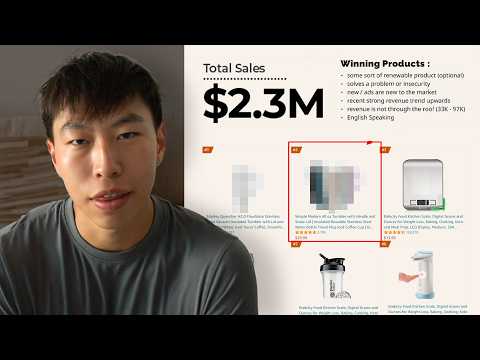
- His criteria are a renewable product where possible (so subscriptions can be offered), a real problem or insecurity, new adverts rather than old ones, a rising revenue trend, 30-day revenue that is "not through the roof" (ideally $33,000 to $97,000), and adverts in English for a US audience.
- The live session uses Kalodata, which scrapes TikTok Shop, accessed through a $49-a-month browser bundle rather than Kalodata's own $80 plan. He filters by category and revenue band, sorts from lowest to highest revenue, ignores the product images and reads the graph, then checks how revenue is spread across a product's videos, how recently the top video was posted, and whether the price is too low (a $9.99 price is a warning sign to him).
- Products that pass are cross-checked for competitors in the Facebook Ad Library and for demand in Google Trends, then tested on Meta with longer ads and a better offer than TikTok Shop, for example a buy-one-get-one at $29.99 plus $4 to $5 shipping for a $15 TikTok product. His closing instruction: "test it leave it for 2 to 3 days on meta ads" and move on if it does badly.
- The video includes a mid-roll and a closing plug for his coaching programme, which he calls "the uni", with a free training video as the first link, and a link to the research bundle.
A specific way to shortlist TikTok Shop products to test with Meta ads; the creator states large results from it, but the title figure is not in the video and the cost and failure rate of testing are not given.
- Pick a category — Health, beauty, apparel
- Filter 30-day revenue — $33k–$97k
- Read the graph — Rising, not spiking
- Check video spread — Not one viral clip
- Check price — $9.99 is a warning
- Count competitors — Facebook Ad Library
- Check demand — Google Trends
- Test on Meta — 2–3 days, then judge
A shortlisting method. The stage that costs money, testing on Meta, is the stage with the least detail.
A useful shortlisting method, attached to a title figure the video does not explain
The lesson underneath the number
- The research method is the substance of the video and it is more concrete than most. Reading a product's revenue graph rather than its photo, preferring a steady climb to a spike, and checking whether revenue is spread across several videos or carried by one viral clip are all practical ways to separate a product with broad demand from a one-off. Sorting from lowest to highest revenue within a band, to find products that are working but not yet crowded, is a sensible rule, and his warning that very high revenue bands mean very high competition is fair.
- He is also open about two things that matter. His early test products were the gadgets beginners tend to choose, and he presents them as the kind of product he has since moved away from. And a product that sells on TikTok Shop is not guaranteed to sell on Meta, because the ads, the offer and the audience are all different; his instruction is to test for two to three days and move on if it fails. That is an accurate description of how this kind of dropshipping works: research narrows the field, and testing decides.
- The results are where a reader needs care. The title says the method made $2.3 million; that figure does not appear in the video. What the video gives instead is a list of separate results from different stores, some revenue and some profit, over periods from a week to three months. The clearest is a store with over $1.5 million in sales and over $360,000 in profit, about 24% by our arithmetic, and giving a profit figure at all is to his credit. But the video does not connect any of these results to products found with this specific method, beyond his statement that it is the same system.
- The missing numbers are the ones that decide whether a beginner can afford to follow it. How many products did he test for each winner? What does a two-to-three-day Meta test cost? What do the product, shipping and fees take from a $29.99 order with an $18 acquisition cost? None is given. The video also promotes his coaching programme and a paid tool bundle, both clearly presented as plugs. The method can be copied for the price of the tool. The testing budget it leads to is the real cost of entry, and it is the part left unpriced.
If it fails you have the method to be able to go back and go ahead and test it again.
The creator on what research cannot guarantee
The research method, as he gives it
The criteria and the live session, in the order the video presents them.
No test budget, hit rate or result is given for any product found during the session.
- Set up the tools — Kalodata for TikTok Shop data, which he says costs $80 a month, or a $49-a-month browser bundle that includes it; plus the Facebook Ad Library and Google Trends. He links to the bundle in the description.
- Filter by category and revenue band — One category at a time; 30-day revenue ideally $33,000 to $97,000. He uses $55,000 to $97,000 and later $36,000 to $70,000 live. If a product from a lower band sells but at a loss, he suggests moving the band up, while warning that very high bands mean heavy competition.
- Read the graph, not the picture — Sort from lowest to highest revenue and look for a graph trending up, not a spike, and not a product that peaked months ago.
- Check how revenue spreads across videos — If one video carries almost all of the revenue ($4,000 against $200 for the next, in one example), he treats it as a warning. An even spread, such as $2,000, $1,800 and $1,400 across three videos, is a good sign.
- Check price and language — Very low prices such as $9.99 are a warning to him; adverts in Spanish mean the product is selling to a different market.
- Cross-check competitors and demand — Search the Facebook Ad Library for other stores selling the product and Google Trends for the search trend. He describes one competitor already running a $29.99 buy-one-get-one offer.
- Test on Meta, judge in two to three days — Sell it on your own store with longer ads and a stronger offer, run it on Meta for two to three days, and move on if it does badly. He says a product that sells on TikTok Shop is not guaranteed to work on Meta.
The business model
Product sales through the creator's own dropshipping stores, with subscriptions on renewable products; separately, a coaching programme promoted in the video.
English-speaking US buyers reached through Meta ads, for health, beauty, apparel and similar problem-solving products.
Products already proven on TikTok Shop, sold with longer ads, a stronger store page and bundle offers such as buy-one-get-one.
Meta ads, with competitors checked in the Facebook Ad Library and demand in Google Trends.
- Research tools — $49 a month bundle, or Kalodata at $80 a month
- Meta ad spend — An $18 CPA cited; test budgets not stated
- Product and shipping costs — Not stated
- Store platform and payment fees — Not stated
- Refunds and chargebacks — Not stated
- Failed product tests — Number and cost not stated
The over-$360,000 profit on over $1.5 million in revenue implies costs of about $1.14 million on that store by our arithmetic, roughly 76% of revenue; how that splits between ads, products and fees is not stated.
What you would actually need
Money
A research tool at $49 or $80 a month. He says he would not waste "$50 $100 of my own money" testing a weaker product.
The research subscription is the smallest cost. Each Meta test needs an ad budget, a store, product samples or supplier orders, and the video gives no test budget, no count of tests per winner, and no product, shipping or platform costs. The one profit figure given implies costs took about three-quarters of revenue on that store.
Costs not priced in the video
- Meta ad spend per product test
- Store platform and theme subscriptions
- Product cost from the supplier
- Shipping, including buy-one-get-one units
- Payment processing and refunds
- Creative production for longer ads
- The coaching programme, if joined
Time
Not quantified, apart from a two-to-three-day test window per product.
The live session makes clear that research itself takes sustained time: most products are rejected on graph, price, language or competition. He says he has been dropshipping for over two years, and his earliest test products were ones he has since moved away from. How many products were tested before the $1.5 million store is not stated.
Where the time goes
- Filtering and reviewing products by category
- Checking videos, prices and competitors
- Building a store page and offer per product
- Producing ad creative for Meta
- Running and reviewing two-to-three-day tests
- Customer service and fulfilment on winners
The part you must pay attention to
The $2.3M in the title is not stated in the video, and the stated results are not one consistent figure.
The video lists results from several stores, in revenue and in profit, over windows from one week to three months. None of them is $2.3 million, and they are not totalled.
- Stated profit on one store — $360,000+
- Stated revenue on that store — $1,500,000+
~24%
Net margin on that store, by our arithmetic
The load-bearing assumption is that these results came from this method. He says it is "literally the exact system" behind the $1.5 million store, but the video does not say how many products were found with it and tested, how many failed, or what the tests cost. During the live session several products are called good candidates; none is followed to a test, so the method is demonstrated shortlisting products, not producing sales.
Credit where it is due: a profit figure for the $1.5 million store is more than most videos of this kind give, and about 24% net is a plausible margin for paid-traffic ecommerce. Later he refers to the same store as "1.59 million dollars", which would put the margin nearer 23%. The other figures are harder to compare: "$140,000 profit in 30 days" is profit, "$500,000 in revenue in three months" is revenue, and "$100,000 in a week" and "$25,000 in seven days" do not say which. The title's $2.3 million is not explained anywhere in the video, so a reader cannot tell which of these, if any, it includes.
- THE ONE STORE WITH A PROFIT FIGURE
- Revenue (stated) $1,500,000+
- Profit (stated) $360,000+
- Margin ~24% (our sum)
- At $1.59M stated later ~23%
- A $29.99 BUY-ONE-GET-ONE, PER ORDER
- Price + shipping $34-$35
- CPA cited -$18
- Left before product,
- shipping, fees ~$16-$17
- Two units + postage -???
- THE TITLE
- $2.3M not stated
- Hit rate not stated
- Test budget not stated
The economics
One profit figure, many revenue figures, and no testing costs.
- One store: revenue — Over $1.5 million
- One store: profit — Over $360,000
- Margin on that store — ~24%
- First month on one product — $17,566
- 1 to 8 April — $23,000
- Subscription revenue — Over $5,000 a month
- CPA cited — $18
- Research tool — $49–$80 a month
- Test budget, hit rate, product costs — Not stated
Margin on the one store with a profit figure
$360,000 ÷ $1,500,000 = 24%
About 24% net, or about 23% if the store's revenue is the $1.59 million he mentions later
IncomeIdeaLab calculation from the figures stated in the video
Both figures are stated as "over", so the margin is approximate. The period over which the store earned them is not stated, and the video does not say what costs are included in "profit".
- What the $2.3 million in the title includes
- How many products were tested per winner
- Meta budget per two-to-three-day test
- Product, shipping and platform costs per order
- Refund and chargeback rates
- The price of the coaching programme
- $23,000 across 1 to 8 April is about $2,900 a day by our arithmetic, stated as revenue.
- On his suggested $29.99 buy-one-get-one with $4 to $5 shipping, an $18 CPA leaves about $16 to $17 per order before two units of product, postage and payment fees, by our arithmetic. The product cost is not stated.
- One in three customers subscribing is a strong rate if sustained; the number of subscribers behind "over $5,000 in monthly recurring revenue" is not stated.
- He says students have had wins "for the past 40 50 weeks"; no student figure is given in the video, and the programme's price is not stated.
- The research bundle is promoted with a description link; whether it is an affiliate link is not stated in the video.
Evidence status
Every substantive claim in the video.
- The method made $2.3 million (title) — Title — Not stated in the video; what it includes is not explained.
- Over $1.5 million on one store with over $360,000 profit — Creator — About 24% margin by our arithmetic. A profit figure is creditable; we could not check it from the video.
- The same store at "1.59 million dollars" — Creator — A later restatement; close to the first.
- $23,000 from 1 to 8 April — Creator — About $2,900 a day; revenue.
- $17,566 in the first month on one product — Creator — Revenue; costs not stated.
- Over $5,000 MRR; one in three customers subscribed — Creator — Subscriber count not stated.
- $164,758.29 in a month; $500,000 in three months; $140,000 profit in 30 days — Creator, earlier case studies — Different stores and periods; revenue and profit mixed.
- $18 CPA on a good product — Creator — Useful benchmark; product price and margin not stated alongside it.
- Ideal 30-day TikTok Shop revenue of $33,000 to $97,000 — Creator — His own range; he says the exact numbers are a judgement call.
- Kalodata $80 a month; bundle $49 a month — Creator — Stated prices; the bundle is linked in the description.
- Students have had wins for 40 to 50 weeks — Creator, coaching plug — No student figure or programme price is given.
What is actually proven?
The method is demonstrated as a filter. Its results are stated, not traced.
- A full research session is walked through with criteria and live filtering.
- A profit figure, over $360,000, is given for the $1.5 million store.
- That store's margin is about 24% by our arithmetic.
- He says TikTok Shop success does not guarantee Meta success, and describes the beginner products he started with.
- The $2.3 million in the title.
- How products found in the session perform when tested.
- Hit rate, test budgets and per-order costs.
What the headline doesn’t tell you
Research is free to copy; testing is where the money goes.
- $2.3M is not in the video. — Only in the title.
- One store shows ~24% margin. — $360k on $1.5M, stated.
- Results mix revenue and profit. — Across several stores.
- No hit rate is given. — Tests per winner unknown.
- No test budget is given. — Two to three days on Meta.
- No live pick is tested. — Shortlisted only.
- A coaching plug, twice. — Mid-roll and close.
- A paid tool bundle is linked. — $49 a month.
Should you try it?
The research method is worth learning; budget for many failed tests before copying the results
Use the filters to build a shortlist. Before testing, set a fixed ad budget per product and work out the profit per order with product, shipping and fees included.
- Specificity of the method — 8 — Revenue bands, graph reading, video spread, price and language checks.
- Evidence for the title figure — 1 — $2.3 million is not stated in the video.
- Profit disclosure — 6 — One store with revenue and profit; others revenue only.
- Testing cost disclosure — 1 — No test budget, hit rate or per-order cost.
- Candour about failure — 6 — Beginner products and the TikTok-to-Meta gap acknowledged.
- Link between method and results — 3 — Asserted; no live pick is followed to a result.
- Disclosure of promotions — 7 — Coaching and tool plugs are clearly presented as plugs.
- Beginner accessibility — 4 — Cheap to research, costly to test.
- The research method is the useful part and costs little to try. Pick one category, filter TikTok Shop products to a middle revenue band, sort from lowest to highest, and read the graphs: you want a steady climb, recent videos, revenue spread across several creators, a price that leaves room for margin, and adverts in English. Then check the Facebook Ad Library for competitors and Google Trends for demand. Doing this carefully will rule out most of the products a beginner would otherwise test.
- What it will not do is tell you which product will sell on Meta. He says so himself: a TikTok Shop winner is not guaranteed to work with a different audience, ad and offer. The only way to find out is to test, and the video does not say how much a two-to-three-day test costs or how many tests he ran for each winner. Decide your test budget before you start, and assume most tests will fail.
- Then do the per-order maths the video skips. At his suggested $29.99 buy-one-get-one plus $4 to $5 shipping, and the $18 acquisition cost he cites as a good result, about $16 to $17 is left per order before two units of product, postage and payment fees. If the product and shipping cost more than that, a "good" CPA still loses money.
- Read the results as what they are. The title figure is not in the video. The one store with a profit figure made about 24% by our arithmetic, which is a realistic margin for this model and a useful benchmark. The other figures are revenue or profit from different stores and periods. And the video is partly a route into his coaching programme; consider what the free method gives you before paying for more.
Passive or automated?
Automation
Suppliers ship orders; research, creative and ad testing are manual.
Passive potential
Sales stop when ad spend stops; products fade and need replacing.
Dropshipping removes inventory and shipping from the seller's hands, but this video makes clear how much remains. Products have to be found, which is the long process walked through in the video; each one needs a store page, an offer and ad creative; each test has to be run, watched and judged within days; and winners decline, as several products discussed in the video illustrate, so the search starts again. Subscriptions on renewable products, which he favours, add some repeat revenue, and he cites over $5,000 a month from one product. Even so, growth depends on continuous ad spend and continuous research.
- Researching and shortlisting products
- Building store pages and offers
- Producing Meta ad creative
- Running and judging tests every few days
- Customer service, refunds and supplier issues
Recommended beginner experiment
Shortlist with the method, test with a fixed budget.
- Choose one category. — He suggests health or beauty.
- Filter a middle revenue band. — His range: $33k–$97k a month.
- Shortlist on graph and video spread. — Steady climb, several videos.
- Reject very cheap products. — $9.99 leaves little room.
- Check competitors and demand. — Ad Library and Google Trends.
- Cost one order fully. — Product, shipping, fees, CPA.
- Fix a test budget per product. — Not stated in the video.
- Judge in two to three days. — Then move on, as he says.
Our verdict: 5/10
A concrete research method, with a title figure the video does not contain one creditable profit figure, and no hit rate or testing cost
Credited for a specific, repeatable product research method, including a revenue band, sorting from low to high, reading the graph rather than the image, checking how revenue spreads across videos, and cross-checking competitors and demand; for giving a profit figure, over $360,000 on over $1.5 million, which puts that store at about 24% by our arithmetic; for showing the products he started with and acknowledging that TikTok Shop success does not guarantee Meta success; and for presenting the coaching and tool promotions openly as plugs. Marked down because the $2.3 million in the title is not stated in the video; because the other results mix revenue and profit across different stores and periods; because no product found in the live session is followed to a test; and because no hit rate, test budget or per-order cost is given for a method whose cost lies in testing.
As a lesson in product research, this video is useful. The method is concrete: filter TikTok Shop products to a middle revenue band, sort from lowest to highest, read the graph rather than the photo, prefer revenue spread across several videos to a single viral clip, avoid very cheap prices and non-English adverts, and confirm with the Facebook Ad Library and Google Trends before testing on Meta for two to three days. He is honest that research cannot guarantee a winner, and describes the beginner products he started with and has since moved away from. And unlike most videos of this kind, he gives a profit figure: over $360,000 on over $1.5 million for one store, about a 24% margin by our arithmetic. The limits are in how the results are presented and what is left out. The $2.3 million in the title does not appear in the video, and the figures that do are a list of separate results, some revenue and some profit, across different stores and periods. None of the products found during the session is followed to a test. And the costs that decide whether a beginner can follow the method, how many tests a winner takes, what each test costs on Meta, and what product and shipping take from a $29.99 order, are not stated. The video also promotes his coaching programme and a paid research bundle, both openly. Learn the filters; budget for the testing separately and assume most products will not work.
- Title figure — $2.3M, not stated
- One store revenue / profit — $1.5M+ / $360k+
- Margin on that store — ~24%
- CPA cited — $18
- Research tool — $49–$80/month
- Hit rate and test budget — Not stated
- Beginner suitability — Method yes; testing needs capital
Sources
- This Product Research Method Made Me USD 2.3M Dropshipping (LIVE HUNTING) — Ben Lyu — YouTube video, 2025-06-20
- FTC — Guides Concerning the Use of Endorsements and Testimonials — Regulatory guidance on earnings claims and endorsements