Ecommerce / Dropshipping · Claim Review
“USD 847k in 30 Days with Dropshipping (PRODUCT REVEALED)”
What we found: The $850,000 Dropshipping Month Comes With a Stated 20% Margin; Ad Spend and Product Costs Are Not Shown
At the stated margin the month leaves about $170,000 in profit; the costs that would produce that margin are not given, the $10,000 profit day needs a margin of at least 25% on the best day stated, and the method closes on a mentorship with a profit guarantee. On-screen slides do give a minimum starting capital of EUR 2-3k and a $100 daily test budget.
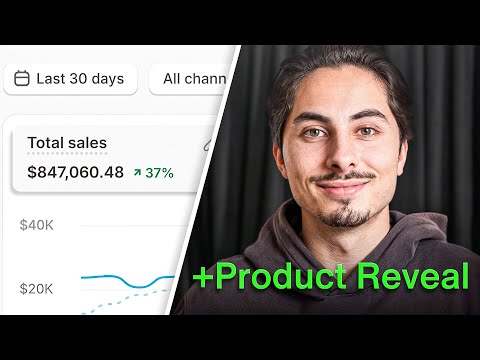
- $850,000 Revenue, last 30 days
- 20% Stated profit margin
- ~$170,000 Implied profit
- Not stated Ad spend
The claim
That a funnel-based dropshipping store did $850,000 in revenue in the last 30 days at a 20% profit margin, and that testing one product a day in three markets should lead to $10,000 a day in revenue.
- Revenue in the last 30 days — $850,000 (title: $847k); an analytics screenshot on the creator's Miro board at 0:03 shows Total sales of $847,060.48 for 7 Dec 2025 to 6 Jan 2026, with 48,961 sessions, 6,696 orders and a 1.61% conversion rate (the platform is not named on the card)
- Profit margin on that revenue — 20%
- Profit at that margin — ~$170,000
- Average daily revenue — ~$28,300
- Best day — $40,000 revenue
- Best profit day — $10,000
- Margin needed for $10,000 profit on a $40,000 day — 25% or more
- Share of revenue from Pinterest ads — ~20%
- Orders shipped with the same supplier — Over 100,000 in 5 years
- Top-funnels table on the creator's Miro board at 13:28 — Figures in euros, store and period not labelled: neck brace advertorial EUR 205.4k (2,825 orders); decompression belt EUR 203.9k (3,021 orders, 2.7% conversion); bee venom serum EUR 169.4k (3,648 orders, 6.7% conversion). About EUR 578.7k and 9,494 orders in all (our arithmetic); the table shows no ad spend, refunds or costs and does not show a period, so it cannot be tied to the 30-day figure
- Revealed product page at 14:44 — Advanced Bee Venom Serum on the Vintesse store: EUR 29.95 (was EUR 60.00, "SAVE EUR 30"), with a "50% discount ends tonight" banner. 3,648 orders at EUR 29.95 is about EUR 109,300 (our arithmetic), below the EUR 169.4k on the table; bundles or other price points, which the page may offer, are not shown
- Starting capital, slide at 20:01 — Minimum EUR 2-3k without coaching, EUR 4-7k with the creator's coaching (depending on monthly income); test budget $100 CBO, one ad set, 5-10 creatives, scaled 20% daily; a winner "likely found after 45 days (30 products tested)"
- Staff cost, slide at 21:41 — Onlinejobs.ph hires at $4-5/h for the roles You, FB, CS, VE and FB manager, run with SOPs, Discord and Sheets
- Ad spend, product cost, fees, refunds, VAT, payroll — Not stated
What is this income idea?
Dropship health, beauty and gadget products to older Facebook users through one-page branded funnels, testing a new product every day and scaling the winners with paid ads.
- The creator says they have been dropshipping since 2020, that the store in the video has been running for two years, and that in the last 30 days it did "$850,000 in revenue with a profit margin of 20%". The highest day in that period is given as $40,000.
- The method is framed as a change from how dropshipping was done a few years ago. Instead of an unbranded general store and five to ten product tests a day, they now test one or two products a day on single-product funnel pages built in Funnelish, and add Pinterest ads to Facebook ads.
- Products come from ad spy tools. The filters given are specific: ads using Funnelish, a reach of at least 10,000, and a creation date no more than about six weeks old. The stated logic is that an ad still running after months is earning for whoever runs it.
- One worked example prices the margin per unit: a micro-needling device selling for €130 against a similar item at about €30 on AliExpress, which the creator puts at "around €100 in profit per sale". They are clear that AliExpress is used only as a price guide and that orders go through a private supplier they say has shipped over 100,000 of their orders in five years.
- Three funnels are given with revenue and conversion rates: an advertorial at $200,000 and 4%, a decompression belt at $200,000 and 2.7%, and a serum funnel described once as $170,000 at almost 7% and once as $70,000 at 7.6%. The creator's Miro board at 13:28 shows a top-funnels table in euros without a period: neck brace advertorial EUR 205.4k, decompression belt EUR 203.9k (2.7%) and bee venom serum EUR 169.4k (6.7%). The revealed product is the bee venom serum, priced at EUR 29.95 on the page at 14:44.
- The scaling plan is to hire four assistants from OnlineJobs.ph at $4 to $5 an hour, write procedures for each role, and test one product a day in each of three markets. The video ends with a free course, which the creator says has 40,000 members, and a one-to-one mentorship with a "0 to 10k per month profit guarantee".
Copy products that are already selling, put each on its own branded sales page, test one a day with $100 of ads, and keep the few that work.
- Set up a company — UK limited, two weeks
- Find products in spy tools — 10,000+ reach, recent ads
- Build a one-page funnel — Copy and images via ChatGPT
- Test at $100 a day — One product a day
- Scale winners 20% a day — Facebook, then Pinterest
- Hire assistants — $4–5 an hour
- Add markets — Three for $10k a day
A specific operating method, with the advertising bill that drives it left unpriced.
The method is specific. The margin is a single stated number.
The lesson underneath the number
- There is more usable detail here than most videos in this genre offer. The spy-tool filters are exact, the test is defined as $100 with five to ten creatives, the scaling rule is 20% a day, the hiring rate is $4 to $5 an hour, and the order of hires is given. The creator also says plainly that reaching $1,000 a day is the hardest part and that most people reach it "by accident". A viewer could follow these steps.
- What the viewer could not do is check the result. A margin is what remains after costs, and in a business that buys every sale with advertising the largest of those costs is ad spend. The video gives the revenue and the margin and leaves the costs out, so the 20% is a figure to take on the creator's word. That matters most for the per-unit example, which describes €100 of "profit" on a €130 sale before any advertising at all.
- Some of the instructions carry risks the video does not discuss. The funnel copy recommends specific results such as "reduces 87% of wrinkles" because a precise number "sounds way more believable", and the testimonials on the example funnel were written with ChatGPT for three customer types. Creatives are taken from competitors at the start. A reader copying these steps takes on the responsibility for backing up product claims and for testimonials reflecting real customers, and may run into platform ad policies and copyright.
- The closing section promotes a free course and a one-to-one mentorship with a stated profit guarantee, linked in the description. The creator does say they receive no referral fee from the supplier they name, which is a useful disclosure. Whether the spy-tool links are affiliate links is not stated.
Going from zero to 1K a day in revenue is absolutely the hardest part in drop shipping.
The creator, on where most of the difficulty sits
The method, as the video gives it
The steps are concrete enough to follow. What they cost is mostly not stated.
No total ad spend, product cost or fee figure is given for any stage.
- Pick products that relieve a physical problem — Health, beauty and gadgets, because "the closer your product is to actually solving a physical pain, the easier your product will be to sell". The target buyer is described as an older, often retired Facebook user.
- Find them in spy tools — Filter for ads using Funnelish, a reach of at least 10,000 and a creation date within about six weeks. A long-running competitor ad is treated as validation.
- Sell from a branded one-product funnel — A single page built around one product, with a one-step checkout. The creator says this converts better than a standard three-step store checkout and that the copy and images were produced with ChatGPT.
- Test one product a day at $100 — One campaign at $100 with five to ten creatives, starting in week three after a two-week setup, in a single market such as the Netherlands and Belgium, Germany or Sweden. Winners are scaled by 20% a day.
- Outsource four roles — Funnel builder, video and image editor, customer service, and a Facebook manager, hired from OnlineJobs.ph at $4 to $5 an hour, each working from written procedures.
- Add markets and creatives — Test one product a day in each of three markets and add five to ten new creatives a day to each winning campaign. The creator says this "should result in 10K a day in revenue".
The business model
One-off product sales through single-product funnel pages, with bundle options at checkout, sold into several European markets.
Older Facebook users, described as near or past retirement age, buying health, beauty and gadget products.
A product that addresses a physical problem, presented on a branded page with specific benefit claims and a money-back guarantee.
Facebook and Instagram ads as the main channel, Pinterest ads for about 20% of revenue, with creatives taken or adapted from competitor ads.
- Ad spend — The main cost of the model. Total not stated
- Product cost and shipping — Through a private supplier. Per-order cost not stated
- Starting capital — Slide at 20:01: minimum EUR 2-3k without coaching, EUR 4-7k with the creator's coaching
- Product tests — $100 per test, one a day, three a day across three markets
- Assistants — $4–5 an hour for four roles; hours not stated
- Tools — Funnelish, Shopify, a spy tool, Google Sheets, Discord. Not priced
- Refunds, payment fees, VAT — Not mentioned
The only prices given are the test budget and the hourly pay. The cost that decides profit in a paid-ads business, total ad spend, is not stated.
What you would actually need
Money
A $100 daily test per product, and the warning that a poorly built test can leave you with "$1,000 spent on Facebook ads with zero sales". A slide at 20:01 gives a minimum starting capital of EUR 2-3k without coaching and EUR 4-7k with the creator's coaching.
The test budget alone adds up quickly. Forty-five daily tests at $100 is $4,500 before the first winner the video expects at around day 45, and three markets at one test each is about $9,000 a month in test spend, before scaling a winner, stock, staff or tools.
Costs named or implied, not priced in the video
- Facebook and Pinterest ad spend, the main cost of the model
- Product and shipping cost per order
- UK company setup and upkeep
- Funnelish, Shopify and a spy tool subscription
- Agency ad accounts
- Payment processing on every order
- Refunds under a "no results, money back" guarantee
- VAT on sales to EU customers
Time
Two weeks to set up, about 45 days of daily testing to find a first winner, and the statement that going from zero to $1,000 a day is "absolutely the hardest part".
The timeline is stated plainly and the creator does not call the work easy at the start. Past that point, running three markets with daily tests and daily new creatives is a full-time management job even with four assistants.
Where the time goes
- Company, bank, store, funnel and ad-account setup
- One product test a day from week three
- Building a funnel for every product tested
- Writing procedures before hiring anyone
- Quality checks and calls with the team
- Finding five to ten new creatives a day per winner
The part you must pay attention to
A 20% margin on $850,000 is stated. The costs that would produce it are not.
The month is "$850,000 in revenue with a profit margin of 20%". Revenue, margin and a best day are given. Ad spend, product cost, shipping, payment fees, refunds, tax and payroll are not.
- Stated revenue, last 30 days — $850,000
- Stated profit margin — 20%
~$170,000
Implied profit for the month; the costs behind the other ~$680,000 are not given
Everything rests on the 20% margin, and the video gives no line that would let a viewer rebuild it. The one per-unit example points the other way from how it sounds: a €130 product against a €30 supplier price is about €100 of gross margin per sale, but at a 20% net margin only about €26 of that €130 would be left. On those numbers roughly €74 of every sale would be going to advertising, shipping, payment fees, refunds and tax, none of which is priced. That is our illustration from the creator's own figures, not a figure from the video, but it shows that ad spend is the cost that decides whether this model works, and it is the one cost the video does not state.
The other figures fit together only loosely. $850,000 over 30 days averages about $28,300 a day, below the "30 to 40k a day" the creator later gives for the whole business, which may cover more than this one store. The "$10,000 profit day" is promised in the opening, but at the stated 20% margin it would need a $50,000 revenue day, above the $40,000 best day given for the period; it needs a margin of at least 25% on that best day, inside the 20% to 30% net range the creator gives later. No breakdown of that day is stated in the video.
- THE MONTH
- Revenue, last 30 days $850,000
- Stated margin 20%
- Implied profit ~$170,000
- Everything else ~$680,000
- -> ad spend, stock, fees, refunds,
- VAT, staff: none stated
- THE DAILY FIGURES
- $850,000 / 30 ~$28,300/day
- Whole business stated $30-40k/day
- Best day stated $40,000
- $10,000 profit / $40,000 = 25%
- $10,000 profit at 20% = $50,000 day
- ONE PRODUCT (euros, creator's example)
- Selling price €130
- Similar item on AliExpress €30
- "Profit per sale" €100
- At a 20% net margin €26
- Left for ads, fees, etc. ~€74
The economics
Revenue and a margin, a test budget and an hourly rate. No total cost.
- Revenue, last 30 days — $850,000
- Profit margin — 20%
- Best revenue day in the period — $40,000
- Best profit day — $10,000
- Pinterest share of revenue — ~20%
- Test budget per product — $100
- Assistant pay — $4–5 an hour (slide at 21:41, Onlinejobs.ph)
- Minimum starting capital (slide, 20:01) — EUR 2-3k without coaching; EUR 4-7k with coaching
- Top three funnels (Miro table, 13:28) — ~EUR 578.7k, 9,494 orders, period not shown (our sum)
- Revealed serum price (page, 14:44) — EUR 29.95 (was EUR 60.00)
- Example product: price vs supplier guide — €130 vs ~€30
- Ad spend, product cost, fees, refunds, VAT — Not stated
What the stated month implies
$850,000 × 20% = $170,000 profit; $850,000 ÷ 30 = ~$28,300 a day; $10,000 ÷ $40,000 = 25%
About $170,000 profit for the month at the stated margin, with about $680,000 of costs that are not itemised
IncomeIdeaLab calculation from the figures stated in the video
The video does not say whether the 20% is after ad spend, product cost, VAT and refunds, or what "profit" includes. The $850,000 is described as this store's last 30 days, while "30 to 40k a day" is given for the whole business, so the two may cover different things.
- Total Facebook and Pinterest ad spend for the month
- Product and shipping cost per order
- Payment processing fees
- Refunds and chargebacks under the money-back guarantee
- VAT on EU sales
- Team size, hours and total payroll
- Tool and agency ad-account costs
- The title says $847k and the video says $850,000. These agree after rounding.
- The funnel table at 13:28 is in euros and the spoken funnel figures are in dollars; the video does not say whether the two describe the same period or currency, so we have not converted them.
- The EUR 130 micro-needling device in the creator's per-unit example is a different product from the revealed serum, which the page at 14:44 prices at EUR 29.95.
- At about 20% of revenue, Pinterest would account for roughly $170,000 of the month, if the share applies to this period. Our arithmetic.
- Four full-time assistants at $4.50 an hour for 40 hours a week would cost about $3,100 a month. The video does not give hours, so this is our assumption.
- Testing one product a day in three markets at $100 per test is about $9,000 a month in test spend, before any winning campaign is scaled. Our arithmetic from the stated budget.
- Student results are given as 10,000 in profit over three days at 36% to 40% margins, a €7,700 day and a €80,000 day. These are stated by the creator about other people and we could not check them from the video.
Evidence status
Every substantive claim in the video.
- $850,000 revenue in the last 30 days — Creator — Stated. The title's $847k agrees after rounding, and an analytics screenshot on screen at 0:03 shows Total sales of $847,060.48 for 7 Dec 2025 to 6 Jan 2026 over 6,696 orders (about $126.50 an order, our arithmetic). The card does not name its platform or show costs.
- 20% profit margin — Creator — Stated with no cost lines. About $170,000 for the month by our arithmetic.
- $40,000 best day in the period — Creator — Consistent with a ~$28,300 daily average.
- $10,000 profit day — Creator — Needs a 25% margin on a $40,000 day, above the 20% stated for the month. No breakdown of the day is stated.
- "30 to 40k a day" for the whole business — Creator — Above the ~$28,300 average for the store; the business may include more than this store.
- Three funnels at $200,000, $200,000 and $170,000 — Creator — The serum funnel is also given as $70,000 at 7.6%. The creator's Miro table at 13:28 shows EUR 169.4k at 6.7% for the serum funnel, EUR 205.4k for the advertorial and EUR 203.9k at 2.7% for the belt, in euros and with no period; the $70,000 at 7.6% is not on that table, so the two spoken figures for the serum do not reconcile.
- €100 profit per sale on a €130 product — Creator — €130 minus €30 is €100 of gross margin, before ads, shipping, fees and tax.
- Over 100,000 orders with one supplier in five years — Creator — Stated, with the note that the creator receives no referral fee from that supplier.
- One product a day in three markets "should result in 10K a day" — Creator — A forecast for viewers, with no hit rate or cost given.
- Mentorship with a "0 to 10k per month profit guarantee" — Creator — Terms of the guarantee are not stated in the video.
- Ad spend, product cost, refunds, VAT, payroll — Not stated — None is given.
What is actually proven?
The method is described in detail. The month's profit rests on a stated percentage.
- The store did $850,000 in the last 30 days at a 20% margin, as stated by the creator.
- The stated margin implies about $170,000 in profit for the month.
- A $10,000 profit day needs a margin of at least 25% on the best day stated.
- Specific testing, scaling and hiring rules are given.
- The closing section promotes a free course and a paid mentorship with a profit guarantee.
- The creator's Miro board shows about EUR 578.7k across three funnels (13:28, no period) and a slide gives a minimum starting capital of EUR 2-3k (20:01).
- The revealed serum is priced at EUR 29.95 (was EUR 60.00) on its product page at 14:44.
- Total ad spend, product cost, payment fees, refunds, VAT and payroll.
- How the 20% margin is calculated.
What the headline doesn’t tell you
In a paid-ads business, revenue is the easy number to give.
- 20% is a stated margin. — No cost lines are given.
- Ad spend is not stated. — It is the main cost.
- "€100 profit per sale" is before ads. — And before shipping and VAT.
- The $10,000 profit day needs 25%. — On the best day given.
- Testing costs $100 a product. — Every day, per market.
- Refunds are not mentioned. — With a money-back guarantee.
- Testimonials were written with AI. — On the example funnel.
- It ends on a mentorship. — With a profit guarantee.
Should you try it?
A usable method for someone with an ad budget
Take the testing discipline and the filters. Work out your own break-even before spending, because the video does not give one.
- Specificity of the method — 8 — Filters, test budget, scaling rule, hires and markets all given.
- Evidence for the revenue — 3 — Stated; not checkable from what is said.
- Cost disclosure — 2 — Test budget, hourly pay and a minimum starting capital shown on slides. No ad spend.
- Internal consistency — 5 — Month and title agree; profit day and serum figures do not fit neatly.
- Candour about difficulty — 6 — Says the first $1,000 a day is the hardest part.
- Conflict-of-interest clarity — 5 — Course and mentorship are plain; spy-tool link status not stated.
- Beginner accessibility — 3 — Needs a company, ad accounts and thousands in test spend.
- The useful part of this video is the testing discipline. One product a day, a fixed $100 test, a defined set of spy-tool filters and a 20% daily scaling rule is a process a beginner can actually follow, and the creator is open that it may take about 45 days to find a first winner and that the first $1,000 a day is the hardest stretch.
- The part to slow down on is the money. At $100 a test, 45 days of testing is $4,500 in ads before the first winner the video expects, and that is the floor. The video gives no figure for what a winning product then costs to advertise per sale, which is the number that decides whether a €130 product with a €30 supplier price makes money or loses it.
- Before starting, build your own per-order sheet: selling price, product and shipping cost, payment fee, VAT for the market, an allowance for refunds under the guarantee, and the ad cost per sale your tests actually produce. If that sheet does not show a margin, scaling 20% a day makes the loss bigger.
- Treat the product-claim and testimonial advice with care. Specific results such as "87% of wrinkles" and testimonials written by AI are the seller's responsibility, and the video does not cover what backing they need. The FTC's endorsement guides are a starting point for what is expected of testimonials.
Passive or automated?
Automation
Fulfilment is outsourced to a supplier; finding, testing and advertising are daily work.
Passive potential
Sales stop when ad spend stops, and winning creatives need replacing daily.
The creator does not describe this as passive. Every sale comes from paid advertising, every winning campaign needs five to ten new creatives a day to keep running, and a new product is tested every day in every market. The plan to reach $10,000 a day is to hire four people and manage them through written procedures, daily calls and quality checks. What is handed off is the work, not the management of it, and the ad account needs someone watching it every day.
- Choosing products to test every day
- Building a funnel for each test
- Producing and replacing ad creatives
- Answering customers and handling refunds
- Managing four assistants and their procedures
- Replacing banned ad profiles
Recommended beginner experiment
Use the testing rules, add the costs the video leaves out.
- Set a total test budget first. — $100 a test, 45 tests is $4,500.
- Build a per-order cost sheet. — Product, shipping, fees, VAT, refunds.
- Use the spy-tool filters. — 10,000+ reach, ads under six weeks old.
- Test one product a day. — In one market only.
- Track ad cost per sale. — The number the video does not give.
- Scale only above break-even. — Then 20% a day, as the creator says.
- Check every product claim. — Only state results you can support.
- Use real customer reviews. — Not written ones.
Our verdict: 5/10
A detailed testing method with the profit taken on trust because the stated 20% margin comes with no ad-spend or cost figures
Credited for a method specific enough to follow, with exact spy-tool filters, a $100 test budget, a 20% daily scaling rule, named hires at a stated hourly rate and a stated timeline; for saying that the first $1,000 a day is the hardest part; for disclosing that the creator receives no referral fee from the named supplier; and for a title figure that matches the spoken one. Marked down because the $850,000 month and its 20% margin come with no figure for ad spend, product cost, payment fees, refunds, VAT or payroll; because the per-sale "profit" example is a gross margin before advertising; because a $10,000 profit day does not fit a 20% margin on the best day stated; because the serum funnel is given two different revenue figures; and because funnel advice on specific results and AI-written testimonials leaves the reader carrying risks the video does not discuss.
This is one of the more detailed dropshipping walkthroughs we have reviewed. The product-finding filters are exact, the test is defined down to the budget and number of creatives, the scaling rule and hiring plan are specific, and the creator is open that the first $1,000 a day is the hardest part and that a first winner may take about 45 days. A beginner can follow it. The headline is a different matter. $850,000 in 30 days at a 20% margin implies about $170,000 in profit, but the video gives no figure for what produced the other $680,000 of costs, and in a business that buys every sale with advertising, ad spend is the cost that decides the margin. The one per-unit example, €100 of profit on a €130 product, is measured before any advertising. The $10,000 profit day promised at the start would need a margin of at least 25% on the best day stated, and no breakdown of it is given. A slide at 20:01 gives a minimum starting capital of EUR 2-3k (EUR 4-7k with the creator's coaching). The video closes on a free course and a mentorship with a profit guarantee. Take the testing method, and work out your own break-even with every cost included before spending on ads.
- Revenue, last 30 days — $850,000
- Stated margin — 20%
- Implied profit — ~$170,000
- Daily average — ~$28,300
- Margin needed for the $10,000 profit day — 25%+
- Test budget per product — $100
- Minimum starting capital (slide, 20:01) — EUR 2-3k; EUR 4-7k with coaching
- Ad spend — Not stated
- Beginner suitability — Only with a test budget
Sources
- USD 847k in 30 Days with Dropshipping (PRODUCT REVEALED) — Samuel Ecom — YouTube video, 2026-01-26
- FTC — Guides Concerning the Use of Endorsements and Testimonials — Regulatory guidance on testimonials and endorsements