Digital Products / Gumroad · Claim Review
“14 Most Profitable Digital Products to Sell in 2026 ($3,000+/Mo Passive Income)”
What we found: The $3,000 a Month Rests on $17,000 Lifetime and One Prompt Guide
A secondhand explainer about one Gumroad seller, alongside six-figure examples whose sellers are never identified.
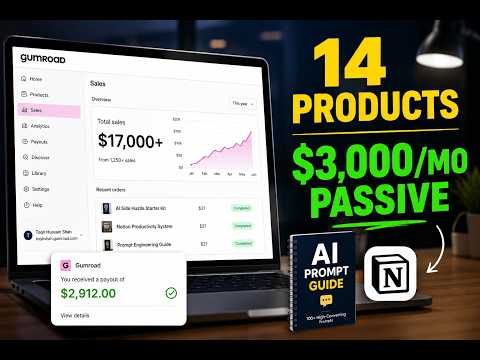
- $17k+ Lifetime sales
- ~$3k Monthly income
- $2k+/mo From one prompt guide
- ~$8.50 Average per sale
The claim
That a Gumroad seller earns about $3,000 a month in passive income from digital products, and that fourteen product types are the most profitable to sell in 2026.
- Digital products sold on Gumroad — Over 2,000
- Total digital product sales — Over $17,000
- Monthly income, described as purely passive — About $3,000
- Monthly income from one AI music prompt guide — Over $2,000
- $5 email sequence — Over 264 sales
- Gross from that email sequence — ~$1,320
- Average revenue per sale — ~$8.50
- $7 ADHD planner, seller unnamed — Over 50,000 sales
- Illustrated slide at 4:22 — Planner (ADHD) 50K+ sales; Worksheet (Anxiety) 10K+ sales — no seller, platform, price or source named
- Restaurant SOP bundle, seller unnamed — Over 35,000 sales
- Fees, refunds, tax, time, audience — Not mentioned
What is this income idea?
Package a shortcut someone would rather buy than build — a template, a short ebook, a planner, a prompt pack — and sell it as a download.
- The video is an "explainer", not a first-person account. A narrator introduces "creator Travis Nicholson" and relays their figures: over 2,000 digital products sold on Gumroad, "over $17,000 in total digital product sales", and "about $3,000 bucks a month in purely passive income".
- The organising idea is stated well and is the strongest part of the video: "People pay for shortcuts." Buyers are not paying for a file, the narrator argues, but for the time they would otherwise spend building it themselves.
- Fourteen product types are grouped into five buckets: time-saving templates (Notion, Canva, client onboarding packs, email sequences), education shortcuts (short ebooks and text courses at $39 to $49), planners, worksheets and SOPs, AI products (prompt guides and personalised children's books), and a free lead magnet as the fourteenth.
- Only some of the examples are Travis's own. Their are a $5 five-email sequence with "over 264 sales", a 42-page ebook, Canva templates, and an AI music prompt guide that brings in "over $2,000 a month". The music tool is not named here.
- The very large numbers come from elsewhere: a content calendar template with "over 50,000 sales" that Travis "shared", a $7 ADHD planner with "over 50,000 sales", a $15 anxiety worksheet with "tens of thousands" of copies, a restaurant SOP bundle at "over 35,000 sales", and personalised AI children's books at $40 with "tens of thousands of sales". None of these sellers is named.
- The closing pitch is a funnel: give away a lead magnet to earn trust, then upsell templates, content vaults and prompt guides.
Sell small downloads that save people time — but the one seller whose numbers you are given has made about $17,000 in total, mostly recently and mostly from one product.
- Spot a tedious task — Something people avoid
- Package the shortcut — Template, guide, planner
- List on Gumroad — $5 to $49 price points
- Offer a free lead magnet — Earn trust first
- Upsell paid products — Templates, vaults, prompts
- Ride new AI tools — Prompt guides per tool
A sound principle, illustrated with one modest real seller and several large unattributed ones.
The principle is right. The proof is thinner than it sounds.
The lesson underneath the number
- "People pay for shortcuts" is a genuinely useful way to think about digital products, and the video applies it sensibly. A $5 email sequence that someone already knows converts, a Notion setup that spares a buyer learning the tool, a prompt pack for a new AI app that people do not want to learn to drive — these are all real time-for-money trades, and the low price points are realistic.
- The problem is how the evidence is assembled. The only person with named figures is a seller with about $17,000 in lifetime sales across more than 2,000 orders — an average near $8.50 an order. That is consistent with the cheap products described, and it is an honest-sounding, modest number. Around it, the narration places much larger counts — 50,000 planners, 50,000 calendars, 35,000 SOP bundles, tens of thousands of $40 books — with no seller attached to any of them. A viewer comes away with the impression of six-figure product lines without any of those figures belonging to anyone identifiable.
- Even the seller's own figures say less than the title suggests. Two-thirds of their stated monthly income comes from one prompt guide for one AI music generator. That is a bet on a single third-party tool staying popular and unchanged, and it is why the lifetime total is only about five and a half months of the current monthly rate: the money is recent and concentrated. Calling it "purely passive" skips the fact that a prompt guide goes out of date as fast as the tool it describes.
- There is a fairness point too. Nothing in the video suggests the narrator is selling anything, and the seller's numbers are small and specific. The weakness is structural: this is a summary of someone else's claims, read in a polished explainer voice, with no dashboard at the points where the figures come up, no time frame and no costs. Treat it as a list of product ideas, not as evidence of what they earn.
People pay for shortcuts. They want things that are already done for you.
The narrator, paraphrasing the creator — the most useful line in the video
The product categories, as the video gives them
Five buckets, fourteen loosely counted product types.
Published 2 August 2026, about 8:17. The video is an illustrated explainer with no presenter on camera. The narrator relays figures attributed to another creator; no Gumroad dashboard for the $17,000 is on screen at the points where it is discussed. A hand-drawn style slide at 4:22 tabulates the large examples (ADHD planner 50K+ sales, anxiety worksheet 10K+) without naming a seller, platform or source.
- Time-saving templates — Notion workspaces, Canva layouts, onboarding packs and proposal formats. The one priced example is Travis's five-email drip sequence: $5, "over 264 sales" — about $1,320 gross by our arithmetic.
- Short written courses — Ebooks and text bundles "that go for 39 to 49 bucks", with optional one-to-one coaching sold alongside. Travis's own 42-page ebook is named; its sales are not given.
- Social media shortcuts — A content calendar template with "over 50,000 sales" and content vaults of pre-made short videos at "around $7". The calendar's seller is not identified; the narrator says only that Travis "shared" it.
- Planners, worksheets and SOPs — A $7 ADHD planner with "over 50,000 sales", a $15 anxiety worksheet with "tens of thousands" of copies, and a restaurant SOP bundle at "over 35,000 sales". No seller is named for any of them.
- AI prompt guides — Travis's "personal favorite product": a prompt guide for an AI music generator, organised by decade and style, said to earn "over $2,000 a month in pure passive income".
- Personalised AI children's books — $40 each, with "tens of thousands of sales" across unnamed creators. The narrator adds that Travis is not in this niche themselves.
- Lead magnet, then upsell — The fourteenth "product" is a free download used to build trust before selling the paid items above.
The business model
One-off sales of downloadable templates, ebooks, planners and prompt guides, mostly between $5 and $49.
Freelancers, small business owners, social media managers and people adopting new AI tools.
A finished shortcut that saves the buyer the time of building it themselves.
Gumroad listings, supported by a free lead magnet and upsells. The source of Travis's traffic is not stated.
- Platform fee — Gumroad takes a cut of each sale. Not mentioned
- Payment processing — Charged per transaction. Not mentioned
- Refunds and tax — Not mentioned
- Tools — Notion, Canva and AI subscriptions implied, never priced
- Creator time — Building, listing and updating each product. Not counted
- Audience — Where buyers come from is never explained
No cost of any kind is mentioned in the video, so even the $3,000 a month is a gross sales figure, not income.
What you would actually need
Money
Not discussed. The video implies a digital product costs nothing to make beyond the idea.
Upfront cash can be genuinely low, which is a real strength of the model. But every sale passes through a platform and payment processor that take a cut, refunds and sales tax apply, and AI-based products assume ongoing tool subscriptions. None of this is mentioned.
Costs the video leaves out
- Gumroad's per-sale platform fee
- Payment processing on every transaction
- Refunds and chargebacks
- Sales tax or VAT handling on digital goods
- Design and AI tool subscriptions
- Any paid traffic, if no audience exists yet
Time
Framed as "totally hands-off income" and "purely passive".
Building each product takes real hours, and the best-earning example — a prompt guide for one specific AI tool — has to be rebuilt or updated whenever that tool changes. The audience that discovers these products also has to come from somewhere, and the video never says where Travis's buyers come from.
Where the time actually goes
- Researching what buyers will pay for
- Building and designing each product
- Writing listings and preview content
- Creating and promoting a lead magnet
- Updating prompt guides as AI tools change
- Building the audience that finds the products
The part you must pay attention to
$17,000 in total is less than six months at $3,000 a month.
The narrator gives two figures for the same seller: "over $17,000 in total digital product sales" and "about $3,000 bucks a month in purely passive income".
- Lifetime sales, as relayed — $17,000
- Stated monthly income — $3,000
~5.7 months
All lifetime sales, at the current monthly rate
The monthly figure is doing all the work in the title, and it rests on one product. The prompt guide alone is said to earn "over $2,000 a month", which is about two-thirds of the $3,000. That guide teaches people how to prompt one particular AI music generator. Its income lasts only as long as that tool stays popular and its prompting style stays the same — which is the opposite of passive. The narrator never says how long the $3,000 level has lasted, but $17,000 in total means it cannot have lasted long.
Read together, the two figures describe a seller whose income rose recently, probably on the back of one AI product, and whose lifetime total is modest. That is a fair, real result — and a different claim from "$3,000+ a month passive income" in the title. The "+" does not appear in the audio either; the narrator says "about $3,000". The truly large numbers in the video, such as 50,000 sales of a $7 planner (about $350,000 gross by our arithmetic), belong to products whose sellers are not named and cannot be checked from the video.
- THE TWO LIFETIME FIGURES
- Total sales >$17,000
- Products sold >2,000
- Average per sale ~$8.50
- THE MONTHLY FIGURE
- Stated monthly ~$3,000
- From one prompt guide >$2,000
- Share from one product ~67%
- $17,000 / $3,000 = ~5.7 months
- THE BORROWED EXAMPLES
- $7 planner x 50,000 = $350,000
- $40 book x 10,000+ = $400,000+
- Sellers named: none
- Travis's own total: $17,000
The economics
One modest seller, one dominant product, and no costs.
- Products sold on Gumroad — Over 2,000
- Total digital product sales — Over $17,000
- Average per sale — ~$8.50
- Monthly income — About $3,000
- Monthly income from one prompt guide — Over $2,000
- Share of monthly from that guide — ~67%
- $5 email sequence × 264 sales — ~$1,320 gross
- How long $3,000 a month has lasted — Not stated
- Platform fees, refunds, tax, tools — Not stated
Reconciling lifetime sales with the monthly figure
$17,000 lifetime ÷ $3,000 a month ≈ 5.7 months
Every dollar ever earned would fit inside six months at the stated rate, so the monthly figure is recent
IncomeIdeaLab calculation from the two figures relayed in the video
Both figures are relayed by a narrator, are not shown on screen at the points where they are discussed, and are not dated. "Sales" may be gross of platform fees. If the $17,000 figure is older than the $3,000 one, the gap could be smaller than it looks — the video gives no dates for either.
- Gumroad and payment processing fees
- Refunds
- Sales tax or VAT on digital goods
- Tool subscriptions, including the AI music generator itself
- How long the $3,000 a month has been sustained
- Where the seller's buyers come from, and whether they had an audience first
- Who sold the 50,000-unit planner, calendar and SOP bundle
- An average of about $8.50 per order fits the price points described ($5 to $49), which makes the $17,000 and 2,000-sale figures internally consistent.
- The $5 email sequence's 264 sales come to about $1,320 gross — a real but small result, and the only one of Travis's products with both a price and a sales count.
- The title says "$3,000+"; the audio says "about $3,000". The plus sign is not supported by what is said.
- The fourteen products are not numbered in the audio; only the lead magnet is called "the 14th". The count is loose but roughly holds.
- The narration is scripted and the seller does not appear or speak, so nothing in the video confirms that they said or showed these figures. The on-screen slide at 4:22 lists sales counts for the large examples with no seller or source.
Evidence status
Every substantive figure in the video.
- Over 2,000 digital products sold on Gumroad — Narrator, about Travis Nicholson — Relayed secondhand. Consistent with the $17,000 total at low price points.
- Over $17,000 in total digital product sales — Narrator, about Travis Nicholson — Modest and specific. Not dated.
- About $3,000 a month in purely passive income — Narrator, about Travis Nicholson — Under six months of this would exceed lifetime sales. Gross, not income.
- Over $2,000 a month from one AI music prompt guide — Narrator, about Travis Nicholson — About two-thirds of the monthly figure from one product tied to one tool.
- $5 email sequence, over 264 sales — Narrator, about Travis Nicholson — About $1,320 gross by our arithmetic.
- Text bundles sell for $39 to $49 — Narrator — A price range, not a sales result.
- Content calendar template, over 50,000 sales — Narrator, "Travis shared" — Seller not identified.
- $7 ADHD planner, over 50,000 sales — Narrator; illustrated slide at 4:22 — About $350,000 gross if true. Slide shows 50K+ with no seller or source.
- Restaurant SOP bundle, over 35,000 sales — Narrator — No price, no seller.
- $40 AI children's books, tens of thousands of sales — Narrator — No seller named. Travis is said not to be in this niche.
- Fees, refunds, tax, time, audience — Nobody — Absent throughout.
What is actually proven?
Very little from the video alone.
- The "people pay for shortcuts" principle is clearly explained and applied consistently.
- One named seller has about $17,000 in lifetime sales from over 2,000 orders.
- That seller is said to earn about $3,000 a month, over $2,000 of it from one prompt guide.
- Lifetime sales equal under six months at the stated monthly rate.
- Average revenue per order is about $8.50.
- The 35,000- and 50,000-sale examples, none of which has a named seller.
- Any cost, and how long the monthly figure has lasted.
What the headline doesn’t tell you
A real but small seller, wrapped in other people's bigger numbers.
- It is secondhand. — A narrator relays another creator's figures.
- $17,000 lifetime. — Under six months at $3,000.
- Two-thirds from one product. — A prompt guide for one AI tool.
- "$3,000+" in the title. — "About $3,000" in the audio.
- The big numbers are unattributed. — No seller named for any of them.
- Passive is a stretch. — Prompt guides date as tools change.
- No costs at all. — Not even the platform fee.
- No audience source. — Where buyers come from is unsaid.
Should you try it?
A cheap experiment worth running, with expectations set by the real number
Use the product ideas. Benchmark yourself against $17,000 lifetime, not against 50,000-sale planners.
- Usefulness of the core principle — 8 — "People pay for shortcuts" is a sound way to pick products.
- Specificity of product ideas — 7 — Concrete formats and realistic price points.
- Evidence for the named seller's income — 3 — Relayed by a narrator, undated, nothing shown.
- Attribution of the large examples — 1 — No seller named for any 35,000+ sale product.
- Consistency of the figures — 5 — Average per sale fits; lifetime versus monthly needs explaining.
- Cost disclosure — 0 — No fee, refund, tax or time cost mentioned.
- Accuracy of "passive" — 3 — The top earner is tied to one fast-changing AI tool.
- Beginner accessibility — 7 — Low upfront cost; the hard part is finding buyers.
- Digital products are one of the few income ideas where trying costs very little, and the video's framing is a good place to start: look for a tedious job people would pay to skip, then sell the finished version. The product types listed — email sequences, onboarding packs, short guides, planners — are all realistic, and the price points are honest about how cheap most of them are.
- Set your expectations by the one real number, not the decorative ones. The seller whose figures are given has sold about $17,000 in total, at an average of about $8.50 an order. That is a respectable side income built over an unstated period. The 50,000-sale planner and the 35,000-sale SOP bundle may exist, but nobody in the video says who sold them, so they tell you nothing about what a new seller can expect.
- Be careful with the AI prompt guide idea specifically. It is the seller's best earner, and it is also the most fragile: its value depends on one third-party tool staying popular and working the same way. Plan to update or replace prompt products regularly, and do not build a whole income on one.
- Finally, the video is silent on the hardest part, which is getting people to see the product. It mentions a free lead magnet but never explains where the seller's traffic comes from. Assume you will need to build an audience or pay for attention, and count the platform fee, payment processing and refunds before you call anything income.
Passive or automated?
Automation
Delivery and payment are automatic once a product is listed.
Passive potential
The best earner depends on one AI tool and needs maintaining.
Once a digital product is listed, the sale, payment and download happen without anyone involved, which is the genuine appeal of the model. But "purely passive" does not describe all of it. Each product has to be researched and built first, buyers have to be found continuously, and the top earner here is a prompt guide for one AI music generator — a product that goes stale as soon as the tool changes or interest moves on. The lifetime figure suggests the monthly income is recent, so whether it continues without new work is untested.
- Choosing and building each product
- Writing listings and preview content
- Finding buyers, which the video never explains
- Updating prompt guides as AI tools change
- Handling refunds and customer questions
Recommended beginner experiment
Small, cheap and measured against realistic numbers.
- Pick one tedious task you already solve. — Something you have done for work.
- Package it as a $5–$15 download. — A template or short guide.
- Check the platform fee before pricing. — Know your net per sale.
- Build one free lead magnet. — Related to the paid product.
- Decide where buyers will come from. — The video never says.
- Track sales and refunds for 90 days. — Gross is not income.
- If you try a prompt guide, date it. — Plan updates as the tool changes.
- Benchmark against ~$8.50 per order. — The one real average in the video.
Our verdict: 4/10
Good product ideas, thin and secondhand evidence one modest seller, one dominant prompt guide, and large examples nobody owns
Credited for a clear and useful organising principle — people pay for shortcuts — and for realistic, specific product formats and price points; for giving the named seller's figures in modest, specific form ($17,000 lifetime, over 2,000 orders, $5 for 264 sales of one product); and for no visible sales pitch in the video. Marked down because every figure is relayed by a narrator with no dashboard on screen; because the $3,000 a month and $17,000 lifetime are never reconciled and imply the monthly level is recent; because two-thirds of that monthly figure comes from one prompt guide tied to one AI tool, which undercuts "purely passive"; because the largest sales counts in the video belong to unnamed sellers; because the title's "$3,000+" becomes "about $3,000" in the audio; and because no cost of any kind is mentioned.
The useful part of this video is its premise. People do pay for shortcuts, and a short email sequence, an onboarding pack or a clear guide to a confusing tool can sell for a few dollars to people who would rather not build it themselves. The product formats are sensible and the prices are realistic. The evidence is the weak part. The video is a narrated summary of another creator's results, and the only person with named figures has made a little over $17,000 in total from more than 2,000 orders — about $8.50 each. They are said to earn about $3,000 a month now, but at that rate their whole lifetime total would fit inside six months, so the monthly figure is recent; and over $2,000 of it comes from one prompt guide for one AI music generator, which makes the income both concentrated and dependent on a tool they do not control. Around them, the narration sets 50,000-sale planners and calendars, a 35,000-sale SOP bundle and tens of thousands of $40 children's books, with no seller named for any of them. No fee, refund, tax or time cost appears anywhere, so even the modest figures are gross sales. Take the product ideas; ignore the borrowed scale; and if you try it, measure yourself against roughly $8.50 an order and a single product that may not last.
- Lifetime sales — >$17,000
- Monthly income — ~$3,000
- From one prompt guide — >$2,000/mo
- Lifetime in months at current rate — ~5.7
- Average per order — ~$8.50
- 50,000-sale examples — Seller not named
- Costs — None mentioned
- Beginner suitability — Yes, with realistic expectations
Sources
- 14 Most Profitable Digital Products to Sell in 2026 ($3,000+/Mo Passive Income) — Source video, 2026-08-02
- FTC — Guides Concerning the Use of Endorsements and Testimonials — Regulatory guidance on earnings claims