Affiliate Marketing / Software · Claim Review
“It's Boring But Makes Me Money DAILY - Since 2020!”
What we found: One Boring Affiliate Page: $18,000 in Commissions Since 2020 Averages Nearer $7 a Day Than the $31 Stated
The recurring-commission method is clear and sensible. The example's own figures, sales, commission rate, clicks and refunds, do not reconcile with each other or with the daily figure.
- $18,000 Commissions, one program
- $31 Stated daily average
- ~$7/day Average if since 2020
- ~$1.29 Earnings per click
The claim
That one simple page solving one search problem, linked to software with a recurring affiliate commission, can pay "$31 a day or more" for years.
- Sales from the example program — $63,000
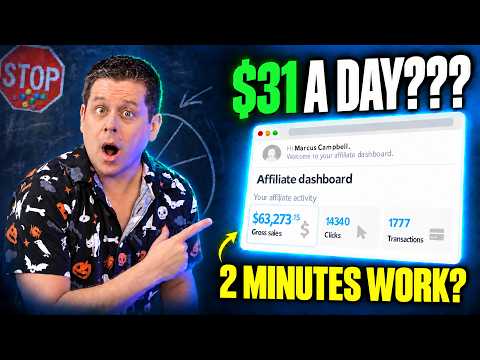
- Commissions to the creator — $18,000 (ThriveCart dashboard at 2:15: net commissions $18,039.97, period not shown)
- Commission rate — "Roughly 25%"
- Clicks to the affiliate link — "About 14,000" (dashboard at 2:15: 14,340 clicks, 1,777 transactions)
- Earnings per click, stated — "Right around $1.50"
- Earnings per click, from their figures — ~$1.29
- Daily range — $9 to over $100; "$31 per day on average"
- Refunds — 20, "less than .1% of the total commissions"
- Other earnings — "Close to $18 million" across other promotions; "over seven figures" from web hosting
- Start date for the example — Not stated in the video; the title says since 2020
- Costs of the site, tool and traffic — Not stated, beyond an API fee they mention
What is this income idea?
Find a task people search for again and again, write a plain page that answers it, and put a software tool with a recurring affiliate commission next to the answer.
- The creator calls it "one problem, one solution". Someone searching "how do I convert an MP4" or "compress a PDF" knows exactly what they want, and a page that answers the question and points to a tool that does it converts well. If the tool is a subscription with a recurring commission, one referral can pay every month.
- Their worked example is a domain-research tool they say costs about $30 a month and pays them about 25% each month. They rank for domain-buying keywords and for a free domain appraisal tool their programmer built in about 30 minutes, which they say brings visitors daily and gets shared on Facebook and Instagram.
- They read from their affiliate dashboard: $63,000 in sales, $18,000 in commissions, about 14,000 visitors sent to the affiliate link, 20 refunds, and daily earnings between $9 and over $100, which they describe as "$31 per day on average". They call it one of their smaller examples and says several others have done over seven figures.
- They are clear about the odds. Early in the video they say the results are not typical, implied or guaranteed, and that the average person watching these videos makes nothing; later they add that it "does take work".
- The rest of the video is a template: start from real searches, check forums and AI tools for what people complain about, make one page per specific search, add a short filtered list and a clear affiliate disclosure, then repeat the pattern for PDFs, audio, images, scheduling and other software. They give example commission rates for several programs and recommends an email list once a niche has several tools.
- They promote their own keyword tool, which they say they programmed themselves, and a notes page with the keyword and offer lists, and at the end a new piece of software of their for affiliate marketing.
Answer one specific "how do I" search with a plain page and link the software that solves it, ideally one that pays you every month.
- Find a repeated task — Real searches, real complaints
- Pick recurring software — 20% to 50% commissions
- One page per search — Plain title, steps
- Add a free mini-tool — Their appraisal tool
- Disclose the link — They say do it every time
- Build an email list — Once a niche has several tools
- Repeat the template — PDF, audio, images, files
A sound method. The example's figures do not reconcile with each other.
A good method, carried by figures that need a second look
The lesson underneath the number
- The core idea is sound and well explained. A person typing "compress a PDF" or "how to back-order a domain" has a specific task and is close to paying for a tool that does it. A short, plain page that answers that exact question, with a disclosed link to the tool, is easier to rank and converts better than a broad content site. Recurring commissions mean each referral can keep paying, and their own $5-a-month example, $60 a year per customer and $6,000 a year from 100 customers, is correct arithmetic, provided each customer stays for the full year.
- They are also clear about the odds. They say early that their results are not typical and that the average viewer of these videos makes nothing, recommends disclosure on every affiliate link, and warns that affiliate terms change and are "never set in stone".
- The example's numbers are less tidy. Five figures from one dashboard should agree, and here they do not: the commissions are higher than 25% of the sales, the earnings per click are lower than stated, the refund rate is about ten times what they say if each commission is $9.99, and $31 a day does not fit $18,000 over the years since 2020 named in the title. None of this means the page does not earn. It means the example is a rough illustration rather than a benchmark, and the $31 figure in the opening is the least supported of the five.
- The context matters too. This page sits on keywords and a free tool built up over years, by someone who has earned online since 2000 and says they have made close to $18 million across promotions. A new page from a new site has none of that, and the video does not say how long a page like this takes to reach its first commission.
The average person watching affiliate marketing videos and make money online videos makes nothing.
The creator, early in the video
The boring-page template, as given
Their steps for each page.
No cost is given for building pages or tools, and no traffic figure is given for a new page.
- Start with a task that repeats — "Don't start with an offer, start with a task that repeats." Convert this file, remove background noise, compress a PDF. They cite about 135,000 monthly searches for compressing a PDF.
- Check the search and the conversation — Use a keyword tool for volumes and competition, then ask an AI tool or read Reddit for what people dislike about existing software.
- One page per specific search — A page for auction domains, another for expired domains, another for expired-domain finders, rather than one general page. A plain headline that names the problem.
- Give a short, filtered answer — A small curated list with a sentence on why each result is there, instead of "a giant uncurated dump", then an obvious next step to the tool.
- Disclose every affiliate link — They say to add a clear affiliate disclosure whenever a tracked link is used.
- Consider a simple free tool — Their domain appraisal tool took their programmer "maybe 30 minutes" and they pay for an API behind it. Free tools earn links and shares and send users on to the paid product.
- Repeat and add email — Once a niche has several tools, start an email list and send subscribers other relevant offers.
The business model
Recurring affiliate commissions, usually 20% to 50% of a software subscription, paid monthly while the customer stays.
People searching for a specific software task: converting files, finding domains, cleaning audio, editing PDFs.
A plain page that answers the exact question faster than the search results, with the right tool next to it.
Google search, plus shares on Facebook and Instagram, and videos or social posts about each tool.
- Domain and hosting — Not priced in this video
- Keyword research tool — They promote their own
- Programmer time for free tools — "Maybe 30 minutes" for one; cost not given
- API fees — Mentioned for the appraisal tool; amount not given
- Refunds and churn — Recurring income stops when subscribers cancel
The commissions shown are gross. No cost figure is given for the example site or tool.
What you would actually need
Money
Very little: one HTML page, perhaps made with AI, plus disclaimer and contact pages. Their appraisal tool "cost me like not much at all", apart from an API fee.
The cash cost of a simple page is genuinely low. The video does not price the domain, hosting, keyword tool, programmer time or the API, and it does not say what traffic a new page gets.
Mentioned, not priced
- Domain and hosting
- A keyword tool, their own or another
- A programmer for any free tool
- API fees behind that tool
- AI tools to draft pages
- An email platform once a list starts
Time
Simple pages, no daily posting, content that keeps earning years later. They add that it takes work and effort.
Ranking is the slow part. Their example earns on keywords and a tool built up over years on an established site, and they have been earning online since 2000. A new page starts with no rankings and no audience.
Where the time goes
- Keyword and forum research per page
- Writing one page per specific search
- Waiting for rankings to build
- Social posts and videos for each tool
- Checking affiliate terms, which they say change
- Running an email list
The part you must pay attention to
The example's figures do not reconcile with the $31 a day.
They give five numbers from one dashboard: $63,000 in sales, $18,000 in commissions, about 25%, about 14,000 clicks and 20 refunds. Put together, they do not produce the figures they draw from them.
- Commissions to the creator — $18,000
- 2020 to October 2026, per the title — ~2,480 days
~$7.30 a day
Average since 2020, against $31 stated
The video does not say when promotion of this tool began or which period the $31 average covers. At $31 a day, $18,000 is about 581 days, or roughly 19 months. If it has paid since 2020, as the title says, the average is about $7.30 a day. The daily range they give, $9 to over $100, may describe recent days rather than the whole period; the video does not specify.
The other figures have the same issue. $18,000 over about 14,000 clicks is about $1.29 a click, not "right around $1.50". 25% of $63,000 is $15,750, not $18,000; $18,000 is about 29% of $63,000. At their stated "$9.99 commission on every sale", $18,000 is about 1,800 commissions, so 20 refunds is about 1.1%, not "less than .1%". Each gap could come from rounding, changing plan prices or a different count of what a refund is measured against, and none changes the method. They do mean the example cannot be used as a precise benchmark.
- DAILY AVERAGE
- $18,000 / $31 a day = ~581 days
- 2020 -> Oct 2026 = ~2,480 days
- $18,000 / 2,480 = ~$7.30 a day
- PER CLICK
- $18,000 / 14,000 = ~$1.29
- Stated ~$1.50
- COMMISSION RATE
- 25% x $63,000 = $15,750
- $18,000 / $63,000 = ~29%
- REFUNDS
- $18,000 / $9.99 = ~1,800 sales
- 20 / 1,800 = ~1.1%
- Stated < 0.1%
The economics
Gross commissions from one dashboard, checked against each other.
- Sales of the example tool — $63,000 ($63,273.15 on the dashboard)
- Commissions to the creator — $18,000 ($18,039.97 on the dashboard)
- Commission rate — ~25%
- Effective rate from their figures — ~29%
- Clicks to affiliate link — ~14,000 (14,340 on the dashboard)
- Earnings per click from their figures — ~$1.29
- Commission per sale — "$9.99"; tool priced "like $30 a month"
- Refunds — 20
- Site, tool and traffic costs — Not stated
Daily average if the $18,000 was earned since 2020
$18,000 ÷ ~2,480 days (January 2020 to October 2026)
~$7.30 a day, against "$31 per day on average"
IncomeIdeaLab calculation from the stated commission total and the start year in the video title
The video does not say when promotion of this tool began. If it began later than 2020, the average is higher; at $31 a day, $18,000 corresponds to about 581 days.
- When promotion of the example tool began
- Which period the $31-a-day average covers
- How many referred customers are still paying
- Traffic and earnings in the first months of a new page
- Cost of hosting, tools, programmer time and API fees
- Earnings breakdown behind "close to $18 million"
- 25% of a $30 monthly plan is $7.50, while they also say "$9.99 commission on every sale". The plan price or rate may have changed over time; the video does not reconcile the two.
- Their $5-a-month example, $60 a year per customer and $6,000 from 100 customers, is correct if every customer stays twelve months. Churn reduces it.
- They give commission rates for several other programs, mostly 20% to 50%, and says themselves that affiliate terms change.
- Their keyword tool, notes page and new affiliate-marketing software are promoted in the video. They recommend a clear affiliate disclosure on every tracked link.
Evidence status
Every substantive claim in the video.
- $18,000 in commissions from one tool — Creator, ThriveCart affiliate dashboard on screen at 2:15 — The central figure is shown as net commissions of $18,039.97 on the ThriveCart affiliate dashboard; the period it covers is not shown in the frame.
- $63,000 in sales of that tool — ThriveCart dashboard on screen — The dashboard shows $63,273.15; $18,039.97 is about 28.5% of it, not 25% (our arithmetic).
- "$31 per day on average" — Creator — Does not match $18,000 since 2020, which averages about $7.30 a day.
- About 14,000 clicks, ~$1.50 a click — Creator; clicks shown on the ThriveCart dashboard (14,340) — The dashboard figures give about $1.26 a click (our arithmetic); the stated $1.50 is not shown.
- 20 refunds, under 0.1% of commissions — Creator — About 1.1% at $9.99 a commission, by our arithmetic.
- Close to $18 million across other promotions — Creator — No timeframe or breakdown given.
- Over seven figures as a web hosting affiliate — Creator — No timeframe given.
- First online sales: three for $21 in 2000 — Creator — Context for their long track record.
- $5 a month × 12 × 100 customers = $6,000 — Creator — Correct, assuming no churn.
- Results not typical; most people make nothing — Creator — Stated plainly. Credited.
- Costs of the example site and tool — Nobody — Not stated in the video, beyond an API fee.
What is actually proven?
The method is clear. The example's numbers do not line up.
- Sales, commissions, clicks and refunds for one tool are shown on a ThriveCart affiliate dashboard on screen at 2:15.
- $18,000 since 2020 averages about $7.30 a day.
- Their figures give about $1.29 a click and a 29% effective rate.
- At $9.99 a commission, 20 refunds is about 1.1%.
- Their recurring-commission example of $6,000 a year from 100 customers is correct before churn.
- They state results are not typical and recommends disclosure.
- When the example started earning, and what it cost.
What the headline doesn’t tell you
A good page on an old site is not a new page.
- $31 a day is not explained. — Since 2020 gives about $7.
- The figures do not reconcile. — Rate, clicks and refunds differ.
- Commissions are gross. — No costs given.
- Recurring means until they cancel. — Churn is not discussed.
- Rankings took years. — On an established site.
- Terms change. — They say so themselves.
- Their own tools are promoted. — Keyword tool, notes, software.
- Most people make nothing. — Their words, early on.
Should you try it?
Yes as a method, without the $31 a day as a target
The one-search, one-page approach is a sensible way to start in affiliate marketing. Expect it to take months to rank and judge it by your own clicks and commissions.
- Clarity of the method — 8 — Specific, repeatable, well explained.
- Honesty about the odds — 8 — Not typical, most make nothing, it takes work.
- Internal consistency of the example — 3 — Five figures, four gaps.
- Cost disclosure — 2 — An API fee mentioned, nothing priced.
- Time-to-first-sale guidance — 2 — Not given for a new page.
- Cash barrier to entry — 8 — A domain, hosting and a page.
- Beginner accessibility — 6 — Simple to build; slow to rank.
- The method is one of the more beginner-friendly affiliate approaches we review. A specific search like "remove pages from a PDF" has less competition than a broad topic, the answer is short, and the software sells itself once someone has the problem. Recurring commissions mean a referral can keep paying. Their advice to disclose every affiliate link is correct and worth following from day one.
- Do not plan around $31 a day. The example's own figures, read together, suggest a long-run average nearer $7 a day if it has paid since 2020, and the video does not say how long it took the page to earn its first commission. It also sits on rankings and a free tool built up over years on an established site.
- Track your own numbers: clicks per page, commission per click, and how many referred customers are still paying after three and six months. Recurring income only stays recurring while customers do, and affiliate terms change, as they say themselves.
- Their keyword tool and notes page are promoted in the video. Free keyword tools, including Google's own planner, which they name, are enough to start.
Passive or automated?
Automation
The vendor bills and tracks; pages and research are manual.
Passive potential
A ranked page can earn for years; getting it ranked is work.
Once a page ranks and the referred customers stay subscribed, this is one of the more passive models we review: the software company handles the product, billing and support, and the commission arrives monthly. They say content they made years ago still earns. The work is up front and ongoing at the edges: research, writing, ranking, adding pages, keeping links current as programs change their terms, and replacing customers who cancel.
- Keyword and forum research
- Writing and updating pages
- Checking affiliate terms as they change
- Building and maintaining any free tools
- Running an email list
Recommended beginner experiment
Ten pages, real tracking.
- Pick one narrow software niche. — PDFs, audio, domains, scheduling.
- List twenty repeated searches. — With volume and competition.
- Choose recurring programs and read terms. — Rates and cookie windows change.
- Write ten plain pages. — One search per page.
- Disclose every affiliate link. — Their advice, and standard practice.
- Track clicks and commission per click. — Your own benchmark.
- Measure churn on referrals. — At three and six months.
- Give rankings six months. — Before judging the niche.
Our verdict: 5/10
A clear recurring-affiliate method, with an example whose figures do not line up and a $31-a-day average that does not fit $18,000 since 2020
Credited for a clear, repeatable method built on specific searches and recurring software commissions; for a correct worked example of recurring income before churn; for stating early that results are not typical and that most people make nothing; for recommending an affiliate disclosure on every tracked link; and for warning that affiliate terms change. Marked down because the worked example's figures do not reconcile: $18,000 since 2020 averages about $7.30 a day rather than $31, $18,000 over 14,000 clicks is about $1.29 rather than $1.50, $18,000 is about 29% of $63,000 rather than 25%, and 20 refunds is about 1.1% of the implied commissions rather than under 0.1%; because no start date or cost is given for the example; and because no time-to-first-sale is given for a new page.
The method in this video is worth learning. Start from a task people search for repeatedly, write a plain page that answers that exact search, place a disclosed link to software that solves it, and prefer programs that pay every month. It needs little money, it suits beginners, and the creator is direct that most people make nothing and that results take work. The worked example is weaker than the method. Its five figures, sales, commissions, rate, clicks and refunds, do not agree with each other, and the headline daily figure does not fit the title: $18,000 earned since 2020 is about $7.30 a day, and at $31 a day it would take about 19 months. None of that means the page does not pay. It means the example is a rough illustration from an established site with years of rankings behind it. Use the method, measure your own commission per click and churn, and expect the first months of a new page to earn little.
- Commissions, one tool — $18,000
- Stated daily average — $31
- Average if since 2020 — ~$7.30 a day
- Earnings per click — ~$1.29
- Refund rate — ~1.1%, not <0.1%
- Costs — Not stated
- Beginner suitability — Yes, as a slow-build method
Sources
- It's Boring But Makes Me Money DAILY - Since 2020! — affiliatemarketingmc — YouTube video, 2026-10-13
- FTC — Guides Concerning the Use of Endorsements and Testimonials — Regulatory guidance on endorsements and affiliate disclosures