Local Services / Bin Cleaning · Claim Review
“How to Start a Bin Cleaning Business in 7 days”
What we found: The $200-a-Day Bin Plan Needs Six Times the Customers It Names
A specific seven-day starter plan and a clear price list — attached to recurring-revenue sums that do not add up to the promise in the first sentence.
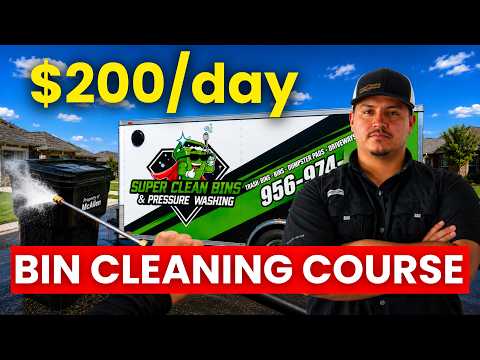
- $200/day Promised daily income
- <$500 Startup budget
- $15/bin Monthly price
- ~13 bins/day $200/day at $15
The claim
That with under $500 of equipment and a seven-day plan, a beginner can build a bin cleaning business paying $200 a day, mainly through $15-a-month recurring customers.
- Daily income promised — $200 a day
- Startup equipment budget — Under $500
- Electric pressure washer — $100–$200
- One-time price — $20–$40 per bin
- Bimonthly price — $18 per bin every two months
- Monthly price — $15 per bin
- Their own business — "Over six figures in revenue" — period never given
- 15 monthly customers at $15 (on-screen equation) — $225 a month — correct
- 40–50 monthly customers at $15 — ~$20–$25 a day, not $200
- Profit, costs beyond equipment, time per bin — Never stated
What is this income idea?
Pressure-wash and sanitise residential wheelie bins at the kerb, sell the service door to door, and convert one-off cleans into monthly subscriptions.
- The pitch opens with a promise: "7 days from right now you could be running a business that pays you $200 a day." All it takes, they say, is "a trip to Home Depot and less than 500 bucks". On-screen text at about 1:06 repeats it: "Trip to Home Depot" and "Less than $500". They own Super Clean Bins and say their company "has done over six figures in revenue".
- The seven days are laid out in order. Day one is equipment: an electric pressure washer in the 2,000–3,000 PSI range ("about $100 to $200"), a portable water tank, liquid pool chlorine, a deodoriser, a two-gallon pump sprayer and a brush.
- Day two is branding — a free logo built with ChatGPT and Canva, a printed shirt, door hangers, flyers and business cards, all of which they note are available from their Etsy shop or a starter bundle. Day three is pricing: $20 to $40 per bin one-time, $18 per bin every two months, or $15 per bin monthly, always steering people towards the monthly plan.
- Day four is where to find customers: door to door, friends and family, Facebook groups, Nextdoor, HOA communities, higher-income neighbourhoods and 55-and-over communities. Day five is a word-for-word door script, day six is objection handling, and day seven is converting one-off jobs into plans and clustering customers street by street.
- The specifics are genuinely useful. The problem is the arithmetic that connects them to the headline. Their worked example, shown as an on-screen equation at about 4:14 and again at 8:43, is "15 Cs/mo" × "$15/Day" = "$225/Monthly": 15 monthly customers at $15 a bin, which is correct, though the on-screen label says "/Day" where the spoken price is "$15 a bin". They then close by saying that 40 to 50 recurring customers will make the $200 a day "take care of itself". At their own monthly price, 40 to 50 customers produce $600 to $750 a month.
- They are candid that a week gets you started rather than finished: "you're not at six figures yet but you've got everything you need to start."
Buy a pressure washer and chlorine, knock on doors, and try to turn one-off $20 cleans into $15-a-month subscriptions — but you need hundreds of those, not dozens, for $200 a day.
- Buy the kit — Under $500
- Brand it — Canva, shirt, door hangers
- Set three tiers — $20–40 / $18 / $15
- Knock on doors — HOAs, 55+, higher income
- Run the script — $15 "today only"
- Handle the nos — Three objections
- Convert to monthly — Cluster by street
- $200 a day — Needs ~13 bins daily
A sound sequence for getting a first customer. The last step is where the numbers stop matching.
Recurring revenue is the right idea. It is just smaller than the video says.
The lesson underneath the number
- The strongest part of this video is its structure. It turns a vague "start a side hustle" into seven concrete days with a shopping list, a price sheet, a target-neighbourhood list, a door script and answers to the three objections a beginner will actually hear. They are also right about the strategic point: a cleaning business that has to find a new customer every day is exhausting, and one whose customers are booked every month on the same street is a route. Clustering by street and steering people to monthly plans is how service businesses of this kind become efficient.
- Where the video does not reconcile is the scale that follows. Its worked example is correct — 15 monthly customers at $15 a bin is $225 a month, shown in an on-screen equation — and it is followed immediately by the claim that 40 to 50 recurring customers make $200 a day "take care of itself". At the price they recommend, they produce $600 to $750 a month. The opening promise of $200 a day would need around 290 monthly bins, cleaned at about 13 a day, every working day.
- There is also a quiet trade-off in the pricing that goes unremarked. Converting a $20 one-off clean into a $15 monthly plan is presented as turning "a $20 job" into "180 a year", which is accurate. But it cuts the price of each clean by a quarter in exchange for frequency, which only pays if the route is dense enough that the extra visits cost little. That is the right bet for a mature route and a thin one for someone with twelve scattered customers.
- None of this makes the business a bad idea, and they are honest that a week gets you to a start, not to six figures. But the number a viewer remembers is the first sentence, and the video's own arithmetic does not reach it. The "over six figures in revenue" behind the advice comes with no time period and no profit figure, and the video also sells a starter bundle and templates to the same audience.
So let's get to 40 to 50 recurring customers and that $200 a day takes care of itself.
At $15 a bin, 50 customers produce about $25 a day
The seven days, as they give them
Concrete, cheap and in a sensible order.
Taken from what is said and shown in the video (published 10 June 2026). The recurring-revenue example appears as an on-screen equation at about 4:14 and 8:43, and the start-up budget as on-screen text at about 1:06; both are the creator's own graphics.
- Day 1 — Buy the equipment — Electric pressure washer, 2,000–3,000 PSI, "about $100 to $200"; a portable water tank so you do not depend on the customer's tap; liquid pool chlorine and a deodoriser; a pump sprayer and a brush. Only the washer is priced; the "under $500" total is asserted rather than itemised.
- Day 2 — Look like a company — Logo from ChatGPT and Canva, a printed shirt, door hangers, flyers and business cards. Sensible advice; they also point viewers to their own Etsy shop and starter bundle for the templates.
- Day 3 — Three price tiers — $20–$40 per bin one-time, $18 per bin every two months, $15 per bin monthly. The structure is clear and the push towards monthly is the right instinct for route density.
- Day 4 — Choose where to knock — HOA communities (bins often kept in the garage), higher-income neighbourhoods and 55-and-over communities, plus Facebook groups and Nextdoor. Targeted and plausible.
- Day 5 — The door script — Greeting, what you do, the price, the plans, and a soft close: "Want me to take care of it right now that I'm here?" They advise against pushing.
- Day 6 — Three objections — Too expensive, I'll do it myself, maybe later. The "maybe later" answer relies on a today-only $15 price — a mild urgency tactic they are open about.
- Day 7 — Stack recurring customers — Convert every one-off clean into a plan, lock down one street at a time, and route customers together. The logic is right; the customer count they attach to $200 a day is not.
The business model
Per-bin cleaning fees: $20–$40 one-time, $18 every two months, or $15 monthly.
Homeowners, with HOA communities, higher-income neighbourhoods and 55-and-over communities named as the best prospects.
Sanitised, deodorised bins without the homeowner touching them — "no more smell no more bacteria".
Door-to-door canvassing with a script, door hangers, friends and family, Facebook groups and Nextdoor.
- Pressure washer — $100–$200, the only priced item
- Water tank, sprayer, brushes — Named, not priced
- Chlorine and deodoriser — A consumable on every job; never priced
- Branding and printed materials — Shirt "for a few bucks"; the rest unpriced
- Transport — "No truck" is said; how the kit moves is not
- Insurance, licensing, waste water — Not mentioned
- Your time per bin — Never stated
The only cost figures are for start-up equipment. Nothing is said about running costs, margin or profit per bin.
What you would actually need
Money
"A trip to Home Depot and less than 500 bucks." No truck, no ad budget, no website.
Under $500 for the listed kit is plausible, but only the pressure washer is priced. The video says no truck is needed, yet you are hauling a water tank, a washer and chemicals from street to street; how they travel is never addressed. Insurance, local licensing and where the chlorinated wash water goes are not mentioned.
Named or implied, not priced
- Electric pressure washer — $100–$200 (the only priced item)
- Portable water tank
- Liquid pool chlorine and deodoriser, replenished continually
- Pump sprayer and brushes
- Branded shirt, door hangers, flyers, business cards
- A vehicle able to carry a filled water tank — not discussed
- Insurance, licensing, waste-water rules — not mentioned
- Their optional starter bundle — price not given in the video
Time
Seven days to a running business; $200 a day once 40 to 50 recurring customers are stacked.
Seven days to a first paying customer is realistic. Reaching $200 a day at $15 a bin means roughly 13 bins cleaned every working day, which in turn needs several hundred monthly bins on the books. That is months of door knocking, not a week.
Where the time actually goes
- Door-to-door canvassing, with "lots of nos" expected
- Return visits to convert one-off cleans into plans
- Travel between customers until routes are dense
- Cleaning time per bin — never stated
- Restocking water and chemicals
- Following up the people who said no "in three weeks"
The part you must pay attention to
At $15 a bin, 40 to 50 monthly customers make about $25 a day, not $200.
The video's closing promise is that once you "get to 40 to 50 recurring customers … that $200 a day takes care of itself." Their own price list says otherwise.
- Monthly customers (their upper figure) — 50
- Per bin, per month — $15
- Days in a month — ~30
~$25 a day
$750 a month, before any cost
The load-bearing assumption is that a few dozen subscribers produce a full-time daily income. They do not at these prices. A monthly customer is cleaned once a month, so each one contributes $15 to one day of work in that month. To earn $200 on every working day — call it 22 a month — you need about 13 bins a day, or roughly 290 monthly bins on the books ($200 × 22 ÷ $15). That is six to seven times the "40 to 50" the video names. The figure would be lower if most households pay for two bins, but the video prices per bin and never says how many bins a typical customer has.
The worked example itself is right: "15 monthly customers at $15 a bin is $225", shown on screen as "15 Cs/mo" × "$15/Day" = "$225/Monthly" (the "/Day" label does not match the spoken per-bin price, but the result does). The gap is in the next step. Neither $225 nor the $600–$750 a month that 40 to 50 customers produce is $200 a day. The plan for getting a first customer stands up; the bridge from that customer to the income in the opening line does not.
- THEIR FIGURES
- On screen: 15 Cs/mo x $15
- = $225/Monthly
- 15 x $15 = $225 (correct)
- 40-50 CUSTOMERS AT $15
- 40 x $15 = $600/month
- 50 x $15 = $750/month
- / 30 days = $20-$25/day
- WHAT $200/DAY NEEDS
- $200 / $15 = ~13 bins/day
- x 22 working days = ~290 bins/mo
- vs their "40 to 50" = 6-7x short
- THE DOWNGRADE
- One-time clean $20
- Monthly clean $15
- 12 x $15 $180/yr
- Per-clean price -25%
The economics
A clear price list, a correct worked example, a daily target it does not reach, and no running costs.
- One-time price — $20–$40 per bin
- Bimonthly price — $18 per bin
- Monthly price — $15 per bin
- Annual value of a monthly bin — $180
- Annual value of a bimonthly bin — $108
- 15 monthly customers at $15 (on-screen example) — $225/month
- 40–50 monthly customers at $15 — $600–$750/month
- Bins needed for $200/day — ~13 a day; ~290 monthly bins
- Startup equipment — Under $500
- Running costs, time per bin, profit — Never stated
What $200 a day requires at the recommended price
$200 ÷ $15 = 13.3 bins a day; 13.3 × 22 working days ≈ 290 monthly bins on the books
About 290 monthly bins — six to seven times the "40 to 50 recurring customers" the video names
IncomeIdeaLab calculation from the prices stated in the video
A customer with two bins counts twice, which would roughly halve the number of households needed. The video prices per bin and never says how many bins a typical household has, so we have not assumed one. The figures are revenue, before chemicals, fuel, insurance or the operator's time.
- Time to clean one bin, and therefore bins per hour
- Running cost per clean — chlorine, water, fuel
- The period over which "six figures in revenue" was earned
- Whether their business is profitable, and by how much
- Monthly customer cancellations
- The price of the starter bundle promoted in the video
- "That's how a $20 job becomes 180 a year" is correct: 12 × $15 = $180. It is also a 25% cut in price per clean, which only pays off if routes are dense.
- The bimonthly tier at $18 every two months is $108 a year per bin — 60% of a monthly bin's value for half the visits, which is arguably the better-margin plan for a sparse route.
- The door-script discount ("regular price is 20 … you're going to do it for 15") means first-visit revenue starts at the monthly rate, not the one-time rate.
- Equipment of under $500 is plausible for the items listed, but it is a stated total, not an itemised one; only the pressure washer has a price.
Evidence status
Every substantive figure in the video.
- "A business that pays you $200 a day" within 7 days — Creator — Needs ~13 bins a day at $15. Not supported by the plan's own numbers.
- Under $500 to start — Creator — Plausible for the kit listed; only the washer is priced.
- Pressure washer $100–$200 — Creator — Specific and reasonable for an electric unit.
- $20–$40 / $18 / $15 price tiers — Creator — Clear and consistent through the video.
- "15 monthly customers at $15 a bin is $225" — Creator; on-screen equation at 4:14 and 8:43 — Correct. The on-screen equation labels the $15 "/Day"; the spoken price is per bin.
- Under $500 and "a trip to Home Depot" — Creator; on-screen text at 1:06 — Shown in an on-screen graphic; not itemised.
- 40–50 recurring customers make $200 a day "take care of itself" — Creator — At $15, 50 customers make ~$25 a day.
- "A $20 job becomes 180 a year" — Creator — Correct, at a 25% lower price per clean.
- Their company "has done over six figures in revenue" — Creator — No time period, no profit figure.
- Running costs, time per bin, profit — Nobody — Absent throughout.
What is actually proven?
The method is specific. The income is not shown.
- A complete equipment list, price list, door script and objection answers are given.
- They say plainly that a week gets you started, not to six figures.
- Their company has done "over six figures in revenue" — no period or profit given.
- The on-screen example, 15 monthly customers at $15 = $225 a month, is correct; 40 to 50 customers at $15 is $600–$750 a month.
- $200 a day at $15 a bin requires roughly 290 monthly bins, not 40 to 50.
- Time per bin, running cost per clean and profit.
- Their own Etsy templates, starter bundle and Discord are promoted in the video.
What the headline doesn’t tell you
The first sentence is the promise; the last section is the arithmetic.
- 50 × $15 is $750 a month. — About $25 a day.
- $200 a day needs ~13 bins daily. — Every working day.
- That is ~290 monthly bins. — Not 40 to 50.
- Monthly is a price cut. — $20 down to $15 per clean.
- "Six figures" has no timeframe. — And no profit attached.
- Only the washer is priced. — The rest of the $500 is asserted.
- "No truck" — but a water tank. — Transport is never addressed.
- They sell the starter kit. — Templates, bundle, Etsy shop.
Should you try it?
A sensible cheap test — with realistic income expectations
Use the seven-day plan to find out whether your street will pay. Do not plan around $200 a day until you have a few hundred bins booked.
- Specificity of the plan — 8 — Kit, prices, target areas, script and objections all given.
- Startup cost realism — 6 — Plausible, but only the washer is priced and transport is skipped.
- Accuracy of the income arithmetic — 3 — The worked example is correct; the $200/day claim is 6–7× beyond its own inputs.
- Evidence for their own results — 3 — "Six figures in revenue" with no period, profit or dashboard.
- Cost disclosure — 2 — Start-up only; no running cost, time or margin.
- Honesty about the timeline — 6 — Says plainly that week one is a start, not six figures.
- Conflict-of-interest disclosure — 6 — Their bundle and Etsy shop are named as theirs.
- Beginner accessibility — 7 — Low capital and learnable skills.
- As a low-cost experiment this is reasonable. The equipment is modest, the skills are learnable in an afternoon, and the target-neighbourhood advice — HOAs where bins live in the garage, older residents who will not wrestle a hose, higher-income streets that pay for convenience — is a good way to find early yeses. Running the plan for a week will tell you quickly whether your area will pay $15 to $20 a bin.
- Set your income expectations with your own calculator, not the video's. A monthly customer is worth $15 a month per bin. Fifty of them is $750 a month, before chlorine, fuel, insurance and your time. The $200-a-day figure in the opening sentence needs around 13 bins cleaned every working day, which means roughly 290 monthly bins on the books — or around half that many households if most have two bins, a figure the video never gives.
- Think carefully about the pricing trade-off they recommend. Moving a customer from a $20 one-off to $15 monthly cuts your price per clean by a quarter. It makes sense once a street is dense enough that one stop covers many houses, and much less sense when your first dozen customers are scattered across town. The $18 bimonthly tier may suit a young route better.
- Finally, work out the things the video leaves out before you knock on doors: how you will move a filled water tank, what insurance you need, whether your area has rules on discharging chlorinated wash water, and how long one bin takes you. Those answers decide whether $15 a bin is a living or a hobby.
Passive or automated?
Automation
Every bin is cleaned by hand at the kerb.
Passive potential
Recurring billing is predictable, but the work recurs too.
The video describes recurring revenue as money that "comes back automatically" and "hits every single month on autopilot". The billing may, but the work does not: a monthly customer is a monthly visit with a pressure washer, chlorine and a water tank. What recurring plans automate is selling, not cleaning — you stop knocking for the same revenue, which is a real benefit, but the income still stops the day the cleaning does. Scaling beyond one person's daily capacity means hiring and equipping someone else, which the video does not cover.
- Cleaning and sanitising every bin, every visit
- Door-to-door canvassing and follow-ups
- Refilling water and chemicals
- Driving the route
- Handling cancellations and objections
Recommended beginner experiment
Run the seven days, then let the numbers decide.
- Price the full kit yourself. — Including transport for the water tank.
- Check local rules first. — Insurance and waste-water discharge.
- Time your first ten bins. — Bins per hour sets your real wage.
- Knock one target street. — HOA or 55+, as they suggest.
- Record yes, no and plan chosen. — Your own conversion rate.
- Track bins per household. — It halves or doubles the target.
- Do the $200-a-day sum honestly. — ~13 bins a day at $15.
- Only then buy templates or kits. — Free Canva works, as they say.
Our verdict: 5/10
A practical starter plan with a broken income sum the $200 a day needs six to seven times the customers the video names
Credited for a genuinely specific seven-day plan — equipment list, a priced pressure washer, three clear price tiers, named target neighbourhoods, a word-for-word door script and answers to the three commonest objections; for saying plainly that a week gets you started rather than to six figures; and for naming their own templates and starter bundle as theirs. Marked down because the closing claim that 40 to 50 recurring customers make $200 a day "take care of itself" is about six to seven times beyond what those customers produce at the stated price; because "over six figures in revenue" has no time period and no profit figure; and because no running cost, time per bin or margin is given.
As a how-to, this is better than most. In under ten minutes it gives a beginner a shopping list, a price sheet, a set of neighbourhoods to target, a door script and replies to the objections they will hear, and its central strategic point — convert one-off cleans into monthly plans and cluster them street by street — is how this kind of service business becomes efficient. The creator is also honest that a week gets you to a first customer, not to six figures. Where it falls down is the arithmetic linking that plan to the promise in its first sentence. Its worked example is sound — 15 monthly customers at $15 a bin is $225, shown in an on-screen equation — but the closing assurance that 40 to 50 recurring customers make $200 a day take care of itself does not survive the video's own prices — at $15 a bin, fifty customers bring in about $25 a day. Reaching $200 on every working day needs around 13 bins cleaned daily, or roughly 290 monthly bins on the books. The "over six figures in revenue" behind the advice has no timeframe or profit attached, and the video also promotes the creator's own templates and starter bundle. Run the seven-day plan as a cheap test of your street; plan your income from your own count of bins, not from the opening line.
- Promised income — $200/day
- Monthly price — $15 per bin
- 15 monthly customers (on-screen example) — $225/month
- 50 monthly customers — $750/month
- Needed for $200/day — ~290 monthly bins
- Startup — Under $500
- Their own revenue — "Six figures", no period
- Running costs — Never stated
- Beginner suitability — Good test, modest income
Sources
- How to Start a Bin Cleaning Business in 7 days — YouTube video, 2026-06-10
- FTC — Guides Concerning the Use of Endorsements and Testimonials — Regulatory guidance on earnings claims