Ecommerce / Amazon FBA · Claim Review
“Best Way To Start Amazon FBA From Scratch! (EXACTLY What I'm Doing)”
What we found: Amazon FBA Men's Eyebrow Pencil: $3,000 First Month, About $1,500 Left After Fees, With Ad Spend Not Stated
The fee arithmetic checks out for both the creator's launch and a student's $280,000 Amazon year. Neither account states advertising, storage or design costs, and the $1,305 inventory outlay is about what month one returned.
- $3,000+ Month-one revenue
- ~$1,500 Left after fees
- $1,305 Paid up front
- Not stated Ad spend
The claim
That Amazon FBA still works in 2026 using "niche branding", shown by a new men's makeup product that was profitable in its first month, and by a student who made over $500,000 in their first year.
- Inventory — 900 units for $1,080
- Freight China to US — $150
- Barcodes — $75 for three
- Total paid before launch — $1,305 (plus unpriced design work)
- Month-one revenue — Over $3,000
- Referral fee / fulfilment fee — Over $400 / over $700
- Product cost of units sold — "A few hundred"
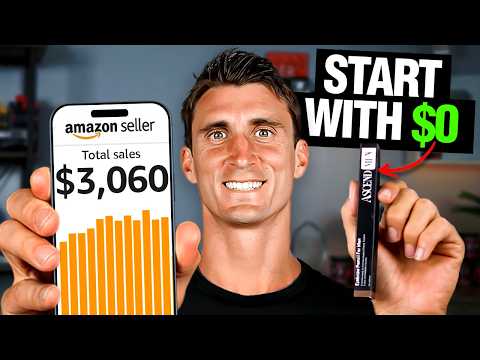
- Left after those costs — "Over $1,500" (called sales); an on-screen overlay at 10:40 shows $3,060, -$283, -$404, -$792 and $1,581
- Student's first year on Amazon — $280,000 sales, "over $100,000 in profit"
- Student's Amazon profit from stated costs — $113,000
- Creator's Amazon income last year — "Over $900,000"
- Advertising, storage, returns, design — Not stated
What is this income idea?
Take a big Amazon category, find a sub-group of buyers no one is serving, and launch a branded product made for them, sourced from an existing manufacturer.
- The creator contrasts three common ways to sell on Amazon (retail arbitrage, wholesale and private label) and argues that all three are easy to copy, citing over 1.1 million active sellers and 85% of them doing private label or wholesale. Those figures are stated without a source in the video.
- The alternative they teach is "niche branding": serve a narrow group inside a large category. Their earlier example is an electrolyte for people on the carnivore diet, which they say did over a million dollars in sales and was part of a business sold for $840,000.
- The new test is makeup for men. Using a keyword tool, the creator says a men's eyebrow brush was searched over 300 times a month with no matching results, so they took an existing women's eyebrow pencil on Alibaba, asked for modifications and new packaging, and ordered 900 units in three colours.
- The costs are given: about $1.20 a unit, $1,080 for the order, $150 freight, $75 for three barcodes. Design was done by an agency the creator links to with a coupon code, and its price is not stated.
- Month one brought in over $3,000 in revenue. The creator is careful to say that is revenue, not profit, and lists the costs: a few hundred dollars of product, over $400 in Amazon's 15% referral fee and over $700 in fulfilment fees, leaving "over $1,500".
- A student's first year is given as a second data point: over $500,000 in sales, $280,000 of it from Amazon, with manufacturing, referral fees and fulfilment fees listed and "over $100,000 in profit" on Amazon.
Make a version of an existing product for a buyer group nobody is targeting, sell it through Amazon's warehouses, and grow it over months.
- Pick a big category — Makeup
- Find an unserved niche — Men's eyebrow pencil
- Check search demand — 300+ searches a month
- Source on Alibaba — 900 units, ~$1.20 each
- Brand and package — Agency, price not stated
- Ship to Amazon — $150 freight
- Launch and sell — $3,000 in month one
- Pay Amazon's fees — ~$1,100+ in month one
Costs are given for almost every step, which is uncommon in this genre.
A rare launch with the fees shown, and a student P&L that adds up
The lesson underneath the number
- Most Amazon income videos give a revenue figure and stop. This one gives the purchase price per unit, the freight bill, the barcode cost, the referral fee, the fulfilment fee and the product cost of what sold, and the creator says clearly that $3,000 was revenue and not profit. The figures reconcile: 15% of $3,000 is $450, and taking the stated costs out of revenue leaves about $1,500.
- The student's first year holds up in the same way. $280,000 of Amazon sales, less $84,000 in manufacturing, $43,000 in referral fees and $40,000 in fulfilment fees, leaves $113,000, which matches "over $100,000 in profit". The referral fee works out to 15.4% of sales, consistent with the rate the creator gives.
- What both accounts leave out is advertising. A new listing on Amazon is usually found either through organic search or paid placement, and the video says nothing about whether either the eyebrow pencil or the student's products used paid ads, or what they cost. Storage fees and returns are not mentioned either. For the student, that means $113,000 is an upper bound on Amazon profit before ads, storage and the student's own time.
- The context is said openly. The keyword tool and design agency are offered with the creator's discount links, and the video invites viewers to a free call where the creator or the team will explain how to join the mentorship programme. The student whose year is described is presented as someone taught the method. The student's other "few hundred thousand", which the video says it will come back to, is not explained in the video.
To be clear that $3,000 was revenue it wasn't profit.
The creator, on month one
The launch, as the creator gives it
A first-month account with most costs attached.
No advertising, storage or design cost is given for any stage.
- Choose a niche inside a large category — The reasoning is that a small share of a very large market is still a lot of buyers, and that a product built for a specific group is harder to copy than a generic one.
- Check demand with a keyword tool — Over 300 monthly searches for a men's eyebrow brush, with no matching products, by the creator's reading of a third-party tool they link to with a discount.
- Modify an existing product — An eyebrow pencil already made for women, with modifications and new packaging. 900 units for $1,080.
- Brand it — Logo, packaging and listing by a design agency, offered to viewers with the creator's coupon code. The price paid is not stated, and "so far I've spent $0" comes just before this step.
- Ship and register — $150 to ship from China to the United States and $75 for three barcodes, one per colour.
- List and launch — A main image, a title and bullet points. Whether any advertising or launch promotion was used is not stated.
- Account for Amazon's fees — Revenue over $3,000; referral fee over $400; fulfilment fee over $700; product cost a few hundred; about $1,500 remaining.
The business model
Unit sales of a branded men's eyebrow pencil in three colours on Amazon, with more men's makeup products planned.
Men interested in grooming and cosmetics, a group the creator says is not served by existing products on Amazon.
A familiar product packaged and positioned for a buyer group that searches for it and finds nothing.
Amazon search, with Amazon storing, packing and shipping each order.
- Inventory — $1,080 for 900 units, about $1.20 each
- Freight and barcodes — $150 and $75
- Amazon referral fee — 15% of revenue, over $400 in month one
- FBA fulfilment fee — Over $700 in month one
- Design agency — Not stated
- Advertising, storage, returns — Not stated
More costs are given here than in most Amazon videos we have reviewed. The ones left out are the ones that tend to grow with sales: advertising and storage.
What you would actually need
Money
"So far I've spent $0 to start my business" (before design and inventory), then $1,080 for 900 units, $150 freight and $75 for barcodes.
About $1,305 in stated cash before the first sale, plus the design agency, plus any keyword tool after its trial. That is a modest stake for a physical product, and the creator's month-one result roughly returned it.
Stated, and not stated
- Inventory: $1,080 for 900 units
- Freight: $150
- Barcodes: $75 for three
- Design and packaging: not stated
- Keyword tool after the free trial: not stated
- Advertising: not stated
- Amazon storage fees and seller account: not mentioned
Time
The launch "took very little work". The earlier carnivore product grew from $6,000 in month one to $100,000 by month ten.
The process described is genuinely short. The creator's own earlier product took ten months to reach $100,000, and says "with Amazon things take time to increase". Manufacturing and shipping lead times are not stated.
The timeline the video gives
- Idea and demand check: a keyword search
- Design: by an agency
- Manufacturing and freight: time not stated
- Month one: $3,000 revenue
- Earlier product: $6k, $10k, $20k, $30k, then $100k by month 10
- Student: one year to $280,000 on Amazon
The part you must pay attention to
The month-one $1,500 is what is left after fees, and it roughly equals what was paid up front.
The video says "we did over $1,500 in sales" for month one, right after listing the costs taken out of $3,000 in revenue. From the arithmetic, the $1,500 is the remainder after fees and product cost, not sales.
- Month-one revenue — $3,000+
- Amazon referral fee (15%) — $400+
- FBA fulfilment fee — $700+
- "A few hundred" in product cost — ~$300
~$1,500–$1,600
Left before advertising, storage and design
The calculation leaves out costs a new Amazon listing usually carries and the video does not state: advertising to get the listing seen, monthly storage for the unsold units, returns, and the design agency. If any advertising was run in month one, the $1,500 is lower. The "already profitable" statement is true on the per-unit costs given; against the $1,305 paid up front for all 900 units, month one roughly broke even.
Credit where due: the creator separates revenue from profit unprompted and gives fee figures that check out. Fifteen per cent of $3,000 is $450, consistent with "over $400". The month-one result is a fair first data point. Read the $1,500 as roughly what came back of the $1,305 stake, with the remaining stock (an estimated 650 units by our reckoning) still to sell, and with advertising not stated.
- MONTH ONE, AS STATED
- Revenue >$3,000
- Referral fee (15%) >$400
- 15% x $3,000 = $450 ok
- FBA pick and pack >$700
- Product cost "a few hundred"
- Left >$1,500
- (the video says "sales")
- AGAINST THE STAKE
- 900 units $1,080
- Freight $150
- Barcodes $75
- Paid up front $1,305
- Month one returned ~$1,500
- -> roughly break-even
- NOT STATED
- Ads, storage, returns, design ???
The economics
Two P&Ls, both reconcilable, both missing advertising.
- Unit cost — ~$1.20 ($1,080 / 900)
- Upfront cash (units, freight, barcodes) — $1,305
- Month-one revenue — $3,000+
- Month-one Amazon fees — $1,100+
- Month-one remainder — $1,500+ said; $1,581 on the on-screen overlay
- Student: Amazon sales — $280,000
- Student: manufacturing + fees — $167,000
- Student: Amazon profit before ads — $113,000
- Advertising, storage, returns, design — Not stated
The student's Amazon year
$280,000 − $84,000 (manufacturing) − $43,000 (referral) − $40,000 (FBA) = $113,000
Matches the stated "over $100,000 in profit" on Amazon; a 40% margin before advertising, storage and tax
IncomeIdeaLab calculation from the figures stated in the video
No advertising, storage, freight, design or software cost is included for the student, so the true Amazon profit is $113,000 less those amounts. The student's remaining sales, over $220,000 outside Amazon by our subtraction, are not explained in the video.
- Advertising spend on the eyebrow pencil or the student's products
- Amazon storage fees on unsold inventory
- Design agency fee
- Keyword tool subscription after the trial
- Returns and refunds
- How the student made the rest of their $500,000+
- The breakdown of the creator's "over $900,000" last year
- 15% of $3,000 is $450, consistent with "over $400" in referral fees. Our arithmetic.
- $43,000 / $280,000 = 15.4%, consistent with the 15% referral rate. Our arithmetic.
- If "a few hundred" in product cost is about $300 at $1.20 a unit, about 250 units sold in month one, an average price near $12, and about 650 units remain. Our estimate; the price and unit count are not stated.
- The earlier carnivore electrolyte grew from $6,000 in month one to $100,000 by month ten, about 16.7 times, which fits "over 15x higher". Our arithmetic.
- Amazon's sales, Prime membership and third-party share figures quoted at the start are attributed to no source in the video and could not be checked from it.
- The creator's statement that a first-year business is usually unprofitable is a general claim, given without data.
Evidence status
Every money figure in the video.
- Over $900,000 on Amazon last year — Creator — Revenue or profit not stated; not broken down in this video.
- Built a business in 7 days, $1M+ in sales, sold for $840,000 — Creator — Not checkable from the video.
- 900 units for $1,080; $150 freight; $75 barcodes — Creator — Specific, and adds to $1,305.
- Month one: over $3,000 revenue — Creator — Stated as revenue, not profit.
- Referral fee over $400; FBA fee over $700 — Creator — Referral fee consistent with 15%.
- "Over $1,500 in sales" after costs — Creator — The arithmetic shows this is the remainder after fees, not sales. The channel's on-screen overlay at 10:40 reads $3,060, -$283, -$404, -$792 and $1,581 (the five lines are not labelled in that frame); $3,060 less the three deductions is $1,581 (our arithmetic).
- "In month one we were already profitable" — Creator — True on per-unit costs; roughly break-even against the $1,305 stake. Ads not stated.
- Student: $500,000+ sales, $280,000 on Amazon — Creator — Not checkable from the video.
- Student: over $100,000 Amazon profit — Creator — Stated costs reconcile to $113,000; ads and storage not included.
- Student's other "few hundred thousand" — Creator — Said to be covered later; not explained in the video.
- Carnivore electrolyte: $6k month one to $100k by month 10 — Creator — Internally consistent with "over 15x".
What is actually proven?
The arithmetic holds. The results are stated, and advertising is missing.
- Upfront costs of $1,305 add up from the stated figures.
- Month-one fees are consistent with Amazon's 15% referral rate.
- Month one left about $1,500, roughly the upfront stake.
- The student's stated Amazon costs reconcile to $113,000 profit before ads.
- The creator separates revenue from profit without being asked.
- Advertising, storage and design costs for either account.
- Where the student's non-Amazon income came from.
What the headline doesn’t tell you
An open set of numbers with one category missing throughout.
- $1,500 is after fees. — The video calls it sales.
- Month one about repaid the stake. — $1,305 in, ~$1,500 back.
- No ad spend is stated. — For the launch or the student.
- Design cost is not stated. — Offered with a coupon code.
- The student's P&L adds up. — $113,000 before ads.
- Half the student's sales are unexplained. — Over $220,000 outside Amazon.
- Links and a call are disclosed. — Affiliate discounts and a mentorship call.
- Revenue is called revenue. — Credit to the creator.
Should you try it?
A realistic starter test, with advertising to budget for
The launch described is affordable and the fee maths is honest. Add an advertising budget and storage to the plan, since the video does not price them.
- Cost disclosure — 7 — Inventory, freight, barcodes and Amazon fees all given.
- Consistency of stated figures — 8 — Fees and the student P&L reconcile.
- Revenue vs profit clarity — 6 — Separated clearly, then the remainder is called sales.
- Advertising disclosure — 1 — Not mentioned for either account.
- Evidence for headline results — 4 — $900k, $1M and $840k are stated without a breakdown.
- Conflict-of-interest disclosure — 7 — Discount links, a coupon code and the mentorship call are all said aloud.
- Startup cost — 7 — About $1,300 plus design, by the video's figures.
- Beginner accessibility — 5 — Simple process; product choice and ads carry the risk.
- This is one of the more useful Amazon launch videos for a beginner because it puts numbers on almost every step. You can see what 900 units cost, what freight and barcodes cost, what Amazon took in referral and fulfilment fees in month one, and what was left. The creator says clearly that $3,000 was revenue and not profit, which is the distinction most beginners miss.
- Read the result as a break-even month, not a profit month. About $1,305 went out before the first sale, and about $1,500 came back after fees and product cost. That is a good outcome for month one, and it means the stake was roughly recovered with stock still on hand. It does not yet tell you what the product earns once advertising and storage are counted.
- Advertising is the cost to plan for. The video does not say whether the pencil or the student's products were advertised. For your own plan, assume you will need some paid placement to get a new listing seen, and price it before you order inventory. Do the same for monthly storage on the units that have not sold yet.
- The student's year is a useful benchmark if you read it carefully: $280,000 in Amazon sales and $113,000 left after manufacturing and Amazon fees, before ads, storage and tax. The student's other sales are not explained in the video. The creator offers a free call that leads to their mentorship programme, and says so; that is worth knowing when weighing the student example.
Passive or automated?
Automation
Amazon stores, packs and ships every order.
Passive potential
Reordering, listings, ads and new products remain ongoing work.
Fulfilment by Amazon removes the most labour-intensive part of selling physical products: Amazon holds the stock, picks and packs each order, and ships it, for the fee the creator lists. The creator's description of the launch as "very little work" fits the steps described. What remains is ongoing: reordering inventory before it runs out, managing the listing and any advertising, handling returns and reviews, and, by the creator's plan, launching more men's makeup products. It is lower-touch than most ecommerce, not passive.
- Choosing and validating each new product
- Ordering and shipping inventory from the manufacturer
- Managing listings, reviews and returns
- Running and monitoring any advertising
- Reordering before stock runs out
Recommended beginner experiment
Copy the launch, and add the costs the video leaves out.
- Find an unserved niche in a big category. — The video's method.
- Confirm search demand. — The creator used 300+ monthly searches.
- Order a small first batch. — 900 units for about $1,080.
- Price the design work up front. — Not stated in the video.
- Budget for advertising. — Not stated in the video.
- Account for 15% referral plus FBA fees. — About 37% of month-one revenue here.
- Count storage on unsold stock. — Not mentioned.
- Judge it at month six, not month one. — The creator's own earlier product took ten months.
Our verdict: 6/10
A transparent launch whose fee maths checks out, with advertising left out month one roughly repaid the $1,305 stake, and the student's Amazon P&L reconciles before ads
Credited for giving inventory, freight, barcode and Amazon fee figures that reconcile; for stating plainly that $3,000 was revenue and not profit; for a student P&L whose costs add to the stated profit; for an earlier product's month-by-month growth that is internally consistent; and for saying aloud that the keyword tool and design agency links carry discounts and that the free call leads to a mentorship offer. Marked down because the month-one $1,500 is called sales when the arithmetic shows it is the remainder after fees; because no advertising, storage, returns or design cost is given for either account; because the student's non-Amazon income, over $220,000 by our subtraction, is not explained in the video; and because the headline figures of $900,000 last year and an $840,000 sale are stated without a breakdown.
Few Amazon videos give this many usable numbers. The creator orders 900 men's eyebrow pencils from an existing manufacturer for $1,080, pays $150 to ship them and $75 for barcodes, and in month one brings in over $3,000, while saying clearly that this is revenue and not profit. The listed costs reconcile: Amazon's 15% referral fee on $3,000 is about $450, fulfilment fees take over $700, product cost a few hundred, and about $1,500 is left. The video calls that $1,500 "sales", but the arithmetic shows it is what remains after fees, and it is roughly the $1,305 paid up front. So month one was close to break-even on the cash put in, which is a reasonable start with most of the stock still to sell. The student example reconciles too: $280,000 in Amazon sales less $167,000 in manufacturing and Amazon fees leaves $113,000, matching the stated "over $100,000 in profit". What neither account includes is advertising, and storage, returns and the design agency are also not priced, so both profit figures are upper bounds. The student's other sales, which the video says it will return to, are not explained. The keyword tool and design agency come with the creator's discount links and the free call leads to a mentorship programme, all said openly. For a beginner, this is an honest template for a first launch, as long as an advertising budget is added to it.
- Upfront stake — $1,305 + design
- Month-one revenue — $3,000+
- Month-one Amazon fees — $1,100+
- Month-one remainder — ~$1,500 (on-screen overlay: $1,581)
- Student Amazon profit before ads — $113,000
- Advertising — Not stated
- Beginner suitability — Yes, with an ad budget added
Sources
- Best Way To Start Amazon FBA From Scratch! (EXACTLY What I'm Doing) — Travis Marziani — YouTube video, 2026-07-06
- FTC — Guides Concerning the Use of Endorsements and Testimonials — Regulatory guidance on endorsements and material connections