SaaS / AI Search Software · Claim Review
“I Built An $85M AI Startup in 5 Months (here's my playbook)”
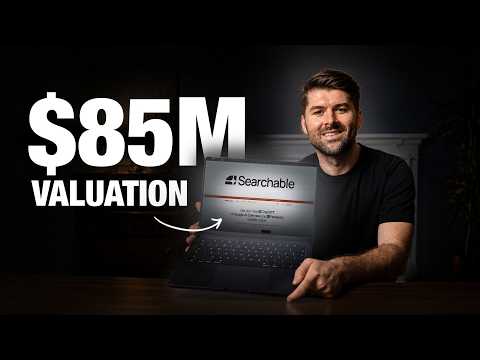
What we found: $3M ARR in Five Months Is Detailed. The $85M Valuation Is a $14M Funding Round Shown for Four Seconds.
A three-founder AI search startup with a team of 18 and a founder on their fourth eight-figure business. The playbook is specific; the valuation comes from a priced round reported on screen and not discussed.
- $3M+ Stated ARR
- $85M Valuation
- ~28× ARR Implied multiple
- 3 founders, 18 staff Team
The claim
That an AI search visibility startup reached $3 million in annual recurring revenue and an $85 million valuation five months after launch.
- Annual recurring revenue, early June — Beyond $3 million
- ARR 60 days after public launch — $1 million
- Valuation — $85 million
- Funding round behind it (Unite.AI article on screen at 0:04, 18 May 2026) — $14 million raised
- Valuation as a multiple of ARR — ~28×
- Time from founding team to $3M ARR — ~9 months (Sept to June)
- Free report users converting to paid — "Nearly 50%"
- Waitlist sign-up rate from content — "50 60 sometimes 70%"
- Early-access discount — 50% for life
- Team — 3 co-founders, now 18 people
- Costs, burn, profit — Not stated
What is this income idea?
Software that shows businesses how often they appear in answers from AI assistants such as ChatGPT, Gemini and Perplexity, and helps them improve it.
- The founder says the business "just hit $3 million in annual recurring revenue and got valued at $85 million just 5 months after we launched it", and adds that this is "the fourth time I've built a business past 8 figures". During that opening line, a news article from Unite.AI is on screen with "$85" highlighted: "Searchable Raises $14M at $85M Valuation as AI Search Reshapes Digital Marketing", dated 18 May 2026.
- The timeline the founder gives starts in September, with a trip to San Francisco to meet two engineers who became co-founders. From October they posted daily educational content about AI search with a waitlist link. In November the three chose a single first feature, prompt tracking. In mid-December they let a larger group from the waitlist in at a lifetime 50% discount. The public launch was in January.
- The founder says the company reached $1 million in ARR within 60 days of that launch, hired into product, engineering and marketing, and by the start of June had passed $3 million with a team of 18.
- The most specific growth claim is about a free "AI visibility report": anyone could generate one, but reading the full results required an account, and "nearly 50% of those free users converted to paid users".
- The $85 million valuation is spoken in the opening sentence and nowhere else. The $14 million raise behind it appears only in the article on screen; the investors and terms are not discussed.
Three co-founders built an AI search visibility tool, used a large existing audience to fill a waitlist, report $3 million ARR five months after launch, and raised $14 million at an $85 million valuation.
- Form a founding team — September
- Daily founder content — From October
- Waitlist — 50–70% sign-up, the founder says
- One-feature MVP — Prompt tracking, November
- Early access at 50% off — Mid-December, for life
- Public launch — January
- $1M ARR in 60 days — Then hiring
- $14M raised at $85M — Reported 18 May
- $3M ARR, 18 staff — Early June
Nine months from founding team to $3M ARR, five of them after launch, with a priced funding round along the way.
A real launch method, and an advantage most viewers do not have
The lesson underneath the number
- The launch sequence here is one of the clearer ones we have seen. Build the audience before the product. Collect a waitlist with no financial ask. Ship one feature for one customer. Let a discounted early group shape the product through daily calls and a shared Slack. Use a free tool that shows a prospect their own problem, and put the full answer behind an account. Each step is concrete and in a sensible order, and the advice to welcome competitors because they prove a budget exists is a useful corrective to "no one else is doing this".
- What makes it work for this founder is stated plainly in the video, and is the part a viewer should weigh most. This is their fourth business past eight figures. They have been posting founder content for four years. They could fly to San Francisco and meet "dozens of engineers" and talk to "hundreds" more on Zoom to find two co-founders. The waitlist method "works at any size", they say, and the mechanism may, but the speed described depends on the audience and network already in place — and, the cold open shows, on a $14 million funding round.
- Then there is the title. "I Built" was three co-founders and is now a team of 18. "5 months" is from the public launch; the founding team met about nine months before the $3 million figure. And the $85 million is a valuation from a priced round, which the video shows in a news article for a few seconds without discussing the raise, the investors or the terms. Each of the three is broader than what the video itself describes.
- One figure deserves more caution than it gets. The founder says nearly half of the people who generated a free report converted to paid, while also saying that 2 to 5% is a good organic conversion rate. A near-50% free-to-paid rate would be exceptional for any software product. It may depend on how "free users" is defined — for example, only those who created an account after seeing a report — but the video does not say.
This is the fourth time I’ve built a business past 8 figures across four different industries and four completely different products.
The advantage behind the five months, disclosed in the first minute
The playbook, as the founder gives it
Seven steps, most of them specific enough to act on.
From the video published 10 June 2026. The company is named as Searchable in the Unite.AI article shown in the cold open at 0:04. A hand-drawn slide at 7:21 shows the 58,000 care homes in the market-sizing example.
- Build a team covering three skills — Product and design, deep engineering, and sales and distribution, with each person owning one. The founder covered distribution; the two co-founders covered product and engineering.
- Validate with the "CODE" framework — Consumer trends, opportunity, demand and economic sizing. For demand the founder says they spent "6 hours a day for a month" reading forums, Reddit and LinkedIn about AI search.
- Look for existing budgets, not empty markets — The argument is that competitors are a good sign: SEO tools already "bill hundreds of millions of dollars", so an AI-search tool is selling into a budget that exists.
- Build an audience and waitlist first — Daily educational content with one line at the end inviting sign-ups. The benchmark: "if you can't get 200 people onto a wait list you're going to really struggle".
- Ship one feature for one customer — Prompt tracking across the main AI assistants. The founder credits an investor in an earlier company with forcing this discipline by offering £100,000 if they launched a stripped-down product within two weeks.
- Run a feedback loop with early users — Lifetime 50% discount, a Slack community, and "10 hours a day on calls" with users while the engineers "work throughout the night" on fixes.
- Use a free tool as the main lead magnet — A free AI visibility report, with the full results behind a free account. The founder says nearly half of those free users converted to paid.
The business model
Recurring software subscriptions for AI search visibility tracking. A five-week live training programme also runs alongside it.
Founders, marketing managers and agencies who want their businesses to appear in AI assistant answers.
Showing where and how often a business is mentioned by ChatGPT, Gemini and Perplexity, compared with competitors.
Founder content on LinkedIn, a waitlist, a free visibility report, demos, personalised outbound, paid ads, press and search.
- Payroll for 18 people — Not stated
- AI platform usage — Prompt tracking across several assistants. Not stated
- Outbound data tools — Apollo, LinkedIn, Clay. Not priced
- Paid adverts — Mentioned as part of inbound. Not priced
- Lifetime 50% discounts — Revenue given up on early users. Size not stated
- Funding — $14M raised at an $85M valuation, per the Unite.AI article on screen; investors and terms not discussed
No cost, burn or profit figure appears. For a company that hired quickly to 18 people with $14 million of outside money, profitability cannot be judged from the video.
What you would actually need
Money
Not discussed for this company. The founder mentions hiring after reaching $1 million ARR and a team of 18 now, and that investors come once traction shows. The cold open shows a $14 million raise.
A team of 18 is a substantial monthly payroll, and the video gives no figure for it or for burn. The $14 million round shown on screen means outside money funds at least part of that growth, which is worth knowing before treating the speed as a template for a self-funded business.
Costs named or implied, none priced
- Salaries for a team of 18
- Flights to San Francisco and time spent recruiting co-founders
- Paid adverts, now part of inbound
- Apollo, LinkedIn and Clay for outbound data
- AI platform usage to run prompt tracking
- Revenue given up through 50%-for-life discounts
Time
"5 months after we launched it."
Accurate from the January public launch. From the September meeting with the co-founders it is about nine months, and it rests on years of earlier work: four previous businesses past eight figures and, the founder says, four years of posting founder content.
The full timeline in the video
- Four earlier businesses past eight figures
- Four years of founder content
- September: co-founders found in San Francisco
- A month of six-hour research days
- October onwards: daily content and waitlist
- January launch; May: $14M round reported; early June: $3M ARR
The part you must pay attention to
The $85 million is the valuation in a $14 million funding round — shown in a news article on screen, not explained aloud.
The title leads with $85 million. In the narration it appears in the first sentence — "got valued at $85 million" — and is not mentioned again. On screen at the same moment is a Unite.AI article dated 18 May 2026: "Searchable Raises $14M at $85M Valuation".
- Valuation, per the article on screen — $85,000,000
- Stated ARR — $3,000,000
~28× ARR
Implied revenue multiple
A valuation in a funding round is the price investors paid per share, applied to the whole company. The article on screen shows that such a round happened: $14 million raised at $85 million. The video does not say who invested, on what terms, or whether $85 million is before or after the new money, and it does not mention the $14 million aloud. Either way, $85 million is a price put on the company, not an amount anyone has earned, and the founder’s own share of it is not stated.
The revenue figure is supported in the sense that it comes with a timeline, a launch sequence and an intermediate milestone ($1 million ARR at 60 days). It is still spoken only, with no dashboard on screen. Two details also affect how to read it: early users received a 50% discount for life, and a five-week live training programme with "hundreds of customers" now sits alongside the software. Whether any training revenue is counted in "annual recurring revenue" is not said.
- THE VALUATION (Unite.AI, on screen)
- Raised $14,000,000
- Valuation $85,000,000
- Reported 18 May 2026
- Stated ARR $3,000,000
- Multiple (ours) ~28x
- Investors / terms not discussed
- THE TIMELINE
- Sept co-founders met
- Oct daily content, waitlist
- Nov one-feature MVP
- Dec early access, 50% off for life
- Jan public launch
- ~Mar $1M ARR (60 days)
- May $14M round reported
- Jun $3M ARR, team of 18
- THE TEAM BEHIND "I"
- Co-founders 3
- Team now 18
- Prior 8-figure businesses 4
The economics
Revenue milestones and a funding round are given. Nothing on the cost side is.
- ARR, early June — Beyond $3 million
- Monthly equivalent — ~$250,000
- ARR 60 days after launch — $1 million
- Valuation — $85 million — Unite.AI article on screen at 0:04, 18 May 2026
- Raised in that round — $14 million — Same article; not spoken
- Implied multiple — ~28× ARR
- Free report to paid conversion — "Nearly 50%"
- Early-access discount — 50% for life
- Team — 18 people
- Payroll, burn, profit — Not stated
Checking the market-sizing example
58,000 care homes × $36,000 a year
$2.09 billion — consistent with the "multi-billion dollar opportunity", if only just
IncomeIdeaLab calculation from the figures stated for an earlier company; 58,000 is shown on a slide at 7:21
The inputs came from searching online, by the founder’s account. $3,000 a month sits at the low end of the $2,000–$5,000 range quoted, so the calculation is conservative on price. It describes a total market, not revenue any company has earned.
- Who invested in the $14 million round, and on what terms
- Whether $85 million is before or after the new money
- Payroll for 18 people and monthly burn
- Whether training revenue is counted in ARR
- How many customers are on the 50% lifetime discount
- Churn
- How "free users" is defined in the near-50% conversion figure
- Going from $1 million ARR at around 60 days to beyond $3 million by early June is about three months for the extra $2 million, by our arithmetic from the founder’s timeline. That is very fast growth, consistent with the hiring described and the funding round shown.
- The founder says a good organic result for selling on social media is 2 to 5%, and that waitlists convert at 50 to 70% because they ask only for a name and email. Those are their own benchmarks; no counts are given.
- The video links the company's own free visibility report "at the top of the description". It is the same lead magnet credited with nearly half of free users converting, so viewers are being run through the funnel the video describes.
- The near-50% conversion would be several times the founder’s own benchmark for organic conversion, and the population it applies to is not defined.
Evidence status
Every substantive figure in the video.
- Beyond $3M ARR, early June — Founder — Spoken, with a coherent timeline. No dashboard shown at the moments described.
- Valued at $85M — Founder; Unite.AI article on screen at 0:04 — A third-party report of a $14M round at $85M, dated 18 May 2026. Investors and terms not discussed.
- $14M raised — Unite.AI article on screen (not spoken) — Outside funding behind the hiring and the valuation.
- 5 months after launch — Founder — True from January. About nine months from the founding team.
- $1M ARR in 60 days — Founder — Consistent with the later $3M figure and hiring.
- Nearly 50% of free report users paid — Founder — Far above the founder’s own 2–5% benchmark. Population undefined.
- Waitlists convert 50–70% — Founder — A general benchmark, not a measured figure for this launch.
- Fourth business past eight figures — Founder — Disclosed. The key advantage.
- Team of 18 — Founder — Broader than the solo framing of "I Built".
- 58,000 × $36,000 = multi-billion — Founder; slide at 7:21 — $2.09 billion. Correct arithmetic.
- Costs, burn, profit — Nobody — Not stated.
What is actually proven?
The method is clear. The revenue is the founder’s word; the valuation is a third-party report.
- The launch sequence is described month by month.
- The founder’s track record, audience and co-founders are disclosed.
- A Unite.AI article on screen reports a $14M raise at an $85M valuation, 18 May 2026.
- $1M ARR at 60 days and beyond $3M ARR by early June.
- Five months from public launch; about nine from the founding team.
- The valuation implies about 28 times ARR.
- A near-50% free-to-paid conversion rate.
- Costs, burn and profit.
What the headline doesn’t tell you
Each part of the title is narrower than it reads.
- "I" is three co-founders. — And a team of 18 now.
- "5 months" is from launch. — About nine from the start.
- $85M is a funding-round price. — $14M raised, per the article on screen.
- The raise is not discussed. — Shown for a few seconds.
- Valuation is not income. — The founder’s share is not stated.
- Fourth eight-figure business. — With four years of content.
- Nearly 50% conversion. — Against a stated 2–5% benchmark.
- No costs at all. — For 18 staff.
Should you try it?
A useful launch sequence; not a five-month plan for most people
Copy the order of steps. Do not expect this speed without the founder’s audience, network, co-founders and outside funding.
- Specificity of the playbook — 8 — Month-by-month, with a named first feature and lead magnet.
- Disclosure of advantages — 7 — Track record and co-founders stated up front; the raise only on screen.
- Evidence for ARR — 5 — Spoken, with consistent milestones.
- Evidence for valuation — 6 — Third-party news report of a $14M round on screen.
- Title accuracy — 4 — "I" and "5 months" are both narrower than they read.
- Cost disclosure — 0 — Nothing, for a team of 18.
- Plausibility of conversion claims — 4 — Near-50% free-to-paid is exceptional and undefined.
- Beginner replicability — 3 — Needs a technical team, an existing audience and capital.
- The order of operations is worth copying: find co-founders who cover what you cannot, read where your customers already complain, build an audience and waitlist before the product, ship one feature, give early users a reason to stay and talk to you daily, and use a free tool that shows a prospect their own problem. Each step is cheap to try and reduces risk on the next.
- The speed is not something to plan around. The founder is on their fourth business past eight figures, has posted founder content for four years, could recruit two engineers by flying to San Francisco and talking to hundreds of candidates, and — per the article in the cold open — raised $14 million. The waitlist "works at any size", they say, and the stated minimum of 200 people is a sensible floor. Reaching $3 million ARR in five months is a different matter.
- Read the headline numbers for what they are. "Five months" is from public launch, after about four months of building. "I" is three co-founders and now eighteen people. The $85 million is the valuation investors put on the company in a $14 million round, not money anyone has received.
- Be careful with the conversion figures. A near-50% rate from free report to paid is far above the 2 to 5% the founder calls a good organic result. It may hold for a narrow group, but without a definition it is not a benchmark to plan with.
Passive or automated?
Automation
The product and report run automatically; growth is people-heavy.
Passive potential
Ten-hour days of user calls and a team of 18.
The software itself scans AI assistants and generates reports without anyone in the loop, and the free report works as an automated sales tool. Everything around it is labour. The founder describes spending "10 hours a day on calls" with users while the co-founders worked through the night on fixes, daily founder content, demos, personalised outbound, a five-week live training programme, and a team that has grown to eighteen. This is a venture-funded startup, not a passive income stream.
- Daily founder content
- Demos and personalised outbound
- Live training for the accelerator programme
- Engineering on a fast-changing product
- Managing a team of 18
Recommended beginner experiment
The founder’s sequence, at a scale you can test.
- Find a co-founder for the skill you lack. — This founder needed two engineers.
- Read where your buyers complain. — A month of six-hour days, here.
- Post useful content with one sign-up line. — No hard sell.
- Aim for 200 on the waitlist. — The founder’s own minimum.
- Build one feature. — For one type of customer.
- Limit lifetime discounts. — Half-price for life adds up.
- Measure free-to-paid carefully. — Define the denominator.
- Track costs from day one. — The video gives none.
Our verdict: 7/10
A clear launch playbook under a title that is broader than the video’s own account three founders, nine months, and an $85 million valuation from a $14 million round shown but not discussed
Credited for a month-by-month launch sequence specific enough to copy — waitlist before product, a single first feature, discounted early access with daily feedback, and a free report used as the main lead magnet; for disclosing a track record of four earlier eight-figure businesses and four years of founder content; for crediting co-founders by role; for a coherent revenue timeline with an intermediate milestone; for showing the third-party news report behind the valuation; and for correct arithmetic in the market-sizing example. Marked down because the $14 million round behind the $85 million valuation is shown for a few seconds and not discussed, with no investors or terms; because "5 months" counts from public launch rather than from the founding team about nine months earlier; because "I Built" describes three co-founders and a team of 18; because a near-50% free-to-paid conversion rate is given without defining who counts, against the founder’s own 2–5% benchmark; because whether training revenue sits inside ARR is not said; and because no cost or burn figure is given.
As a playbook, this is better than most. The steps are in a sensible order and specific: build an audience and a waitlist before the product, ship one feature for one customer, bring early users in at a discount and talk to them every day, and use a free tool that shows a prospect their own problem before asking for an account. The point that competitors prove a budget exists is a good one, and the founder is upfront that this is their fourth business past eight figures. The headline is broader than the playbook. "I Built" was three co-founders and is now a team of eighteen. "5 months" runs from the January public launch; the team formed about four months earlier. The $85 million valuation is spoken once; the cold open shows its source, a Unite.AI article of 18 May 2026 reporting that Searchable raised $14 million at that valuation, but the raise, the investors and the terms are not discussed, and a valuation is not money anyone has received. The $3 million ARR comes with a consistent timeline, though early users pay half price for life and a live training programme now runs alongside the software. A near-50% free-to-paid conversion rate is quoted without defining who counts. No cost or burn figure is given for a company that hired to eighteen people in five months with outside money behind it. Take the sequence; set your own expectations for speed.
- Stated ARR — Beyond $3M
- Valuation — $85M ($14M raised, Unite.AI on screen)
- Implied multiple — ~28× ARR
- Time from launch — 5 months
- Time from founding team — ~9 months
- Team — 3 co-founders, 18 staff
- Costs and burn — Not stated
- Beginner suitability — Sequence yes, speed no
Sources
- I Built An $85M AI Startup in 5 Months (here's my playbook) — YouTube video, 2026-06-10
- FTC — Guides Concerning the Use of Endorsements and Testimonials — Regulatory guidance on earnings claims