E-commerce / Organic Dropshipping · Claim Review
“$21,981/week with ai organic dropshipping (case study)”
What we found: AI Dropshipping Case Study: The Spoken Average of Just Under 1K a Day Is About a Third of the $21,981 Weekly Title
The store owner gives an average of just under 1K a day, an AOV of £53 and a unit cost of 23. The $21,981 week in the title is not stated in the video, and no profit figure is given.
- Just under 1K Stated daily average
- ~7K Week at that average
- ~54–57% Product margin
- Not stated Profit
The claim
That a new organic dropshipping store, run with a mix of AI-generated and real clips, reached about $21,981 in sales a week within roughly two months of launch.
- Title figure — $21,981 a week; this number is not stated in the video
- Host’s description — "Like 20K a week almost like like 17 16 17,000 a week"
- Store owner’s daily average — "Averaging just under 1K a day"
- One week at that average — ~7K (our arithmetic: 7 × just under 1K)
- Store start — April; first video posted the same day
- Time to about 10K a week — About two weeks after testing began
- Average order value — £53, then restated as £50, "like USD 67"
- Unit cost — 23 (currency not stated)
- Bundle prices on the store page shown on screen (0:24) — Single $59.88 (shown struck from $115.00), Duo $108.87, Trio $155.14, with an "Offer expires" banner; currency as displayed on the page
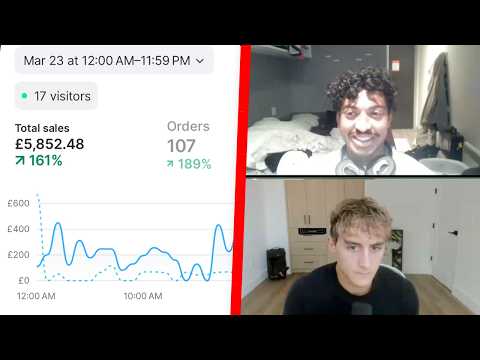
- Store analytics on screen — A Shopify admin panel appears in a small window at 0:35, but its figures are not readable and no weekly or daily sales total is shown at the moments where the average is discussed
- Margin as stated — "Just under 50% margins"
- Product margin from AOV and cost — ~54–57% if both are in pounds
- Daily site sessions — "Over a 1,000 sessions at least a day"
- Best video — 1.6 million views on the fifth creative
- Chargebacks — Two, per the host
- Production time — About 3 weeks
- Profit, fees, refunds, tax — Not stated in the video
What is this income idea?
Find a product that is already selling on short-form video, run it in a niche nobody else is using, and post AI-made clips so you can start before the physical product is in hand.
- The video is a case study on the host’s channel. The guest, Rahul, says they are from England, have been dropshipping for about a year, and before that made their "first £4,000 online" in six months from long-form YouTube compilations.
- The product is a custom fridge magnet styled like a record player. They say they found it on an Instagram burner account, where sellers were running it in a BTS fan niche using real, filmed footage. They chose a Taylor Swift niche instead.
- Because the item is custom and "no one's going to get it in hand for another 2 weeks at least", they say they used AI to create "some custom packaging some custom designs that didn't actually exist yet", which let them post about two weeks before competitors could.
- The account already existed and had been warmed up for another product. They say the first video went up the same day they found the product, the fifth creative reached 1.6 million views, and the business hit about 10K a week roughly two weeks after testing began.
- Orders come from organic Reels and TikTok views. Comments trigger ManyChat auto-replies with a link; the host estimates 40,000 to 50,000 flows sent. Rahul says the store gets over 1,000 sessions a day, that adding product variants raised the order value, and that a shipping-protection upsell raised conversion.
- They give an average order value of £53 (then £50, "like USD 67") and a cost of 23, and call the result "just under 50% margins". The store page on screen lists a single unit at $59.88, a duo at $108.87 and a trio at $155.14. They describe themselves as "averaging just under 1K a day". The host introduces them as doing "like 20K a week". The video ends with a pitch for the host’s coaching programme, of which Rahul is a member.
Spot a trending product early, sell it to a different fan group, use AI clips so you can post first, and let free views drive orders.
- Spot a trending product — Instagram burner
- Pick an unused niche — Taylor Swift, not BTS
- Make AI clips — Before stock exists
- Post on a warmed account — Same day
- Auto-reply to comments — ManyChat link
- Add variants and upsells — Raises order value
- Ship in ~3 weeks — Custom production
A specific organic-sales sequence. The sales figures are spoken; the costs after the product itself are not given.
Being early did the work. AI made being early possible.
The lesson underneath the number
- The useful idea in this video is about timing, not AI. The store owner says other sellers were running the same product for BTS fans with real footage, and that a custom item takes at least two weeks to reach anyone’s hands. By generating clips of the product and its packaging, they could post in a fan niche nobody else had picked, before anyone could film the real thing. They say that early start is why the account performed as it did.
- There is a practical risk in that approach which the video does not discuss. If marketing shows packaging and designs that did not yet exist, buyers are ordering from a picture of the product rather than the product. With a three-week production time, the gap between what was shown and what arrives becomes visible only after the money is collected. Ad and consumer-protection standards generally expect product imagery to represent what is sold, and the seller carries the refund and chargeback risk if it does not. The host mentions two chargebacks; refunds are not stated.
- The numbers in the video are more specific than usual on one side. An order value of about £53 and a unit cost of 23 give a product margin in the mid-fifties, and the store owner calls it just under 50%. Over 1,000 daily sessions and an average of just under 1K a day imply roughly twenty orders a day. Those figures fit together. The weekly figure in the title does not fit them: at the stated daily average a week comes to about 7K, roughly a third of $21,981.
- The context matters too. This is a case study on the channel of a coaching programme the store owner belongs to, and it closes with that programme’s pitch and its "1K or you don’t pay" guarantee. The relationship is plain in the conversation, and the store owner is asked for an honest review. The results of other members mentioned by the host, including daily and monthly sales figures, are not detailed and could not be checked from the video.
People wait for permission almost… don’t wait for permission to know if an idea is good, go test it yourself first.
The store owner’s main advice
The process, as described
Speed and positioning carry most of the weight in this account.
No cost is given for any stage except the unit cost of the product.
- Keep warmed accounts ready — "Big thing you want to have accounts pre-warmed up." They say they had accounts warming in other niches, including one they had prepared for a different product, so they could post the day they found this one.
- Run the product in a different niche — Competitors ran it for BTS fans; they chose Taylor Swift fans and had a Kanye West niche ready as a second option. The host’s main point is that copying another seller’s exact angle leaves you sharing their views.
- Use AI to post before the stock exists — They say they used AI to depict custom packaging and designs "that didn't actually exist yet" so they could post two weeks earlier than others. They add that showing the product in use was hard to generate, so they used existing clips for that part.
- Turn comments into store visits — ManyChat replies to commenters with the link. The host reads off comment and automation counts on several videos and puts the total at around 40,000 to 50,000 flows.
- Check where sessions come from — Both describe removing traffic from countries with low buying power before judging conversion, so that a targeting problem is not mistaken for an offer problem.
- Raise order value with variants and upsells — More design variants led more buyers to take two or three, they say, and a shipping-protection upsell raised conversion "even at the same price".
- Hire customer service early — "Get someone on Fiverr" once a product starts selling, rather than answering every email yourself. The cost of doing so is not stated.
The business model
One-off sales of a custom record-player-style fridge magnet, with multi-buy variants and add-ons such as shipping protection and warranties.
Taylor Swift fans reached through Instagram Reels and TikTok.
A personalised fan item shown in AI-made clips with custom packaging, available to order before competitors had footage of it.
Organic short-form video on a pre-warmed account, with ManyChat sending the store link to commenters.
- Product cost — 23 per order against an AOV of about £53; currency of the cost not stated
- Store platform and apps — An upsell app is named; no fees are given
- Payment processing — Not mentioned
- ManyChat and AI video tools — Used; not priced
- Shipping and the 3-week production wait — Whether shipping is inside the 23 is not stated
- Refunds and chargebacks — Two chargebacks mentioned; refunds not stated
- Customer service — Recommended via Fiverr; their own cost not stated
The video gives the two figures needed for a product margin, which many case studies do not. Every cost after the product itself is left unpriced.
What you would actually need
Money
The only cost given is the product: 23 against an order value of about £53. Growth is organic, and no ad spend is mentioned.
Organic distribution removes ad spend, which is the largest cost in most dropshipping. It does not remove store fees, payment processing, apps, shipping, refunds, VAT on UK sales or paid customer service, and none of these is given.
Costs the video does not price
- Store platform subscription and apps (an upsell app is named)
- Payment processing on every order
- ManyChat subscription
- AI video tools
- Shipping, unless included in the 23
- Refunds and the two chargebacks mentioned
- Freelance customer service
- Tax
Time
About a year of dropshipping before this product, and about two weeks from first post to roughly 10K a week.
The fast result rests on a year of practice, accounts warmed in advance and being early to a trend. They are open that they had "almost every skill" seven or eight months in and still took a year to get a big win.
What sits behind the result
- Six months earning £4,000 from YouTube compilations
- About a year of dropshipping attempts
- Several accounts warmed in advance
- Daily posting and creative testing
- Customer emails during a 3-week production wait
- Running it during university exams, by their account
The part you must pay attention to
The spoken daily average does not add up to the weekly figure in the title.
The title says $21,981 a week. The host says "like 20K a week almost like like 17 16 17,000". The store owner says they are "averaging just under 1K a day".
- Stated daily average — Just under 1K
- One week — 7 days
~7K a week
About a third of $21,981
Everything rests on which number describes the business. Reaching $21,981 in a week needs about $3,140 a day (our arithmetic), more than three times the average the store owner gives. Possible reasons, none of which is stated in the video: the title is a single best week, the average includes slow early weeks, or the two figures use different currencies. The video does not say which week produced $21,981 or how many weeks came close to it.
Whatever the weekly figure, it is sales, not profit. The one margin given is "just under 50%", and the AOV and cost given put the product margin at about 54% to 57% if both are in pounds. That is before store fees, payment processing, apps, shipping, refunds and tax, none of which is given. At just under 1K a day and a margin near 50%, about 500 a day would remain before those costs (our arithmetic). Profit is not stated.
- THE WEEKLY FIGURE
- Title $21,981/week
- Host "17 16 17,000"
- Store owner just under 1K/day
- 7 x ~1K = ~7K/week
- $21,981 / 7 = ~$3,140/day
- THE MARGIN (our arithmetic)
- AOV £53 (or £50)
- Unit cost 23
- (53 - 23) / 53 = ~57%
- (50 - 23) / 50 = ~54%
- Stated "just under 50%"
- ORDERS AND CONVERSION (our arithmetic)
- ~1K / £50-53 = ~19-20 orders/day
- Sessions 1,000+ a day
- Implied conversion ~2% or lower
- NOT GIVEN
- Fees, shipping, refunds, tax, profit
The economics
Order value and product cost are given. Nothing after that is.
- Daily sales average — Just under 1K
- Weekly sales (host) — "17 16 17,000" to "20K"
- Weekly sales (title) — $21,981
- Average order value — £53, restated as £50 (~USD 67)
- Unit cost — 23
- Product margin — ~54–57%
- Orders per day — ~19–20
- Daily sessions — 1,000+
- Ad spend — None mentioned; growth described as organic
- Fees, shipping, refunds, tax, profit — Not stated
Gross margin before every cost except the product
Just under 1K a day × just under 50% margin
About 500 a day before store, payment, app, shipping, refund and tax costs, roughly 3,500 a week
IncomeIdeaLab calculation from figures stated by the store owner
The currency of the daily average and the unit cost is not stated. If the 23 excludes shipping, or if the daily average is in pounds, the result moves in opposite directions. The video gives no figure for what reaches the owner after costs.
- Which week, if any, reached $21,981
- Total sales since the store opened in April
- Store platform, payment processing and app fees
- Whether shipping is included in the unit cost
- Refund rate on a custom item with a 3-week production time
- ManyChat, AI tool and customer-service costs
- Tax on UK sales
- Profit
- The AOV conversion checks out: £53 at an exchange rate near 1.27 is about $67 (our arithmetic), matching the host’s figure.
- The store owner’s "just under 50%" is lower than the 54% to 57% our arithmetic gives from their AOV and cost, which would fit a unit cost that excludes some per-order costs, or a margin figure that already includes them. The video does not say.
- At about £50 to £53 per order, just under 1K a day means roughly nineteen or twenty orders, which against more than 1,000 daily sessions is a conversion rate near 2% or below (our arithmetic). The store owner describes conversion as volatile from day to day.
- The store opened in April and the video was published on 5 June, so the account covers at most about eight weeks. Whether the sales lasted after that is not stated.
- The product page on screen lists a single unit at $59.88, a duo at $108.87 and a trio at $155.14. The order value stated in the conversation is £53, and the page does not show how many units of each bundle were sold, so the two cannot be reconciled from the video.
- The host asks to pull up the dashboard; the Shopify admin panel that appears in a small window at 0:35 is not readable, so no sales figure from it is shown.
- The host runs a paid programme, Organic Overdrive, which the store owner belongs to. The video closes with a link to apply and a guarantee to "send every single dollar back" if a member does not reach a 1K day. The programme’s price is not stated.
Evidence status
Every substantive claim in the video.
- $21,981 a week — Video title — Not stated in the video. About three times the store owner’s stated daily average over seven days.
- "Like 20K a week almost like 17 16 17,000" — Host — A range rather than a figure; does not match the daily average given.
- Averaging just under 1K a day — Store owner — About 7K a week. Currency not stated.
- About 10K a week two weeks after testing began — Host, agreed by store owner — A quick ramp, attributed to being early to the product.
- AOV £53 (or £50), about USD 67 — Store owner and host — The currency conversion is consistent. The store page on screen at 0:24 lists $59.88 for a single, $108.87 for a duo and $155.14 for a trio.
- Bundle prices: single $59.88, duo $108.87, trio $155.14 — Store product page on screen at 0:24 — Shown on the product page, with the single priced from a struck-through $115.00; currency as displayed. These are list prices, not sales.
- Unit cost 23, "just under 50% margins" — Store owner — Our arithmetic gives 54% to 57% on product cost alone. Other costs not stated.
- 1.6 million views on the fifth creative — Host — Organic reach is the core of the model; we could not check view counts from the video.
- 40,000 to 50,000 ManyChat flows sent — Host estimate — An estimate added up live from several videos.
- Over 1,000 sessions a day — Store owner — Consistent with roughly twenty orders a day at a conversion near 2%.
- AI used for packaging and designs that did not yet exist — Store owner — Stated openly. Buyers order from depictions; refund exposure is not discussed.
- Two chargebacks — Host — Refund numbers are not stated.
- Production time about 3 weeks — Store owner — The host calls it "terrible" and offers another supplier.
- Other members at 1K days and 50K months — Host — Not detailed; could not be checked from the video.
- Profit — Nobody — Not stated in the video.
What is actually proven?
A specific method and a usable margin input. Not the title figure, and not profit.
- An average of just under 1K a day from a store started in April.
- At that average a week is about 7K, roughly a third of the title’s $21,981.
- AOV and unit cost give a product margin of about 54% to 57%.
- Sessions, order value and daily sales are consistent with each other.
- AI clips depicted packaging and designs before the product existed, by the store owner’s account.
- The store owner is a member of the host’s paid programme.
- Fees, shipping, refunds, tax and profit.
- Which week reached $21,981, if any.
What the headline doesn’t tell you
The headline is a weekly sales figure. The video describes a daily one.
- Just under 1K a day. — About 7K a week, not $21,981.
- Sales, not profit. — No profit figure is given.
- A year of practice first. — They say so themselves.
- Accounts were pre-warmed. — Ready before the product was found.
- The product was shown before it existed. — In AI clips, by their account.
- Three weeks to make each order. — Buyers wait after paying.
- At most about eight weeks of trading. — April to a June video.
- A coaching case study. — The programme is pitched at the end.
Should you try it?
A real timing tactic, with sales figures that do not line up
Take the lesson about niches and speed. Price every cost after the product before you treat the margin as yours, and be careful about selling from images of things that do not exist yet.
- Specificity of method — 7 — Niche choice, warmed accounts, comment automation, upsells and geo checks are all described.
- Consistency of the sales figures — 3 — Title, host and store owner give three different weekly pictures.
- Cost disclosure — 4 — Order value and unit cost given; everything else not stated.
- Profit disclosure — 1 — Not stated.
- Candour about the path — 7 — A year of attempts, early mistakes and the 3-week production time are all volunteered.
- Independence of the source — 2 — A member’s case study on the programme owner’s channel.
- Durability of the result — 3 — Built on being early to a trend that others were copying.
- Beginner accessibility — 3 — Needs warmed accounts, AI video skill and a supplier for custom goods.
- The most transferable idea here is costless: when you find a product already selling, look for the audience nobody is selling it to yet. The store owner says competitors all ran the same fan niche, and they took a different one. That decision, plus posting within a day, is what they credit for the result, and it applies to almost any organic product test.
- Treat the AI part with more care. Generating clips of a product so you can sell it before you can film it means customers buy from an image. With a three-week production time, the difference between that image and the item only shows up weeks later, when a refund or chargeback is the buyer’s remedy. If you try this, make sure the clips match what the supplier will actually ship.
- Then read the numbers on their own terms. Just under 1K a day is a real-sounding small store: about twenty orders a day at roughly £50 each. It is about 7K a week, not the title’s $21,981, and it is sales. After a product cost of 23, the store owner puts the margin at just under 50%, so around 500 a day would remain before store fees, payment processing, apps, shipping, refunds and tax. None of those is given.
- Finally, weigh the source. The video is a case study for the host’s coaching programme, recorded shortly before a coaching call and closing with an application link. That does not make the figures wrong, but it does mean you are seeing a result the programme chose to feature, from a store that had traded for at most about eight weeks.
Passive or automated?
Automation
Comment replies and checkout are automated; content, testing and support are not.
Passive potential
Sales depend on daily posting and on staying ahead of copycats.
ManyChat answers comments and the store takes orders without anyone present, but that is the only automated part. Sales come from new videos, which they describe testing and posting continuously across several accounts. The trend itself is short-lived by their own account: being two weeks ahead of competitors was the advantage, and the host notes that others started copying their AI approach. Customer emails during a three-week production wait need a person, which is why they recommend hiring help on Fiverr. This is an active, trend-chasing business.
- Finding products and choosing niches
- Producing AI and real clips every day
- Warming and managing several accounts
- Handling customer emails and chargebacks
- Managing a supplier with a 3-week production time
Recommended beginner experiment
Test the niche idea cheaply, and price the whole order.
- Find one product already selling organically. — Note which audience every seller targets.
- Choose a different audience. — The core of this case study.
- Warm an account before you need it. — Their stated advantage.
- Only show what you can ship. — Match clips to the supplier’s actual item.
- Cost a full order, not just the unit. — Fees, payment, shipping, refunds.
- Check production time first. — Three weeks drew the host’s criticism.
- Track daily sales, not best weeks. — The average is the honest number.
- Plan for the trend to end. — Copycats follow early winners.
Our verdict: 4/10
A clear timing tactic, but the title’s weekly figure is not stated and profit is not given and the stated daily average comes to about a third of $21,981 a week
Credited for a specific, transferable method (a different niche for a proven product, accounts warmed in advance, same-day posting, comment automation and geo-checked conversion); for giving both an order value and a unit cost, which makes a product margin calculable; and for an open account of a year of attempts before this result and of a three-week production time. Marked down because the title’s $21,981 a week is not stated in the video and the store owner’s own average of just under 1K a day comes to about 7K a week; because no profit, fee, shipping, refund or tax figure is given; because the store had traded for at most about eight weeks; because marketing relied on AI depictions of packaging and designs that did not yet exist, with refund exposure not discussed; and because the video is a member case study for the host’s paid programme.
The store owner in this case study describes a real and specific tactic. They found a product that was already selling on short-form video, noticed every seller was aiming it at the same fan group, aimed it at a different one, and used AI clips to start posting about two weeks before anyone could film the physical item. Accounts were warmed in advance, comments were turned into store visits with ManyChat, and order value went up with more variants and a shipping-protection upsell. They are open about the year of attempts that came before it and about a three-week production time the host calls terrible. They also give the two numbers most case studies leave out, an order value of about £53 and a unit cost of 23, which put the product margin in the mid-fifties and their own estimate at just under 50%. The sales figures do not line up with the title. They say they are averaging just under 1K a day; seven days of that is about 7K, while the title says $21,981 a week and the host says "like 20K… 17 16 17,000". The video does not say which week, if any, reached the title figure. Whatever the weekly number, it is sales: store fees, payment processing, apps, shipping, refunds and tax are not stated, and nor is profit. Two further points belong in any reading of the result. Selling from AI depictions of packaging and designs that did not yet exist means buyers paid for an image and then waited three weeks for the item, and the refund side of that is not discussed. And this is a member case study on the host’s channel, closing with a pitch for their programme. The niche-and-timing lesson is worth taking. The headline figure is not established by the video.
- Title figure — $21,981 a week (not stated in the video)
- Stated daily average — Just under 1K
- Week at that average — ~7K
- AOV / unit cost — £53 / 23
- Product margin — ~54–57%
- Orders per day — ~19–20
- Profit — Not stated
- Beginner suitability — Method yes, numbers with care
Sources
- USD 21,981/week with ai organic dropshipping (case study) — Smith Rees Business — YouTube video, 2026-06-05
- FTC — Guides Concerning the Use of Endorsements and Testimonials — Regulatory guidance on endorsements and earnings claims