AI Businesses / Founder Productivity · Claim Review
“What Is an AI Operating System? (And Why Every Business Will Need One)”
What we found: One Webinar Week, NZ$1M in Revenue, and No Way to Tell What the AI Did
A sensible method for giving an AI assistant your business context, sold on a launch figure with no costs, no product, no price and no control.
- NZ$1M Webinar revenue
- 83 Tasks audited
- 60–70% Automation share
- None Costs disclosed
The claim
That building an "AI operating system" around a business frees enough founder time to produce results like a million New Zealand dollars of revenue from a webinar planned and run in seven days.
- Revenue from one new webinar — NZ$1,000,000 in 7 days
- Same figure, restated later — "a million dollars in seven days" — currency dropped
- Average per day of the launch — ~NZ$142,857
- Time spent building his own system — "the past 3 weeks"
- Tasks in his audit — 83
- Tasks he aims to automate or augment — 54 (60–70%)
- 54 as a share of 83 — 65.1% — inside the stated range
- Calls analysed in one daily brief — 80, across six business streams
- Product sold, price, buyers, ad spend, refunds — Never stated
- Team size and revenue per employee — Never stated
What is this income idea?
Not an income idea at all, by the creator’s own definition. It is a way of running an existing business with an AI coding assistant wired into everything the business knows.
- He is explicit on this point early: "it is not a business model it is an business methodology." The business still has to sell something. The "AI operating system" is a wrapper around it, built up "in what I call layers and not leaps."
- The practical core is a folder on his computer that the assistant can read: files describing who the business is and what it sells, connections to data sources such as spreadsheets, Stripe and a link-tracking tool, a store of meeting recordings and Slack messages, and written-down workflows the assistant can repeat.
- On top of that sits a daily brief — "a 5 to 10 page PDF every morning and a nice short summary via Telegram" — which on the day shown had analysed "80 calls… over six different streams of my business."
- The next layer is a task audit. On his whiteboard he lists 83 tasks across a content business, an agency, an education business and a software portfolio, and says "I'm trying to get to about 60 to 70% which is 54 of these being crossed off."
- The money claim arrives in the middle. Using the time the system freed, he says, he planned and ran a new webinar in seven days and "was able to generate a million New Zealand dollars in revenue over just 7 days."
- The video closes by inviting viewers to a free two-hour training in the description, and mentions an accelerator through which he has been releasing packaged versions of each layer to "people who are in my program."
Give an AI assistant a permanent, organised memory of your business, then hand it your repetitive tasks one at a time.
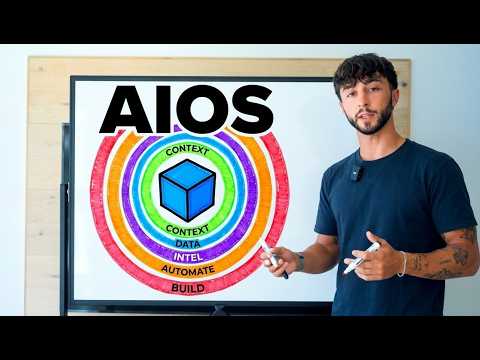
- Context — Who you are, what you sell
- Data — Sheets, Stripe, links
- Intelligence — Meetings and Slack
- Daily brief — PDF plus Telegram
- Task audit — 83 tasks listed
- Automate — Target: 54 of 83
- Build — Or enjoy the time
A coherent set-up for an existing business. The revenue figure hung on it is a separate claim.
The method is reasonable. The proof offered for it cannot show what the AI did.
The lesson underneath the number
- Stripped of the framing, the set-up he describes is sound and fairly modest. Keep a written description of your business where an AI assistant can always read it. Connect it to your numbers so it can answer questions without copy-pasting. Feed it your meeting notes and internal messages so it can summarise what happened. List every recurring task you do, and move them to the assistant one by one, starting with the ones that cost you the most time. None of that requires believing that "AGI is here", and most of it would help a small, already-busy business.
- He deserves credit for several things this genre usually blurs. He says plainly that this is not a business model and will not make money on its own. He offers "enjoy" as a legitimate use of freed time, not only more work. He gives an actual task count — 83 — and a target of 54 that matches his stated percentage when you do the division. And in the KPI section he describes 60–70% automation as what he is "going for… over the next 30 days", which is an honest framing of a goal.
- The problem is what gets attached to it. The single hard number in the video is a webinar that earned a million New Zealand dollars in a week, and it is offered as the result of freed bandwidth. A launch like that depends on an audience, an offer, a price and a funnel — things he had before the three weeks began. The video names none of the offer’s details and none of the launch’s costs, and there is no comparison with his previous webinars, so a viewer has no way to separate what the AI contributed from what seven years of audience-building did.
- The title overreaches in a second way. "Why every business will need one" is contradicted by the video itself, which says the approach is "not really suitable for companies with ERP systems or kind of clunky legacy software" and is "the benefit of the small business who can be nimble." That is a more accurate claim than the title, and a narrower one.
It is not a business model it is an business methodology — a way of approaching business, a way of running your business.
The creator, correctly, near the start of the video
The method, as he gives it
Five layers and three KPIs. The layers are concrete; the KPIs carry no figures for his own business.
- Write down the business once — Who you are, what you sell, your values, your team and your current strategy, stored as files the assistant always reads. His point that this ends the habit of re-pasting the same background into every chat is practical and correct.
- Connect the numbers — Spreadsheets, Stripe and a link-tracking tool plugged into one place the assistant can query, so it can "investigate the connection between" clicks, videos posted and revenue. No example output is quoted.
- Store every meeting and message — Meeting-recorder videos and every Slack message logged to a local database. Useful, and it raises data-handling questions for staff and clients that the video does not address.
- Generate a daily brief — A 5–10 page PDF and a Telegram summary each morning. On the day shown it covered 80 calls across six business streams — which also tells you the scale of the operation this is built for.
- Audit tasks, then automate the costliest — 83 tasks listed, with a target of 54. He recommends a "/explore" prompt that asks the assistant to research how a given task could be automated, and scheduled jobs to run the results.
- Measure three KPIs — Away-from-desk autonomy, task automation percentage and revenue per employee. Sensible measures — but he gives no revenue-per-employee or headcount figure for his own business, so the video offers no baseline.
The business model
None of its own. It is a way of operating an existing business; the revenue in the video comes from a webinar selling an unnamed offer.
Founders of small, API-connected businesses. He says it is "not really suitable for companies with ERP systems or kind of clunky legacy software."
Less founder time spent "in the business", more spent on new initiatives, with an assistant that already knows the context.
For the method itself: YouTube videos leading to a free two-hour training, and packaged installs released through his accelerator.
- AI assistant subscription — The core tool. Never priced
- Connected services — Meeting recorder, Slack, Telegram, Stripe, email and calendar APIs, hosting
- Founder set-up time — 3 weeks for a technical founder
- Webinar launch costs — Traffic, ads, payment fees, refunds, delivery. None stated
- Team — Implied by staff briefings and six business streams. Size never given
- Data-handling obligations — Recording every meeting and Slack message. Not raised
No cost of any kind is mentioned — not for the tools, and not for the launch that produced the only revenue figure.
What you would actually need
Money
Never discussed. No subscription, tool or set-up cost is mentioned, and the paid accelerator that distributes his packaged layers is referred to but not priced.
The software is probably the cheap part. The real prerequisite is a business that already produces data, meetings and tasks worth automating — his daily brief summarises 80 calls from six revenue streams. A founder without that has little for the system to read.
Named or implied, never priced
- A subscription to the AI coding assistant he uses
- A meeting recorder, Slack, Telegram and Stripe
- API access to email, calendar, hosting and link-tracking tools
- The accelerator where packaged layers are released
- For the NZ$1M week: traffic, a funnel and an offer to sell
- Whatever team delivered the webinar and the product sold
Time
Three weeks to build his own system. For followers using packaged installs, "within a few days you've got your own Claude Code AIOS system set up."
Three weeks for someone who describes himself as "quite technical" and has run AI businesses for three years. The few-days figure refers to installing his pre-built modules, and is not evidenced.
Where the time actually goes
- 3 weeks building his own set-up
- Writing the context files and strategy
- Connecting each data source by API
- An 83-item task audit
- Automating tasks one at a time, 30-day target
- Periodic "run the business from the beach" tests
The part you must pay attention to
NZ$1M of webinar revenue is not evidence that the AI system produced it.
The only money figure in the video is attributed directly to the method: "I focused all of this bandwidth that I had at a new initiative."
- A YouTube channel, 7 years in business — An existing audience
- Product and price never named — An offer
- The part credited to the AI — Freed founder time
NZ$1M revenue in 7 days
Gross, before any cost, refund or fee
The load-bearing assumption is that the webinar would not have happened, or would have earned much less, without the AI set-up. Nothing in the video tests that. He says he has been in business for seven years, runs an agency, an education business, a software portfolio and "a content business around this YouTube channel", and that last time "we had an excellent turnout" for a similar training. A founder with that audience and an established webinar funnel has the main ingredients for a large launch week whatever tools were used to draft the slides. The system may well have saved him time. The video gives no way to know whether that time was worth NZ$10,000 or NZ$900,000 of the result, and no product, price, buyer count, ad spend, refund rate or delivery cost to judge the result itself.
There is also a quieter drift in the figure. At about the ten-minute mark it is "a million New Zealand dollars in revenue". Nine minutes later it is restated as "I was able to do a million dollars in seven days", with the currency gone. A New Zealand dollar is worth less than a US dollar, so a viewer who hears only the second version — the natural reading on an English-language channel — will overestimate the sum. And revenue from a webinar is typically what was sold during the launch, which may include payment plans not yet collected; the video does not say which it means.
- THE LAUNCH FIGURE
- Stated revenue NZ$1,000,000
- Days 7
- Per day ~NZ$142,857
- Buyers needed = NZ$1M / price
- at NZ$1,000 each 1,000
- at NZ$5,000 each 200
- -> price never stated
- Ad spend -???
- Payment fees -???
- Refunds -???
- Delivery / team -???
- -------------------------------
- Profit unknown
- THE TASK TARGET
- Tasks audited 83
- Target automated 54
- 54 / 83 = 65.1%
- 60% of 83 = 50, 70% = 58
- -> checks out, but it is
- a goal, not a result
The economics
One revenue figure, from one week, with nothing on the other side of the ledger.
- Webinar revenue — NZ$1,000,000 in 7 days
- Average per launch day — ~NZ$142,857
- Time to build his system beforehand — ~3 weeks
- Tasks audited / targeted — 83 / 54
- Target share automated — 60–70%
- Discretionary time today vs goal — ~20% → ~80%
- Product sold, price, number of buyers — Never stated
- Ad spend, payment fees, refunds, delivery cost — Never stated
- Headcount, revenue per employee — Never stated
What NZ$1M in a week implies about the audience
Buyers = NZ$1,000,000 ÷ price. At NZ$1,000 → 1,000 buyers; at NZ$5,000 → 200 buyers
Hundreds to thousands of paying buyers inside seven days — a scale that presupposes a large existing audience
IncomeIdeaLab calculation; the two prices are illustrative because the video names no price
The video does not say whether "revenue" means cash collected or sales booked, including instalment plans, and gives no refund window. The currency is stated as New Zealand dollars once and then dropped when the figure is repeated.
- What the webinar sold, and at what price
- How many people attended and how many bought
- Advertising spend and cost of the traffic
- Payment processing fees, refunds and chargebacks
- Who delivers the product sold, and at what cost
- Results of his previous webinars, for comparison
- Team size, needed for his own revenue-per-employee KPI
- Subscription and API costs of the AI set-up
- The task arithmetic checks out: 54 of 83 is 65.1%, inside his 60–70% range (60% would be 50 tasks, 70% would be 58). Automating 65% of tasks is not the same as saving 65% of time, since tasks differ in size; the video treats them as equivalent.
- The bandwidth goal — moving from roughly 80% of time "in the business" to 80% "on the business" — would quadruple discretionary time. It is drawn as a diagram and not measured.
- Earlier in the video he says he has "done full videos on how I'm using this to automate up to 60 to 70% of my tasks"; later the same figure is a target for "the next 30 days." The second, more cautious version is the one supported by his own whiteboard.
- The daily brief covering "80 calls… over six different streams of my business" is the clearest indicator of scale in the video. This is a multi-business operation with staff, not a solo founder starting out.
Evidence status
Every substantive claim in the video.
- NZ$1M revenue from a webinar in 7 days — Creator — Revenue only. No offer, price, buyer count or cost given.
- The launch was made possible by freed bandwidth — Creator — No comparison with earlier launches; existing audience not separated out.
- "A million dollars in seven days" — Creator, restating — Same figure with the New Zealand currency dropped.
- Built his own system in 3 weeks — Creator — Plausible for a technical founder. Not shown in the video.
- 83 tasks audited; target 54 (60–70%) — Creator, whiteboard — Arithmetic is correct. A target, not an outcome.
- Automating "up to 60 to 70%" of his tasks — Creator — Framed as current early on, as a 30-day goal later.
- Daily brief analysed 80 calls across six streams — Creator, screen-shown — Shown on screen; content not readable from the video.
- Ran "basically everything" from a phone on a day out — Creator — Anecdotal, single day, no list of what was done.
- Followers can be set up "within a few days" — Creator — Refers to his packaged installs. No evidence given.
- Every business will need one (title) — Video title — Contradicted in the video for ERP and legacy-software companies.
- "AGI is here" — Creator — An opinion, stated as fact.
- Costs of tools, launch or team — Nobody — Absent throughout.
What is actually proven?
The method is described clearly. The results attributed to it are not established.
- The layered set-up is described concretely enough to reproduce in outline.
- He states plainly that this is a methodology, not a business model.
- 54 of 83 tasks is 65.1%, consistent with his 60–70% target.
- NZ$1M of webinar revenue in seven days, as stated.
- That the AI set-up, rather than the existing audience and funnel, drove that result.
- The 60–70% automation level and the 80% discretionary-time goal.
- The product sold, its price, the costs of the launch, and any profit.
- His headcount and revenue per employee, his own headline KPI.
What the headline doesn’t tell you
The method is free to copy. The result depends on things the video takes for granted.
- NZ$1M is revenue. — No cost is given.
- It is New Zealand dollars. — Until the currency is dropped.
- The offer is never named. — Nor its price.
- The audience came first. — Seven years and a YouTube channel.
- 60–70% is a target. — For the next 30 days.
- Not for every business. — His words, on ERP firms.
- There is a program to join. — Plus a free training funnel.
- Every meeting is recorded. — Privacy is never raised.
Should you try it?
Worth borrowing as a habit, not as an income plan
The context-file and task-audit ideas cost little and help. Do not expect them to produce a launch result without an audience and an offer.
- Clarity of the method — 7 — Five named layers, each with a concrete example.
- Honesty about what it is — 7 — Says outright it is not a business model; offers "enjoy" as an option.
- Evidence for the revenue claim — 2 — One stated figure, no offer, price, buyers or dashboard numbers in the video.
- Attribution of results to the AI — 1 — No baseline, no earlier launch for comparison.
- Consistency of figures — 5 — Task maths reconciles; currency and automation tense both drift.
- Cost disclosure — 0 — No cost of any kind is mentioned.
- Conflict-of-interest disclosure — 5 — Program and free training are mentioned; what they sell is not.
- Beginner accessibility — 3 — Needs an existing business with data, meetings and staff to be useful.
- If you already run a business, two pieces of this are worth doing this week at almost no cost. Write a short document describing your business, customers, offers and current priorities, and keep it where your AI assistant always reads it. Then list every recurring task you do in a normal fortnight — he found 83 — and mark the ones that take the most time. Those two steps alone make any AI tool more useful, and they are the parts of the video that are clearly described and not dependent on anything else.
- Be much more careful with the promise attached to it. The million-New-Zealand-dollar week was a webinar launch by someone with a seven-year-old business, a YouTube channel, an agency, an education business and previous webinars with "an excellent turnout." The AI may have helped him prepare it faster; the video offers no way to tell how much. If you do not already have an audience and an offer people pay for, freeing up your time does not create those things.
- Treat the 60–70% automation figure as what it is by the end of the video: a goal he is working toward over thirty days, measured by counting tasks rather than hours. Counting tasks flatters the result, because the easiest tasks to automate are often the smallest ones.
- Finally, note what the video is doing. It explains the method free, then points you to a free two-hour training and mentions an accelerator where he releases packaged versions of each layer. That is a webinar funnel of the same kind that produced the NZ$1M week. Nothing about that is improper, but the video does not say what the training sells or what the program costs, and you should find out before committing time to it.
Passive or automated?
Automation
Reports, briefs and scheduled jobs genuinely run unattended once set up.
Passive potential
It makes an existing business cheaper to run; it does not earn by itself.
The set-up automates real work — a daily brief assembled from meetings, messages and data, scheduled jobs, drafted reports — and some of that will run without the founder touching it. But by the creator’s own account this is a layer around a business, not a source of income. The revenue in the video came from a new webinar that he planned, filmed videos for, drove traffic to and presumably delivered on, all described as active work made possible by the time saved. His own "away from desk" test is about doing the same work from a phone, not about stopping work. What becomes cheaper is operating; what earns money is still selling.
- Writing and maintaining the business context and strategy
- Choosing which tasks to automate and checking the output
- Creating the offer, the webinar and the videos that sell it
- Delivering whatever product the launch sold
- Managing the staff whose calls the daily brief summarises
Recommended beginner experiment
Take the cheap parts, measure honestly, ignore the launch figure.
- Write your business context file. — One page. Offers, customers, priorities.
- List two weeks of recurring tasks. — Record the minutes each one takes.
- Automate the biggest time sink first. — Not the easiest one.
- Measure hours saved, not tasks ticked. — Tasks are not equal in size.
- Check what data you are storing. — Meetings and messages involve other people.
- Price every tool before connecting it. — The video prices none.
- Keep a before-and-after baseline. — The one thing the video lacks.
- Ask what a training sells before attending. — Then decide.
Our verdict: 4/10
A sensible way to use an AI assistant, sold with an unattributable number and a title that the video itself contradicts
Credited for stating plainly that an AI operating system is a methodology and not a business model; for describing each layer — context, data, meeting intelligence, automation, build — concretely enough to reproduce; for giving a real task count of 83 and a target of 54 that reconciles exactly with his stated 60–70%; for offering "enjoy" the freed time as a legitimate choice; and for conceding that the approach does not suit companies with ERP or legacy systems. Marked down because the only money figure, NZ$1M of webinar revenue in seven days, is credited to the method with no baseline, no earlier launch for comparison and no separation from a seven-year-old business and established YouTube audience; because the offer, price, buyer count, ad spend, fees, refunds and delivery cost are all absent, so profit cannot be assessed; because the figure is later restated as "a million dollars" with the New Zealand currency dropped; because the 60–70% automation figure is presented as current early on and as a 30-day target later; because no tool, subscription or set-up cost is given; and because the title’s claim that every business will need one is contradicted inside the video.
Take away the framing and this is a clear, fairly modest description of how to make an AI coding assistant useful to a business owner. Give it a permanent written account of the business. Connect it to the numbers. Feed it meeting notes and messages so it can summarise the day. Then list every recurring task — he found 83 — and hand them over one at a time, measuring how many are gone. He is candid that this is a way of running a business rather than a business, that the freed time can be spent enjoying life rather than working more, and that it suits small nimble companies far better than ones tied to legacy systems. The task arithmetic he offers reconciles exactly. The trouble is the evidence attached to the pitch. The single money figure — a million New Zealand dollars in revenue from a webinar planned and run in seven days — is presented as the product of bandwidth freed by a system he had been building for three weeks. It comes from a founder with seven years in business, an agency, an education business, a software portfolio and a YouTube channel whose previous trainings drew "an excellent turnout." The video names no offer, no price, no number of buyers, and not one cost of the launch, and it compares the week with nothing. When the figure returns nine minutes later it has become "a million dollars", currency gone. The 60–70% automation claim shifts in the same way, from something he is doing to something he is aiming for over the next month. And the title’s promise that every business will need one is withdrawn by the video itself. Borrow the context file and the task audit, measure the hours they save, and do not read the launch figure as a result you should expect from them.
- Webinar revenue — NZ$1M in 7 days
- Attributable to the AI set-up — Cannot be determined
- Tasks audited / target — 83 / 54
- Target share — 65.1% — reconciles
- Automation achieved — Not stated; target only
- Launch costs — Never stated
- Tool costs — Never stated
- Beginner suitability — Habits yes, income no
Sources
- What Is an AI Operating System? (And Why Every Business Will Need One) — Liam Ottley — YouTube video, 2026-03-08
- FTC — Guides Concerning the Use of Endorsements and Testimonials — Regulatory guidance on earnings claims