Dropshipping / Google Shopping Ads · Claim Review
“how to literally print money while you sleep with AI dropshipping (just copy me)”
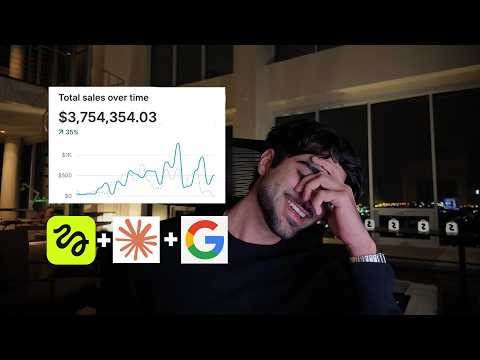
What we found: An AI Dropshipping Store’s “$3.7 Million” Appears on a Shopify Report as Total Sales, and the Competitor Estimate Works Out at $15.8 Million a Year, Not $24 Million
The Claude-and-Shopify workflow is shown step by step. The revenue figures around it are sales, not profit, and no ad spend, product cost or refund figure is given for any store.
- $3.7M One store’s revenue
- $543k One brand, Sep–Dec
- $15.8M Competitor, annualised
- None Ad spend, COGS, profit
The claim
That an AI system built with Claude and Shopify can run a Google Ads dropshipping store on one or two hours a week, and that one such store made $3.7 million.
- Revenue of one AI dropshipping store — $3.7 million with Google Ads said; Shopify report on screen at 0:07 shows total sales $3,755,141.34 and net sales $3,378,791.34 (store and period not legible)
- Hours worked per week — “Like one or two”
- Staff let go — 95%
- One brand’s sales, September to December — $34,000, $74,000, $165,000, $270,000 said; the on-screen whiteboard at 24:47 reads $34K, $74K, $165K, $268K
- Those four months added — $543,000
- Competitor revenue, said — “More than $24 million every single year”
- Competitor revenue, from the creator’s own working — $1,314,000 a month, about $15.8 million a year
- First exit — “$300,000 in profit”
- Ad spend, product cost, refunds, profit — Not stated in the video
What is this income idea?
List thousands of AliExpress products on a Shopify store, use Claude to rewrite and re-image them in bulk on a schedule, and sell through one Google Performance Max campaign.
- The creator opens by saying one of their AI dropshipping stores “made $3.7 million with Google Ads” and runs “without me basically ever touching it,” and that they work “like one or two hours a week” across their brands. They say they let go of 95% of their staff in recent months and replaced them with AI.
- The method avoids Facebook, TikTok and Instagram ads and video creative entirely. Instead the store sells through Google Shopping, where, the creator says, buyers are already searching with “your wallet out.” The model is volume: list as many products as possible rather than hunting for one winner.
- The example competitor is a home-decor store with over 2,700 products, selling items the creator says cost about $20 on AliExpress for $125 to $225, with the supplier’s own photos. Using a traffic-estimate tool, the creator puts its traffic at 650,000 to 660,000 visits a month, assumes a 2% conversion rate and a $100 average order, and arrives at $1,314,000 a month.
- The build is shown step by step. Claude, connected to Shopify, copies a competitor’s theme and pages, an AI image tool connected to Claude generates new product photos, a bulk-import tool brings in hundreds of products at a time, and further prompts rewrite titles and descriptions, raise prices 20% with a $49.99 floor, and add sections to each product page. These run as daily scheduled tasks.
- Ads run as a single Performance Max campaign. The creator suggests starting at about $50 a day and raising the budget once “insanely profitable.” The prompt documents used are offered by direct message on Instagram.
- Near the end the creator gives one brand’s sales for September to December, $34,000 rising to $270,000, says their first exit sold for “$300,000 in profit”, and says the store now being automated was bought “not too long ago.” A link to paid help building a store closes the video.
The automation is shown; the money is stated in sales figures with no costs, and the $3.7 million store is described only in the opening line, with a Shopify sales report on screen at 0:07 showing total sales of $3,755,141.34.
- Copy a competitor’s theme — Claude + Shopify
- Bulk-import products — Hundreds at a time
- Regenerate images — AI image tool
- Rewrite and reprice — +20%, $49.99 floor
- Build product pages — Benefits, FAQs
- Schedule it daily — 9am to noon
- One PMax campaign — From ~$50 a day
- Raise the budget — When profitable
Every step of the build is described. The step where money is spent and made is not costed.
The automation is real work saved; the revenue figures are not profit
The lesson underneath the number
- The workflow is the substance of this video and it is shown in detail. Connecting Claude to a Shopify store, having it rebuild a theme, regenerate product images, rewrite titles for search, reprice in bulk and add sections to every product page, then scheduling those tasks to run each morning, is a practical way to handle a catalogue of thousands of products with few people. The creator explains why each step matters for Google Shopping, where the first image and the title are most of the ad.
- The figures around it are a different matter. The opening $3.7 million is not returned to, though a Shopify sales report on screen at 0:07 shows total sales of $3,755,141.34 (net sales $3,378,791.34); the store and period are not legible there, and no cost is shown. The competitor estimate is built from a traffic tool and two assumptions the creator chooses, and even then its monthly result annualises to about $15.8 million, not the $24 million said a minute earlier. The four months of one brand’s sales are specific, but they are sales.
- What is missing is everything a Google Ads dropshipping store spends. Every visitor is a paid click. Every order carries a supplier cost; the example product costs about $20 and sells for $125 to $225. There are payment fees, returns, and the staff still kept on. The creator says refunds are not a problem and that they only need to “pay off my expenses,” without saying what those are.
- The context matters too. The store the creator is now automating was bought, not built in 24 hours, and they describe the approach as “basically private equity”: buy, scale and sell. The video says it is free and that viewers do not need to buy anything, and it closes with a link to paid help building a store. Both are said on camera.
The only real thing I do is just increase the budget, make sure AI is working properly and just pay off my expenses.
The creator, on the one or two hours a week
The system, as the creator gives it
Five scheduled prompts on top of a Shopify store and one Google campaign.
No ad spend, product cost, refund rate or profit is given for any store.
- Clone a competitor’s design — Identify the theme a successful store uses, install it, and have Claude rebuild the homepage and product page with new images, copy, logo and favicon. The creator says this took under 15 minutes.
- Import a large catalogue — A bulk-import tool, which the creator says costs about $10 a month and is not an affiliate, brings in products from AliExpress and other stores. In the demonstration, 250 products are imported in about 30 seconds.
- Replace the supplier photos — Product images are regenerated in lifestyle settings, since Google Shopping uses the first product image in the ad. Only the first five products are done in the example.
- Rewrite titles and raise prices — Titles and descriptions are filled with search keywords, prices go up 20% with a $49.99 minimum, and products are tagged by season. The creator says a placemat a competitor sells for $65 could sell for about $120 with better images.
- Add marketing to each product page — Benefits, image-and-text sections and three FAQs per product, generated by a further prompt.
- Run one campaign and scale on profit — A single Performance Max campaign from about $50 a day, raised to $150 and then $300 to $350 as it becomes “insanely profitable.” No figure is given for what profitable means here.
The business model
Retail sales of dropshipped home and general products through a Shopify store, sold at a markup over AliExpress prices.
Shoppers searching Google for a specific product, whom the creator describes as ready to buy.
Better images, titles and product pages than competing dropshippers selling the same items.
One Google Performance Max campaign across Search, Shopping, YouTube, Discover, Maps, Display and Gmail.
- Google Ads — Pay per click; from ~$50 a day. Total not stated
- Product cost — About $20 for the example light on AliExpress; COGS not stated for the creator’s stores
- Shopify and payments — Not mentioned in the video
- Import and AI tools — Import tools about $10 a month; others not priced
- Refunds and returns — Said to be no issue; no rate given
- Remaining staff — About 5% kept; cost not stated
The creator says they only “pay off my expenses” each week but does not say what the expenses are. In a paid-ads business the cost side decides the result.
What you would actually need
Money
Import tools “like $10 a month”, a Claude prompt the creator says can run for free, and an ad budget from about $50 a day.
The tools are cheap; the ads and the stock are not. At $50 a day the starting ad budget is about $1,500 a month before any sale, and every order carries the supplier price, payment fees and a share of returns. None of these is given for any store in the video.
Named or implied, not priced
- Google Ads, from ~$50 a day (~$1,500 a month)
- Supplier cost of each product sold
- Shopify plan and payment processing
- Claude plan for scheduled tasks
- AI image generation for thousands of products
- Refunds, returns and chargebacks
- The 5% of staff kept on
Time
A store “built in less than 24 hours”, then “like one or two hours a week.”
The build steps shown are quick. The creator also describes the five steps as part of “a 30-step process workflow”, mentions customer service, supplier communication and negative keywords, and keeps some staff. One or two hours a week describes the creator’s own time, not the work done in the business.
Where the time goes
- Setting up the five prompts and connectors
- Checking AI output across thousands of listings
- Customer service and supplier contact
- Managing the Google campaign and budget
- Handling refunds and returns
- The remaining staff’s time
The part you must pay attention to
The competitor estimate gives about $15.8 million a year from the creator’s own inputs, and every figure in the video is sales before costs.
The creator says the example store is “making more than $24 million every single year,” then works out its monthly revenue from traffic, conversion rate and order value.
- Monthly visits implied by 13,140 orders at 2% — 657,000
- Assumed conversion rate — 2%
- Assumed average order — $100
$1,314,000 a month
About $15.8 million a year, against the “more than $24 million” said
Both versions of the competitor figure rest on assumed inputs: a traffic estimate from a third-party tool, a conversion rate the creator picks, and an average order the creator picks. Neither is the competitor’s actual revenue, and neither says anything about its profit after a product that costs about $20 and the Google clicks that bring each visitor.
The creator’s own working gives $1,314,000 a month, about $15.8 million a year, which is about two-thirds of the $24 million said earlier. The $3.7 million for the creator’s own store is stated once, and a Shopify sales report at 0:07 shows total sales of $3,755,141.34, of which net sales are $3,378,791.34. The September-to-December figures, $543,000 in total, are sales for one brand, with no ad spend, product cost or refund figure beside them. For a business where Google is paid for every click, revenue says little about what is kept.
- THE COMPETITOR ESTIMATE
- Orders a month 13,140
- (= ~657,000 visits x 2%)
- x $100 average order
- = $1,314,000 a month
- x 12 = ~$15.8M a year
- Said earlier: "more than $24M"
- ONE BRAND, AS STATED
- September $34,000
- October $74,000
- November $165,000
- December $270,000
- Total $543,000
- NOT STATED FOR ANY STORE
- Ad spend ?
- Product cost ?
- Refunds ?
- Profit ?
The economics
Sales figures and a traffic estimate, with no costs beside them.
- One store’s revenue with Google Ads — $3.7 million said; $3,755,141.34 total sales on the Shopify report at 0:07
- One brand: Sep / Oct / Nov / Dec sales — $34k / $74k / $165k / $270k
- Those four months added — $543,000
- Competitor monthly visits (traffic tool) — 650,000–660,000
- Conversion rate used — 2% (4–6% said to be typical)
- Average order used — $100
- Competitor monthly revenue, creator’s working — $1,314,000
- Competitor annual revenue, said — More than $24 million
- Competitor annual revenue, from the monthly working — ~$15.8 million
- Example product: AliExpress cost vs price — ~$20 vs $125–$225
- First exit — $300,000 “in profit”
- Ad spend, COGS, refunds, profit — Not stated in the video
Checking the competitor estimate and the monthly growth
13,140 × $100 = $1,314,000; × 12 = $15,768,000; $34k + $74k + $165k + $270k = $543k; $74k ÷ $34k = 2.2; $165k ÷ $74k = 2.2; $270k ÷ $165k = 1.6
The competitor working gives about $15.8 million a year, about two-thirds of the $24 million said; the brand’s sales roughly doubled twice and then rose about 60%
IncomeIdeaLab calculation from the figures stated in the video
At 650,000 visits, 2% gives 13,000 orders rather than 13,140; the stated order count matches about 657,000 visits. The difference is small. All competitor figures are estimates from traffic data and the creator’s chosen rates, not the store’s own results.
- Which store the Shopify report at 0:07 belongs to, and its date range
- Google Ads spend for any store
- Product and shipping cost per order
- Refund and return rates
- Shopify, payment and AI tool costs
- Profit, for any store or month
- The creator says the brand’s sales “doubled” each month from September. By our arithmetic the first two rises were about 2.2 times and the third about 1.6 times, which the creator describes as “almost doubled.”
- The creator says Google Shopping conversion rates average 4 to 6% and uses 2% “to be extra conservative.” We could not check either rate from the video.
- Raising prices 20% raises revenue per order only if conversion holds; the video does not test it.
- The video describes itself as free and not sponsored, and says the import tools are not affiliates. It ends with a link to paid help building a store. Both statements are made on camera.
Evidence status
Every figure in the video that bears on the result.
- One store “made $3.7 million with Google Ads” — Creator, opening — Shopify report at 0:07 shows total sales $3,755,141.34 and net sales $3,378,791.34; store, period and costs not legible or stated.
- Works “like one or two hours a week” — Creator — The creator’s own time; some staff are kept.
- Let go of 95% of staff — Creator — Remaining team size and cost not stated.
- Competitor makes “more than $24 million every single year” — Creator — The creator’s own working gives ~$15.8 million a year.
- Competitor makes $1,314,000 a month — Creator’s estimate — From a traffic tool, an assumed 2% and an assumed $100 order.
- Sales of $34k, $74k, $165k, $270k, Sep–Dec — Creator — $543,000 in total. Revenue only.
- No refund or return problems — Creator — No rate given.
- First exit for $300,000 in profit — Creator — No detail on the store or the terms.
- A store can be built and automated in under 24 hours — Creator — The build steps are quick; the store being automated was bought.
What is actually proven?
The workflow is described step by step. The results are stated as sales, without costs.
- The Claude, Shopify and image-tool workflow is described in detail.
- One brand’s sales for four months are stated, $543,000 in total.
- The competitor estimate gives about $15.8 million a year, not $24 million.
- The $3.7 million is stated once; a Shopify report at 0:07 shows total sales of $3,755,141.34, mostly the online store ($3.6M) with $150.8K from a bundler channel.
- Ad spend, product cost, refunds and profit are not stated for any store.
- Paid help is linked at the end; the store being automated was bought.
What the headline doesn’t tell you
Google charges for every click, and none of the clicks are counted.
- $3.7 million is stated once. — A Shopify report at 0:07 shows $3,755,141.34 total sales; costs are not shown.
- Every figure is sales. — No profit is given.
- No ad spend is stated. — On a paid-ads model.
- $24M becomes $15.8M. — On the creator’s own working.
- The store was bought. — Not built in 24 hours.
- Some staff remain. — About 5%.
- $50 a day to start. — About $1,500 a month.
- Paid help is linked. — In a video called free.
Should you try it?
A useful automation walkthrough, with the business case not set out in numbers
Use the workflow to save time on listings. Do not budget from the revenue figures, which come without ad spend or product costs.
- Detail of the workflow — 8 — Each prompt and connector is explained.
- Evidence for the $3.7 million — 5 — Shopify report on screen; store and period not legible.
- Consistency of the competitor figures — 3 — $24M said, $15.8M from the working.
- Cost disclosure — 1 — Only the import tools are priced.
- Candour about context — 5 — Bought store and paid help both said on camera.
- Beginner accessibility — 3 — Needs an ad budget and AI subscriptions.
- The workflow is the part worth keeping. If you run a Shopify store with many products, using Claude connected to Shopify to rewrite titles for search, regenerate images and add product-page sections on a schedule could save a lot of hours. The creator explains why the first image and the title matter so much on Google Shopping, and that is sound.
- The business case is a separate question, and the video does not answer it in numbers. Every visitor from a Performance Max campaign is paid for. Every order carries a supplier cost, here about $20 for an item sold at $125 to $225, plus payment fees and returns. The creator does not give any of these for any store, so none of the revenue figures tells you what was kept.
- Be careful with the competitor estimate. It is built from a traffic tool and two numbers the creator chooses, and its own monthly result comes to about $15.8 million a year, not the $24 million said first. It is an estimate of someone else’s sales, not a result.
- If you try this, start with a small daily budget you can afford to lose, decide in advance what return on ad spend you need after product cost and fees to break even, and judge the store on profit after a full month, not on sales.
Passive or automated?
Automation
Listings, images and pages run as scheduled AI tasks.
Passive potential
Ads, budget, suppliers and customers still need managing.
More of this model is automated than in most dropshipping videos: imports, image generation, title rewrites, repricing and product pages run as scheduled tasks each morning, and Google’s campaign type chooses where ads appear. What remains is the part that decides profit. Someone has to set and raise the budget, check that thousands of AI-written listings are accurate, deal with suppliers, answer customers and handle returns. The creator says they spend one or two hours a week and keep about 5% of their staff, and describes the five steps shown as part of a 30-step workflow.
- Setting and raising the ad budget
- Checking AI-written listings and images
- Supplier communication and order issues
- Customer service, refunds and returns
- Choosing which stores to buy and sell
- The staff the creator kept on
Recommended beginner experiment
Automate the listings, measure the margin.
- Work out break-even first. — Product cost, fees, ads.
- Start with a small catalogue. — Check the AI output by hand.
- Automate one step at a time. — Images, then titles, then pages.
- Start ads small. — The creator suggests ~$50 a day.
- Track spend per order. — Not just sales.
- Watch refunds and returns. — No rate is given in the video.
- Scale only on profit. — Define it in numbers.
Our verdict: 5/10
A detailed AI listing workflow, wrapped in revenue figures with no costs with $3.7 million shown as Shopify total sales and a $24 million estimate that its own working puts at $15.8 million
Credited for showing a Claude-and-Shopify workflow in enough detail to follow, including connectors, prompts, scheduling and the reasons each step matters on Google Shopping; for giving four months of one brand’s sales; for suggesting a small starting budget; for saying the store being automated was bought; and for disclosing on camera that the import tools are not affiliates and that paid help is linked. Credited because a Shopify sales report on screen shows total sales of $3,755,141.34 for the opening figure. Marked down because the store and period are not legible and no costs are shown; because the competitor’s “more than $24 million” a year does not match the creator’s own working of about $15.8 million; because no ad spend, product cost, refund rate or profit is given for any store in a model that pays for every click; and because one or two hours a week sits beside retained staff and a 30-step workflow.
The useful part of this video is the workflow. The creator shows how to connect Claude to a Shopify store and an AI image tool, rebuild a store’s design, import products in bulk, regenerate images, rewrite titles for search, reprice, add product-page sections and schedule all of it to run each morning, then sell through a single Google Performance Max campaign. For anyone managing a large catalogue, that is a practical time saver, and the reasons given for each step are sound. The figures around it are weaker. The $3.7 million in the opening is not returned to. The competitor said to make more than $24 million a year comes to about $15.8 million on the creator’s own working, and that working rests on a traffic estimate and two assumed rates. The four months of sales for one brand, $543,000 in total, are specific but are sales. Nowhere is ad spend, product cost, refund rate or profit given, in a model where every visitor is a paid click and the example product costs about $20. The store being automated was bought, some staff remain, and the five steps are described as part of a 30-step workflow. The video calls itself free and ends on a link to paid help. Use the workflow; work out the margin yourself.
- One store’s revenue — $3.7M; Shopify total sales $3,755,141.34 on screen
- One brand, Sep–Dec sales — $543,000
- Competitor, said — >$24M a year
- Competitor, from working — ~$15.8M a year
- Ad spend and profit — Not stated
- Hours a week — 1–2, creator’s own
- Beginner suitability — Workflow yes, budget with care
Sources
- how to literally print money while you sleep with AI dropshipping (just copy me) — Romas Ecom — YouTube video, 2026-08-16